
World Models: Levels, Networks, and Living Systems
These images explore how inner strengths, daily environments, relationships, institutions, resources, and wider realities may interact. They are translations from KI/Welt. Each note identifies visible translation weaknesses and conceptual limits.
Inner Strengths and Outer Levels
Four inner strengths are placed within concentric layers of daily life, livelihood, social surroundings, culture, and nature. Feedback cycles illustrate how environments and action may reinforce strain or stability.
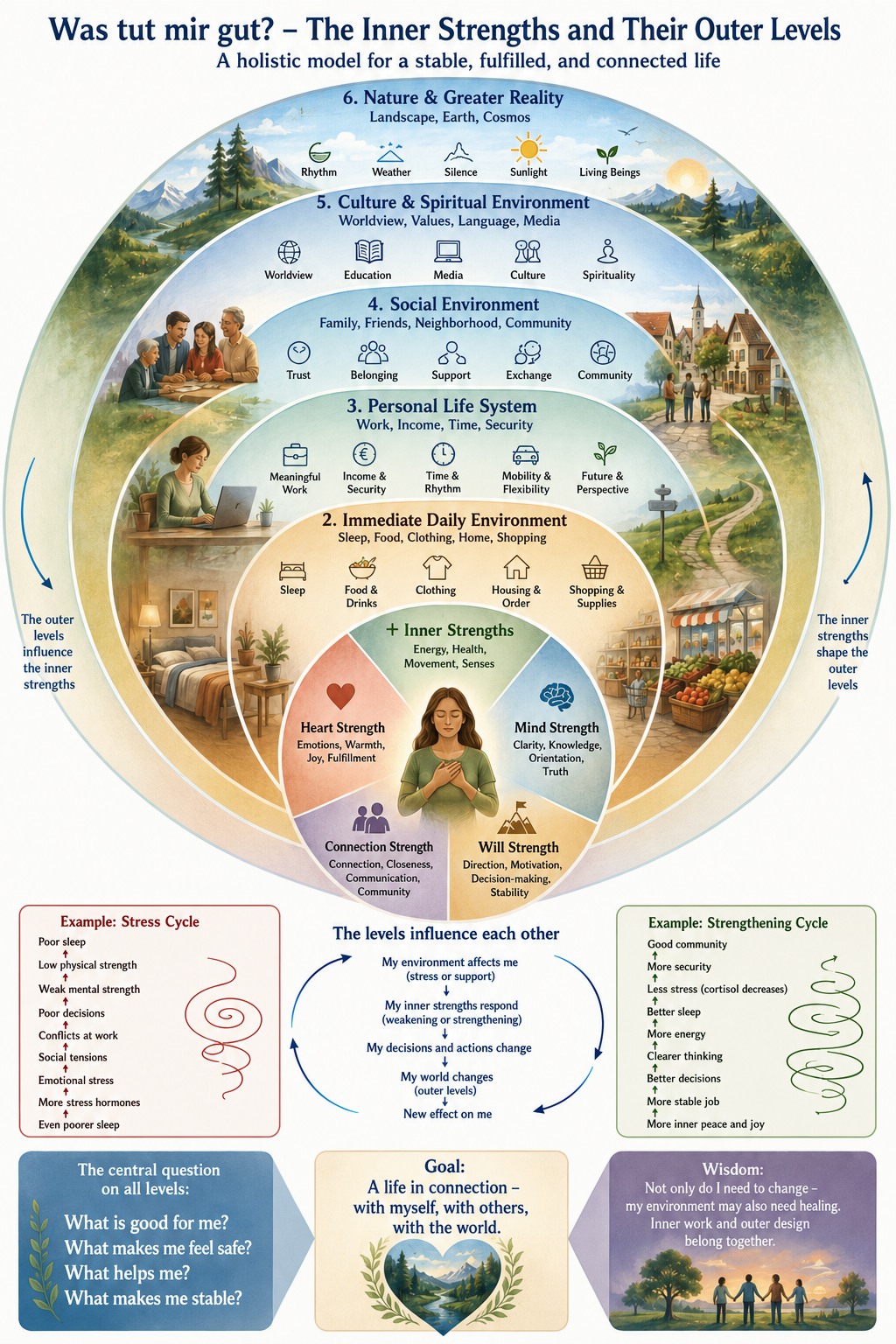
Translation note: The opening German question “Was tut mir gut?” remains untranslated (“What is good for me?”). In the nature ring, “Weite” (expanse/openness) became “Weather.” The stress-cycle arrows point upward rather than following the German downward sequence, and the cortisol example is an oversimplified illustration, not medical guidance.
Networks, Spaces, and Dimensions
The systemic map distinguishes structures of connection, areas of experience, dimensions of meaning, central encounter practices, tensions, disruptions, and principles for shaping living systems.
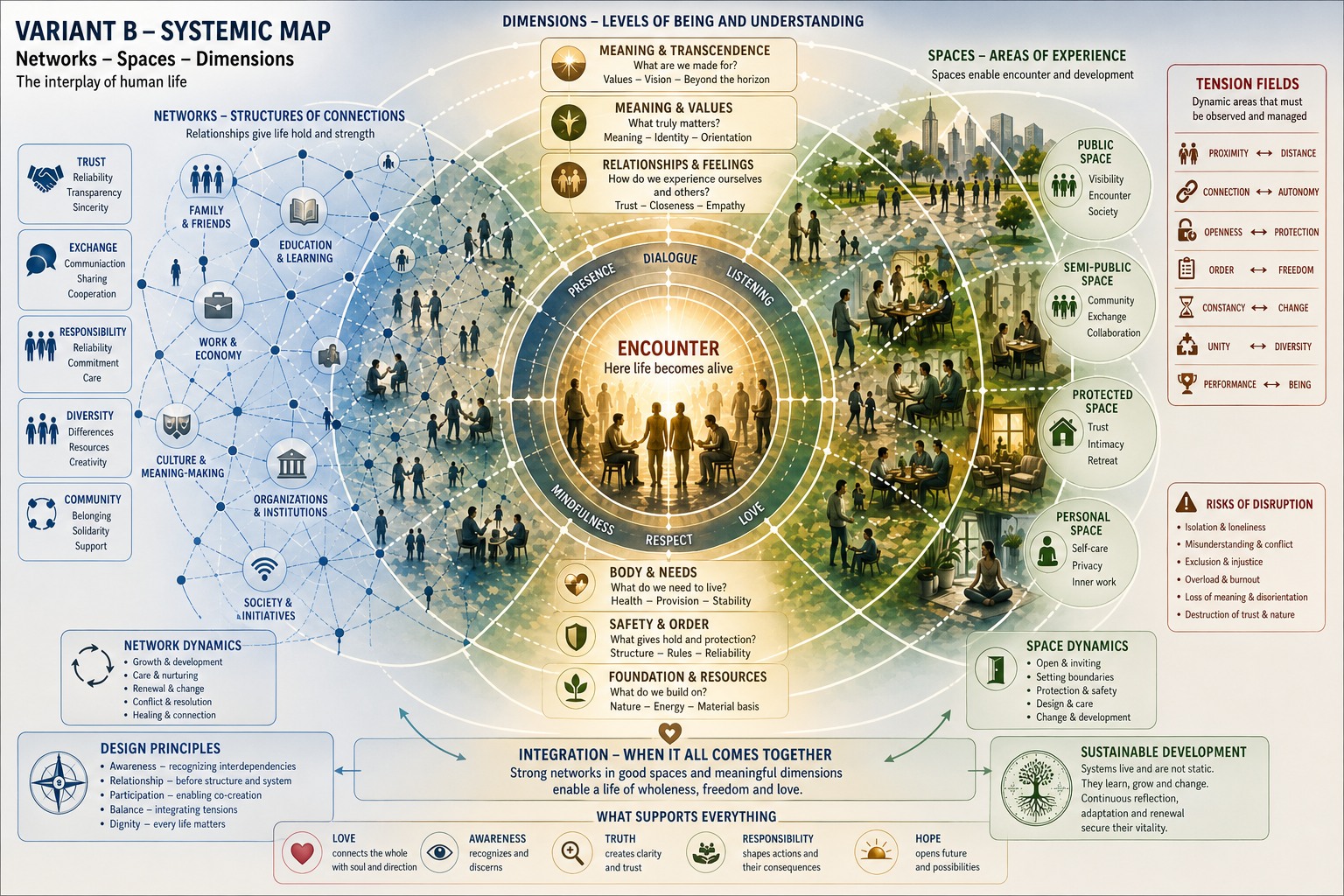
Translation note: This complex translation is remarkably complete. “Meaning & Transcendence” and “Meaning & Values” overlap in English more than the German “Sinn” and “Bedeutung.” The model combines descriptive, ethical, and spiritual claims and should not be mistaken for an empirically validated systems theory.
Organizational Spaces of a Community
Seven spaces are compared with community tasks, political and social examples, branches of government, civil society, media, education, diplomacy, and the role of money.
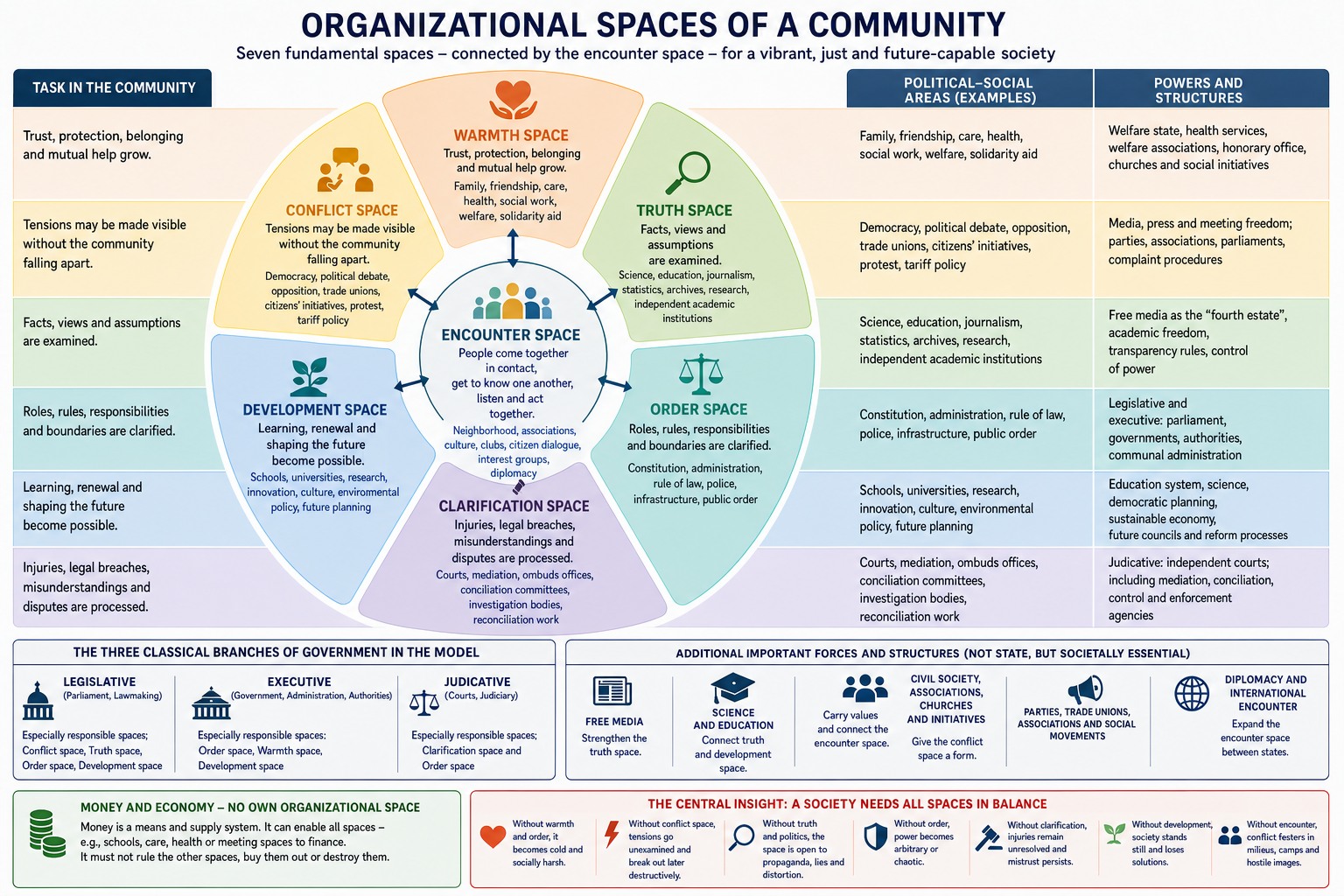
Translation note: The institutional map is clear but rooted mainly in a German democratic-social-state context. “Money is a means and supply system” is awkward English for a medium and system of provision. Assigning institutions to single spaces simplifies overlapping mandates, conflicts, and differences among political systems.
A World Model of Relationships, Change, and Money
Three linked sections present relationship spaces, transformation processes, and money as a flow system. Family, society, public order, learning, conflict, and resources form one normative whole.
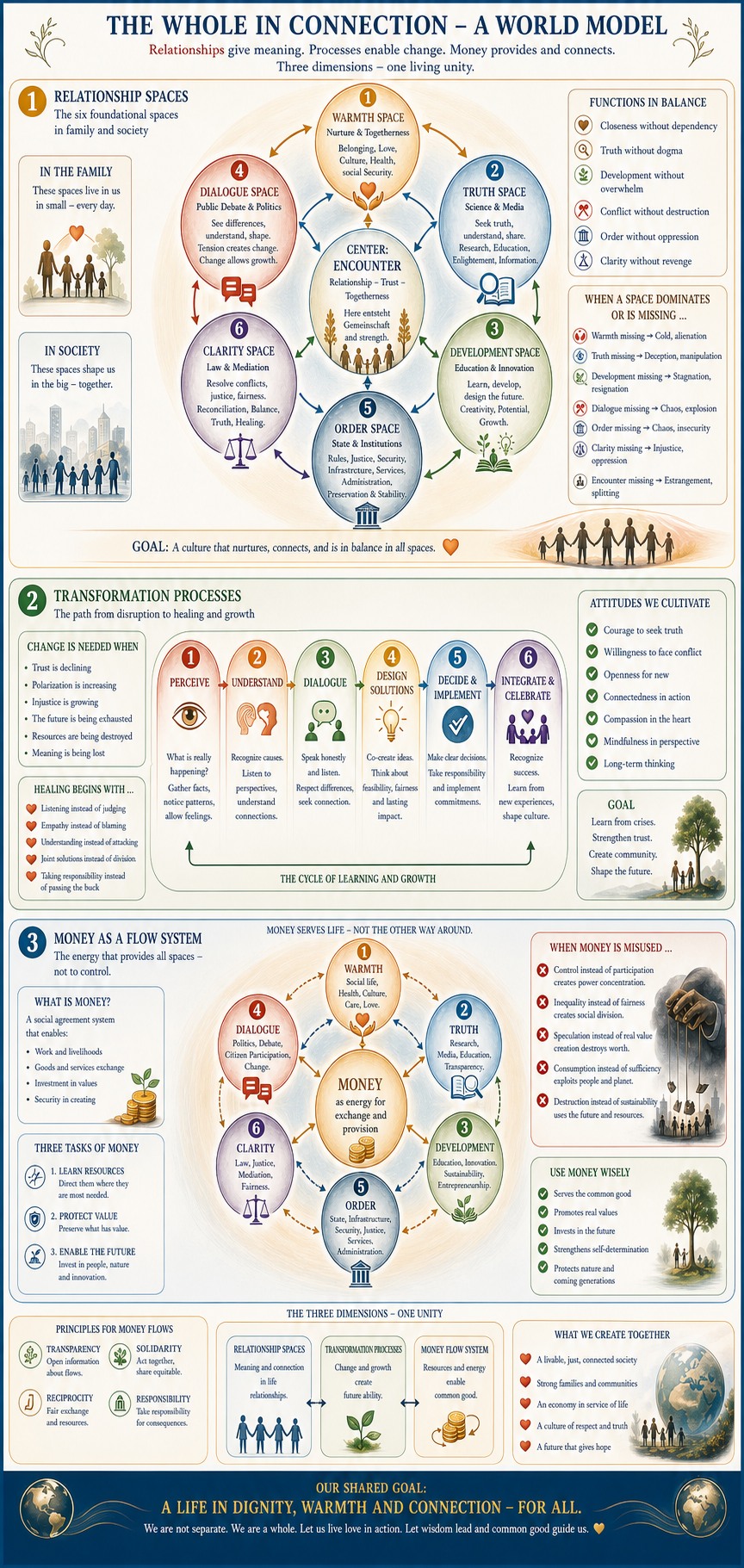
Translation note: Two core space names drift from the established terminology: “Konfliktraum” becomes “Dialogue Space,” and “Klärungsraum” becomes “Clarity Space.” “Ressourcen lenken” is mistranslated as “Learn resources” instead of directing resources. The economic and social claims are values-based, not a complete explanatory model.
Three Basic Dimensions of Living Life
Security and order, perception and exchange, and unfolding and shaping are traced through the person, family, community, and world. A cycle illustrates their mutual dependence.
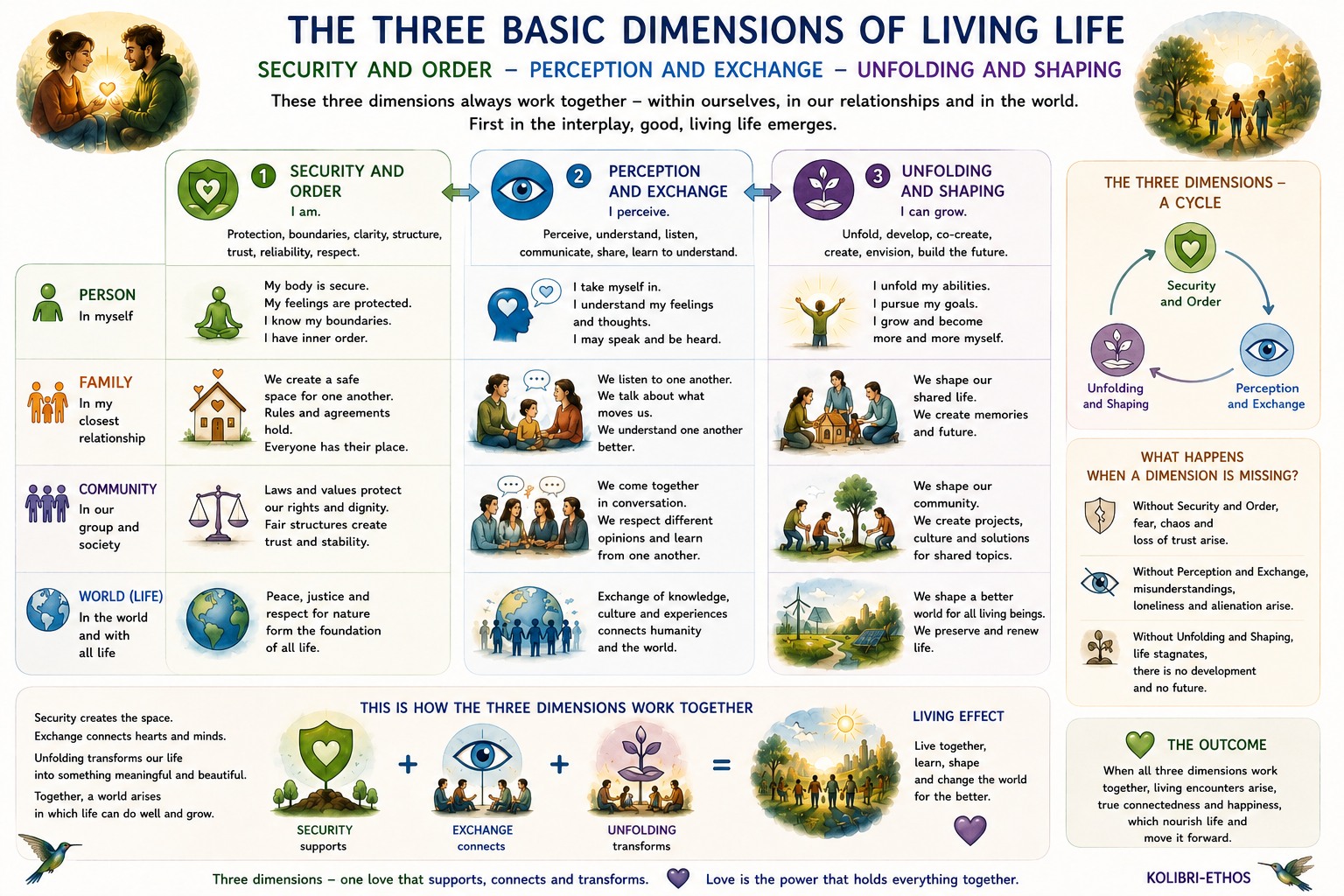
Translation note: Most terminology is consistent. In the result panel, the German “Wirklichkeit” (reality) is replaced by “happiness,” adding a claim not present in the source. The table presents clean causal relationships that should be read as a reflective model rather than psychological or social proof.
The Group Level
Family, teams, associations, classes, villages, and other small groups are shown as places where personal love may become shared culture through strengths, spaces, processes, and practices.
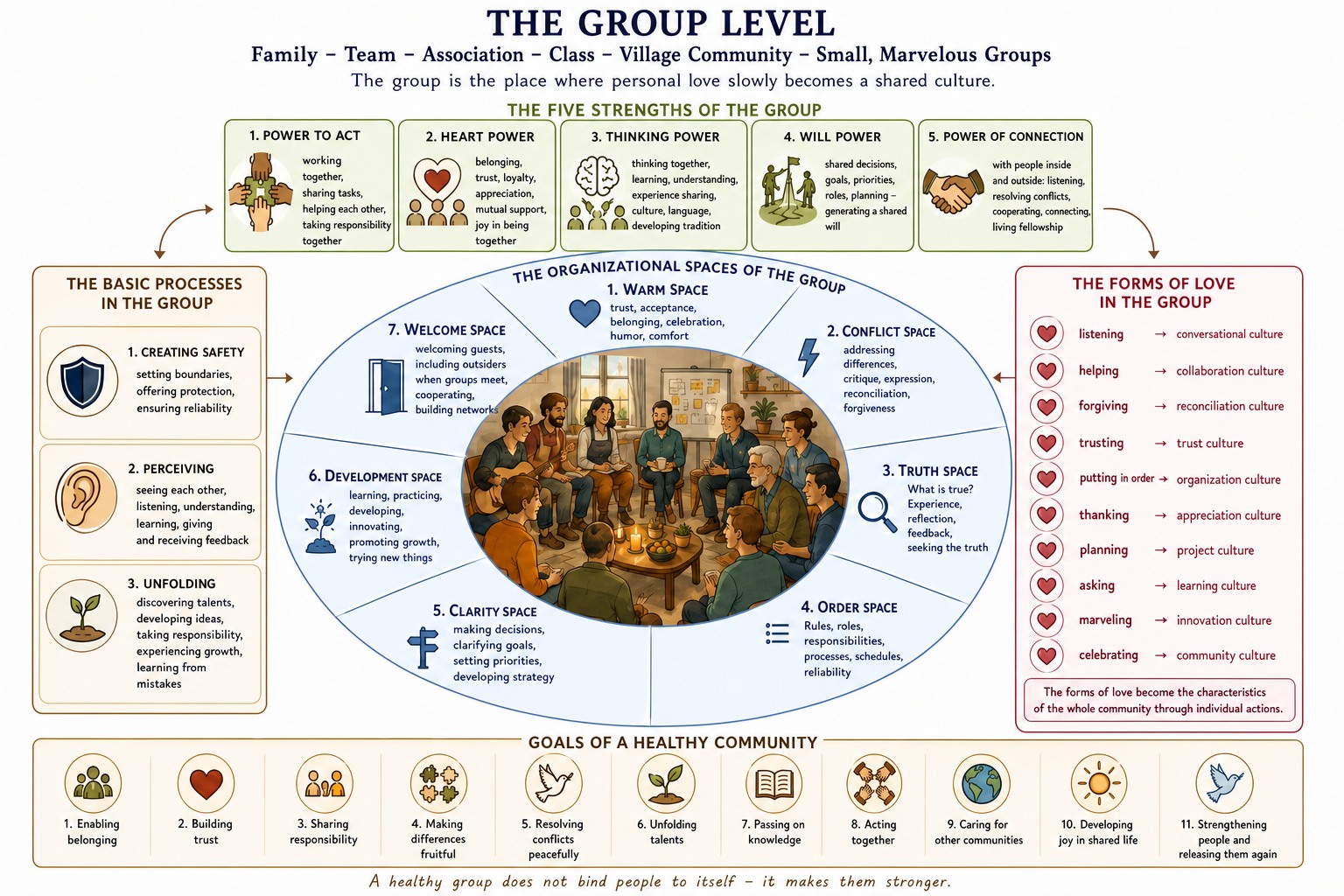
Translation note: “Kleine überschaubare Gruppen” means small, manageable or close-knit groups, not “Small, Marvelous Groups.” “Begegnungsraum” becomes “Welcome Space” and “Klärungsraum” becomes “Clarity Space,” weakening consistency with other images. The final goal phrase “releasing them again” is an awkward rendering of setting people free.
Society and the Individual
The paired model distinguishes shared structural values from personal life goals while comparing strengths, spaces, life processes, and forms of love.
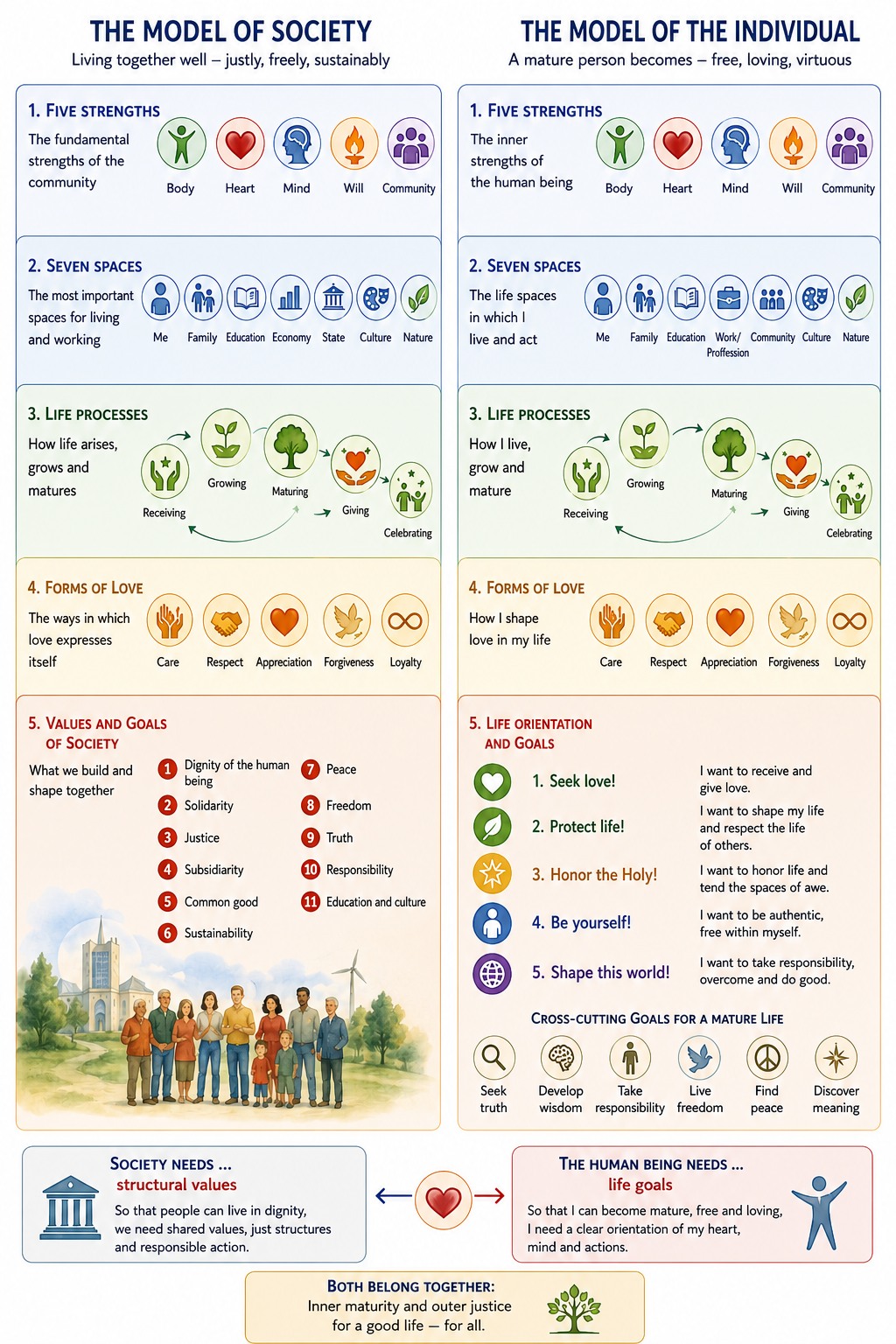
Translation note: The subtitle describes the mature person as “virtuous,” but German “schöpferisch” means creative. The fifth strength “Begegnung” is reduced to “Community.” The diagram's symmetry is helpful for comparison but can understate tension between individual autonomy and collective structures.
A Detailed Model of the Individual
The poster expands spaces, life processes, forms of love, and five life orientations into a personal developmental model.
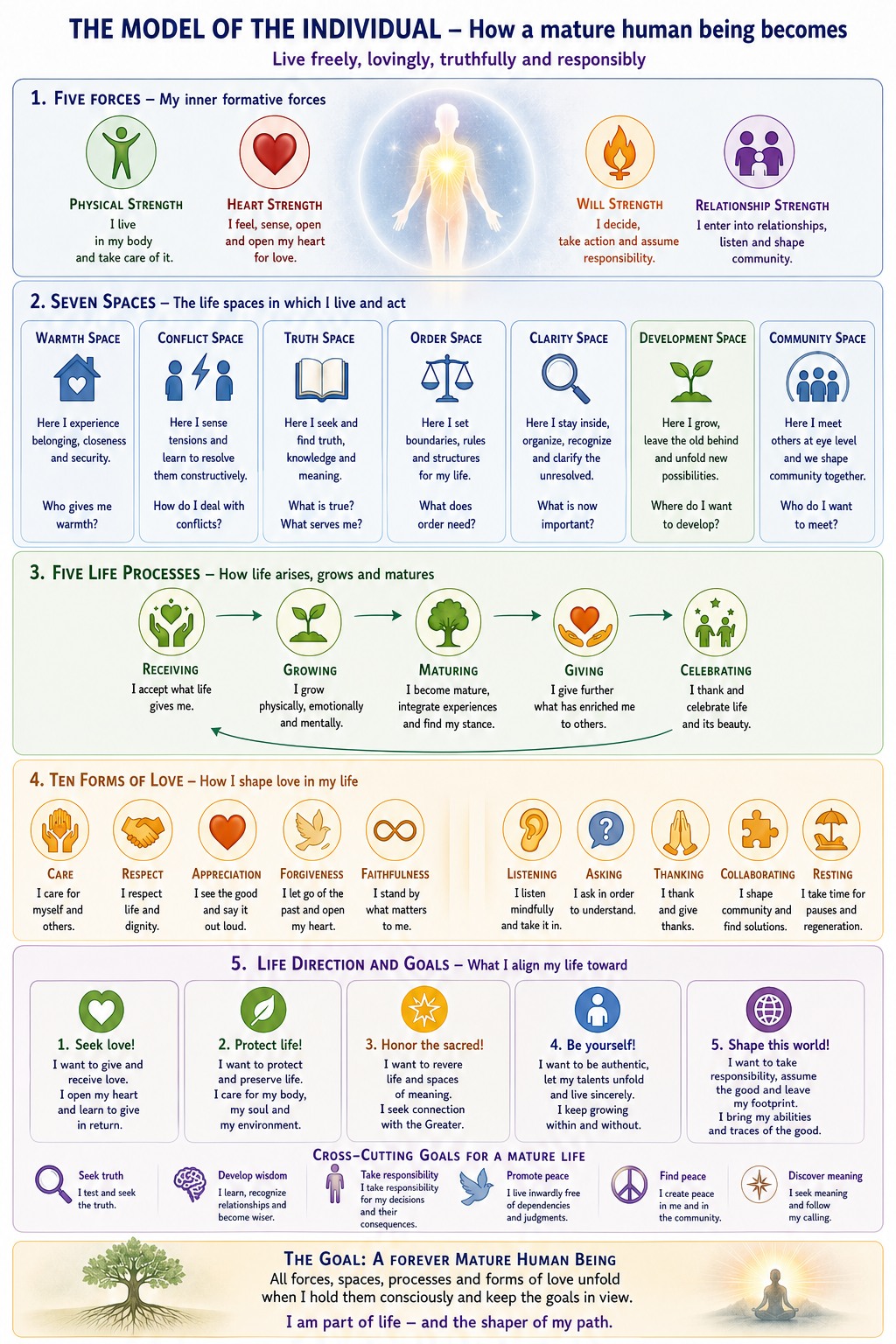
Translation note: The source heading says five forces, but only four are visibly named; thinking power is absent, and the translation correctly does not invent it. However, “Freiheit leben” is wrongly changed to “Promote peace,” while peace appears again separately. “Dem Größeren” becomes the more theological “the Creator,” and creative living in the subtitle becomes responsible living.
Social Architecture — Encounter, Protection, Responsibility
Private retreat, low-threshold encounter, and visible protection roles are combined with a staged response process and architectural principles intended to balance closeness, freedom, and safety.
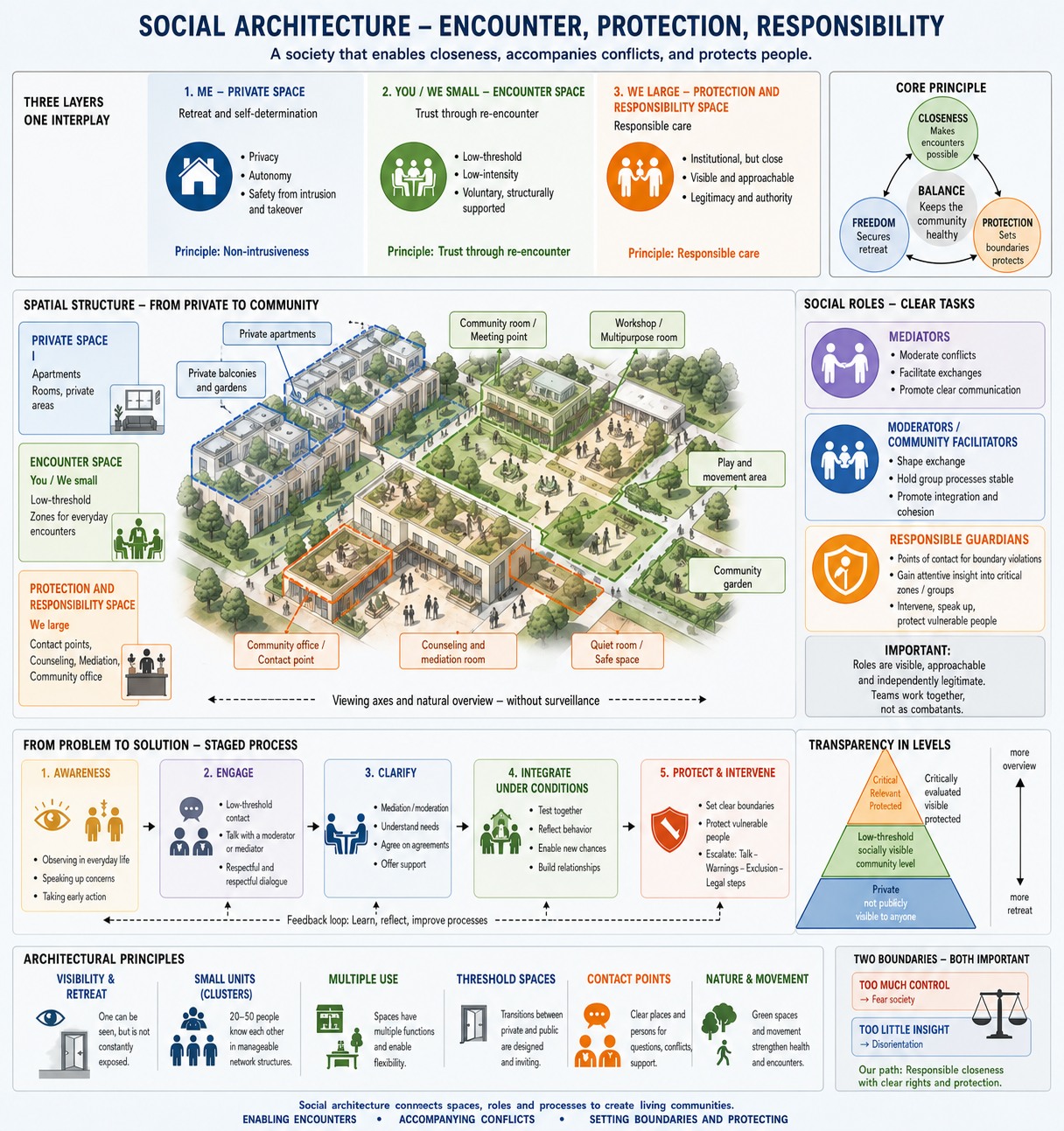
Translation note: “Safety from intrusion” is followed by the erroneous words “and takeover.” Built form and visible roles cannot by themselves guarantee safety, legitimacy, confidentiality, accessibility, or fair conflict resolution. Cost, power, disability access, and misuse of oversight remain outside this visual model.
Social Building and Living
A neighborhood plan uses clusters, courtyards, transition zones, shared resources, workshops, guest rooms, gardens, and public links to encourage everyday community.

Translation note: “Innenhöfe als Herz” means courtyards as the heart, not “Heart Spaces Indoors.” The guest-room statement “teilen statt besitzen” (share rather than own) becomes “always well received,” losing the ownership idea. The plan is an aspirational design, not evidence that architecture alone produces trust, sustainability, inclusion, or conflict competence.
Conflict and Protection Architecture
A four-level continuum moves from prevention through clarification and protection to separation. Three spatial zones, defined roles, an escalation ladder, tools, rules, and external support aim to combine relationship and safety.
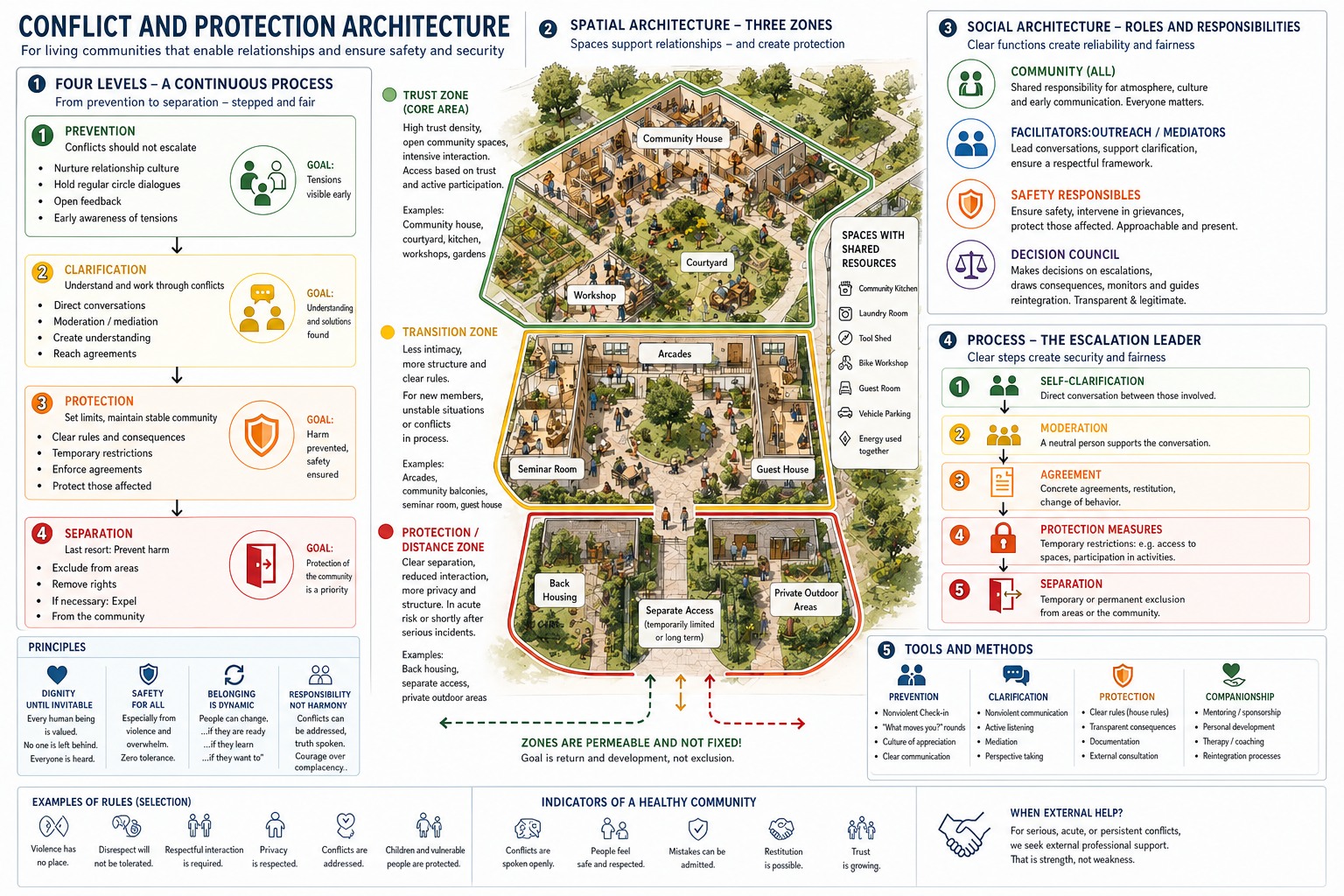
Translation note: The principle panel contains the serious typo “Dignity until invitable”; it should say “Dignity is inviolable.” “Self-clarification” is described as direct conversation between those involved, which is not always safe or suitable. The staged sequence must not replace emergency services, current law, safeguarding duties, trauma-informed practice, or qualified professional help.
Systemic Map — Integration of Forms of Love
Networks, dimensions, spaces, tensions, and four qualities of loving action are connected in a single integration model: understanding, encountering, nourishing, creative, and protective elements appear around a shared center.
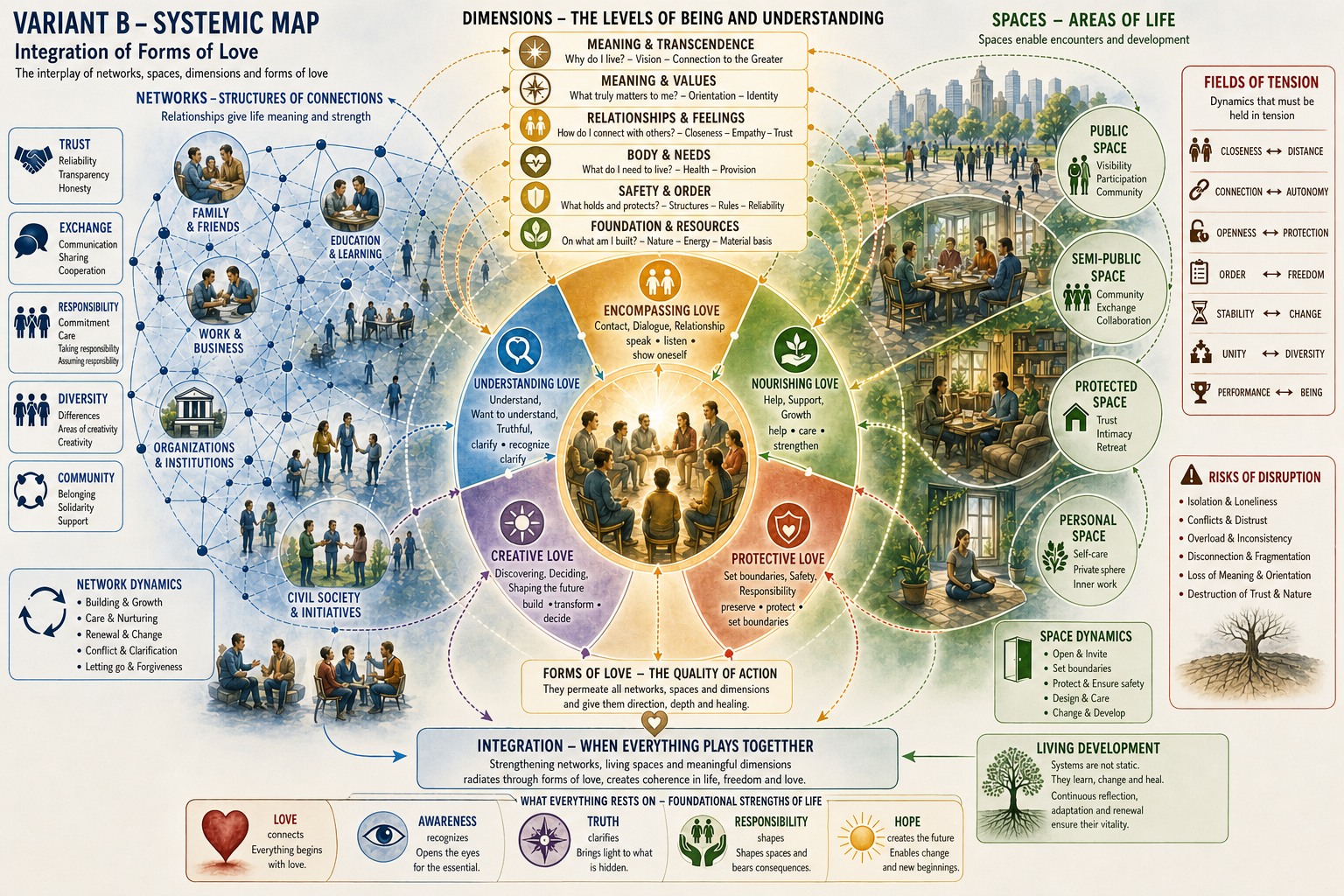
Translation note: German “Verbindung zum Größeren” is again narrowed to “Connection to the Creator,” adding a specific theological interpretation. “Begegnende Liebe” is rendered “Encompassing Love,” which loses the active meaning of meeting/encounter. The understanding segment also repeats “clarify” and omits some nuance.
The Network of the Human Being and the World
Reality, thinking, feeling, body, and love-meaning networks surround a person and connect inner capacities with institutions, resources, relationships, and action.
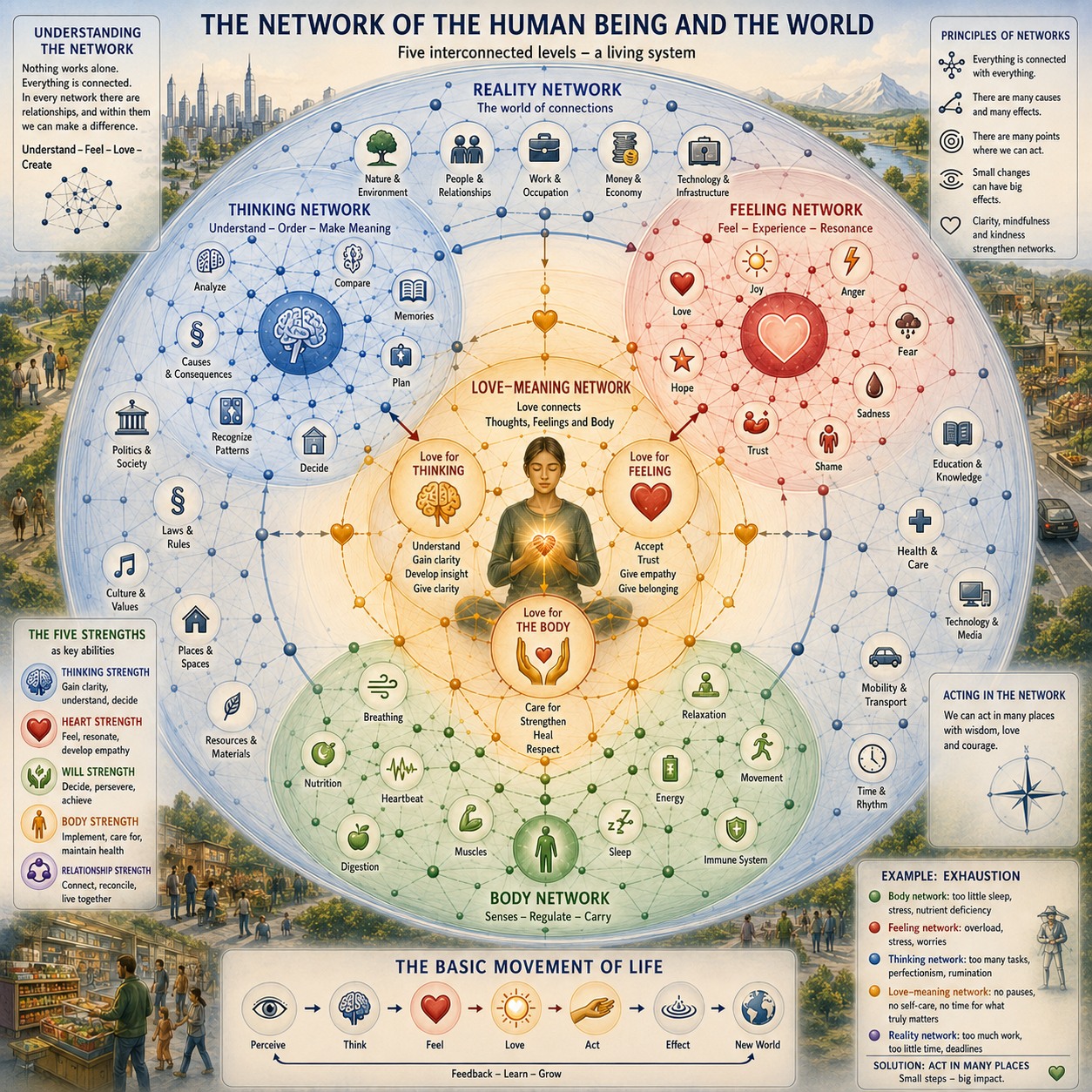
Translation note: Several short lists are freely rewritten; “Love for thinking” repeats clarity and loses part of the German sequence. The exhaustion chain is a reflective systems example, not a medical diagnosis or proven causal pathway. Its labels mix bodily symptoms, emotions, work conditions, and ethical interpretation.
Five Interconnected Network Levels
The final model places a love network at the center of reality, thinking, feeling, body, and action/shaping, with feedback into a transformed world.
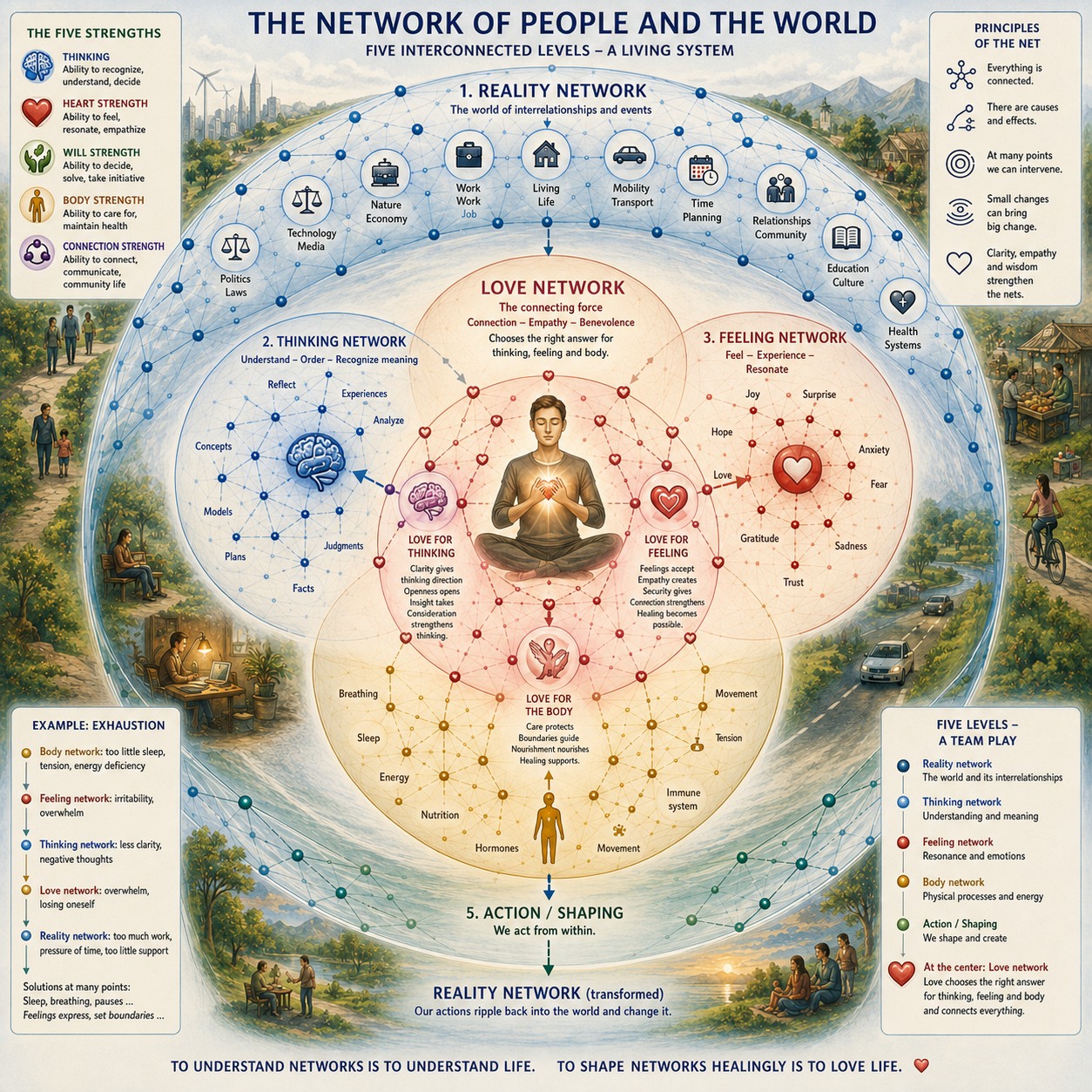
Translation note: Several reality-network captions are paired with the wrong icons or shifted categories, such as technology/media, nature/economy, and work. The source triad encounter–compassion–wisdom becomes “Connection–Empathy–Benevolence,” losing wisdom. The title changes “human being” to “people,” and the exhaustion sequence remains illustrative rather than diagnostic.
This page now includes all 14 images currently used on the German source page KI/Welt. Visible imperfections are retained as prompts for reflection, correction, and discussion.