
Hate and Negative Behaviour
Hate does not appear only as an isolated emotion. It can grow through repeated distortions of understanding, encounter, trust, acceptance, support, protection, truth, shared joy, service, and giving. The images on this page examine those transitions, their self-destructive effects, and the forms of love that can interrupt them.
From Distortion to Active Hate
Negative behaviour may begin in an intermediate space of lack, distortion, and alienation. Misunderstanding can become deliberate falsification; distance can become dehumanization; distrust can become hostile attribution; obstruction can become sabotage. Seeing these transitions helps distinguish inability or confusion from an active wish to harm.
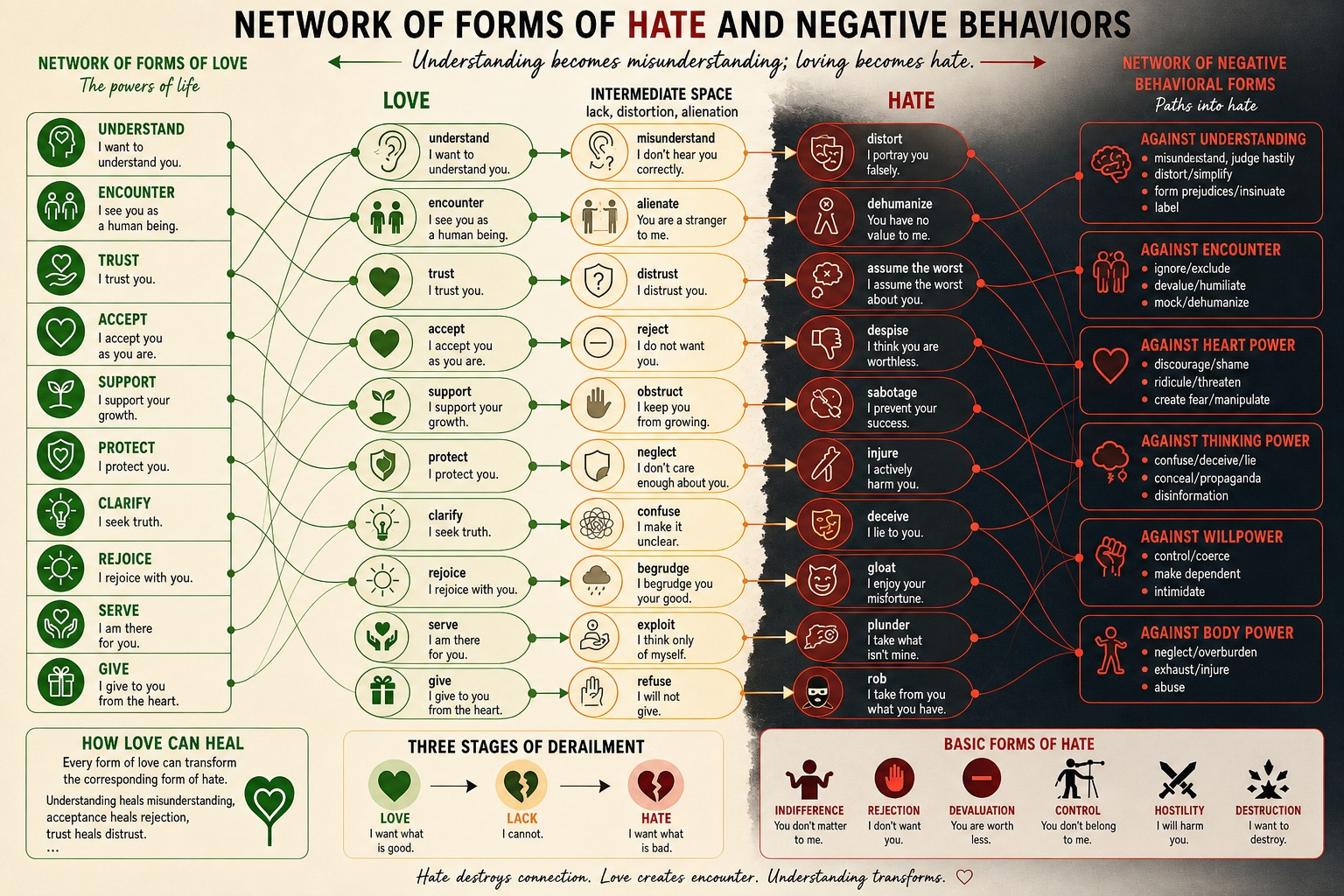
Translation note: The ten love-to-hate rows, right-side force categories, and three-stage model are translated with exceptional clarity. In the final basic form, the source `You should disappear` becomes the incomplete `I want to destroy`. This changes the grammar and slightly shifts destruction from eliminating the other person toward an unspecified act.
How Hate Destroys Itself
Hate may promise strength, yet its repeated effects are isolation, withering, and a pseudo-world. Separation erodes resonance and self-connection; obstruction prevents growth; ideology and enemy images replace reality with fear and sham power. Encounter, growth, truth, humility, and responsibility provide a contrasting movement toward inner strength and genuine connection.
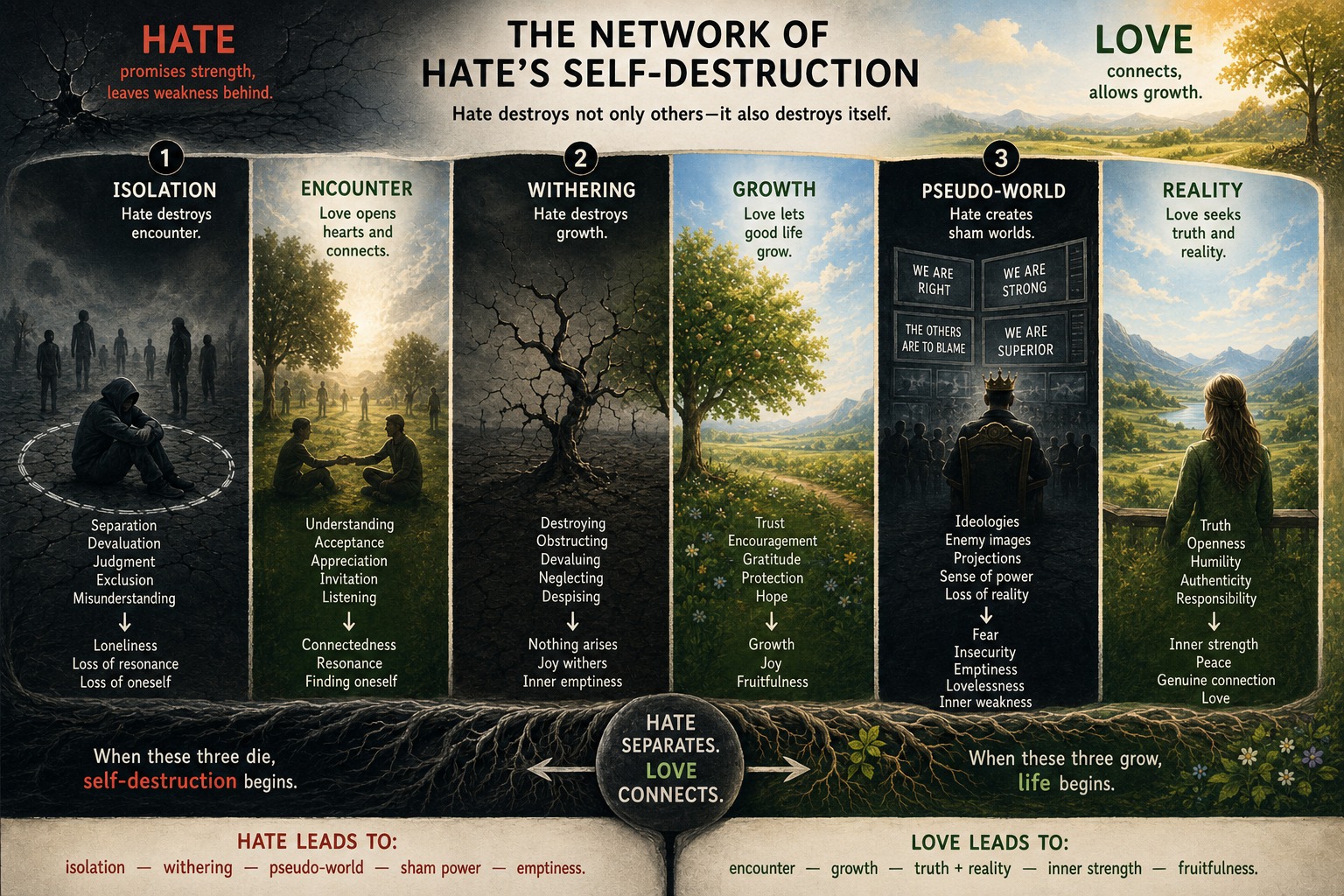
Translation note: All six contrasting panels, lists, roots, and conclusions are translated faithfully. `Pseudo-world` and `sham power` are deliberately literal technical terms for the source concepts. The full causal contrast between hate and love remains clear, with no serious error visible.
Root Sins and the Network of Hate
The seven deadly sins are presented as roots that can deepen ordinary weakness into active forms of hate. Pride, greed, lust, envy, wrath, gluttony, and sloth distort different capacities, yet converge in isolation, withering, and loss of reality. Insight, conversion, and love can also work from within, reconnecting these damaged roots with life.
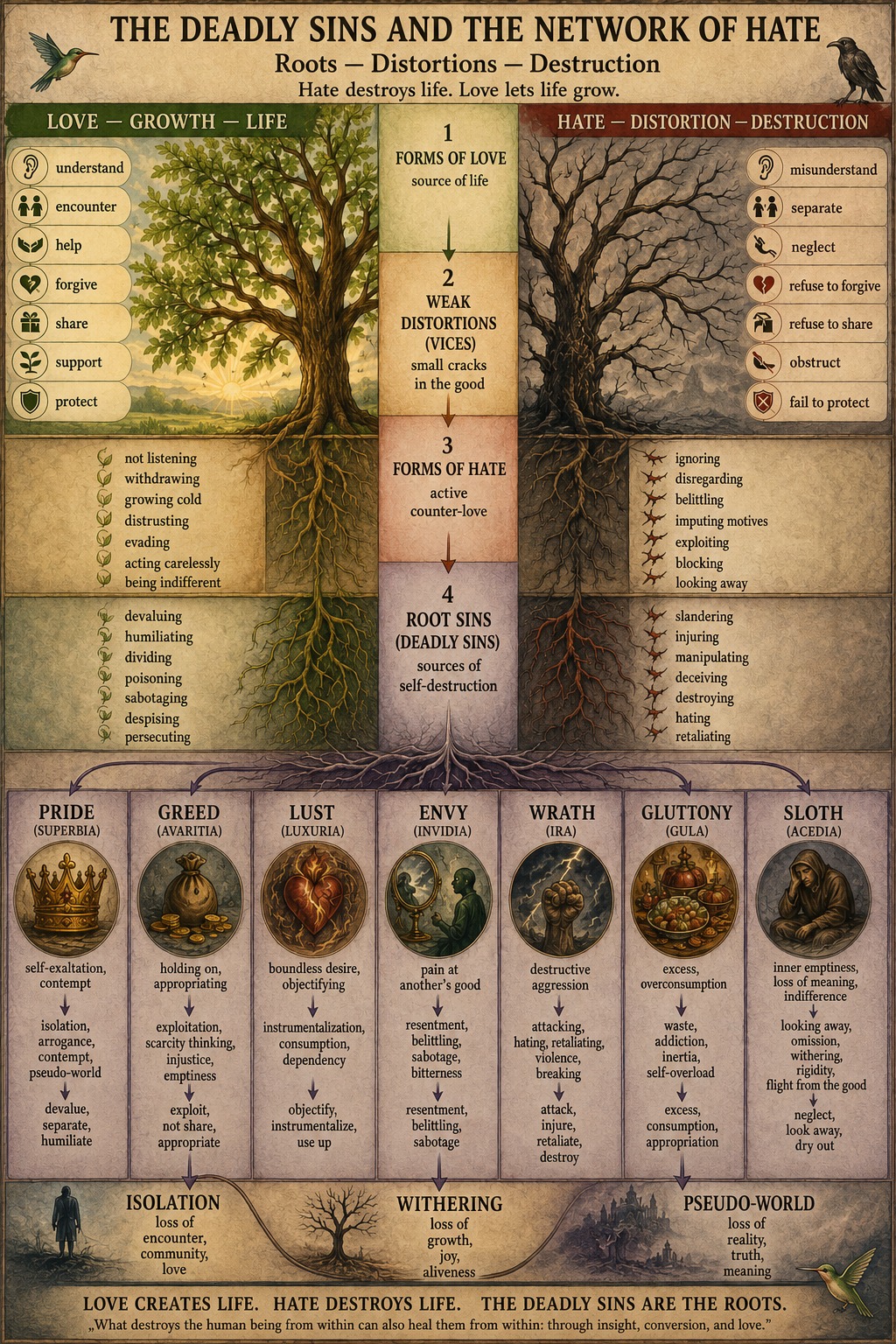
Translation note: This very dense portrait image is translated with unusually high fidelity. The living and dead trees, four escalation levels, fourteen side lists, seven Latin-labelled columns, and three outcomes are all preserved. Some theological terms such as `conversion` and `counter-love` are formal but accurate; no major semantic error is visible.
Scapegoating Hides Solvable Problems
Scapegoating concentrates diffuse fear and frustration on a simplified culprit. It offers a sense of certainty while distracting from economic structures, demographic change, climate, education, housing, health, technology, justice, corruption, and social cohesion. Looking closely, understanding, and working together protect reality from distortion and keep complex problems open to real solutions.

Translation note: The contrast between manipulation and collaborative problem-solving is translated accurately and completely. The hostile slogans remain explicit because they are clearly framed as examples of scapegoating, not endorsement. All problem signs, consequences, and closing ethical statements are legible; no material error is visible.
When Encounter Is Replaced by Control
A toxic relationship can become a distorted field in which one person occupies space, defines reality, and imposes direction while the other retreats, doubts perception, and gives up decisions. The dynamic reinforces itself. Healing therefore begins with bodily boundaries, differentiated empathy, reality checking, autonomous choice, and relationships based on mutuality rather than interaction alone.
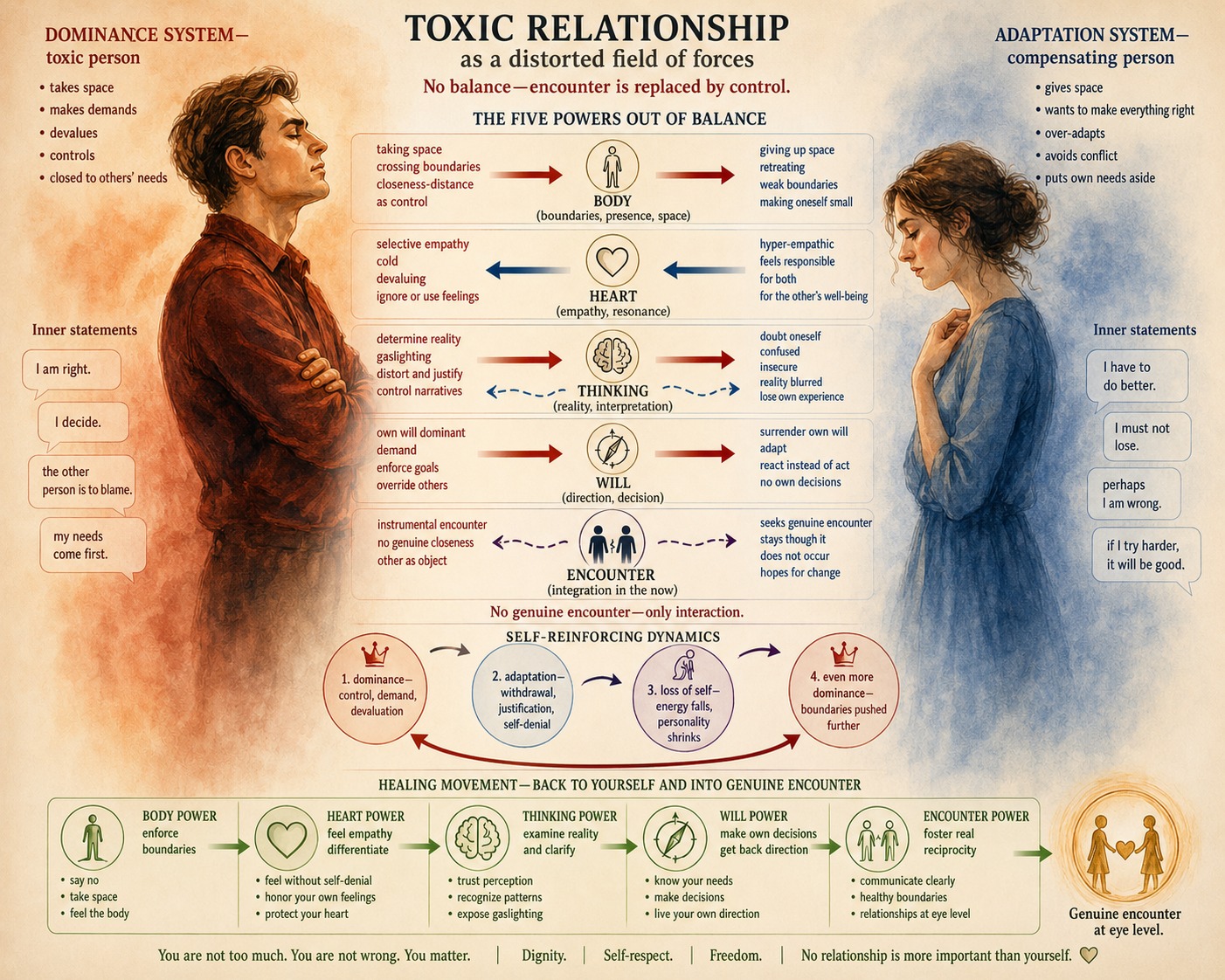
Translation note: The dominance/adaptation contrast, all five power rows, inner statements, reinforcing cycle, and healing path are translated with very high fidelity. The image describes relational patterns rather than adding a clinical diagnosis. `Relationships at eye level` is slightly idiomatic, but the intended equality remains clear.
Basic Forms of Toxic Behaviour
Manipulation, devaluation, control, duplicity, isolation, threats, gaslighting, exploitation, and denial of responsibility differ in mechanism and effect. The table also warns against using the label too broadly: frequency, intention, and effect matter, and not every mistake or conflict is toxic. Clear recognition can support boundaries, help, and healing.
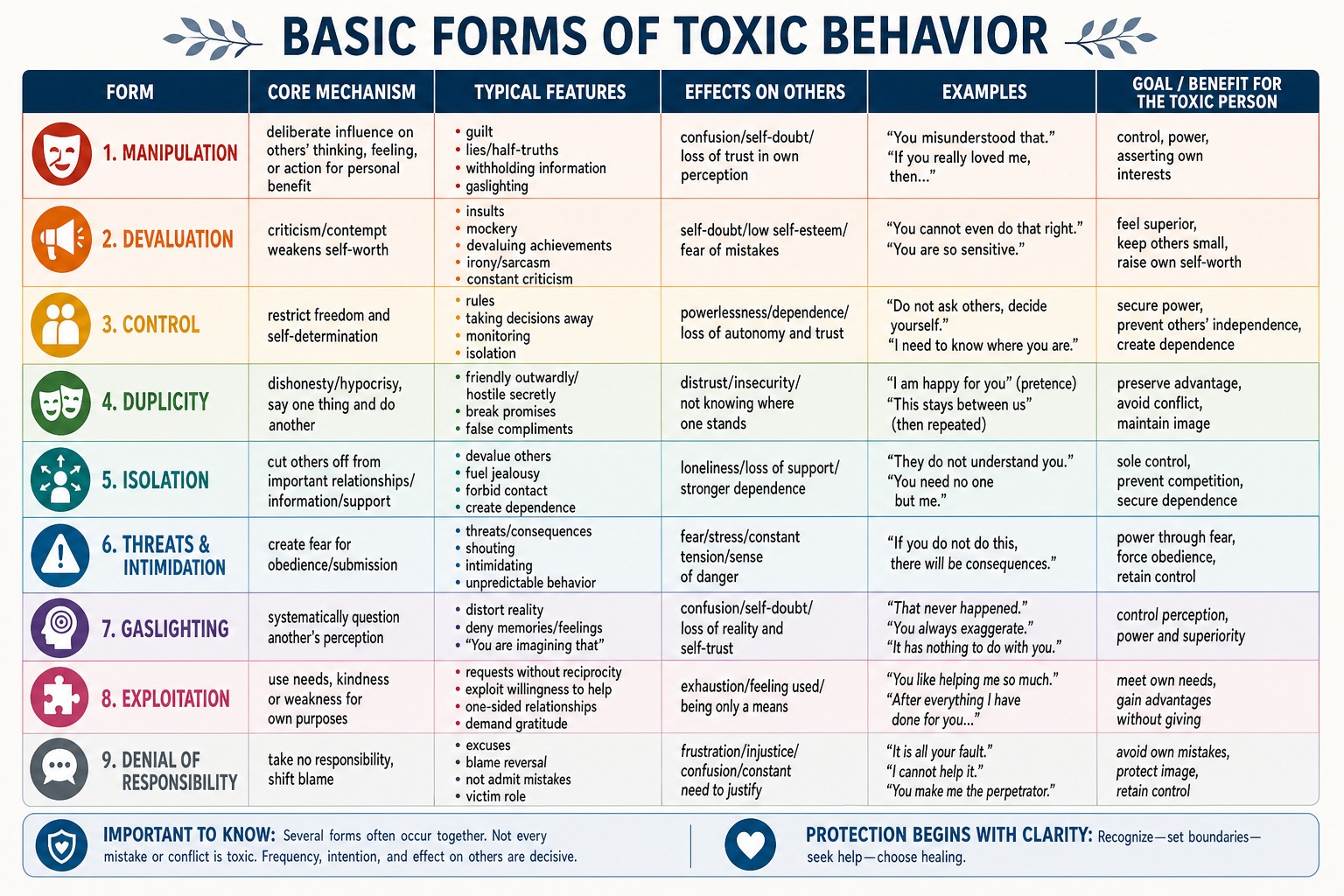
Translation note: This is an exceptionally clear translation of a nine-row technical table. Mechanisms, features, effects, examples, and benefits to the acting person remain correctly aligned. In the control example, the source itself contains the unusual sentence `Do not ask others, decide yourself`; the English faithfully preserves it rather than silently correcting its apparent inconsistency.
A Path from Recognition to Growth
Recovery can move through five distinct tasks: recognizing patterns, clarifying reality, establishing boundaries, healing the body and self-worth, and gradually allowing trust and encounter again. The sequence does not require instant certainty. It creates a bridge from manipulation and blame toward safety, support, connection, and renewed enjoyment of life.
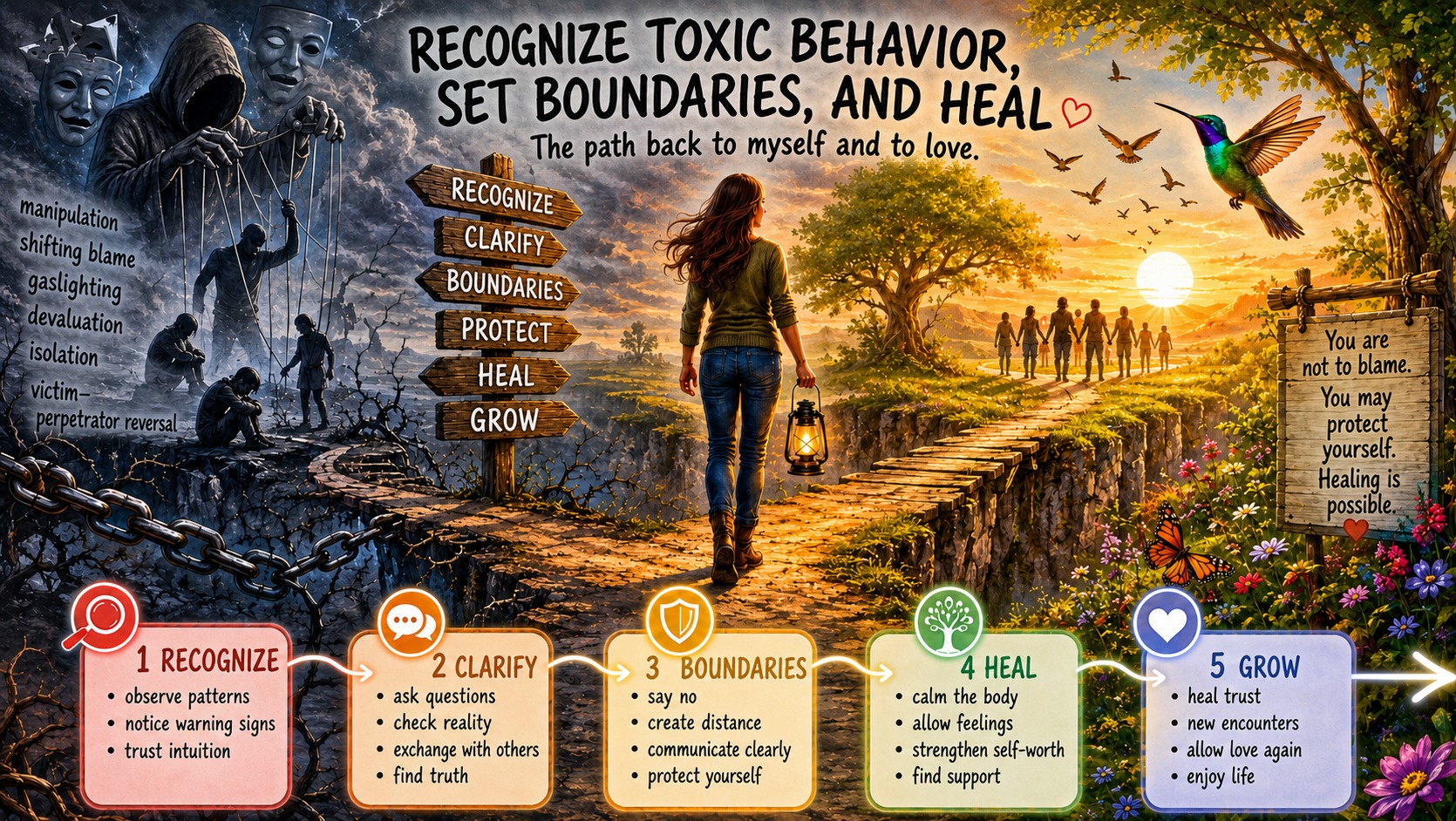
Translation note: The dark-to-light movement, six warning terms, signpost, reassuring statement, and all five recovery boxes are translated accurately. `victim–perpetrator reversal` is a formal but precise term. No significant semantic or spelling error is visible.
Antidotes Preserve Love in Freedom
Different relational poisons call for different healing principles. Intrusion needs consent; control needs trust in autonomy; projection needs self-reflection; covert undermining needs dignity and clarity; self-abandonment needs self-empathy; punitive withdrawal needs transparent distance. The shared principle is love that respects self, other, boundaries, and space.
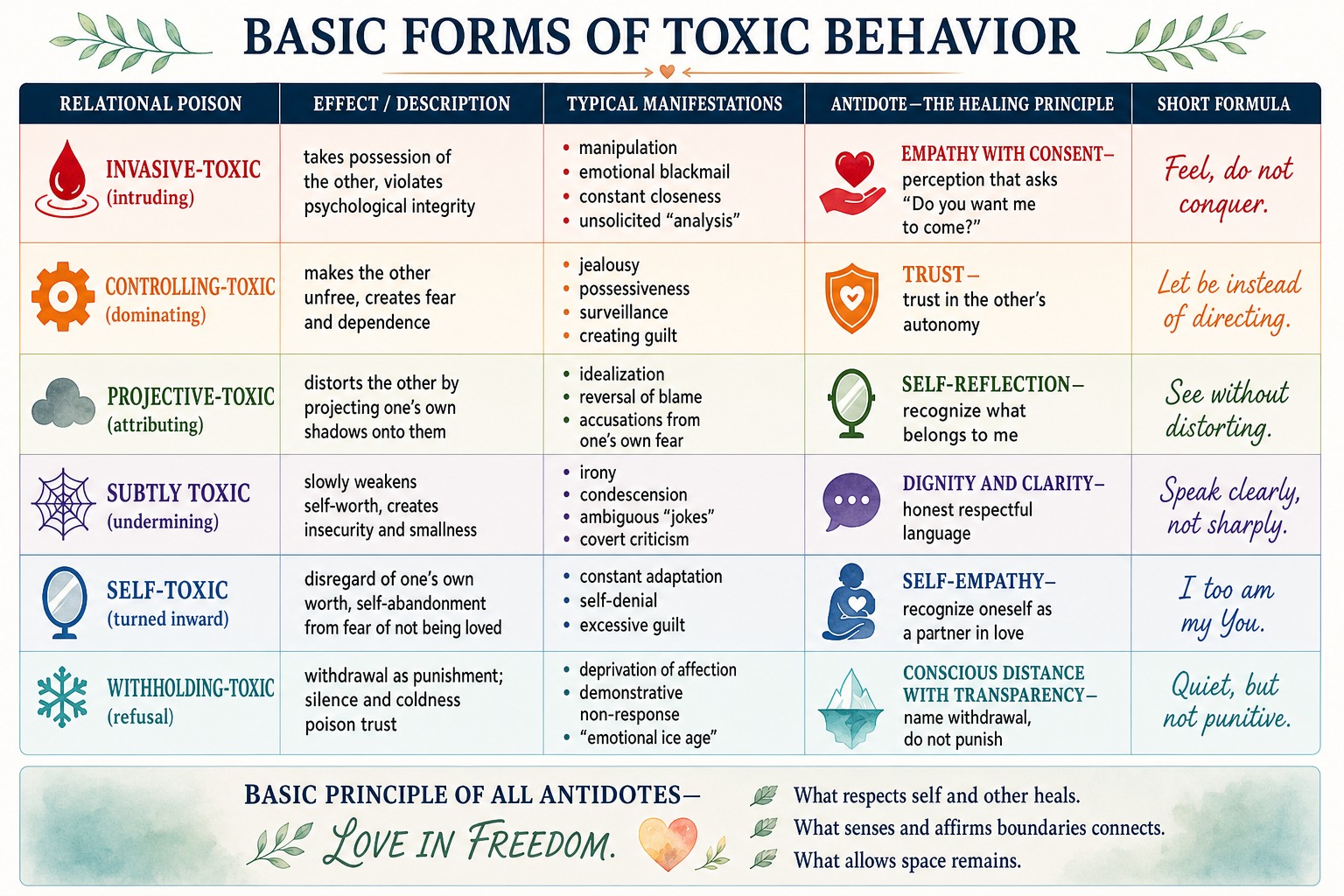
Translation note: All six rows, manifestations, antidotes, short formulas, and closing principles are translated very faithfully. `I too am my You` deliberately retains the unusual philosophical wording of the German `Ich bin auch mein Du`. The consent question `Do you want me to come?` is literal and context-dependent but understandable.
Ethical Strength Can Become Caricature
Ethical traditions draw on different forms of love: responsibility, compassion, virtue, freedom, solidarity, care, preservation, and faith. When one strength is exaggerated, absolutized, or separated from the network, it can turn into legalism, groupthink, paternalism, dogmatism, exclusion, or violence. Humane ethics remains connected, self-correcting, and open to humility, dialogue, and forgiveness.
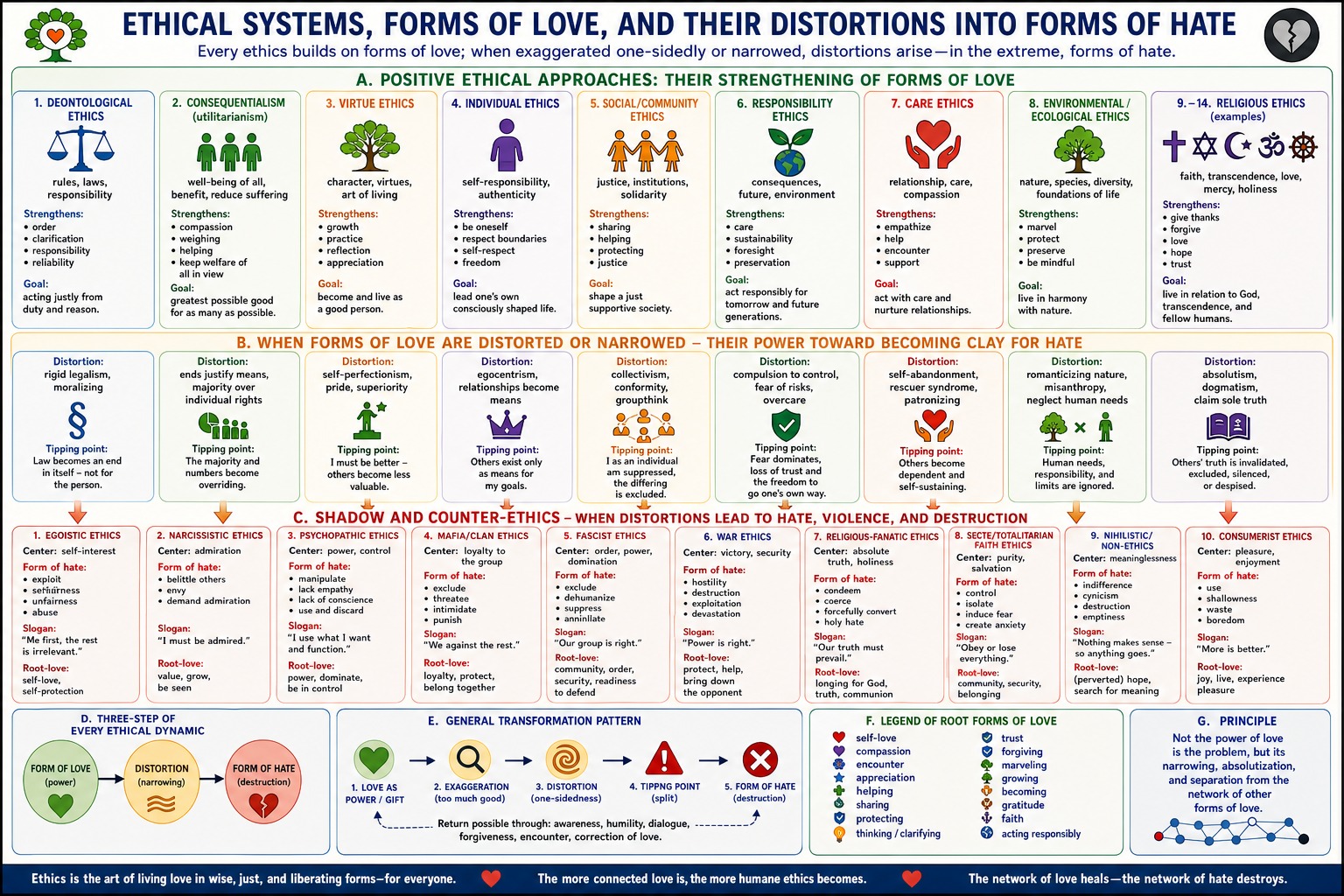
Translation note: The nine positive approaches, their distortions, ten counter-ethics columns, transformation model, legend, and principles are translated with remarkable completeness. The heading of section B is mistranslated as `their power toward becoming clay for hate`; the German means `from strength/power to caricature`. The detailed columns below that heading remain coherent.
Ethical Communication Instead of Manipulation
Knowledge about emotion, stories, authority, repetition, and social influence can be used either to manipulate people or to support responsible public communication. The ethical difference lies in transparency, freedom, understanding before persuasion, respect for human dignity, and responsibility for the common good. Communication remains humane when it strengthens independent judgment instead of exploiting fear or dependence.
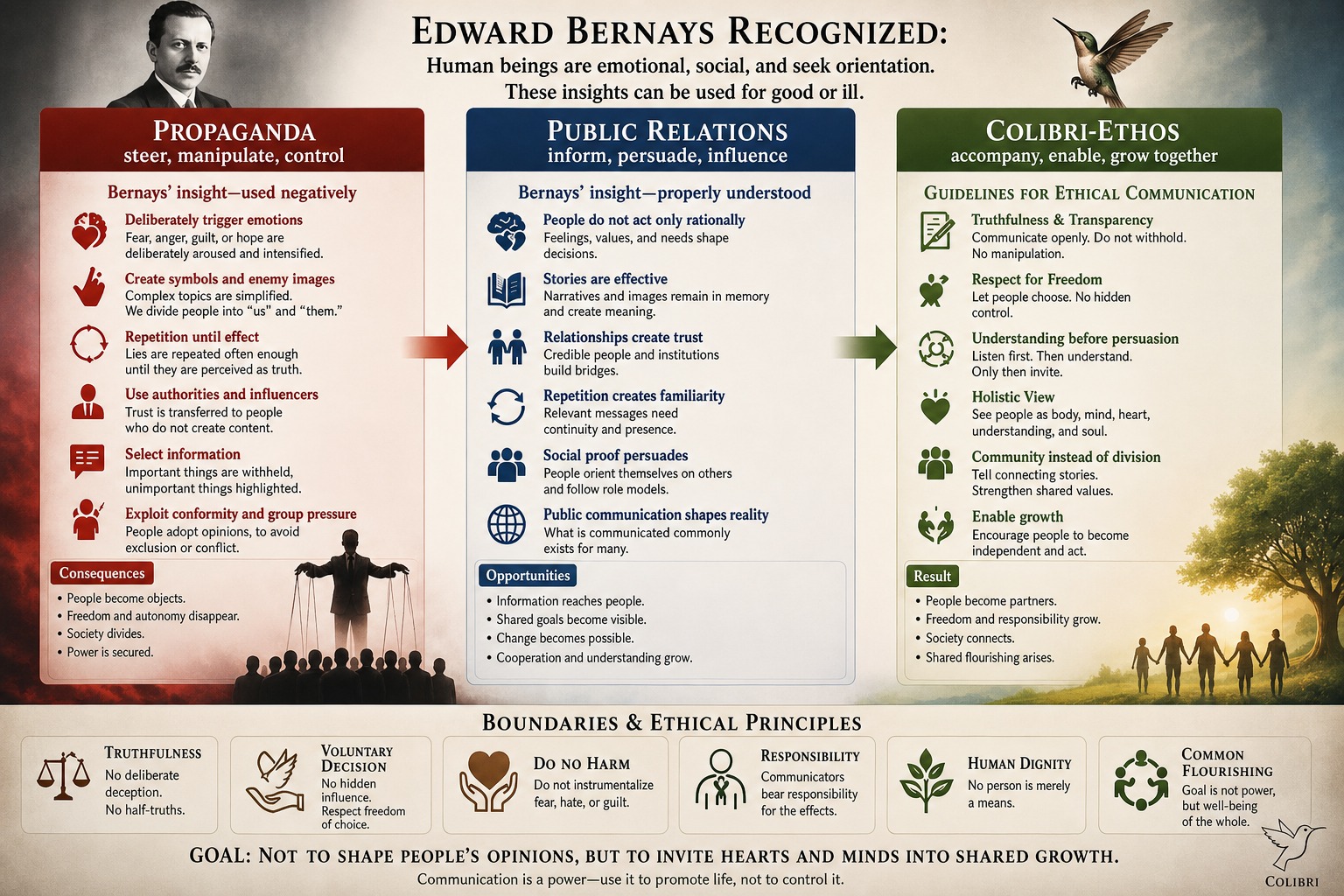
Translation note: The three-part contrast, central questions, ethical principles, and closing orientation are translated clearly and completely. The term `Colibri-Ethos` is preserved. No significant semantic or spelling error is visible.