
Understanding
Understanding grows through perception, listening, interpretation, questions, empathy, clarification, and response. It is both a moment within an encounter and a long path of learning together. This page begins the English translation of the source chapter; further images can be added later.
To Love Means to Understand
Understanding connects the five human forces. It needs bodily calm, emotional openness, thoughtful interpretation, patient attention, and a relational space in which questions, self-criticism, knowledge, and experience can meet. Deep understanding develops across many encounters and can support forgiveness, growth, and shared learning.
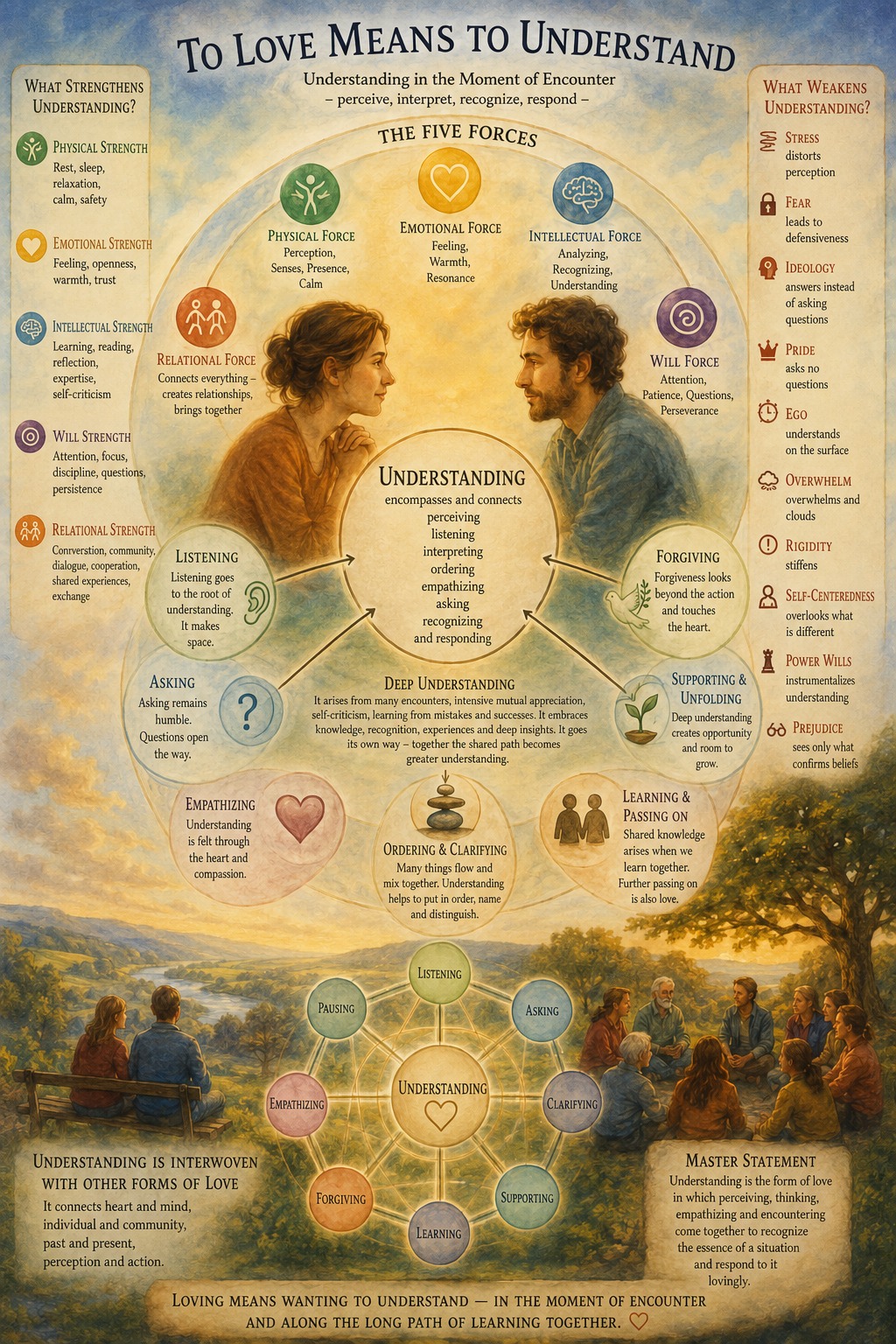
Translation note: The portrait composition, five forces, strengthening factors, central practices, deep-understanding paragraph, love-form network, master statement, and footer are translated clearly. Three labels change meaning: German Eile (haste) becomes Ego, Reizüberflutung (sensory overload) becomes Rigidity, and Staunen (wonder/marvelling) becomes Pausing in the lower network.
Five Paths to Understanding
Understanding is not a single mental act. We can approach reality through analysis, feeling, reflection on feelings, intuition, will, and action. Each path reveals something and also has its own blind spots. Deeper understanding grows when the five human powers correct and strengthen one another.
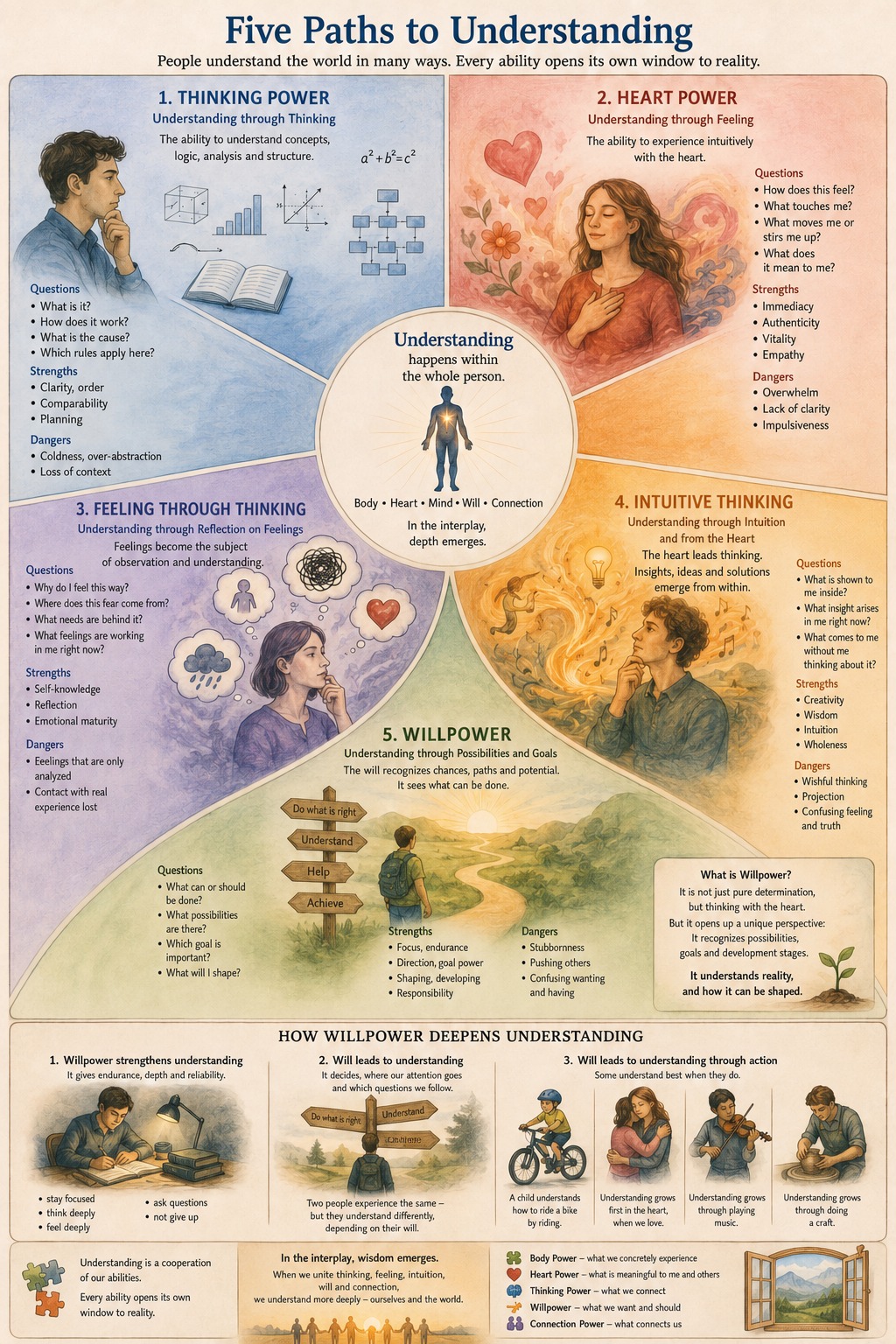
Translation note: The five-part structure is clear, but the explanatory box changes the German idea that willpower is not primarily a cognitive power like thinking or feeling into “not just pure determination, but thinking with the heart.” The legend also renders “how things are connected” imprecisely as “what we connect.”
Why Discussions Often Go Wrong
Discussions become clearer when people distinguish the speaker from the statement, a number from an established fact, and a fact from its explanation. Observation, measurement, interpretation, evaluation, and action belong to different levels. Separating them does not weaken dialogue; it helps participants examine evidence and move closer to truth together.
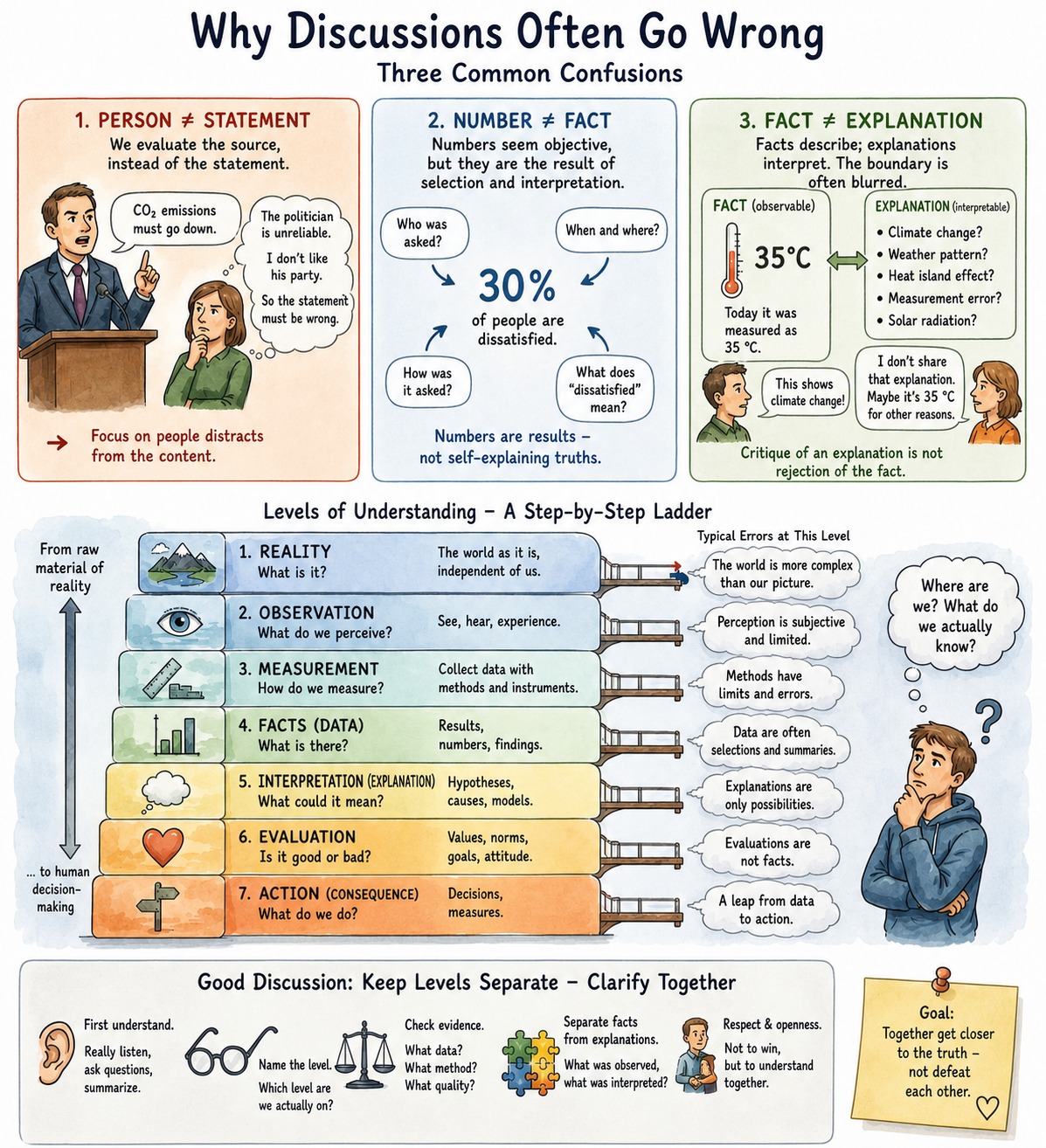
Translation note: The three central distinctions and the seven levels are translated clearly. Some wording is slightly smoothed, but no material change of meaning was found.
The Double Matrix of Understanding
Every message may speak on several communication levels while also expressing different inner powers. Listening well therefore means asking both what kind of message is being sent and which human power needs attention. The matrix invites a response to the whole person rather than to isolated words alone.
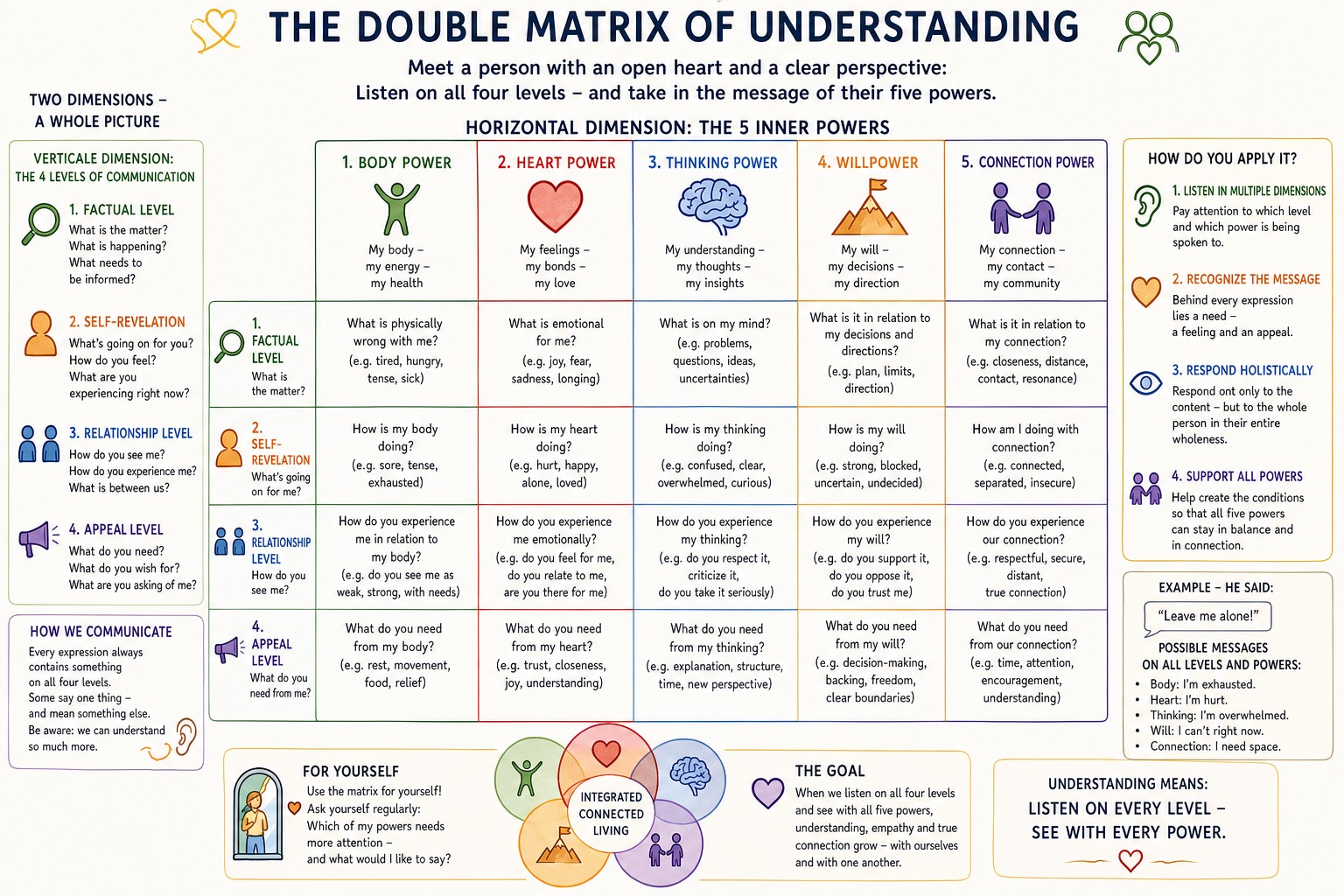
Translation note: Two cells shift meaning. Neutral German “What is physically going on?” becomes the more pathological “What is physically wrong with me?” More importantly, the relationship example “you show consideration / you demand too much of me” becomes “weak, strong, with needs” and loses the intended relational contrast. A few pronouns in the willpower column are also less precise.
The Special Path: Understanding Yourself
Self-understanding asks for honesty without self-condemnation. Body, heart, thought, will, and connection can each reveal needs, feelings, interpretations, direction, and blind spots. Accepting what is present makes it possible to put experience in order and grow without turning inner life into a fight against oneself.
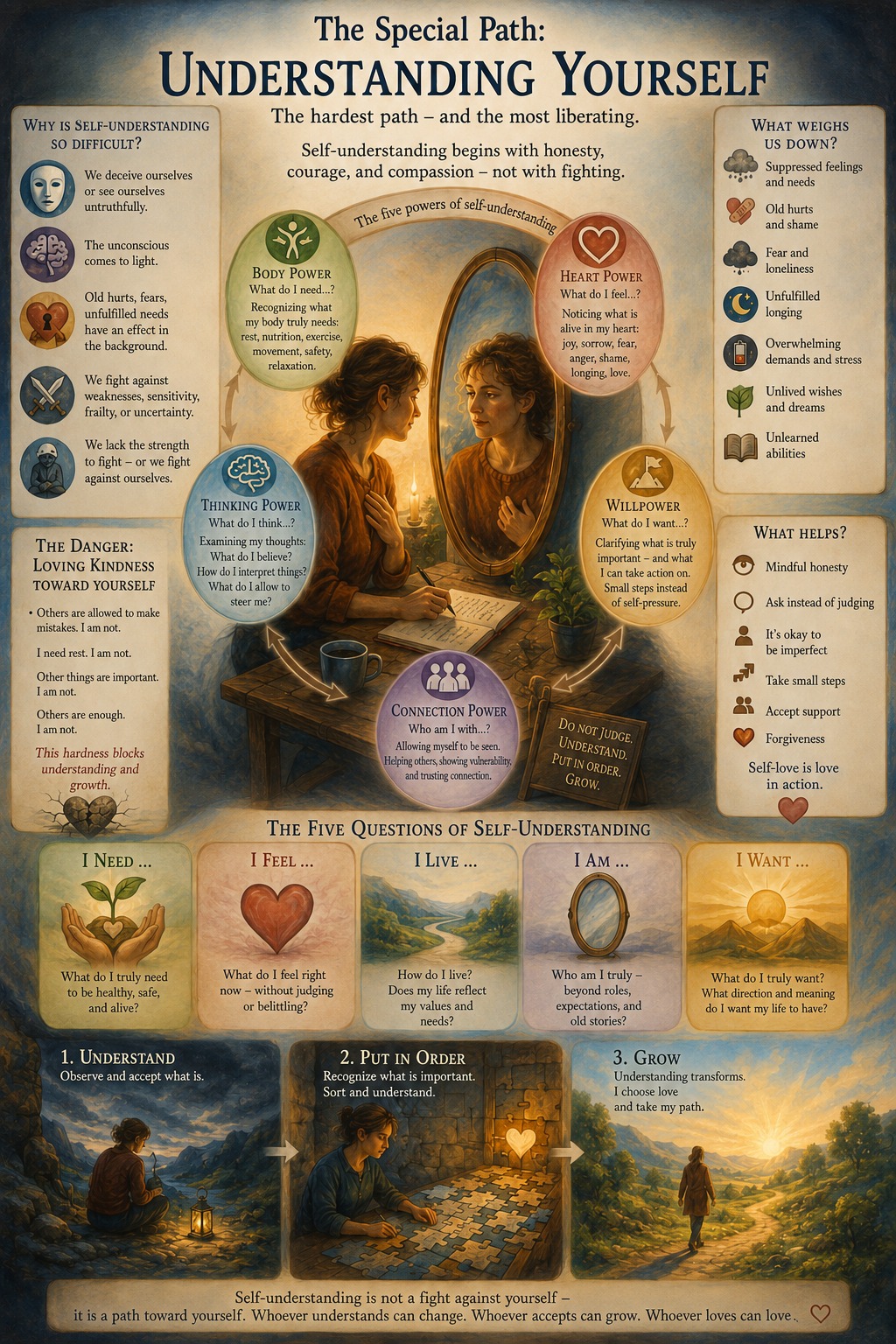
Translation note: Important reversal of meaning: German “Danger: lovelessness toward oneself” is printed as “The Danger: Loving Kindness Toward Yourself.” The English heading says the opposite of the source; the intended danger is lack of love or harshness toward oneself. “Who am I?” is also rendered less clearly as “Who am I with...?”
You Are Not Your Judgments About Yourself
An event, a feeling, or a mistake is not a complete description of a person. Harmful self-attributions turn temporary experiences into global verdicts. A healthier response separates facts from interpretation, allows boundaries and help, and uses honest feedback without surrendering personal worth.
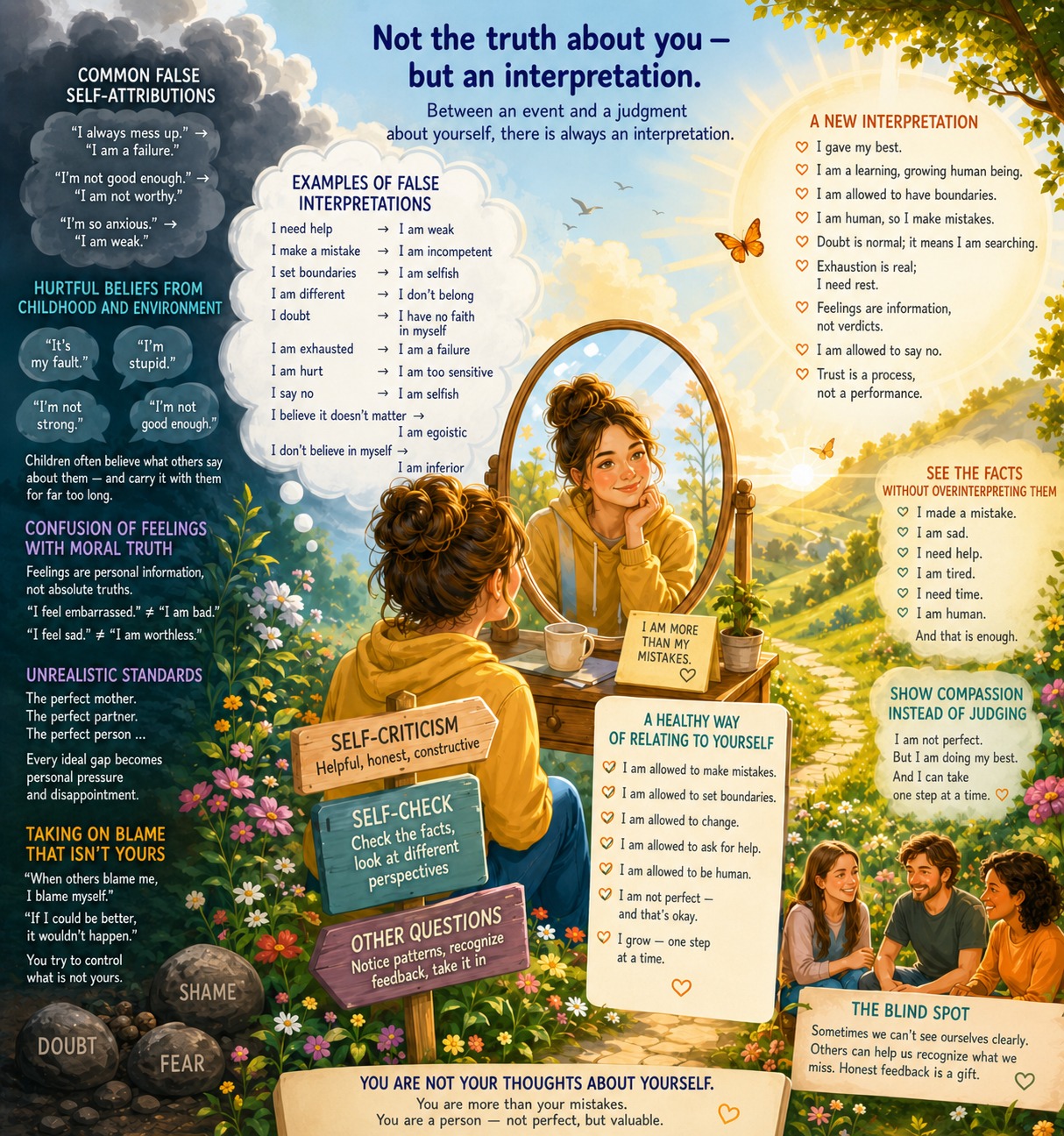
Translation note: Several details change meaning. “Faith is a path, not a performance test” becomes “Trust is a process, not a performance.” The image invents “I don't believe in myself → I am inferior,” replaces “I am valuable as I am” with “I am human, so I make mistakes,” and labels “Ask Others” as “Other Questions.” The main distinction between events and global self-judgments nevertheless remains understandable.
Thinking Is Greater Than Language
Thought includes bodily knowledge, emotion, relationship, spatial orientation, stories, expectations, and social patterns that may exist before they can be named. Language gives these processes structure, precision, and a form that can be shared. Maturity develops when preverbal experience, reflective thought, responsible choice, and action are brought into dialogue.
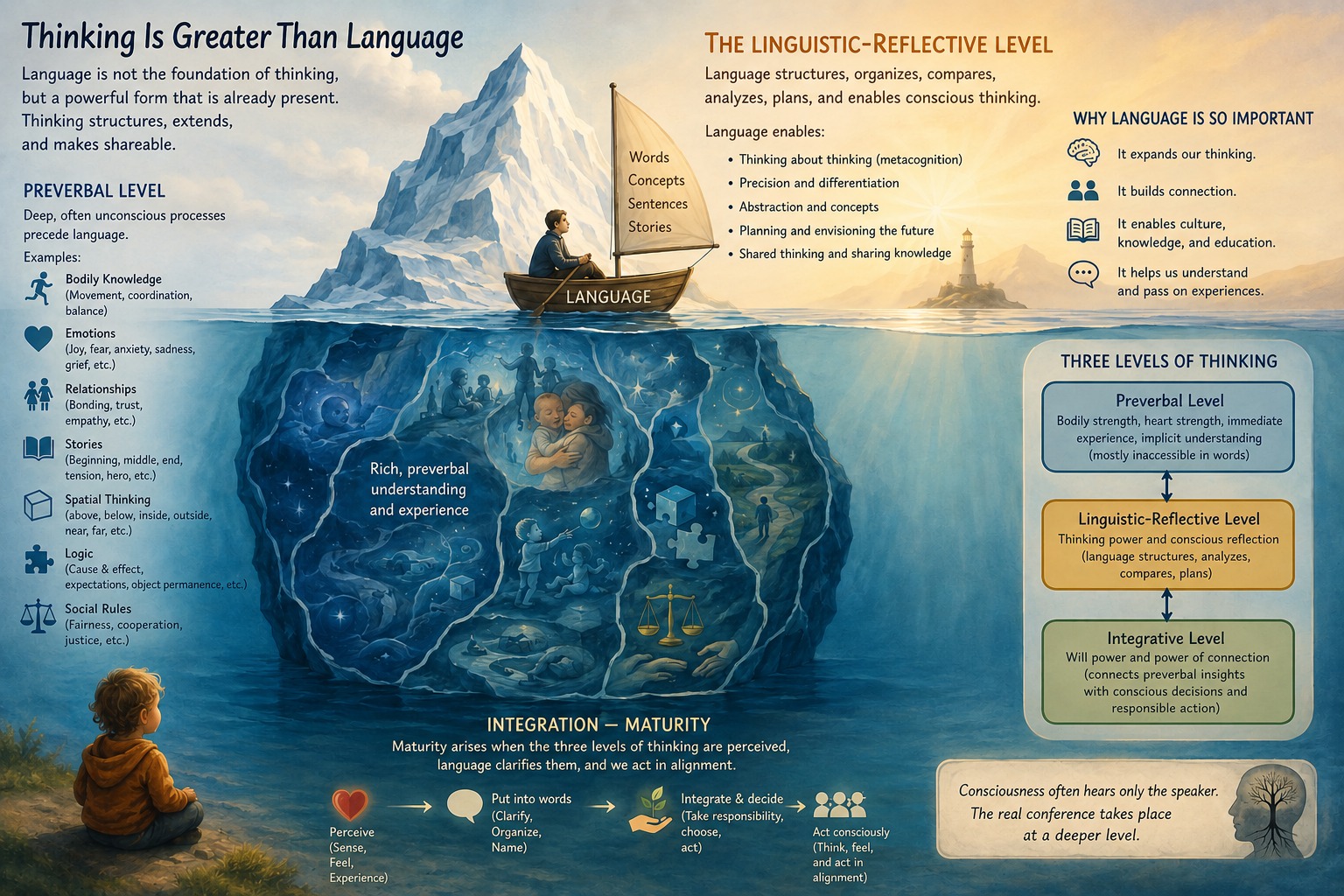
Translation note: The three levels remain understandable, but the opening changes its grammatical subject. The source says language is a powerful form for structuring, extending, and communicating already existing thought; the English says “a powerful form that is already present” and then makes thinking itself perform the structuring. The maturity sentence is also slightly shortened.
Deeper Than Language — Richer Than Words
A human being encounters the world before every experience can be put into words. Gesture, feeling, memory, relationship, pattern, and resonance form a rich background beneath explicit speech. Words can deepen and clarify encounter, but genuine meeting also requires attention to what is embodied, implicit, and shared without language.
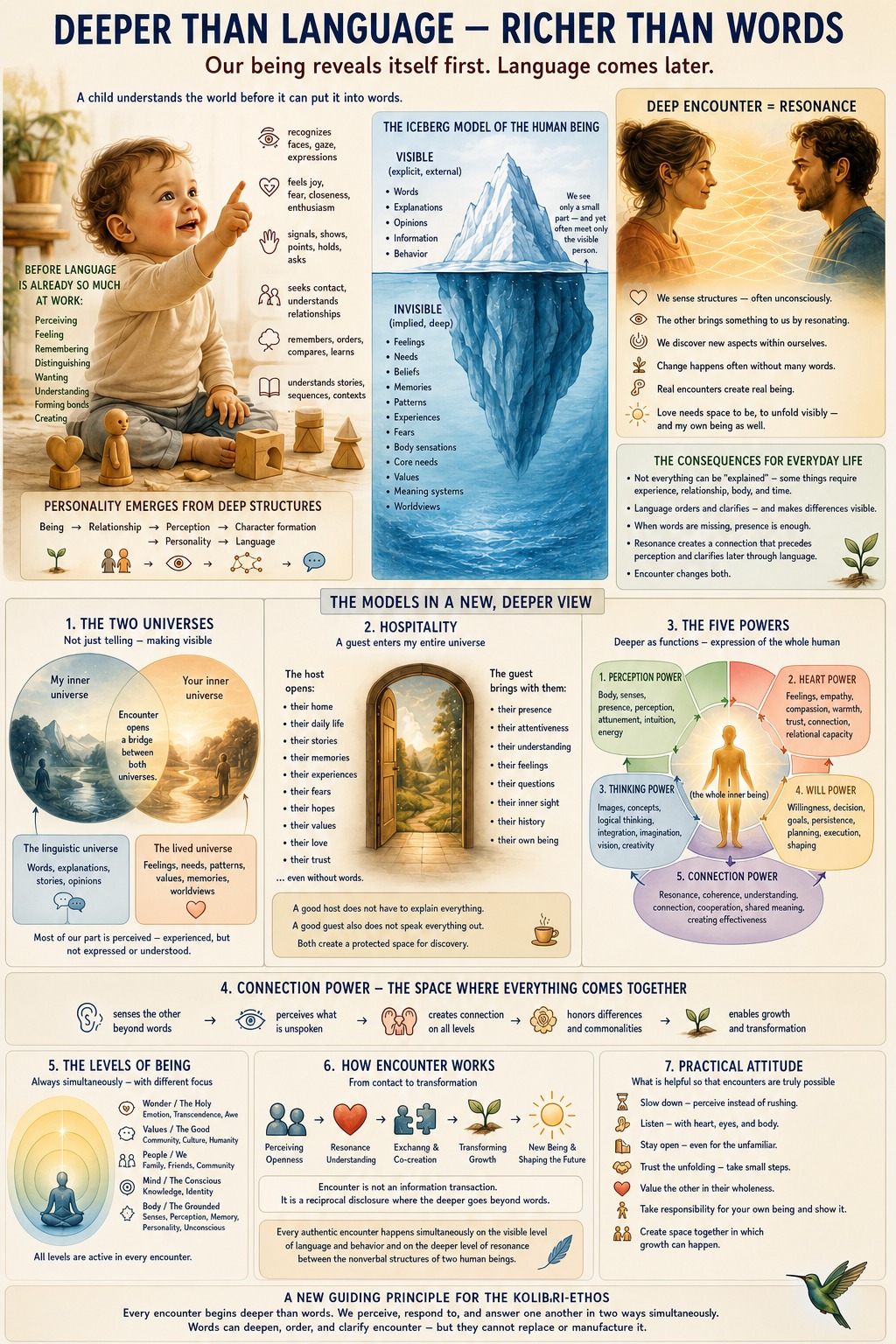
Translation note: The central account of preverbal perception and resonance is clear. In the five-power model, German “Body Power” becomes “Perception Power.” The “Levels of Being” are materially reorganised: original dimensions such as “Expanse/World,” “Closeness/We,” “Centre/I,” and “Depth/Subconscious” are partly replaced by new categories including “Values/The Good,” “People/We,” “Mind/The Conscious,” and “Body/The Grounded.” “Most of our part is perceived” is also unclear English.
Four Paths Between Thinking and Feeling
Analysis and feeling are not opposites. We can think conceptually, feel directly, reflect on our feelings, or allow an insight to emerge through feeling. Each path has strengths and risks. Understanding becomes deeper when the paths complement one another and remain connected with bodily experience, will, and relationship.
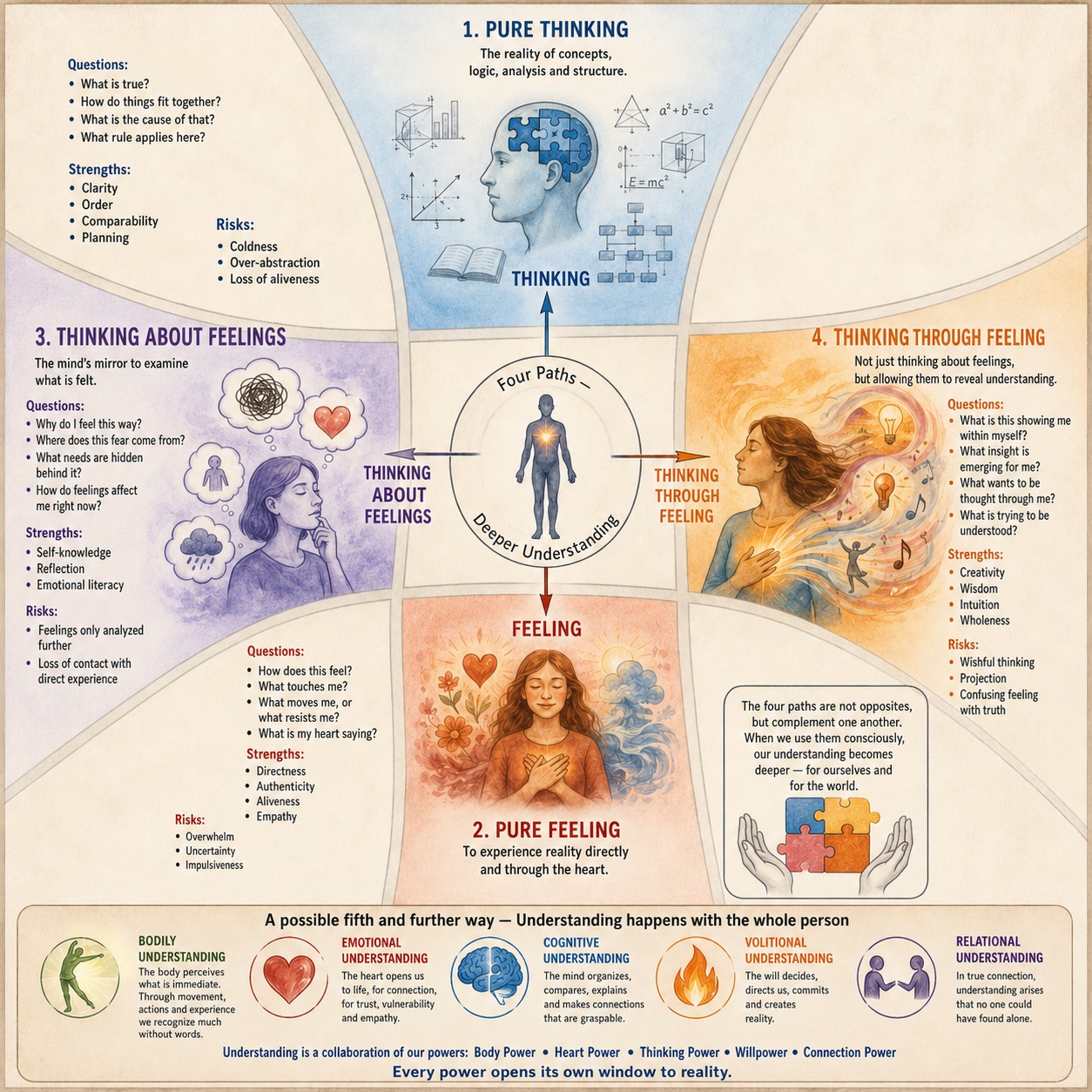
Translation note: The four paths, their questions, strengths, and risks are translated clearly. The additional path of understanding with the whole person is also preserved. No material change of meaning was found.
Trust as a Living Relationship
Trust is built through many small experiences of honesty, reliability, openness, responsibility, boundaries, and repair. Conflict tests whether people remain fair and connected when trust is under strain. When harm occurs, a responsible middle path avoids both punitive exclusion and permissive denial, and makes room for truth, understanding, responsibility, amends, time, and renewed experience.

Translation note: The trust model and repair cycle are clear. German “lack of remorse” is intensified to “betrayal.” “Talking behind someone's back” is printed as the incomplete “taking behind someone's back.” “Keeping one's word” also becomes “Keeping promises,” duplicating the neighbouring concept.
The Pendulum of Attention
Attention repeatedly moves between the outer world and the inner world. Outward attention supports perception, learning, decision, and action; inward attention supports memory, reflection, feeling, planning, and meaning. Neither permanent outward stimulation nor endless inward rumination is healthy. Rhythm allows a person to perceive, integrate, respond, and then listen again.
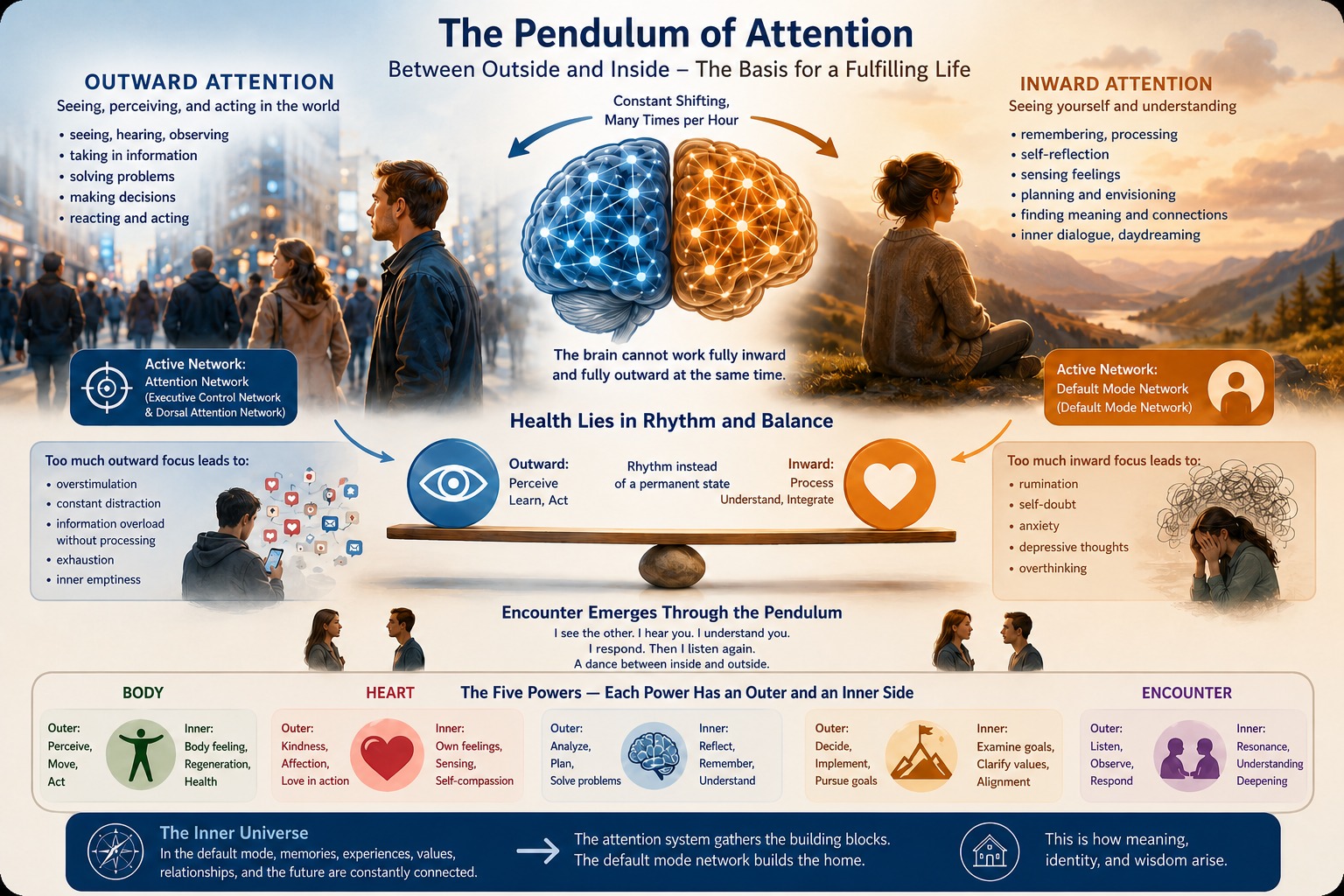
Translation note: The outward and inward modes, their active networks, their risks, and rhythmic alternation are translated clearly. The only notable terminology issue is that “Connection Power” is shortened to “Encounter” in the lower five-power strip.
Four Directions of Attention
Attention may turn toward the world, another person, one's inner self, or the meaning of the whole. Each direction can become a healthy form of deep absorption, yet each can also be exaggerated. Well-being depends on awareness, flexible movement, and balance rather than on declaring one direction permanently superior.
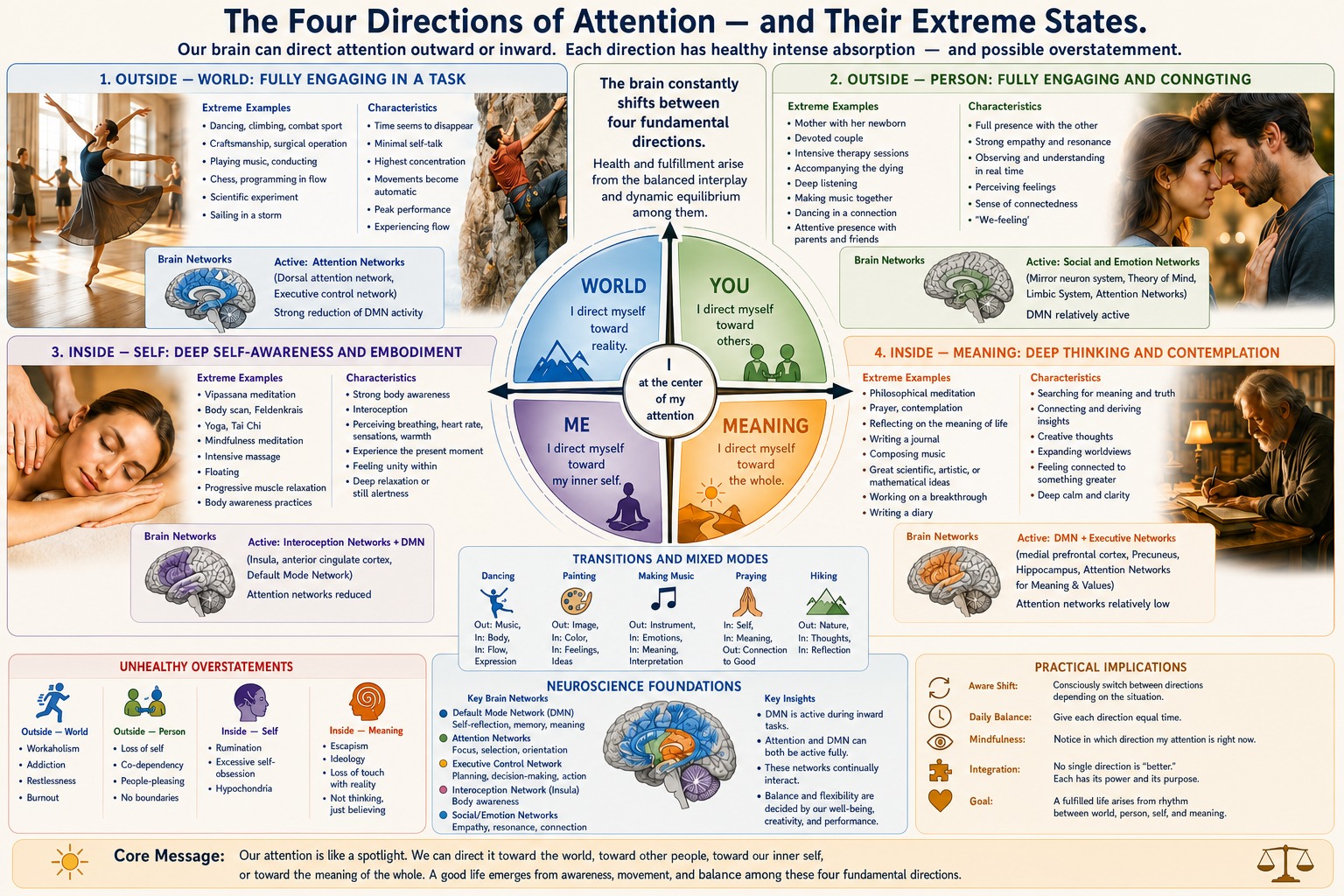
Translation note: The four directions and the difference between healthy intensity and unhealthy exaggeration remain clear. The heading “Fully Engaging and Connecting” contains the typo “Conngting.” More importantly, German “only thinking, no action” is reversed to “not thinking, just believing”; the source describes thought without action.
The Brain's Internal Networks
The brain alternates between inwardly directed processing and networks that support outward attention and tasks. The default mode network contributes to self-reference, memory, future thinking, understanding others, meaning, and creative insight. Healthy functioning is not permanent inwardness or permanent task focus, but flexible, rhythmic switching between modes.
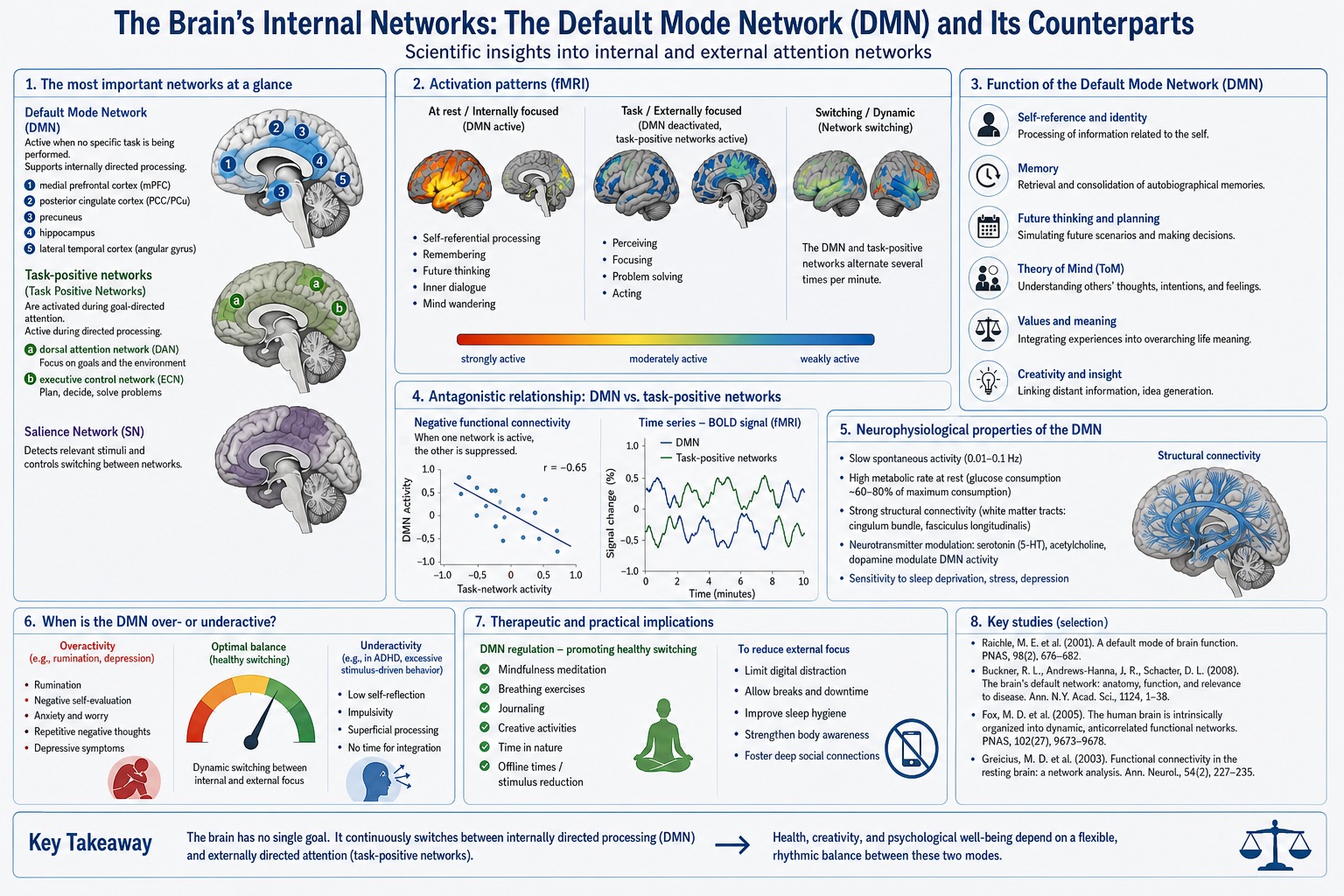
Translation note: Scientific terminology, numerical values, graphs, and citations are transferred very well. The footer shifts “The brain never works without a goal” to “The brain has no single goal,” which may imply the absence of one unified goal rather than continuous goal-directed processing.
From Knowledge to Wisdom: Eight Stages
Data become information when they are placed in context; information becomes knowledge through models and principles. Understanding, intelligent application, experience, and habit deepen what is learned. Wisdom asks what knowledge is for and brings it into harmony with oneself, other people, and the whole.
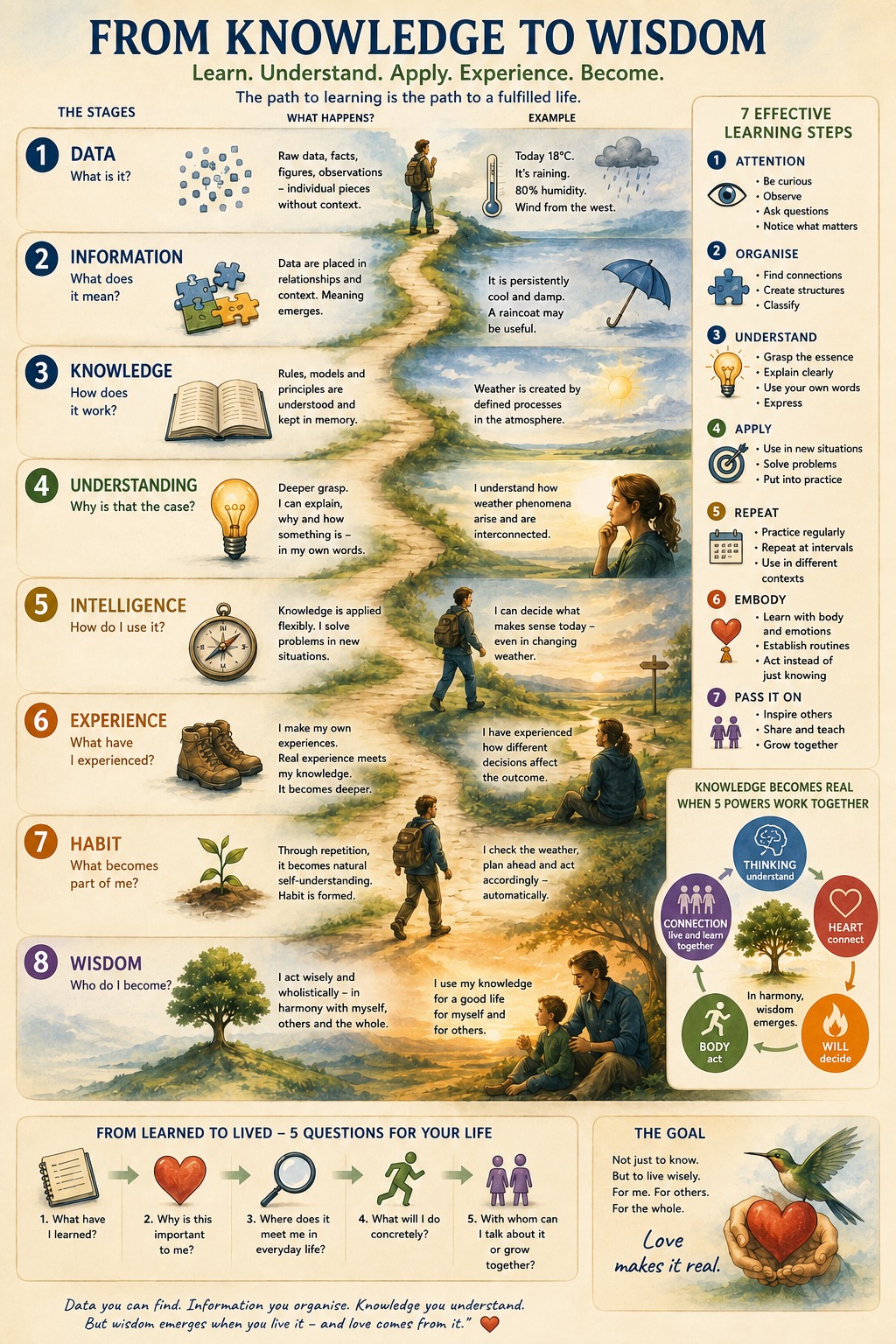
Translation note: All eight main stages and seven learning steps are present. The wisdom question “What do I use it for?” becomes “Who do I become?” “Realise or embody love” is rendered ambiguously as “Love makes it real.” The weather example also changes “unsettled and cool” to “persistently cool and damp.”
Learning Becomes Wisdom Through Practice
Knowledge alone changes little until it is organised, explained, applied, repeated, embodied, and passed on. The five human powers help learning become lived reality: thought understands, the heart senses meaning, will chooses, the body acts, and connection shares life with others. Wisdom is finally visible in how a person lives and acts.

Translation note: The stages, seven steps, five powers, and final message are well preserved. The four failure statements become grammatically unclear passive phrases such as “one isn't felt” and “one isn't trained.” The source means that the learner does not feel, want, practise, or live the knowledge with others.
Knowledge Is Potential; Wisdom Is Lived Life
Effective learning requires attention, a place for new information, understanding in one's own words, application in a new situation, repetition across time, bodily practice, and teaching others. Information gradually becomes experience, experience becomes ability, and ability can become wisdom when all five powers participate.
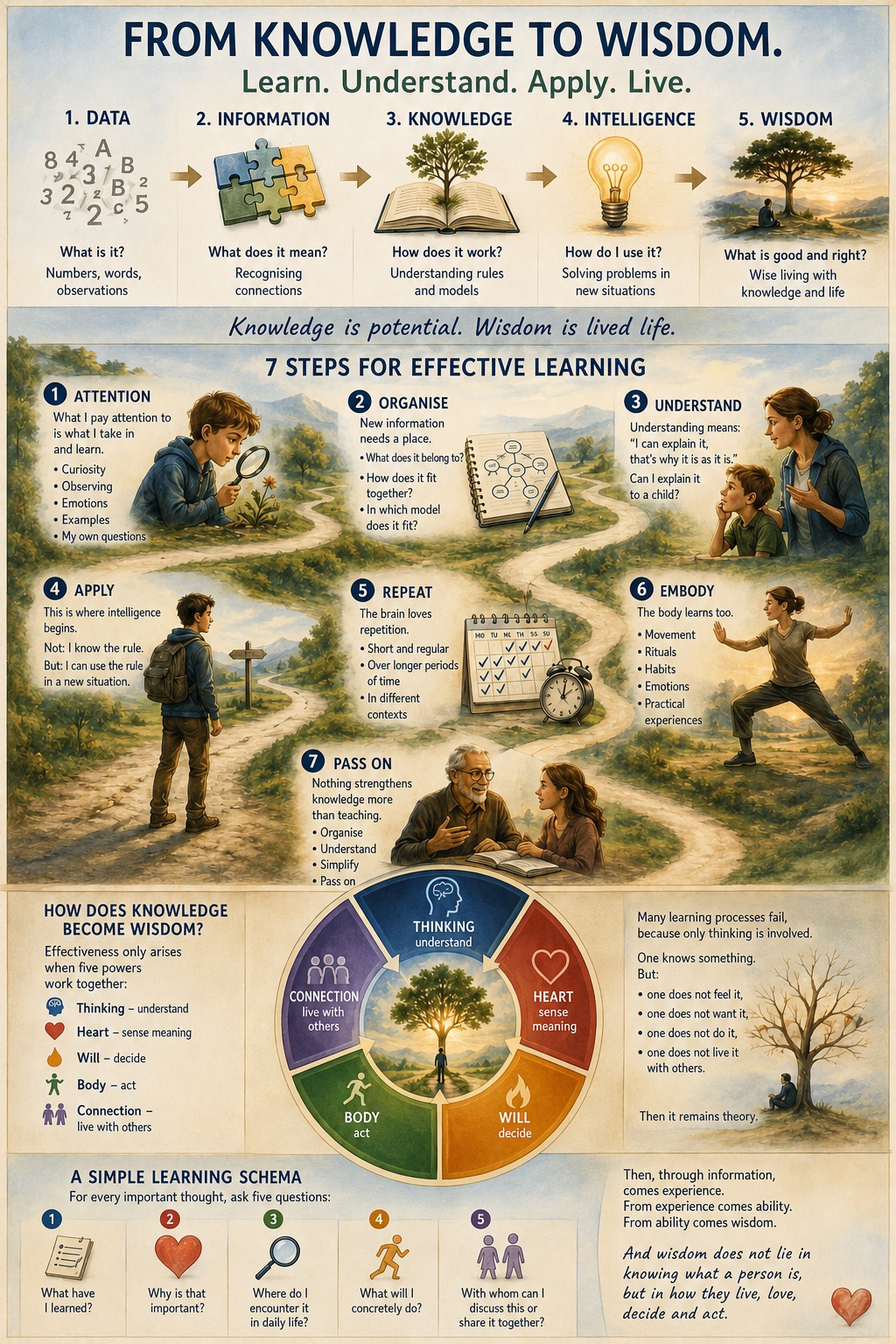
Translation note: The model is clear and complete. “Reality arises” is mistranslated as “Effectiveness arises.” In the handwritten conclusion, “what a person knows” becomes “what a person is.” The word “gradually” is also lost from the progression from information to experience.
Thinking and Feeling: A Learning Overview
People can learn differently without one profile being simply better than another. Effective learning combines suitable conditions, active recall, spaced practice, elaboration, multiple representations, flexible task order, simple explanation, and self-generated work. Sleep, movement, nutrition, light, breaks, and protection from overstimulation help the brain consolidate what is learned.

Translation note: The profiles and most learning guidance are clear. The “7-Step Chain” is materially mislabelled: “Wisdom” appears at position 5, “Intelligence” follows, and “Well-being” replaces wisdom at the end; the duplicated number 5 also remains. Some dopamine conditions are smoothed or recombined.
Understanding Your Own Brain
Self-knowledge can make learning more compassionate and effective. Different profiles may need different amounts of structure, stimulation, movement, quiet, challenge, feedback, and social support. Obstacles such as procrastination, overstimulation, perfectionism, underchallenge, and overchallenge become easier to address when conditions are shaped deliberately and all five human powers cooperate.

Translation note: Two labels reverse their meaning and should not be followed as advice. German “Dopamine is disrupted by” becomes “Dopamine is supported by.” Likewise, “Acetylcholine is disrupted by” becomes “Supported by,” falsely presenting multitasking, interruptions, notifications, and overstimulation as helpful. These factors impair focus rather than support it.
The Art of Learning
Learning becomes transformative when methods serve a living purpose. Retrieval, distributed repetition, deeper questions, word-and-image links, interleaving, simple explanation, and generative work help knowledge become usable. Appropriate challenge can support flow; small starts, reduced friction, clear goals, rewards, and permission to improve imperfect work can reduce procrastination.

Translation note: The seven methods, developmental stages, flow model, anti-procrastination rules, five powers, and learning block are present. The connection question “Can I explain it?” changes to “Who can I learn with?” The sentence about the highest form of learning is grammatically unclear, but its intended ethical direction remains understandable.