
Dimensions, Reality, and Relationship
This working page explores inner universes, levels of reality, humility, and communication. Each image is accompanied by a note identifying translation weaknesses that should be considered during review.
Two Fundamental Models of Love
Love can welcome another person as a guest and can accompany the unfolding of an inner universe. Both models protect freedom, boundaries, uniqueness, resonance, and a relationship that remains alive through coming and going.
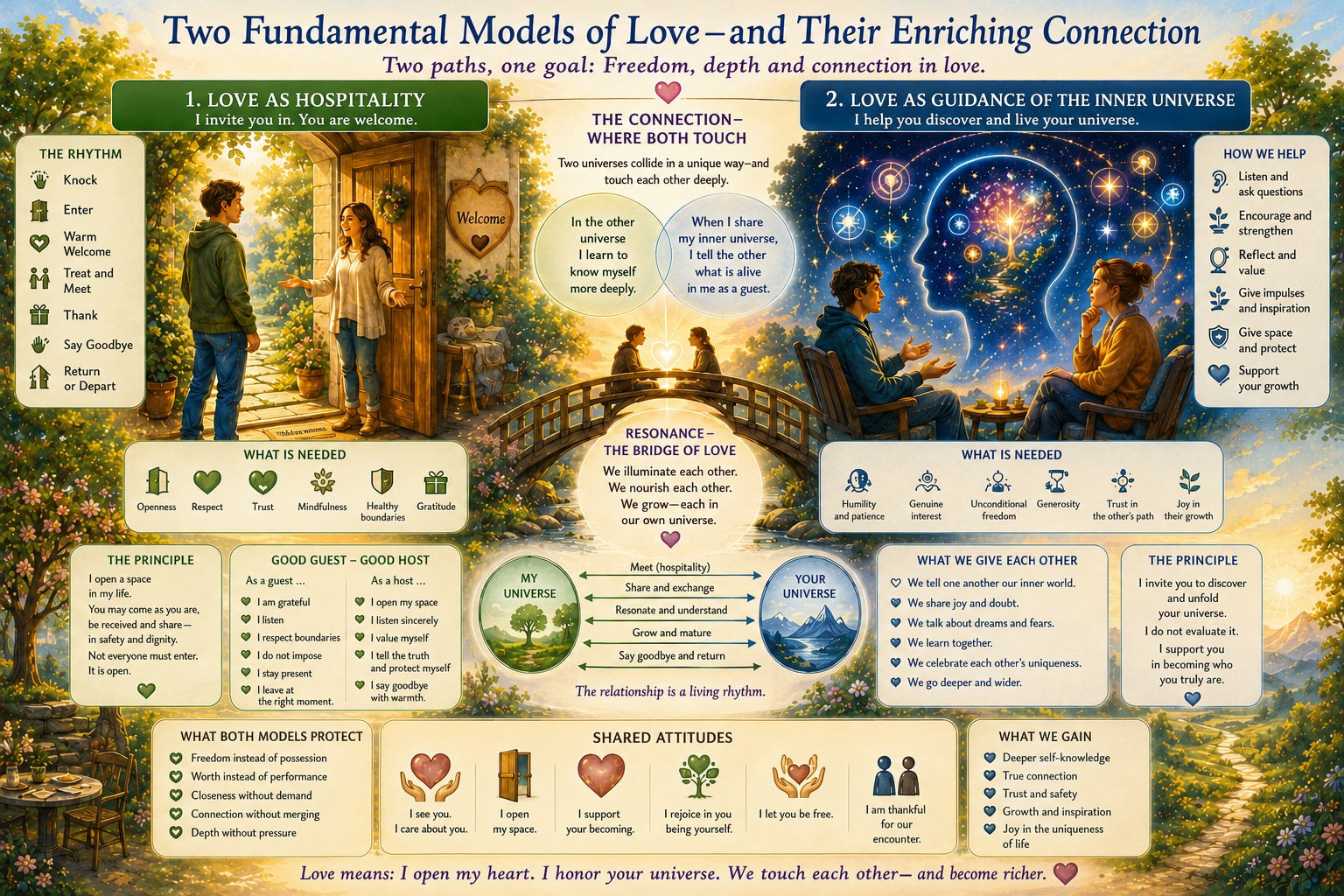
Translation note: “Dignity instead of appropriation” became “Worth instead of performance”, changing both concepts; “we foster depth and breadth” became the freer “we go deeper and wider”.
The Different Dimensions of Reality
Reality includes physical, biological, psychological, social, symbolic, mathematical, and intellectual or spiritual dimensions. Understanding grows when we use several methods and keep reality distinct from the truth of a statement about it.
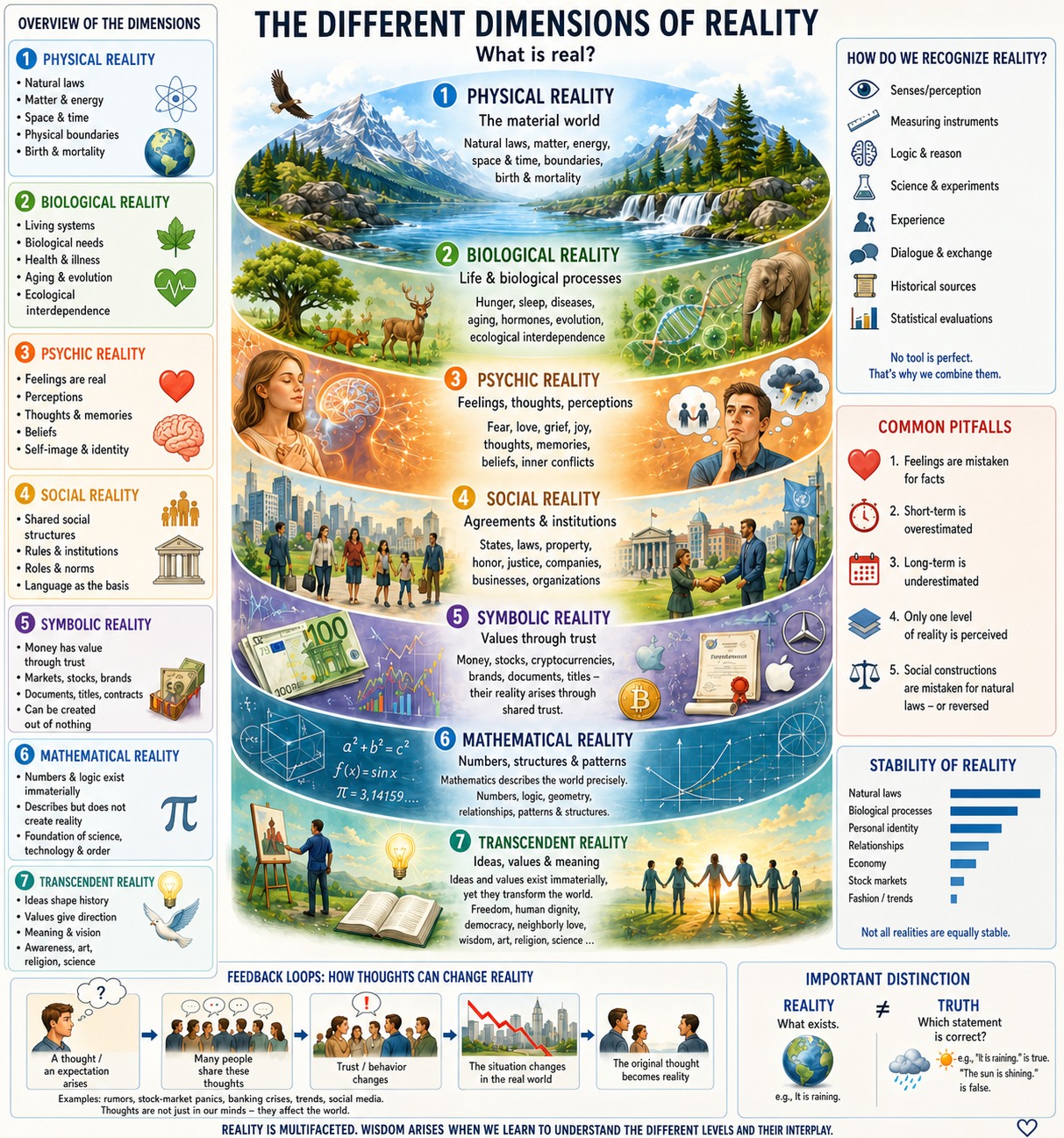
Translation note: Geistige Realität was mistranslated as “Transcendent Reality”, collapsing intellectual/spiritual reality into transcendence. In Social Reality, marriage and language were incorrectly replaced by honor and justice.
The Subject and the Inner Universe
We do not receive reality as a finished copy. Perception, selection, interpretation, classification, memory, belief, feeling, and action help build an inner universe that can influence the outer world in return.
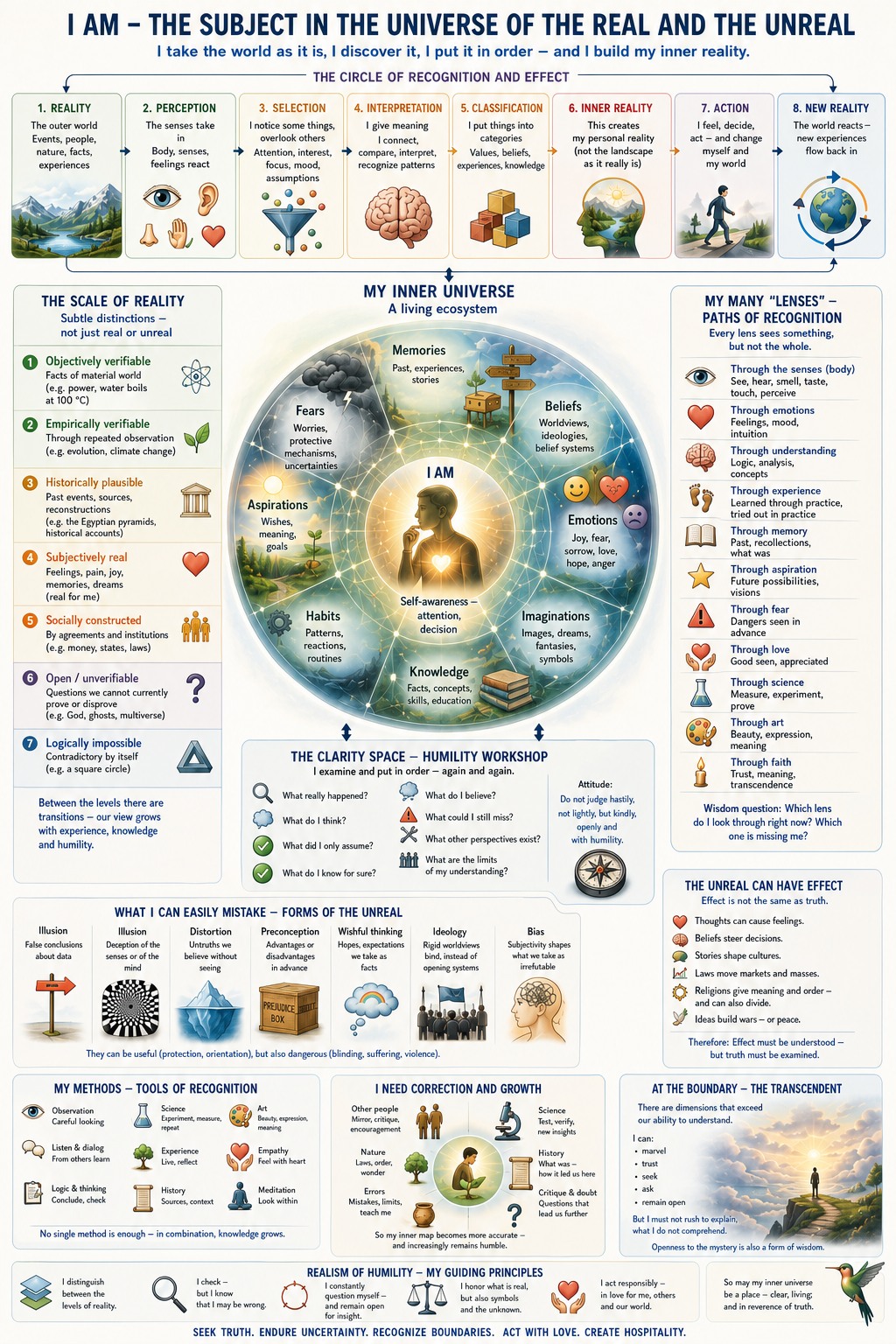
Translation note: In the forms of the unreal, Irrtum became Illusion, Verdrängung became Distortion, and Wahn became Bias. The opening also changes “I perceive the world” into the stronger “I take the world as it is”.
Realism of Humility
Humility does not deny knowledge; it places claims on the appropriate level and acknowledges their limits. Different realities need different methods, standards of proof, and degrees of certainty.
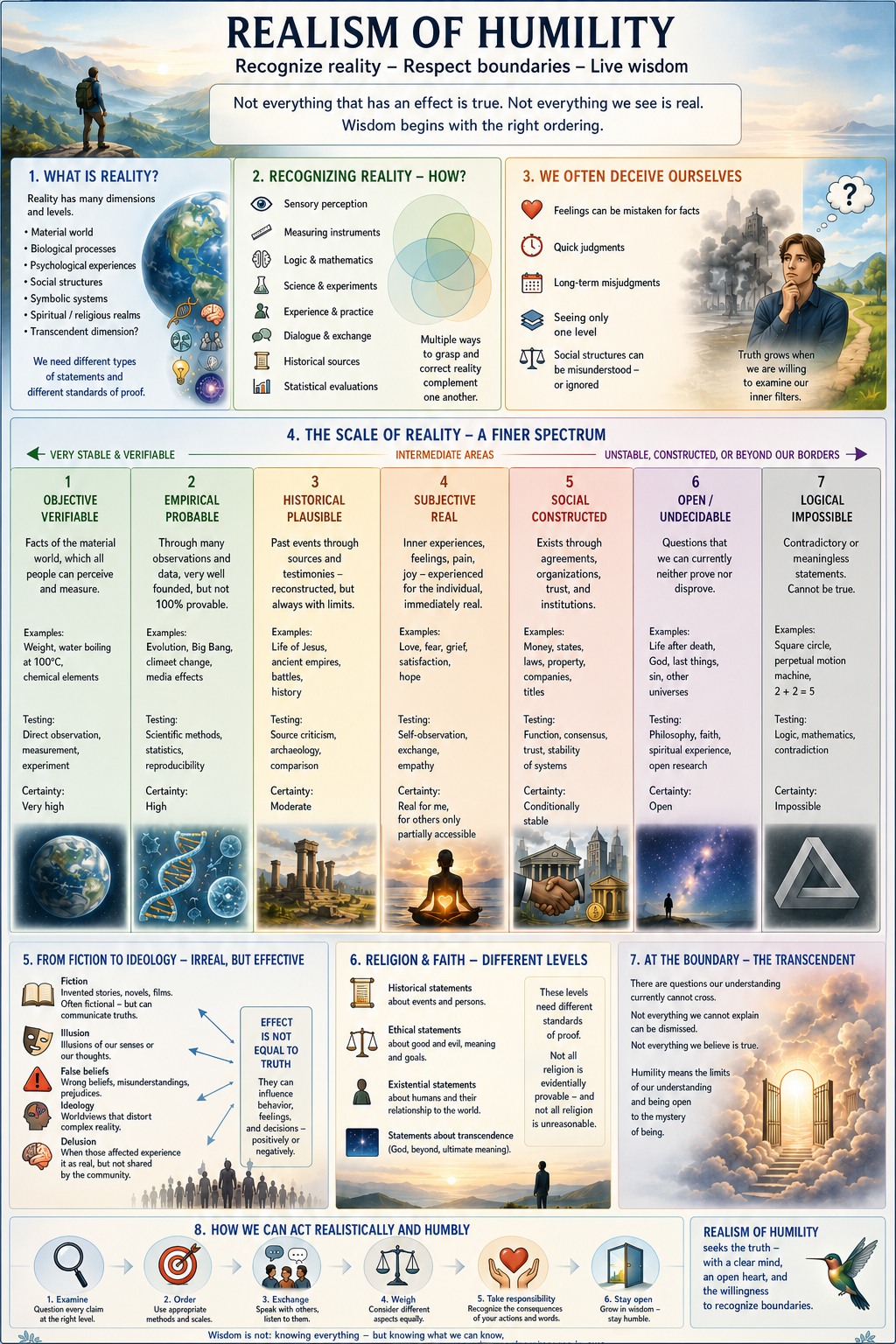
Translation note: Short-term overestimation became “Quick judgments” and long-term underestimation became “Long-term misjudgments”. Most importantly, letzter Sinn was rendered as “last things, sin” instead of “ultimate meaning”.
Relationship Problems on Four Communication Levels
Relationship conflict can appear on the factual, relationship, self-revelation, and appeal levels at the same time. Healing becomes possible when hidden needs can be seen, safety grows, and wishes are expressed clearly.
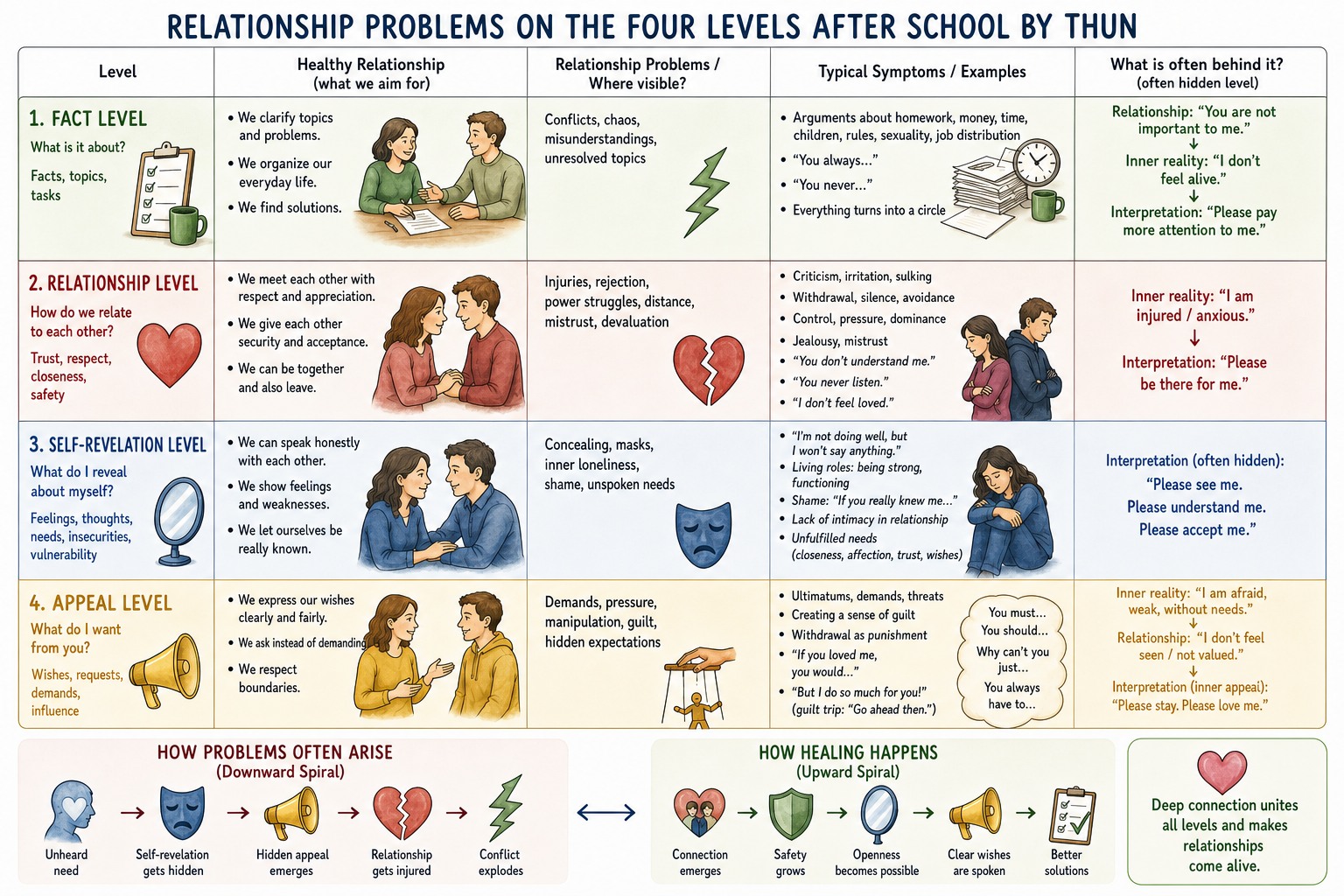
Translation note: The title “according to Schulz von Thun” was mistranslated as “after school by Thun”. In the final column, self-revelation and appeal are repeatedly generalized as Inner reality or Interpretation.
Networks, Dimensions, and Spaces
Human life becomes easier to understand when three perspectives are held together: networks show relationships, dimensions deepen meaning and values, and spaces provide concrete areas in which life can unfold. Encounter is presented as the point where these perspectives become living practice.
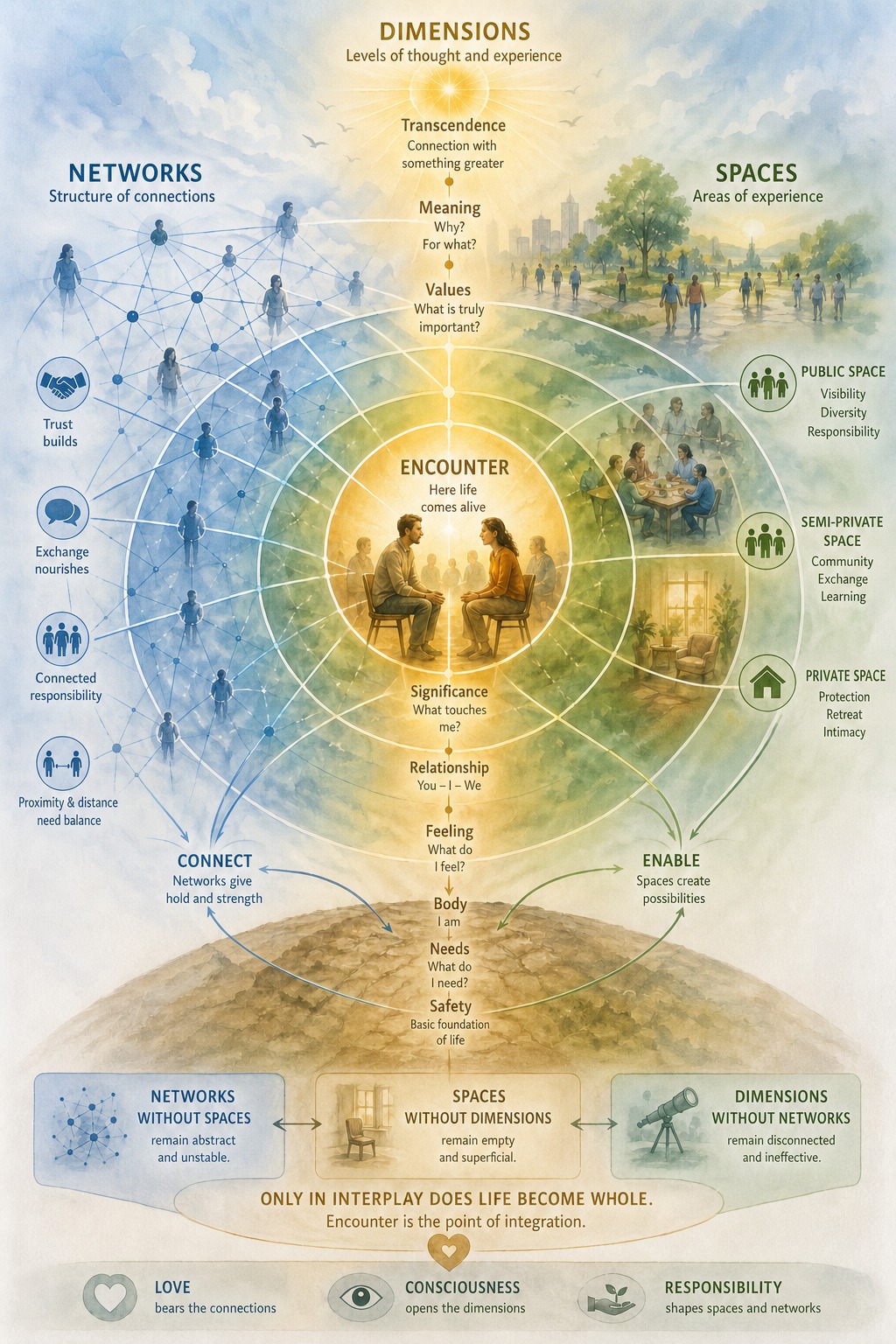
Translation note: Meaning and significance provide a useful distinction for Sinn and Bedeutung. The final statement “lebendiges Leben entsteht” was translated more freely as “life becomes whole”.
The Five Forces and Their Time Dimension
The physical, heart, thinking, will, and encounter forces each relate differently to the past, present, immediate moment, and future. The image invites reflection on memory, present awareness, planning, decisions, and relationships as connected aspects of time.
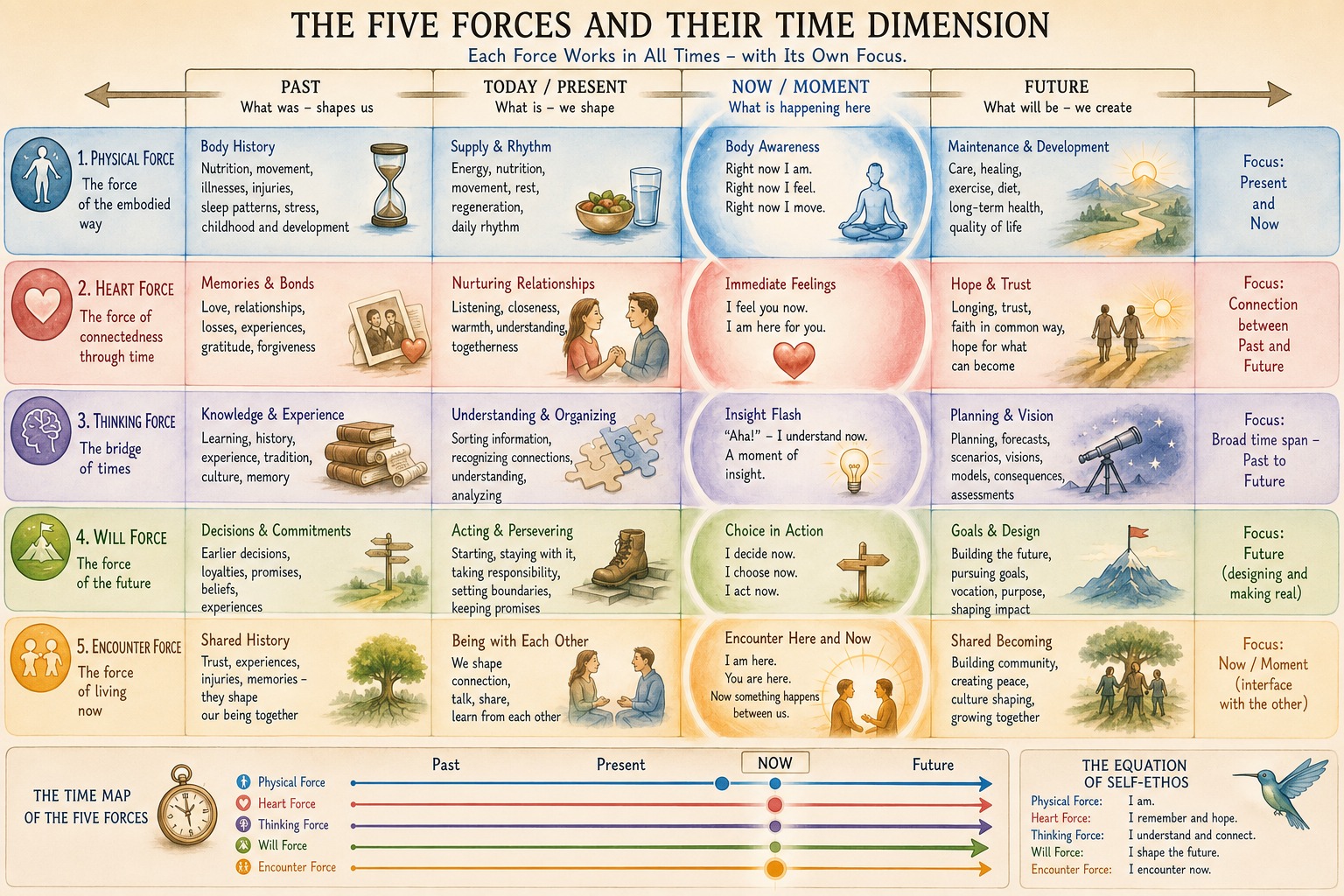
Translation note: The extensive table is unusually complete and readable. “Encounter Force” is understandable but not an established English technical term, and several force names remain project-specific concepts.
My Six Inner Living Spaces
Six inner spaces describe warmth, order, encounter, education and truth, clarification and boundaries, and creative realization of meaning. Together they form an inner architecture that can support a self-determined and connected life.
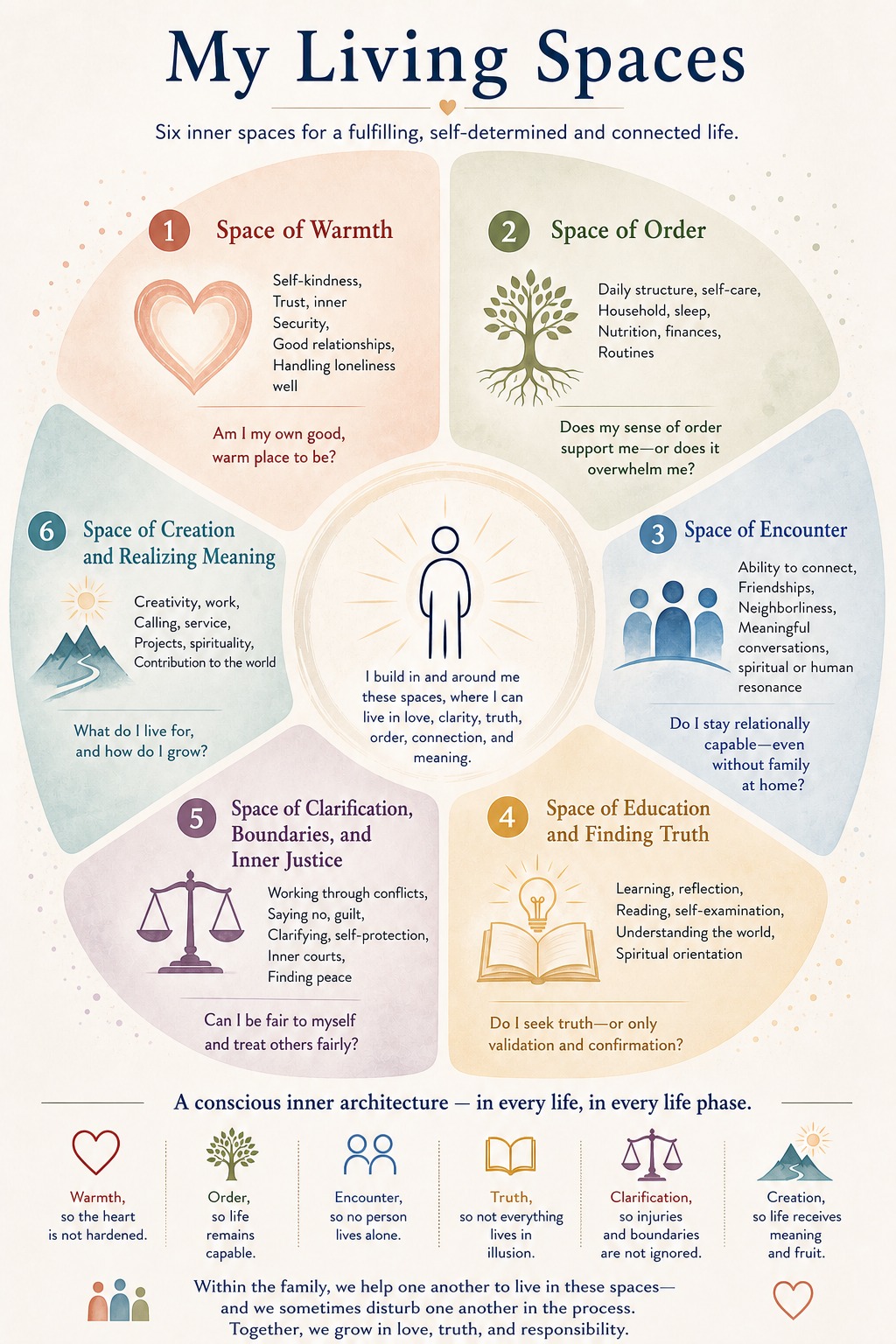
Translation note: “Am I my own good, warm place to be?” is understandable but stylistically awkward. In the truth section, Ablenkung und Bestätigung became “validation and confirmation”, so distraction was lost.
Living Spaces for a Person Living Alone
The house metaphor shows that living alone need not mean living without relationship, warmth, truth, structure, clarification, or purpose. These spaces can be consciously cultivated within and around a person.

Translation note: Lebensordnung was rendered more freely as “way of living”, and Sinn in the central house became “purpose”. The main message is preserved, but several questions are paraphrased rather than translated closely.
A Dynamic Map of Family Life
A family moves repeatedly through warmth, truth, development, order, clarification, and conflict. The model emphasizes transitions, warning signs, practical tools, shared responsibility, and a return to connection.
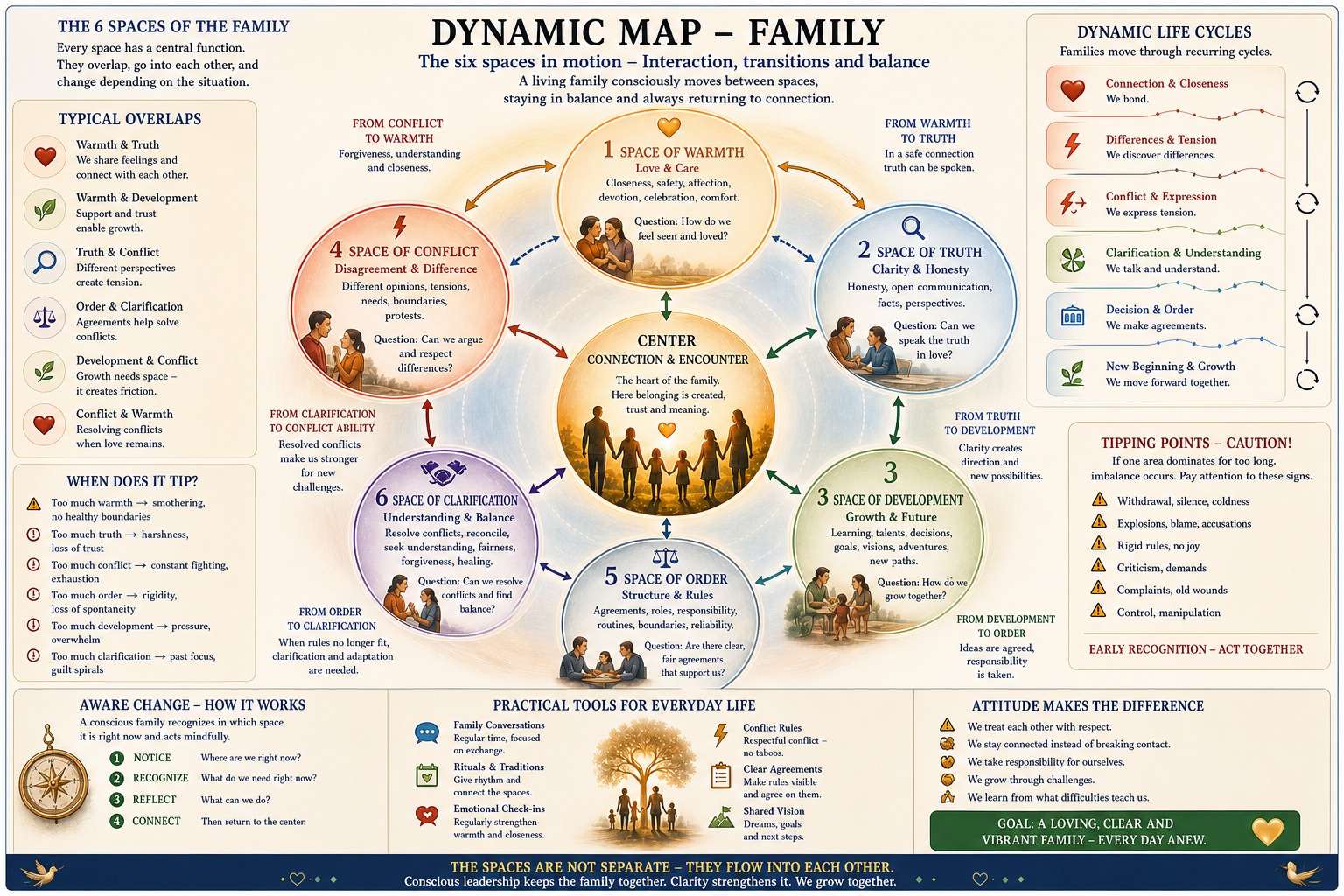
Translation note: The dense structure is very well preserved. Klärungsraum was expanded to “Understanding & Balance”, and several transition statements were smoothed, so the English wording is less exact than the German categories.
Five Dimensions of Being Human
Relationship, safety, energy, self, and meaning are presented as dimensions in which forms of love can heal lack, separation, fear, heaviness, shame, and emptiness. The lower path links inner support, connection, self-acceptance, energy, and meaning.
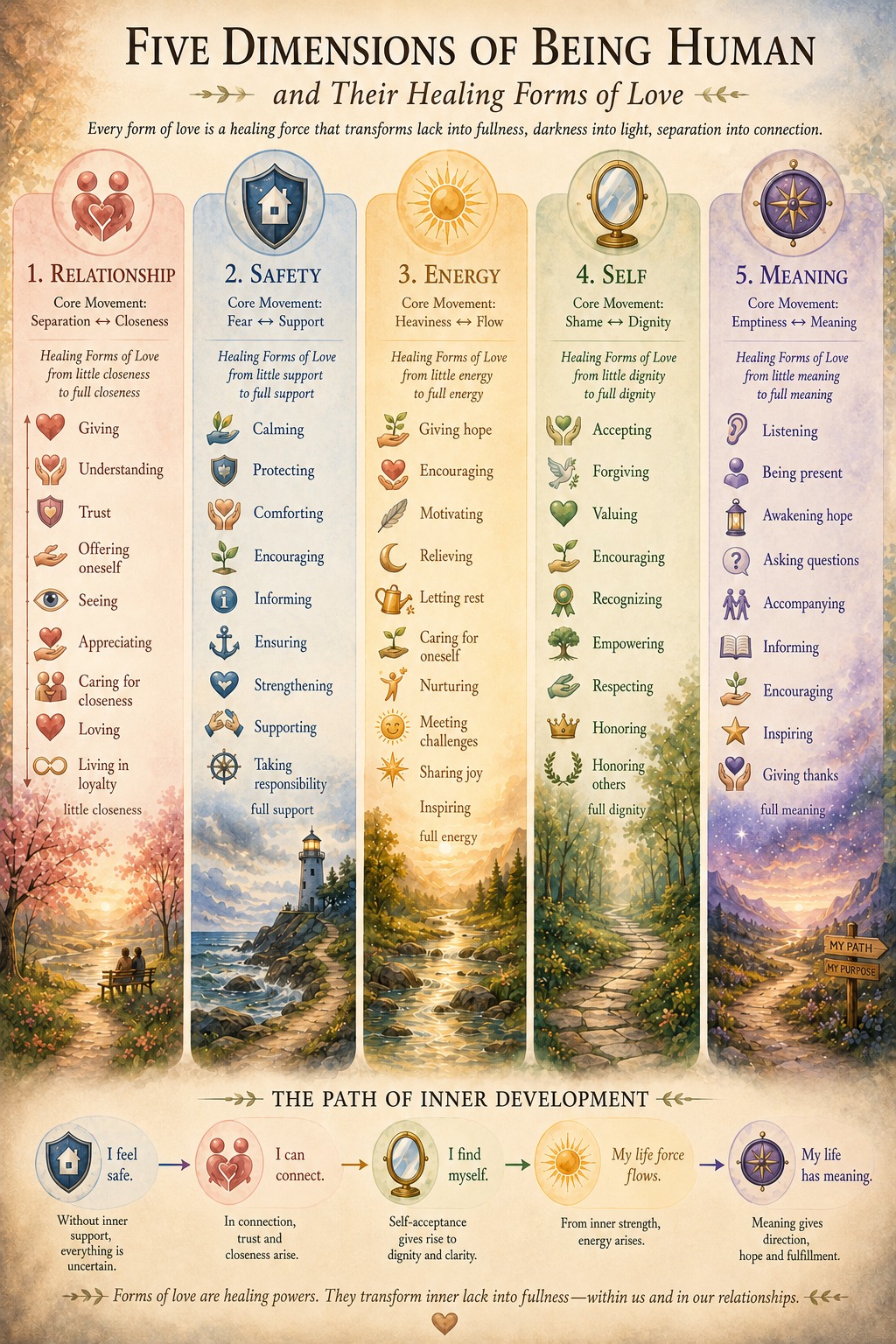
Translation note: Several list items are seriously shifted. Vergeben in the Relationship column became “Giving”, and the Energy column replaces Mitfühlen with “Encouraging” while moving or changing several following actions. Treat the lists as an approximation, not an exact translation.
The Five Human Forces
Body, heart, and thinking form a foundation; will provides direction; encounter connects and fulfills. The image also contrasts connecting and structuring movements and shows how all five forces influence one another.
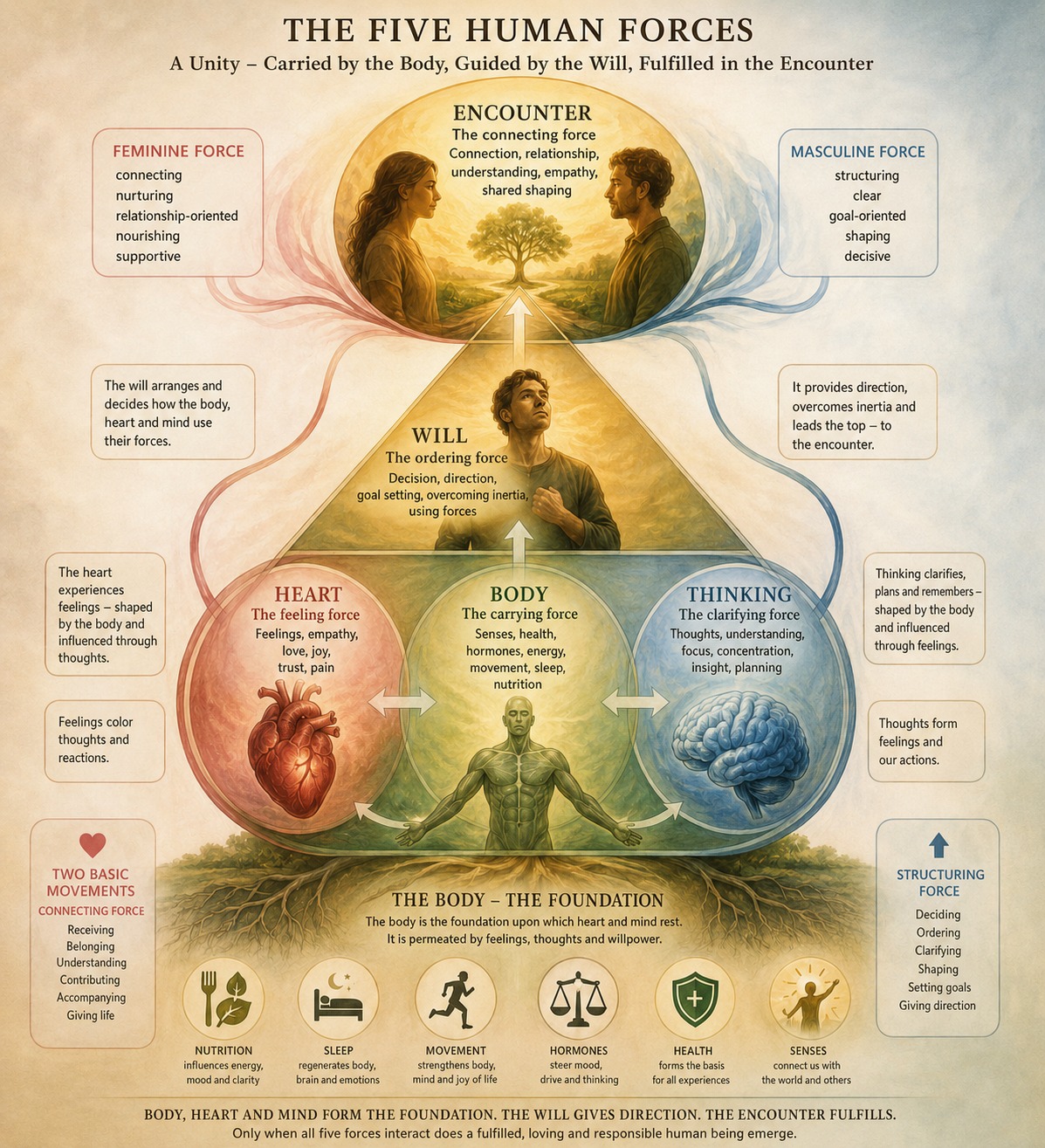
Translation note: In the feminine-force list, fühlend and begleitend became “nourishing” and “supportive”; in the masculine list, ausrichtend became “clear”. More seriously, Zuhören became “Belonging” and Mitfühlen became “Contributing”. The sentence “leads the top” is also a wording error.
Five Areas of Consciousness and Their Interactions
Depth, center, closeness, expanse, and wonder are shown as interacting currents rather than isolated islands. The image explores healthy balance, disturbances, mutual influence, responsibility, relationships, and the sacred.
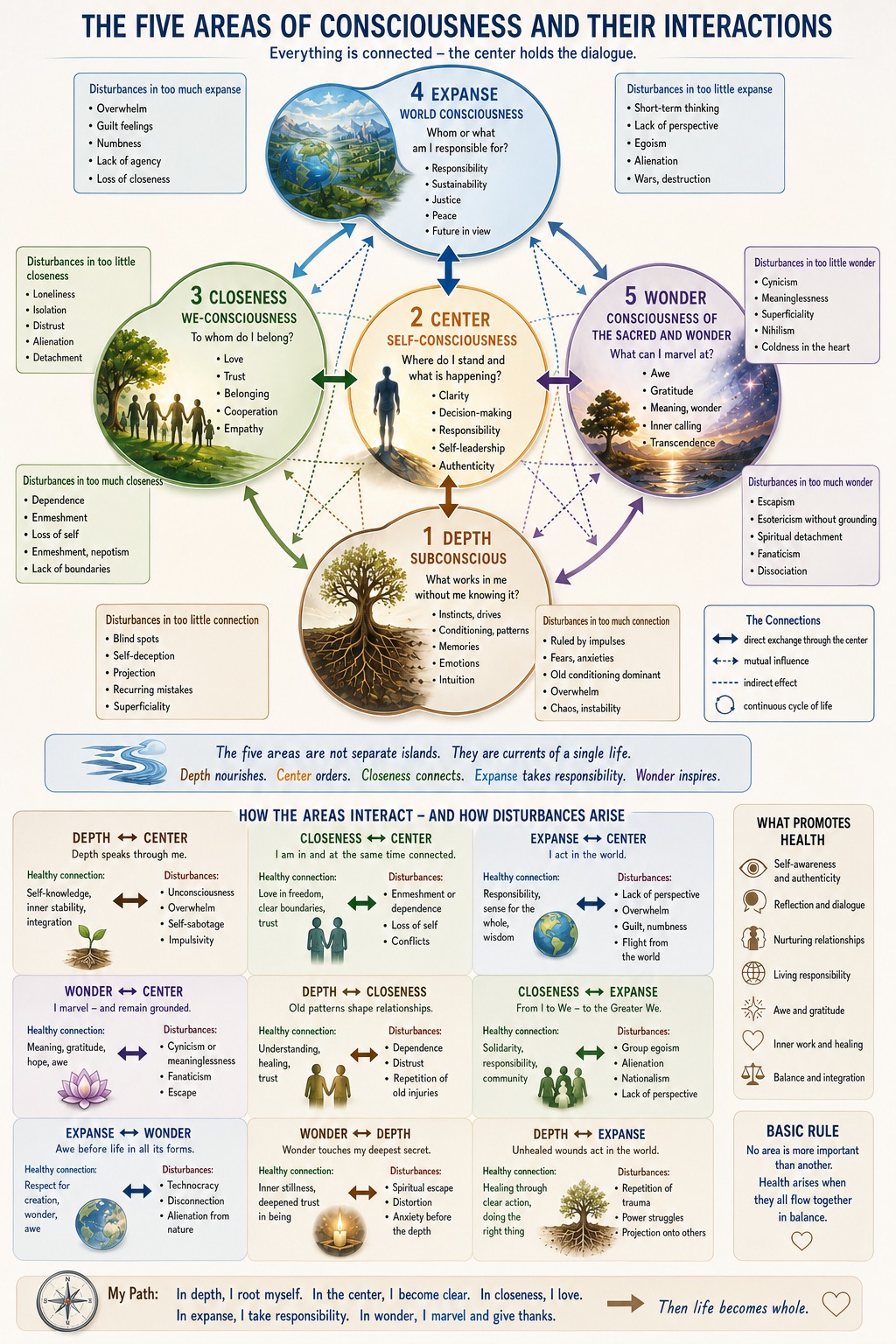
Translation note: Ohnmacht became “Numbness” rather than helplessness, and Gleichgültigkeit became “Lack of perspective”. “Vom Ich zum Wir – zum großen Wir” was translated as “to the Creator We”, adding a theological meaning not present in the German wording.
Forms of Love as Streams of Life
Understanding, listening, compassion, forgiveness, gratitude, responsibility, and loving action can flow through every area of consciousness. The matrix shows how the same form of love may take a different expression in depth, center, closeness, expanse, and wonder.
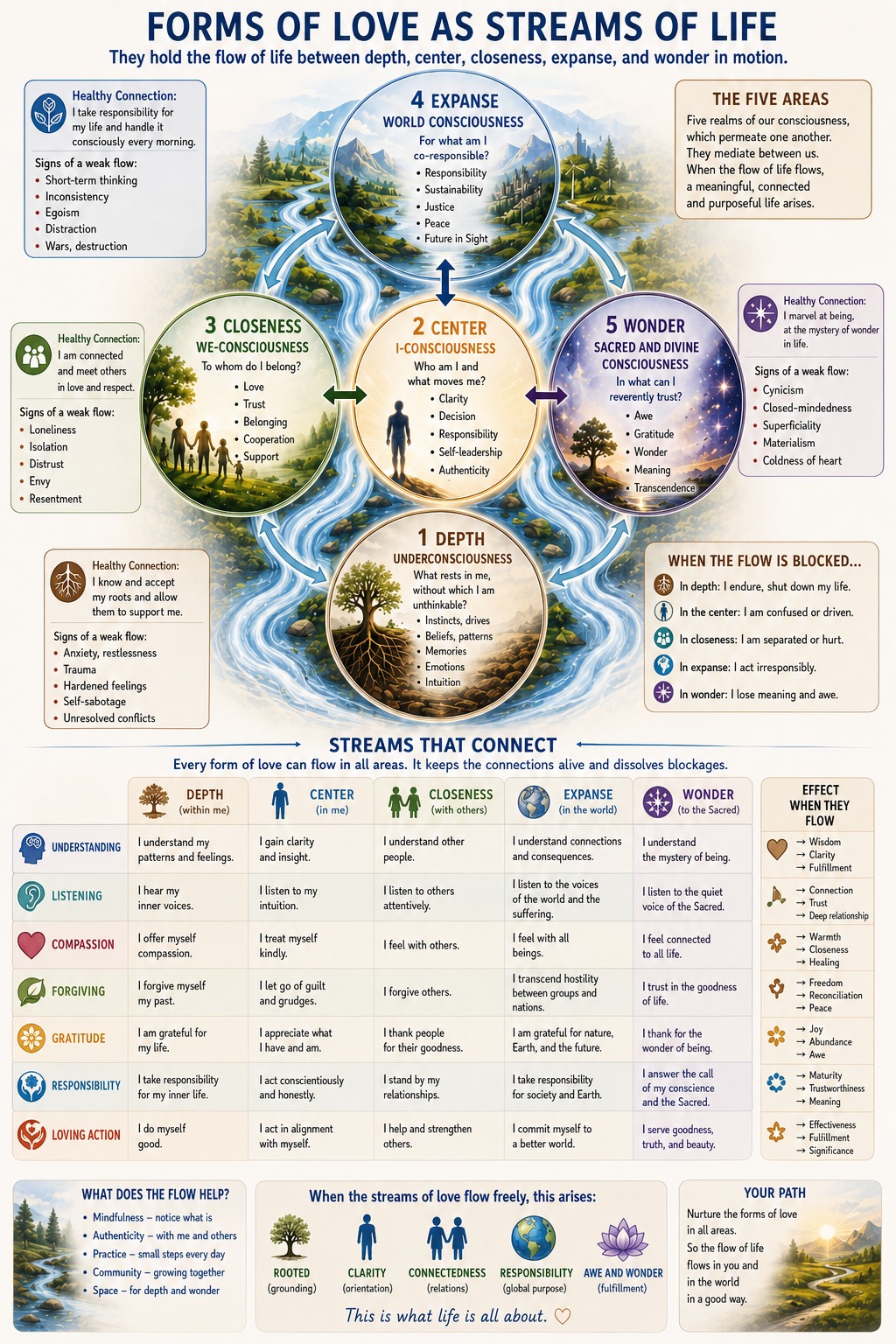
Translation note: “Ich handle für ein gutes Morgen” became “I handle it consciously every morning”, confusing tomorrow with morning. Feindbilder became “Envy”, and “So wird das Leben ganz” was changed to “This is what life is all about”. The first effects row also loses compassion.
The Whole Picture of the Human Being
This synthesis connects three levels: spaces of consciousness, movements of the heart, and human energies. It presents awareness, love, and strength as mutually supporting parts of one life in connection.
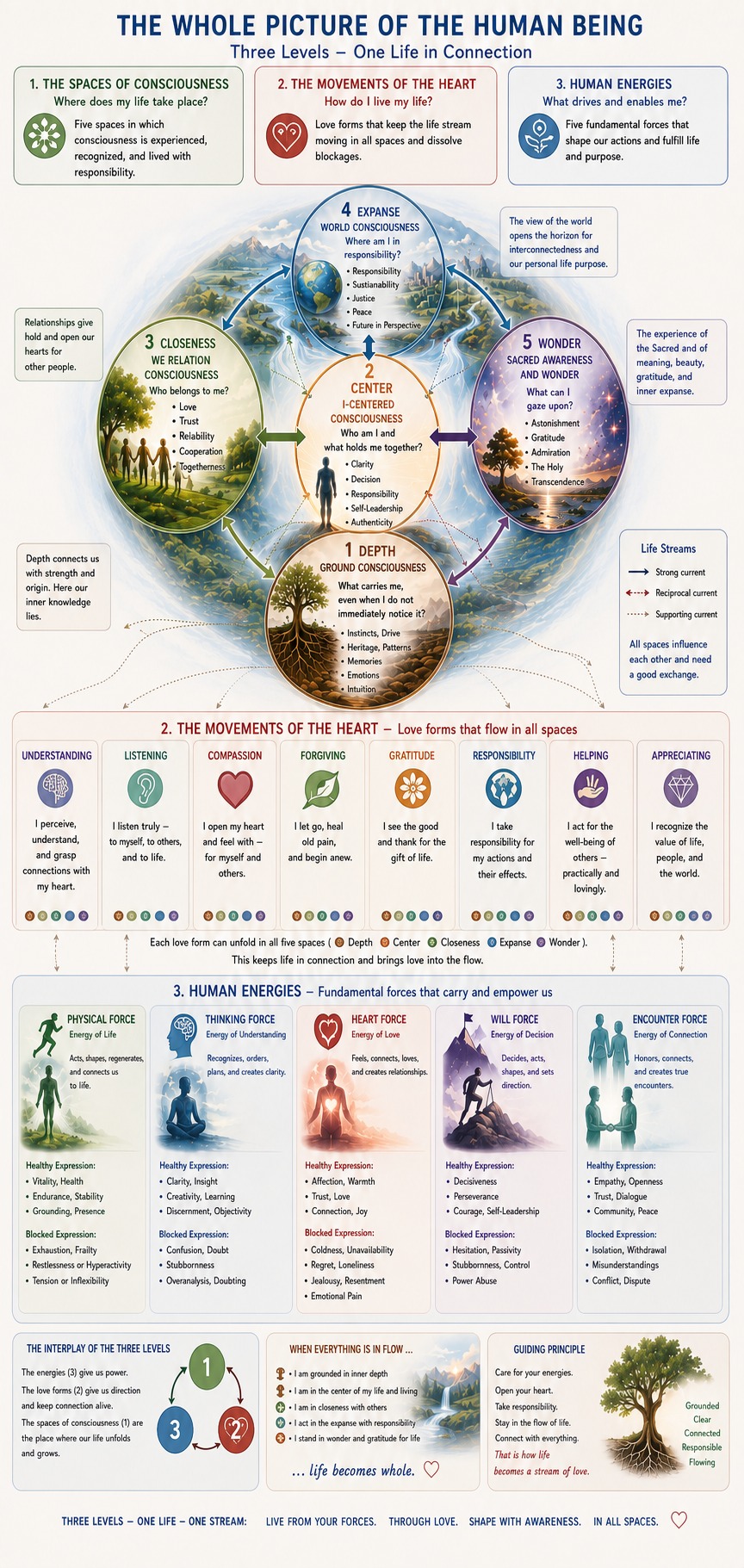
Translation note: Nähe/Wir-Bewusstsein became the unidiomatic “WE RELATION CONSCIOUSNESS”. The Center question was changed from “what is happening right now?” to “what holds me together?”, and several healthy and blocked force expressions were freely condensed or replaced.
Five Spaces, Present at the Same Time
The five spaces of consciousness are not stages that replace one another. Depth, center, closeness, breadth, and wonder remain simultaneously present and influence each other. Conscious living means noticing them, caring for them, and bringing them into a workable balance.
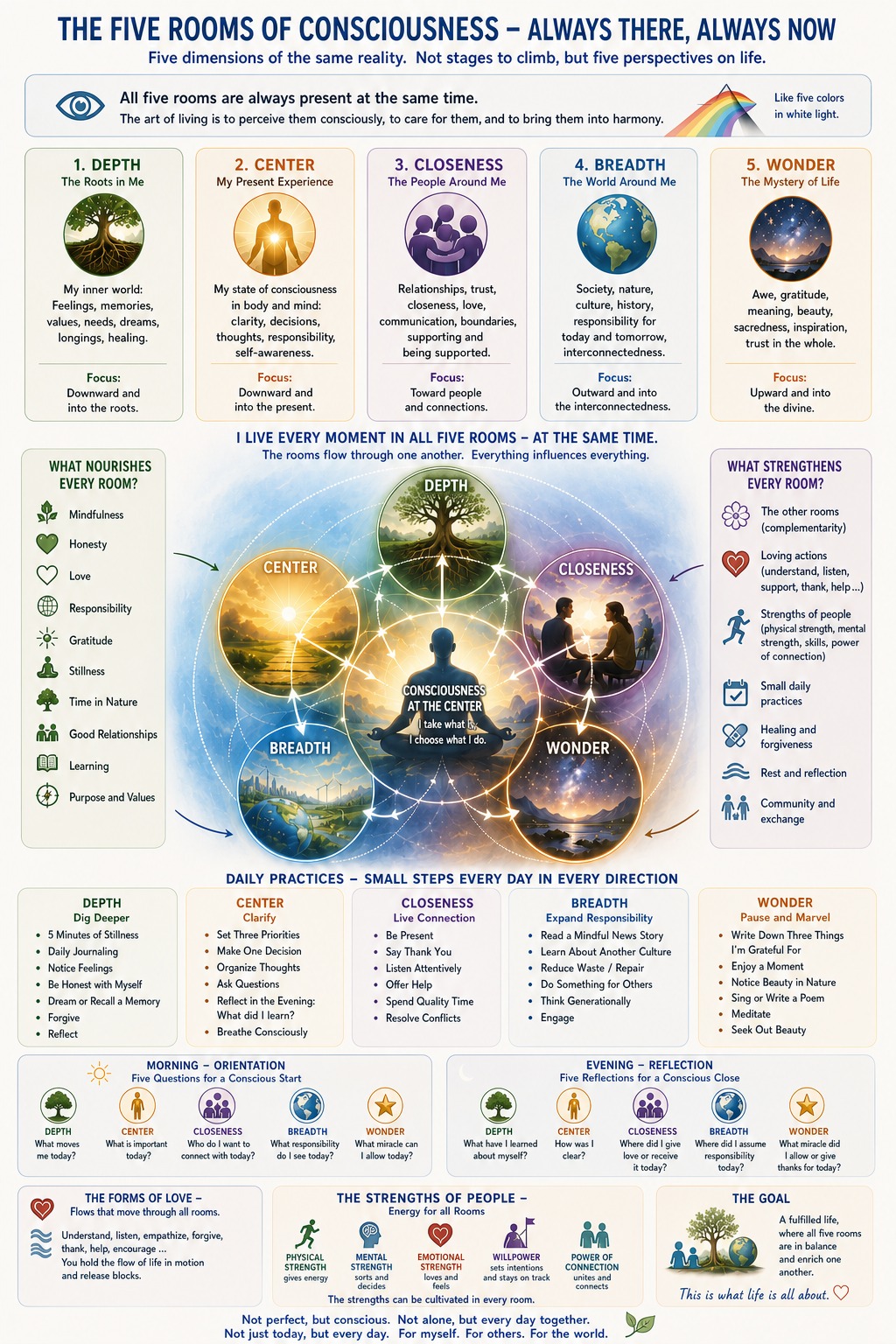
Translation note: The overall meaning is retained well. In the top-right comparison, “Wie fünf Farben ein weißes Licht” became the awkward “Like five colors in white light.” Several detailed lists were shortened or freely rephrased; the bottom closing line changed “many for one another” into “for the world.”
Living the Five Spaces Every Day
Small daily practices make the spaces tangible: stillness and honesty nourish depth, conscious decisions strengthen the center, attentive relationships foster closeness, responsibility widens breadth, and gratitude opens wonder. The morning and evening questions invite brief reflection without demanding perfection.
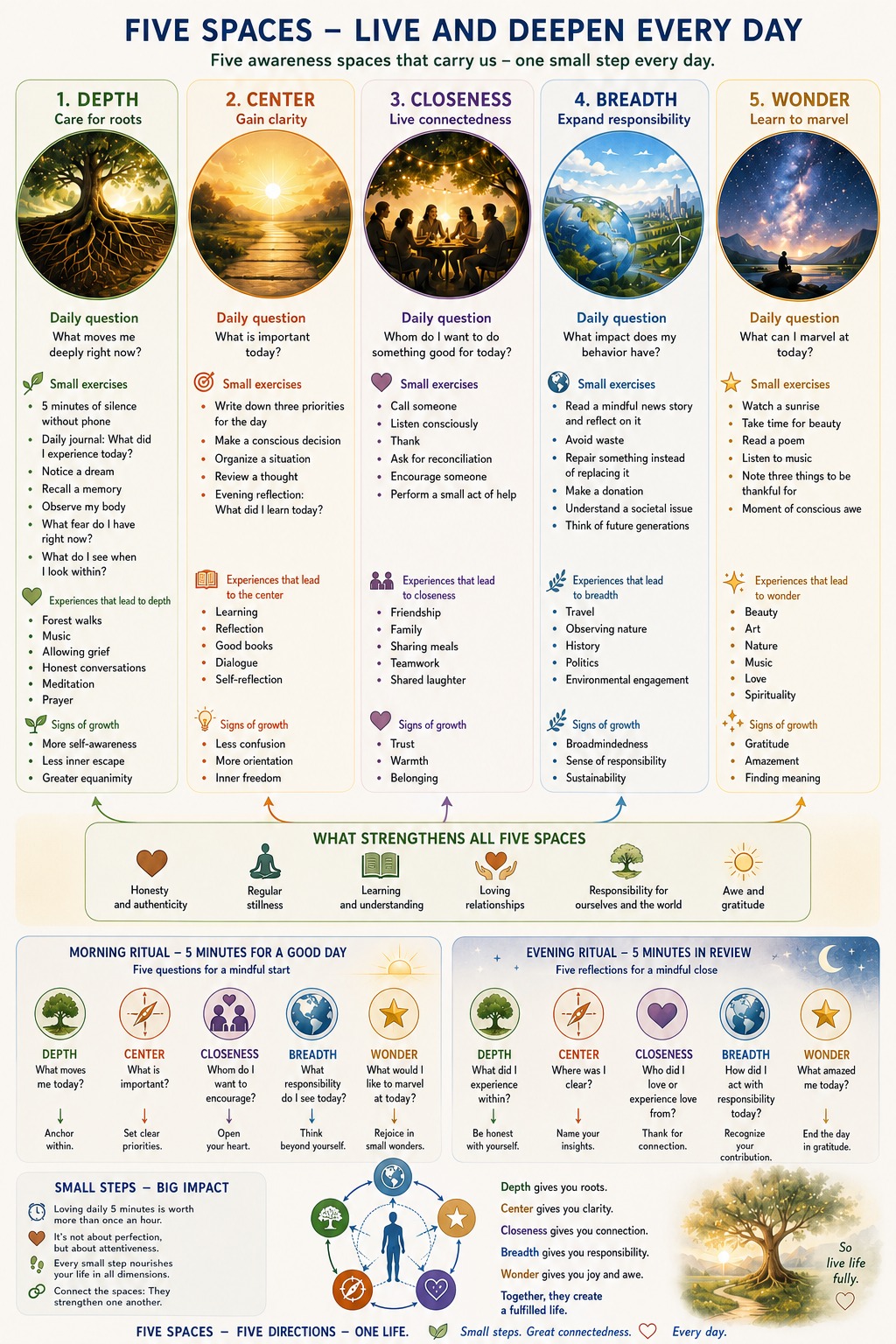
Translation note: The central concepts are understandable and consistent. “Nähe” is rendered as “Closeness,” while the title uses “Spaces” instead of “Rooms.” A few prompts are paraphrased, and “größere Gelassenheit” became “greater equanimity,” which is accurate but more formal than the surrounding language.
Integration and Participation
Integration gives a person belonging, support, recognition, and meaning within places and communities. Participation adds movement: shaping life, accepting responsibility, contributing, and having an effect. The diagram links body, mind, self, encounter, and community to spaces and processes.
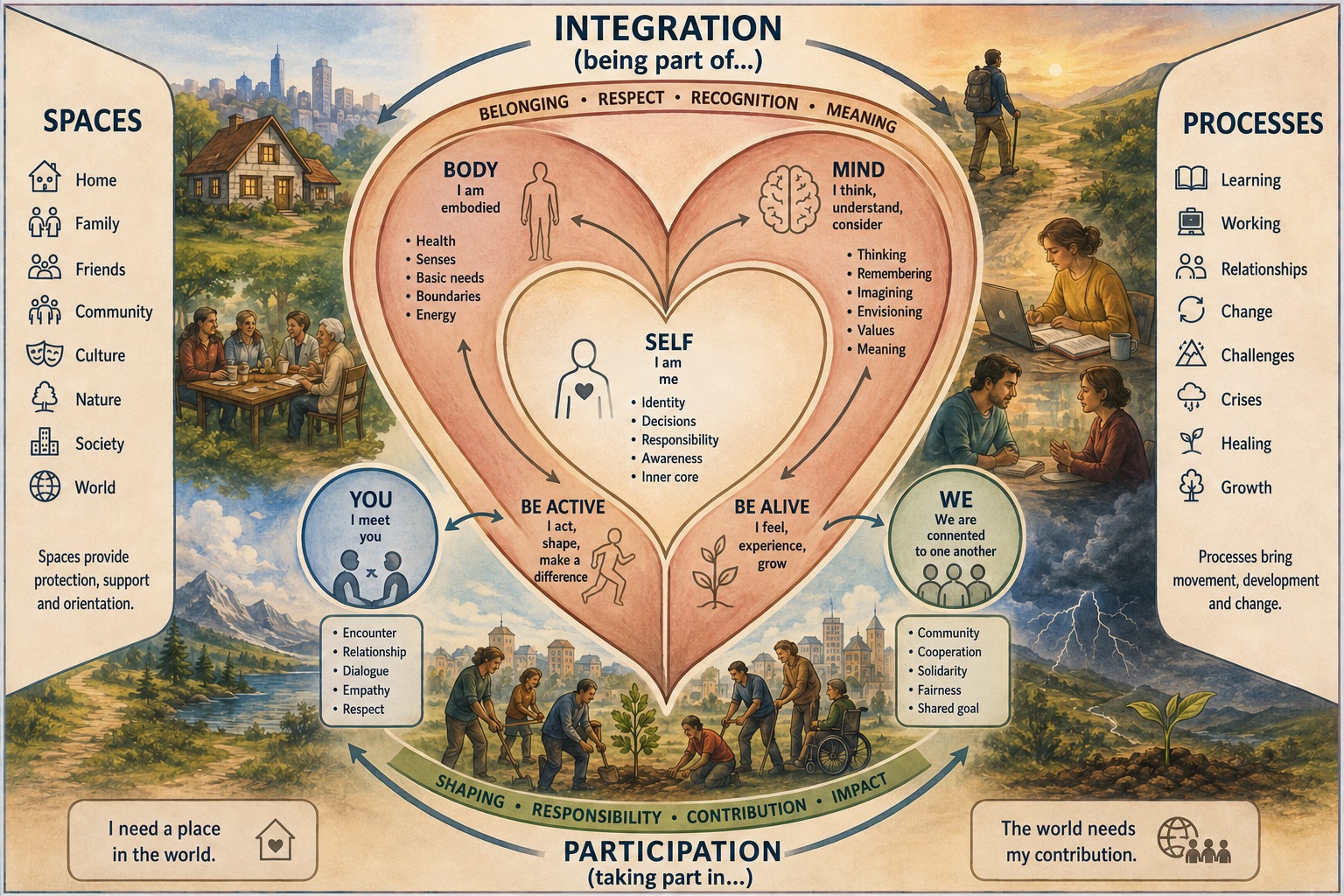
Translation note: The upper sequence “Zugehörigkeit – Halt – Anerkennung – Sinn” became “Belonging – Respect – Recognition – Meaning.” Here “Halt” means support or stability, so “Respect” is a semantic error. “Geist” is translated as “Mind,” which is reasonable but narrower than the German term.