
Social Order, Boundaries, and Living Spaces
This page explores principles, boundaries, knowledge, institutions, and recurring social processes. The images are translated from the German source page KI/Ordnung. Each translation note records visible weaknesses rather than hiding them.
Ten Pillars of a Humane Society
Human dignity stands at the center of ten connected principles: work, the common destination of goods, solidarity, subsidiarity, care for creation, peace, responsibility, the common good, truth, and justice.
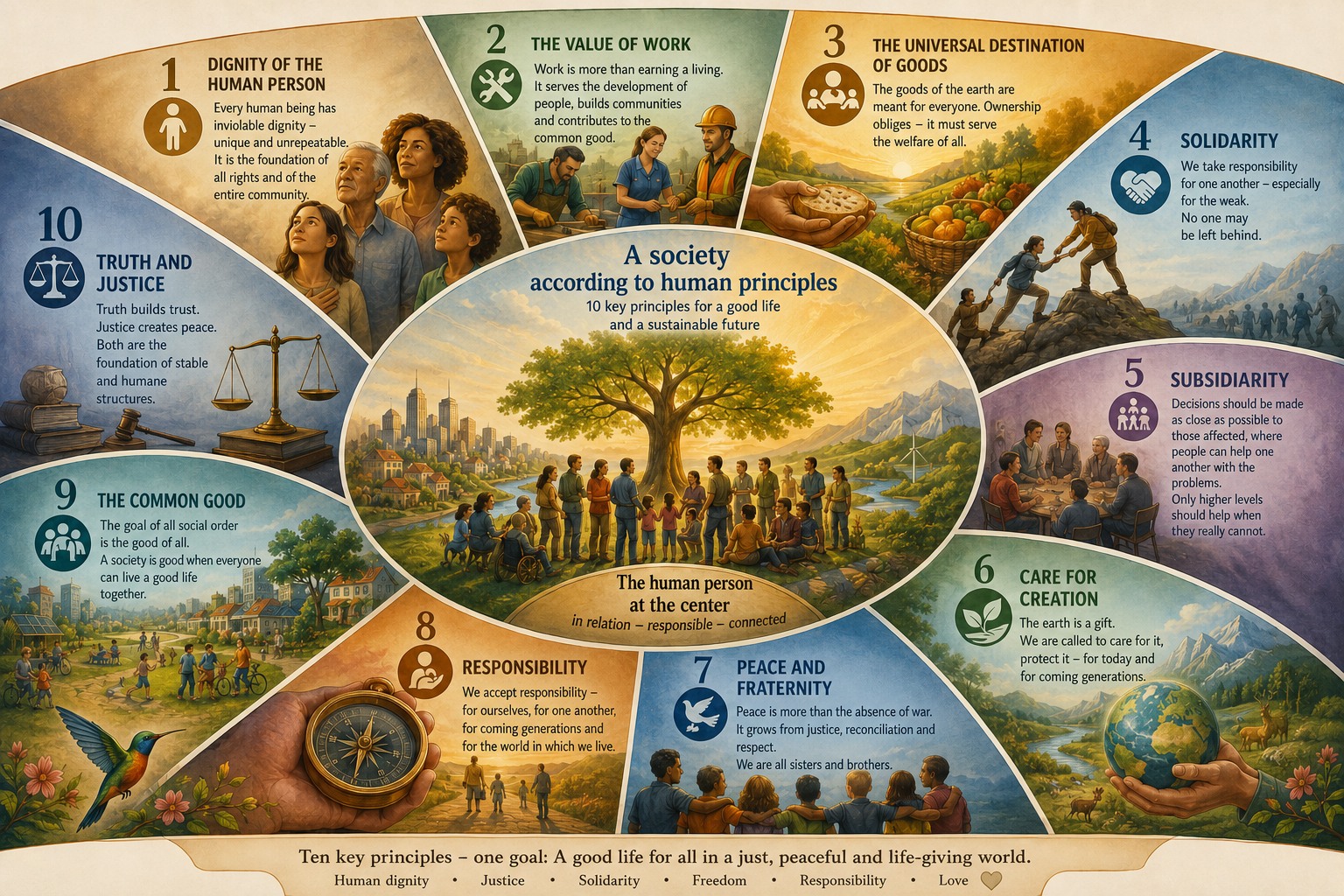
Translation note: The rendering is unusually complete. “Universal destination of goods” is a technical social-ethical term and may require explanation. The wording and selection of ten principles express a particular normative framework; they are not a universal consensus.
Cultural, Social, and Legal Boundaries
The diagram distinguishes cultural, social, economic, legal, digital, and personal boundaries. It connects freedom with respect, responsibility, protection, and mature judgment.
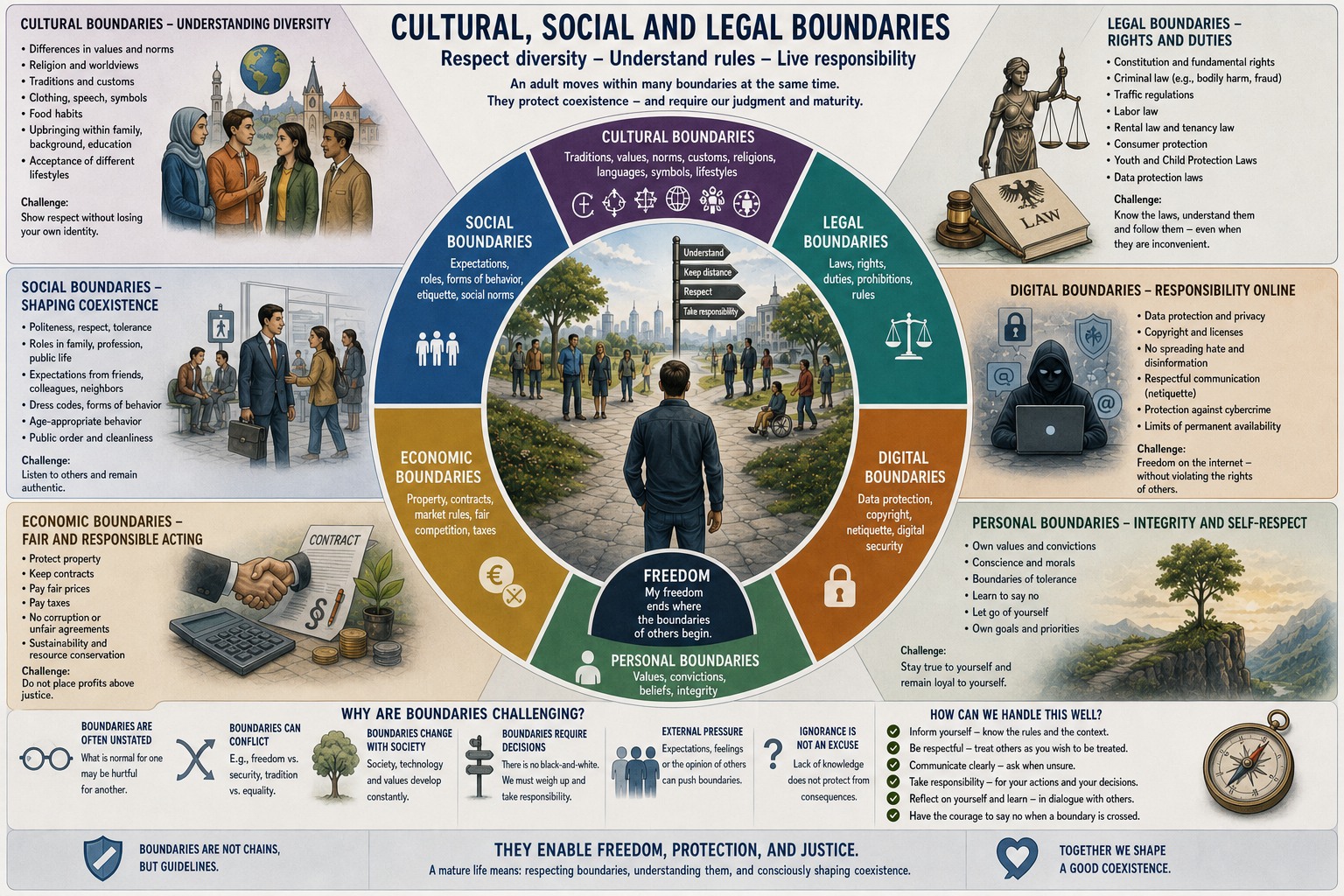
Translation note: The digital panel contains the misspelling “netiquettee.” The legal examples and Federal Eagle/Basic Law imagery reflect a German context and must not be read as legal advice for other jurisdictions. Some boundary categories overlap and can conflict in practice.
Preserving and Connecting Knowledge
A divided landscape contrasts overload, forgetting, obsolete files, and lost languages with archives, access, intergenerational learning, living traditions, and shared knowledge.
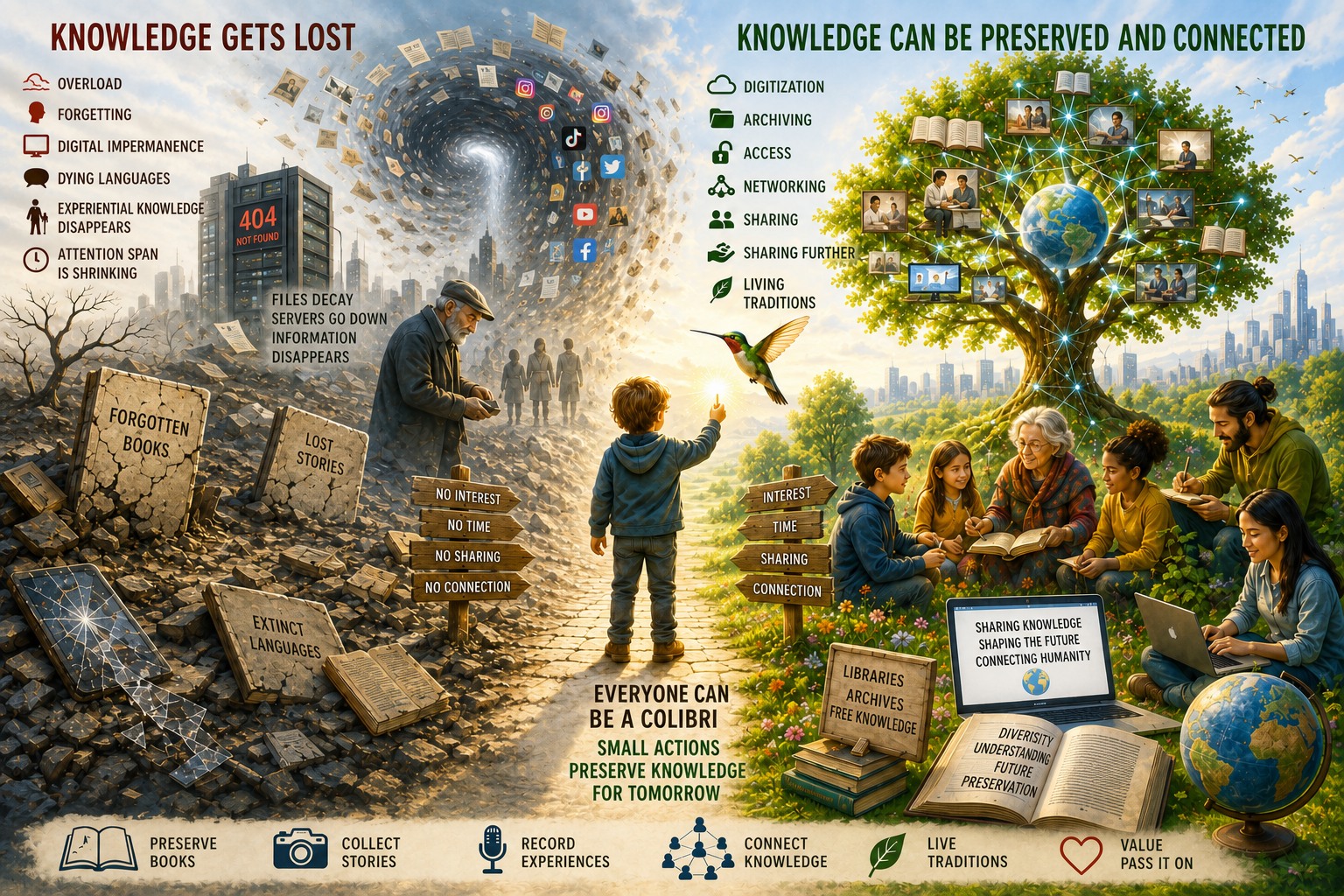
Translation note: “Everyone can be a COLIBRI” retains an incorrect spelling; the project name is Kolibri, while the ordinary English word is hummingbird. “Sharing further” is unnatural English and means passing knowledge on. The image also idealizes digitization: digital preservation itself requires maintenance, context, rights, and resilient storage.
The Six Spaces of a Thriving Society
Warmth, truth, development, order, conflict, and clarification spaces surround a center of encounter. Each space contributes a function and also carries risks when weak or dominant.
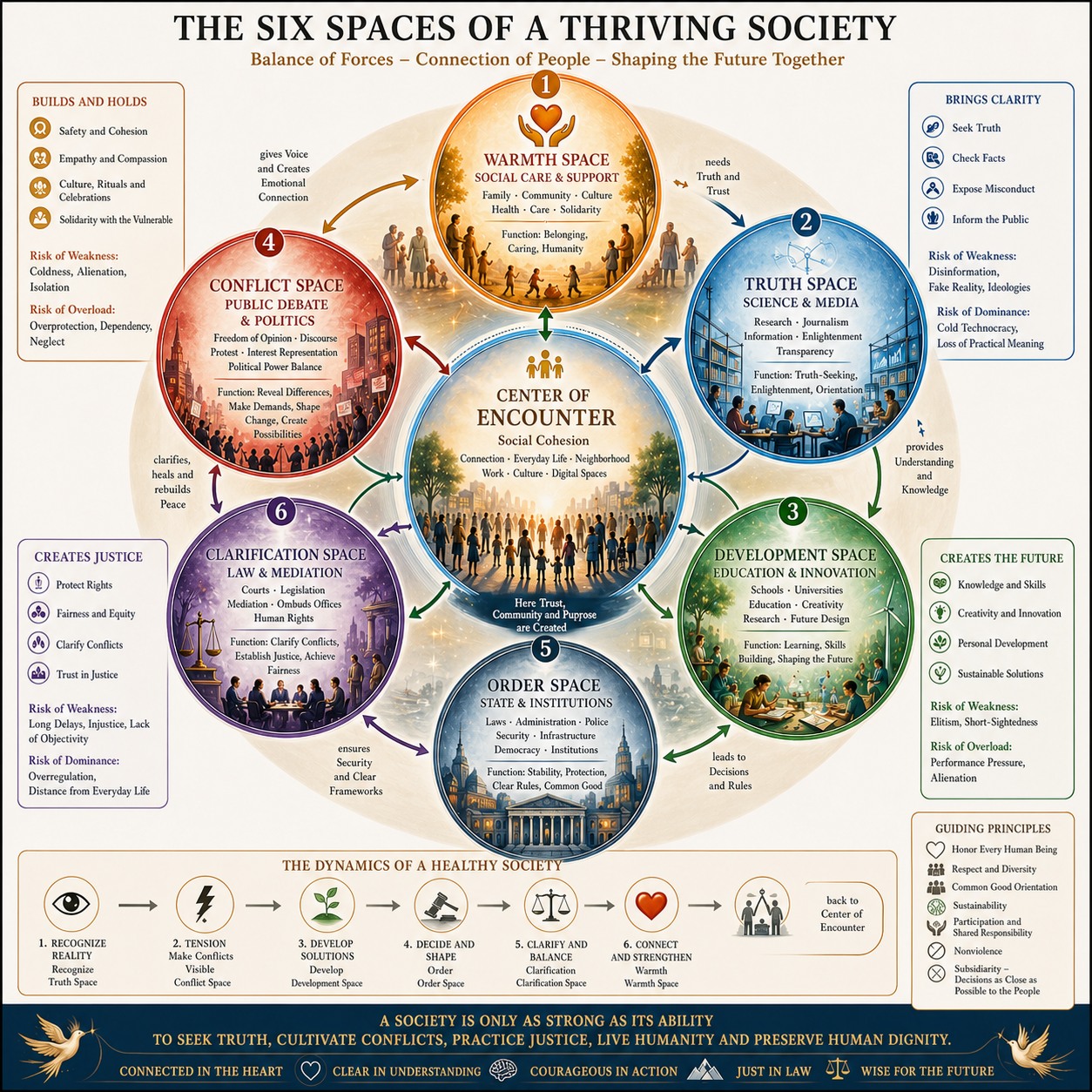
Translation note: Terminology is consistent and most small text is readable. “Cultivate conflicts” in the footer can sound like creating conflict; the intended meaning is to engage with conflict constructively. The six-space system is an interpretive social model, not an established scientific taxonomy.
A Dynamic Map of Society
The second six-space image emphasizes overlaps, transitions, cycles of change, warning signs, practical tools, and attitudes that can support a living society.
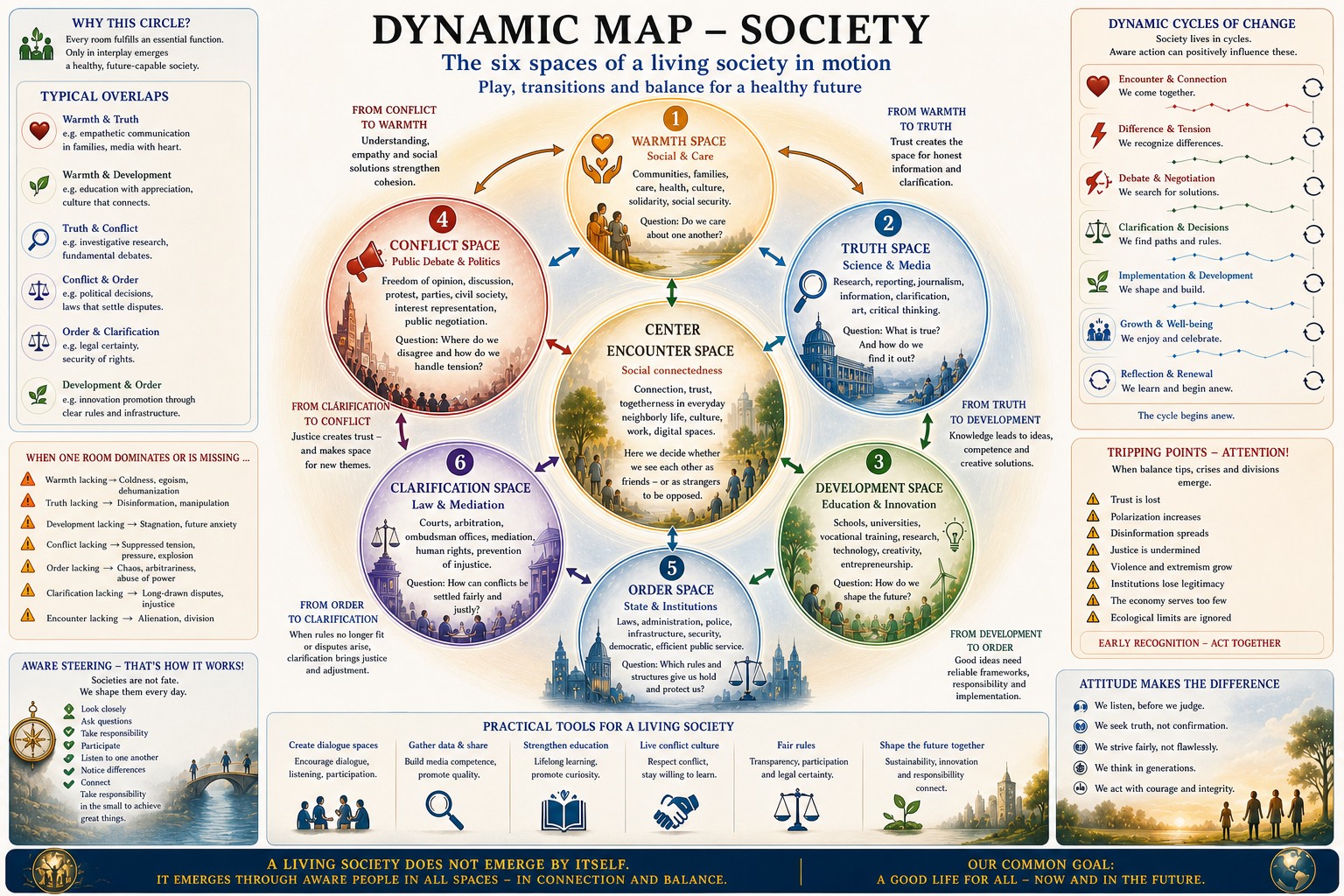
Translation note: The subtitle mistranslates “Zusammenspiel” as “Play”; “interplay” would be accurate. Several formulations are streamlined, and the warning lists can suggest simple causal relationships where real social developments are complex. The model should be used as a prompt for dialogue, not as a diagnostic instrument.
Money as a System of Provision and Exchange
Money is shown as a flow among family, care, knowledge, development, institutions, law, public debate, and society. The model asks whom each cash flow serves and whether it supports life, dignity, fairness, and the future.
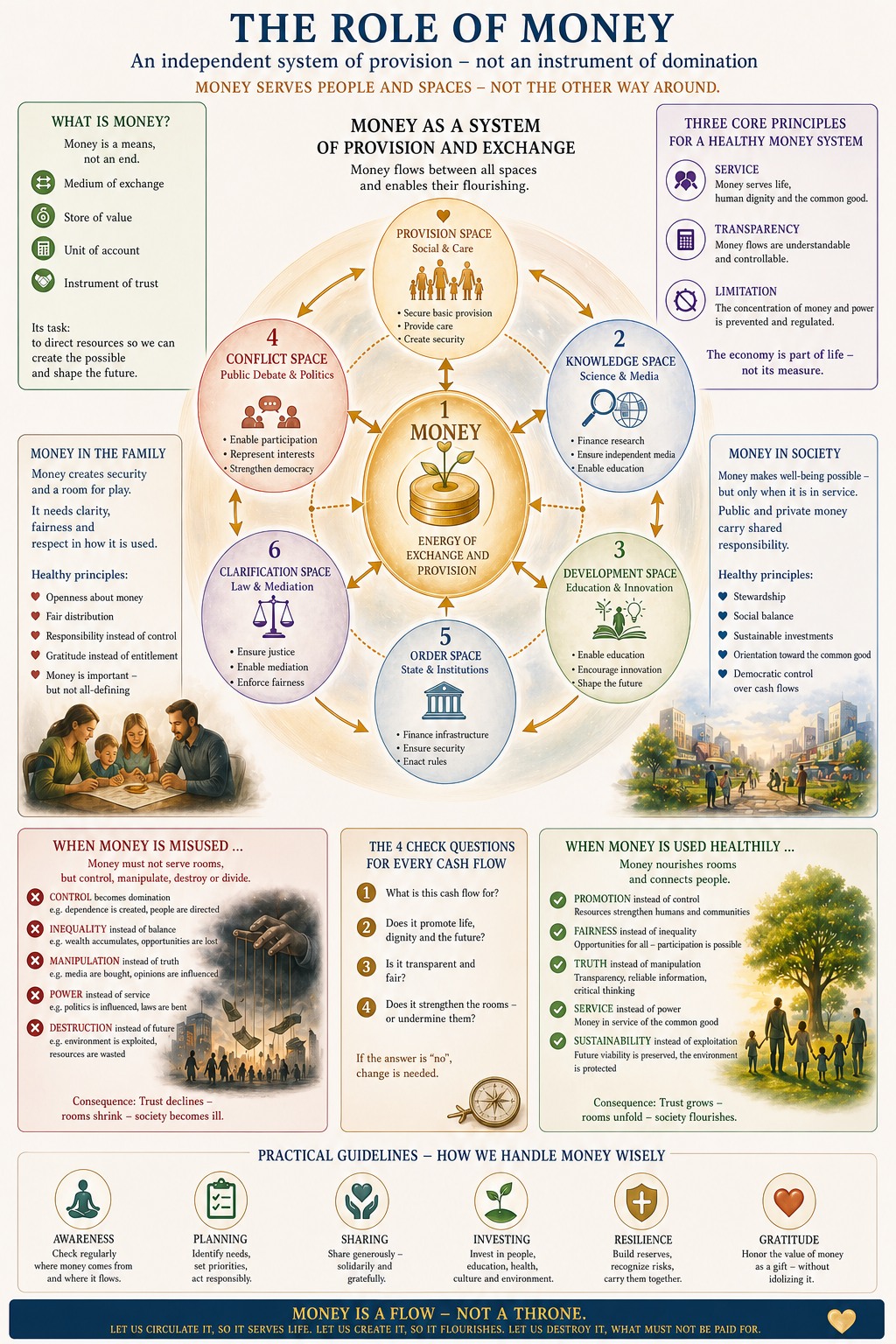
Translation note: Two of the six spaces were renamed incorrectly: German “Wärmeraum” became “Provision Space,” and “Wahrheitsraum” became “Knowledge Space.” The final sentence is grammatically and semantically damaged; the intended German meaning is that when money rules, it destroys what it is meant to support. The economic model is normative rather than a complete account of monetary systems.
From Lived Love to Rights
Personal forms of love connect with five guiding principles and with organized protections: human rights, laws, institutions, procedures, and enforcement. The image argues that voluntary care and binding rights need one another.
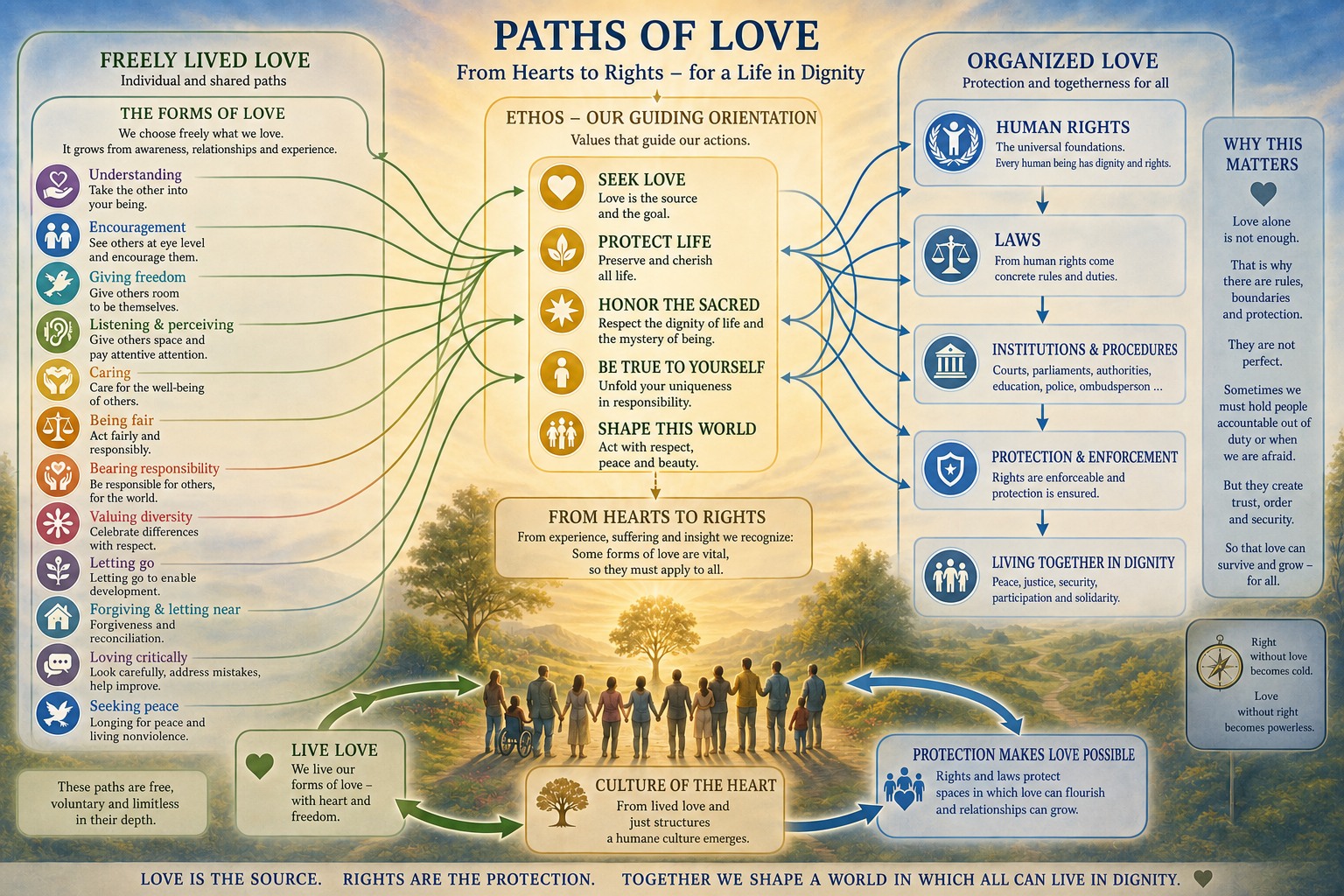
Translation note: “Wachsen lassen” means allowing growth, not “Letting go.” “Verweilen & Nähe schenken” was changed to “Forgiving & letting near,” which adds forgiveness and loses the sense of staying present and offering closeness. “Take the other into your being” is also an awkward rendering of accepting the other in their way of being.
Boundary Violations and German Legal Protection
The poster summarizes selected constitutional protections, offences, aggravating circumstances, protected social spheres, and duties of care toward children.
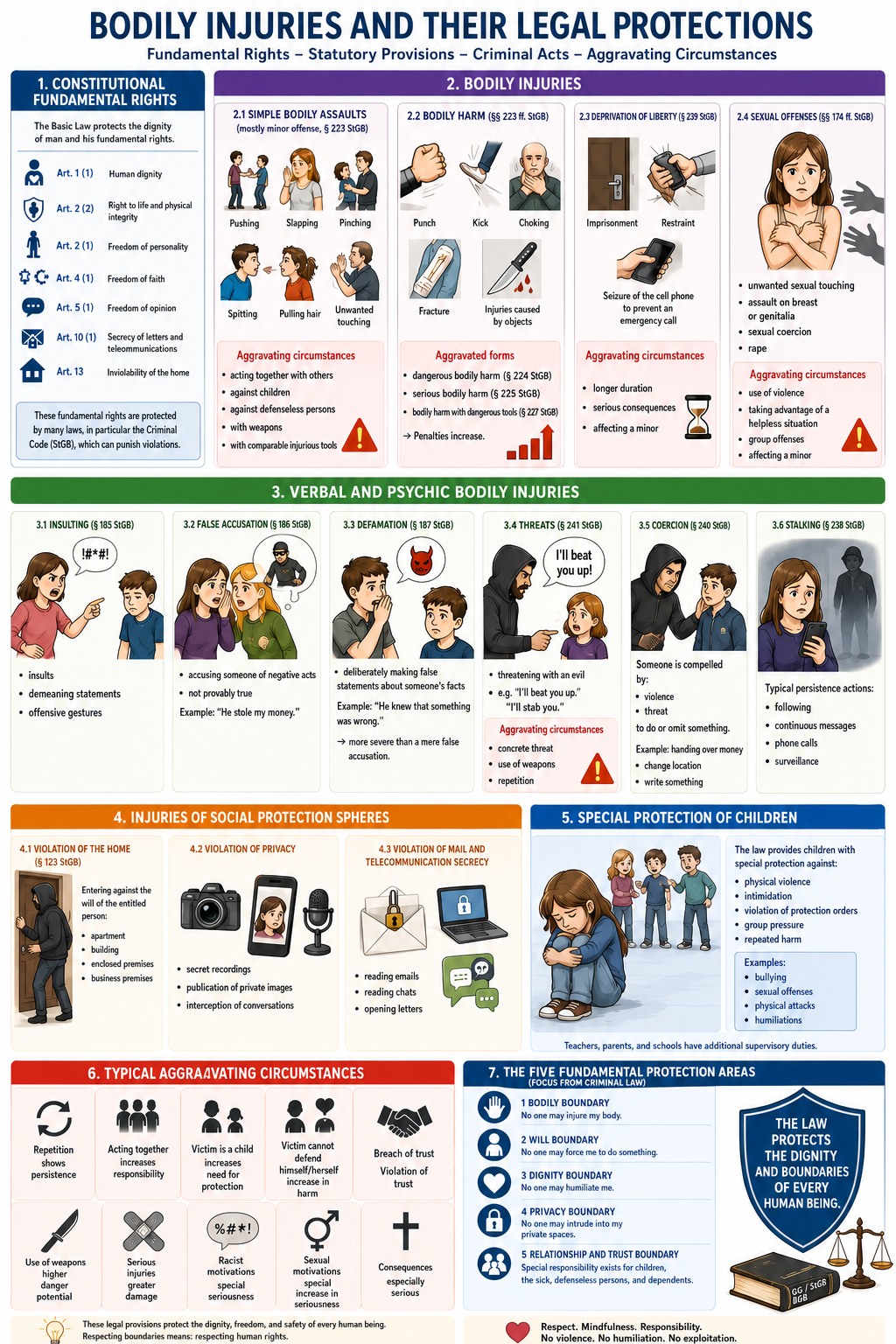
Translation note: This image is only a simplified German legal-awareness overview and is not legal advice. The English title narrows “boundary violations” to “bodily injuries,” while section 3 becomes the contradictory “verbal and psychic bodily injuries.” Article and section references, legal definitions, and penalties must be verified against current official German law before use.
The Diversity and Meaning of Boundaries
Physical, emotional, cognitive, volitional, and encounter-related boundaries are presented as structures that can protect identity, freedom, orientation, responsibility, and loving encounter.
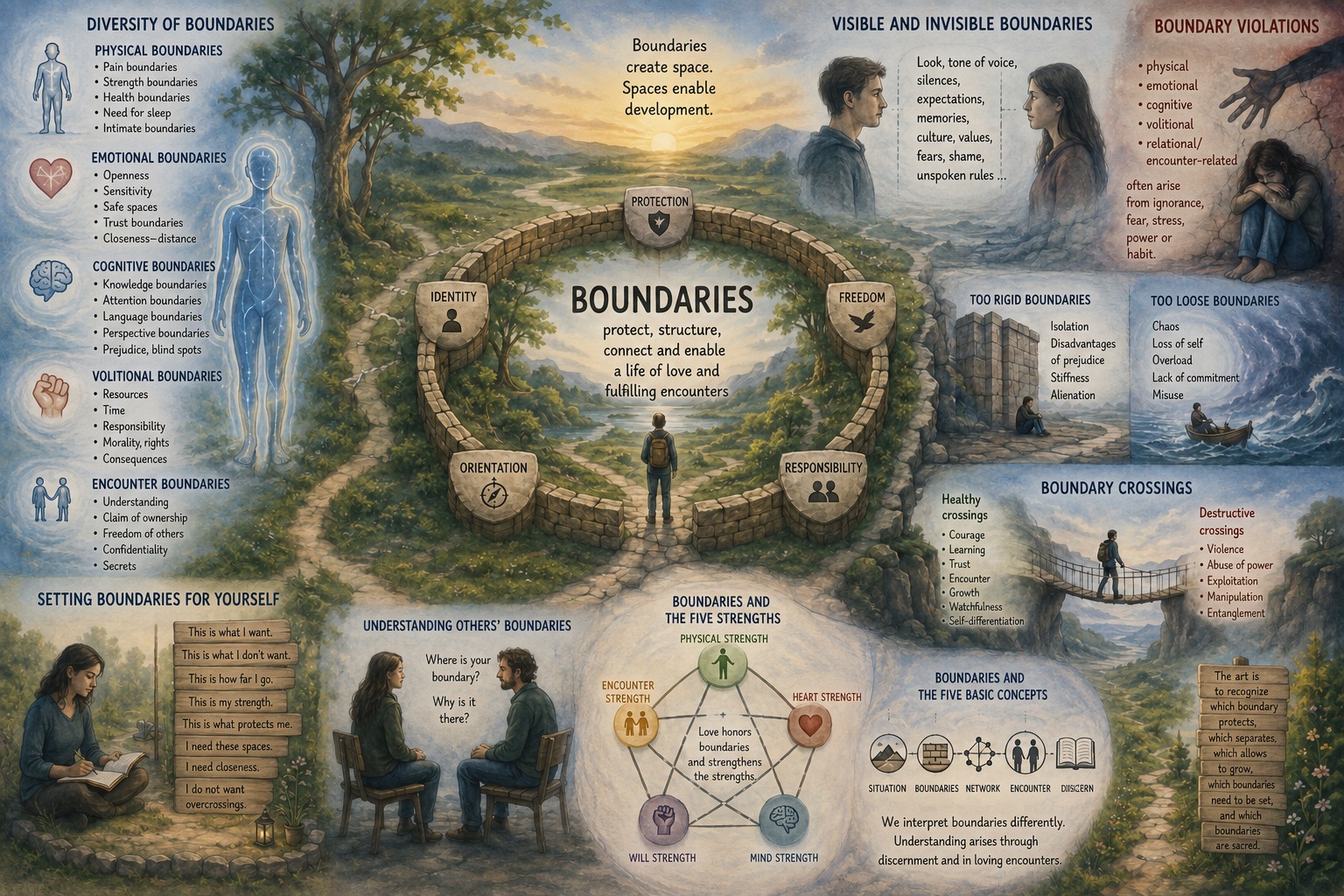
Translation note: “Begegnungshaft” has no established one-word English equivalent; “relational/encounter-related” is an explanatory choice. Some categories overlap, and “healthy” boundary crossing always depends on consent, context, power, and safety. The five-strength mapping is an interpretive project model.
Sosein — Recognizing What Something Is Like
The German philosophical term “Sosein” points toward careful perception of a being, thing, or situation: its qualities, possibilities, limits, needs, relationships, purposes, and remaining unknowns.
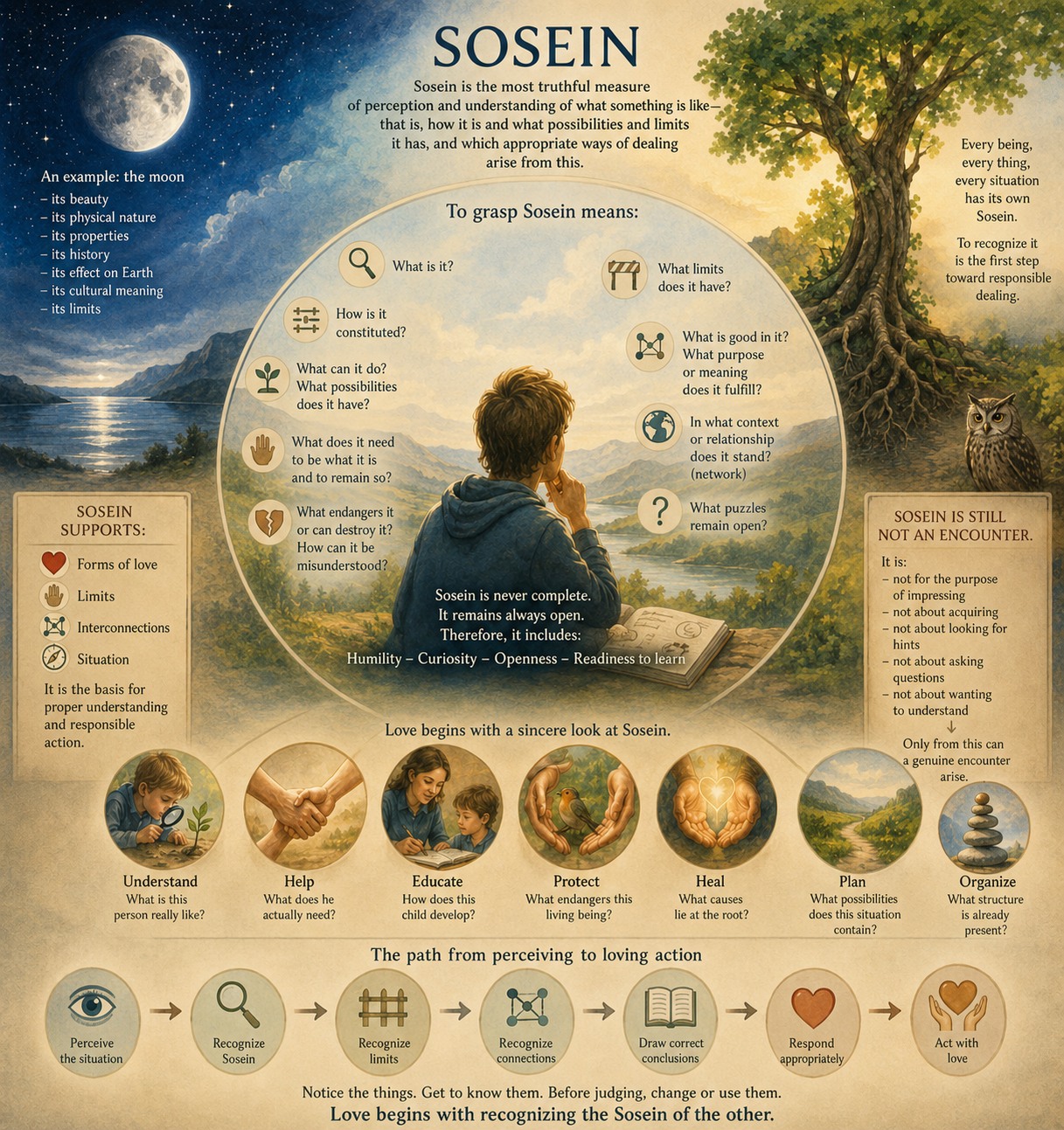
Translation note: A severe reversal appears in the right-hand panel. The German says Sosein involves taking interest, engaging, attending, looking, asking, and wanting to understand; the English wrongly negates all of these actions. The central definition is also stiff English. Read the rest as an invitation to humble inquiry, not as a fixed philosophical definition.
A General Model of a Good Society
The table connects societal functions, organizational spaces, six basic processes, forms of love, practical tools, and shared goals. Its central claim is that no force, room, or process stands alone.
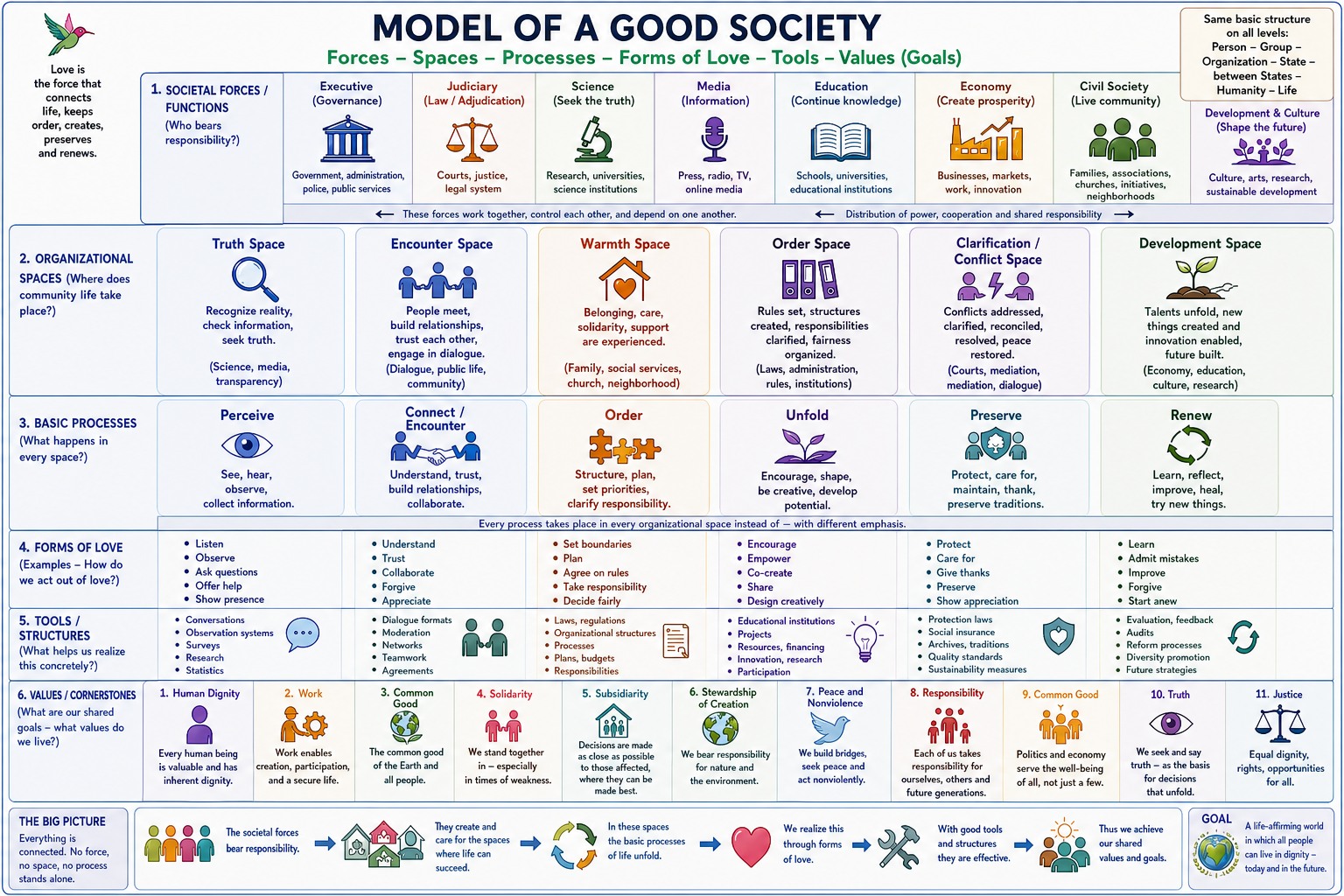
Translation note: Pillar 3, “Allgemeine Bestimmung der Güter,” was changed to “Common Good,” making it incorrectly duplicate pillar 9. A closer translation is “universal destination of goods.” “Peace and fraternity” was also changed to “Truth and Nonviolence” in the model. The source itself calls these ten pillars while displaying truth and justice separately as values 10 and 11.
Ten Pillars — Problems, Responses, and Questions
Each column pairs a principle with dangers, contemporary problems, constructive responses, and a guiding question. Truth and justice are presented as two aspects, 10A and 10B.
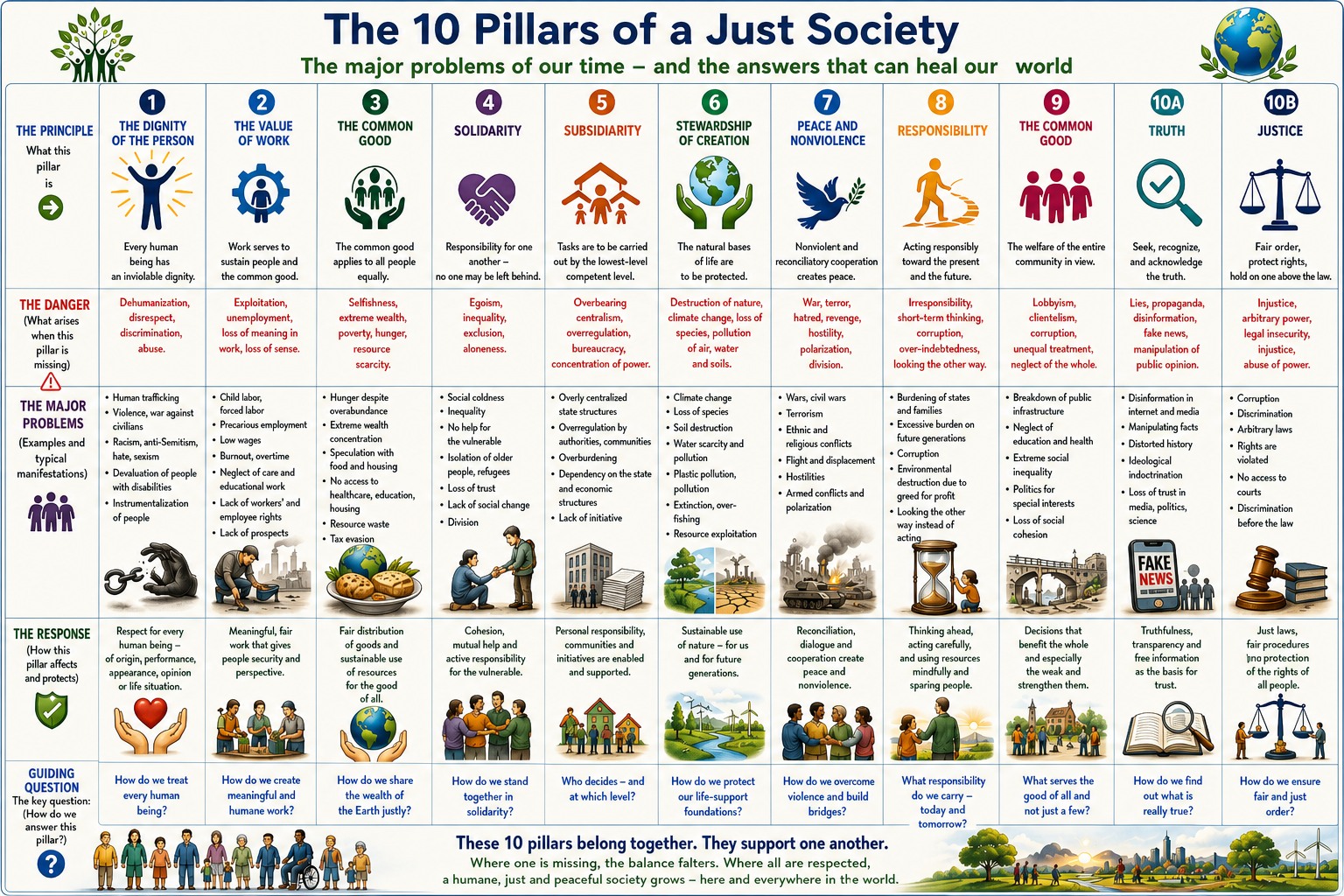
Translation note: Again, pillar 3 is wrongly rendered “The Common Good,” duplicating pillar 9 instead of translating the universal destination of goods. Pillar 7 loses “fraternity” and becomes “Peace and Nonviolence.” The problem lists are illustrative political judgments, not neutral measurements or exhaustive causal explanations.
Six Processes Across Three Levels of Action
Perceiving, connecting, ordering, unfolding, preserving, and renewing are compared across personal, group, and institutional action, with tools and indicators of success.
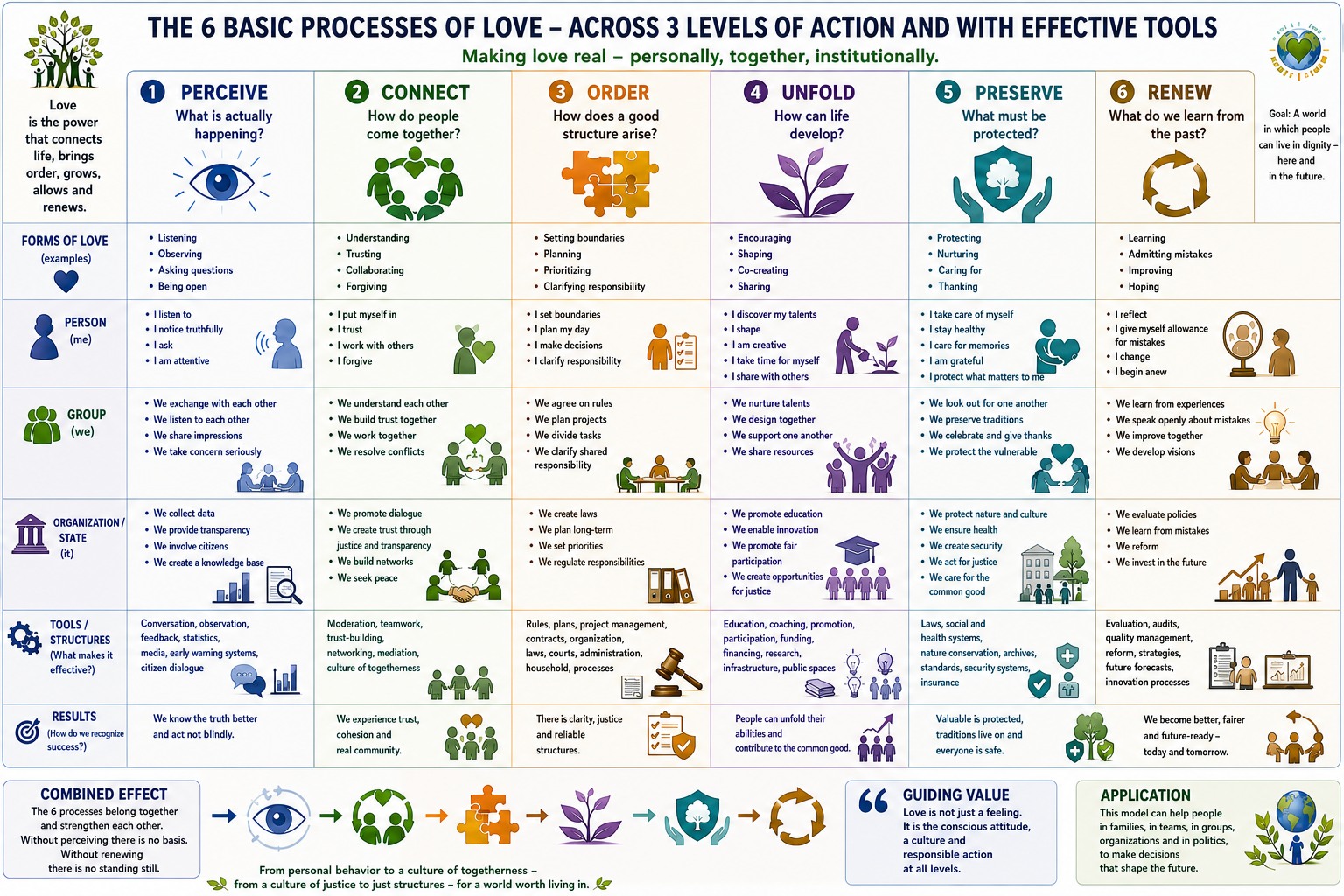
Translation note: This dense translation is nearly complete. “I give myself allowance for mistakes” is awkward English; “I admit my mistakes” or “I allow myself to make mistakes” would be clearer. The neat matrix can obscure overlap, conflict, and unequal power between personal, communal, and institutional levels.
This page now includes all 13 images currently used on the German source page KI/Ordnung. Visible imperfections are retained as prompts for reflection, correction, and discussion.