
Practising Forms of Love: Simplifying
Simplifying is not emptiness or withdrawal. It creates room for what matters by clarifying, understanding, helping, protecting, listening, resting, sharing, and shaping. The images on this page explore simplifying as a concrete form of love supported by thinking, will, heart, encounter, and bodily action.
Making Room for What Matters
Expectations, comparisons, fear, stress, perfectionism, and the pressure to please everyone can obscure what is essential. Simplifying clears a path toward clarity, freedom, ease, and connectedness. It can serve people when it combines discernment and letting go with warmth, compassion, relationship, and practical changes in daily life.
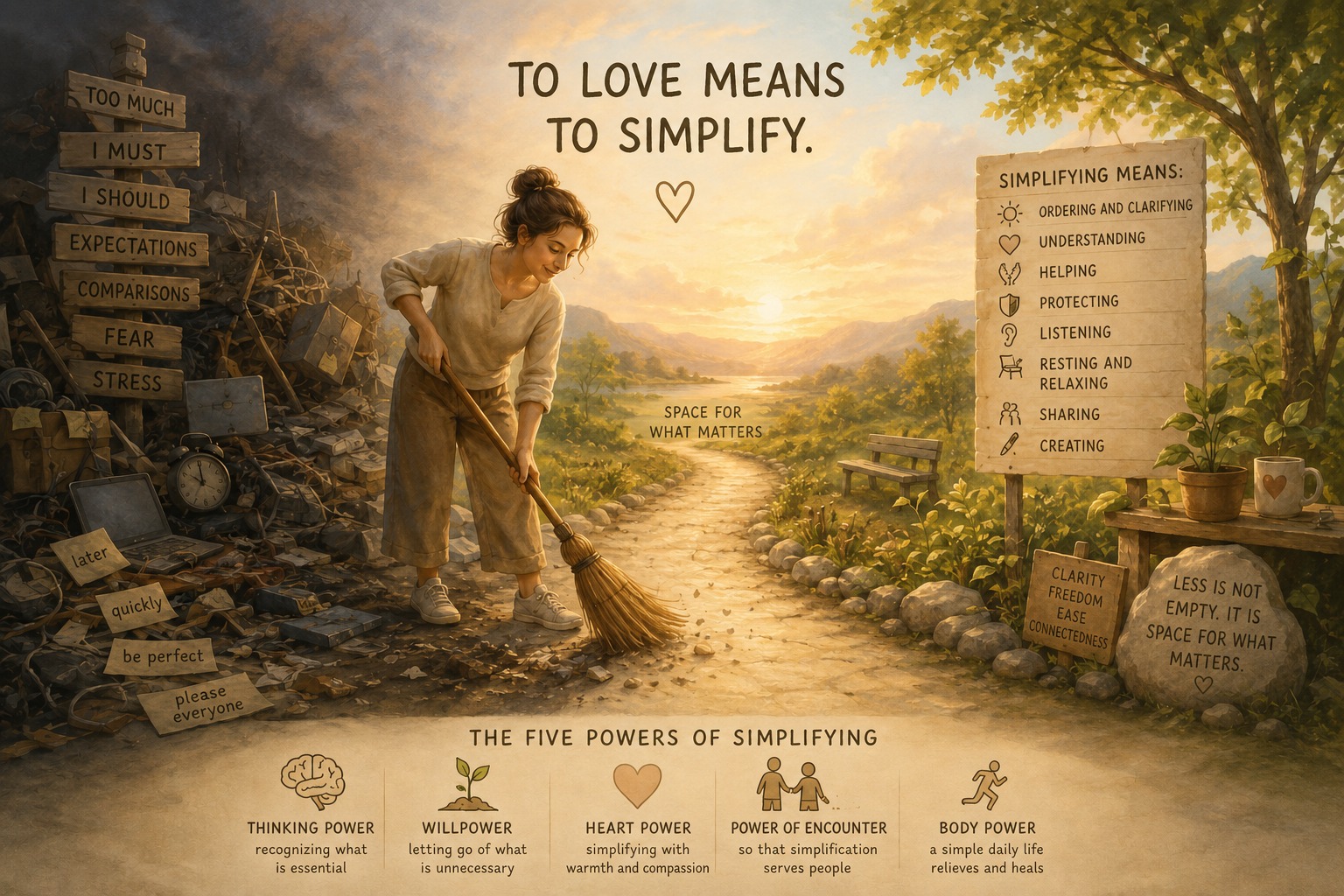
Translation note: The visual contrast between clutter and open space, the action list, and all five powers are translated very well. The loose note `allen gerecht werden` is rendered as `please everyone`, which is slightly stronger and more psychological than the source, but it remains close to the intended burden. No serious meaning error is visible.
From Excess to Clarity and Encounter
Possessions, information, technology, bureaucracy, communication, and unlimited choice can become a maze when quantity replaces depth. Simplifying does not reject these parts of life; it orders, clarifies, releases, pauses, and returns them to human encounter and presence. Less can then become more life rather than mere deprivation.

Translation note: This is a very strong and unusually complete translation. The seven overload fields, all six direction signs, and the contrast between possession and encounter are preserved. The final four contrasts—depth, encounter, understanding, and being—are accurate and clearly readable; no significant meaning error is visible.
Listening as a Quiet Form of Love
Listening joins bodily sensing, emotional awareness, thought, inner movement, and encounter. It needs time, calm, safety, trust, openness, and non-judgmental spaces. Active listening does not rush to answer; it reflects, understands, and can also make room for silence, grief, memory, unresolved experience, and the voice within oneself.
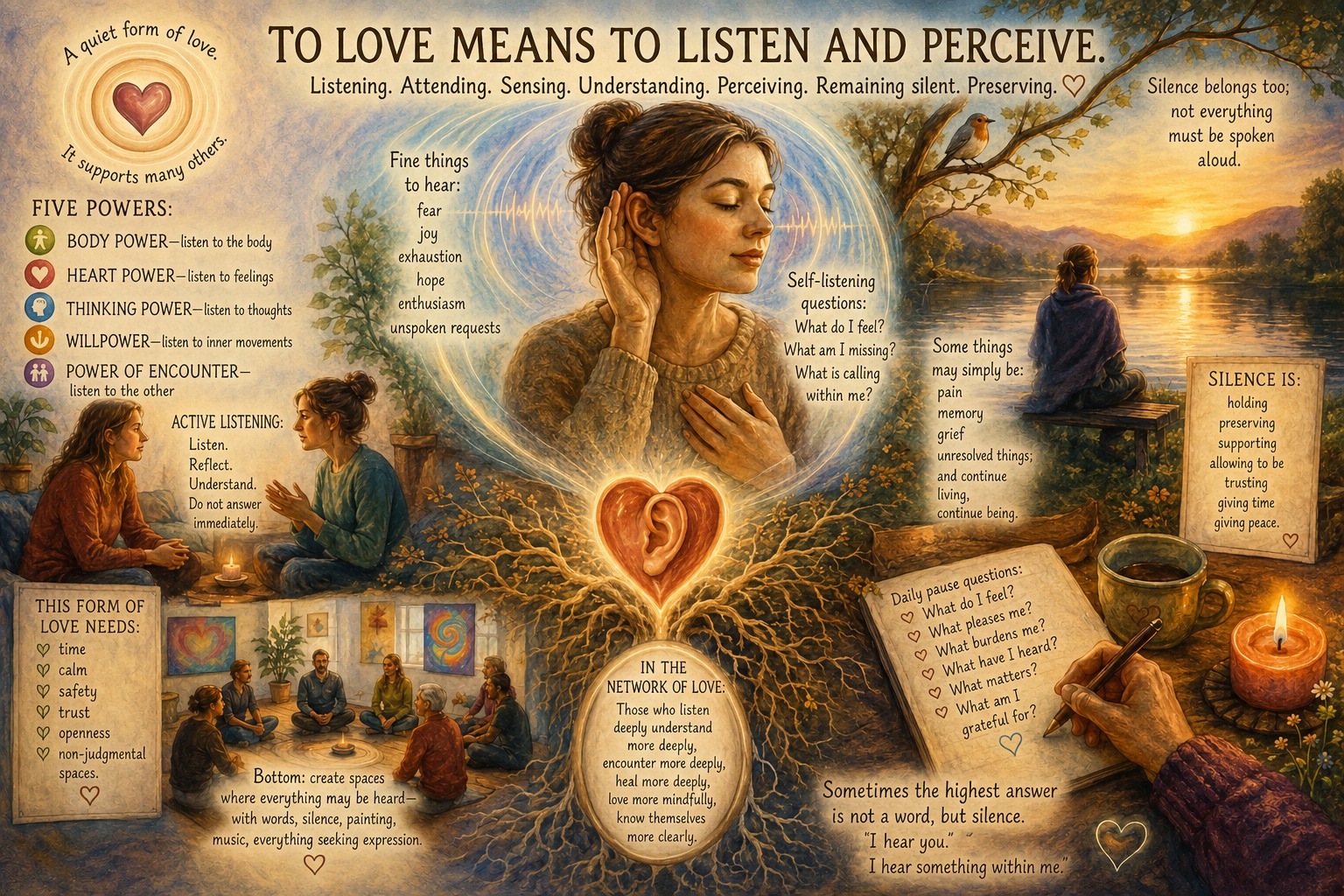
Translation note: Nearly all poetic text islands, questions, lists, and the five powers are translated with remarkable clarity. Before the paragraph about creating spaces, the generator inserted the unintended label `Bottom:`. This is a visible production artifact, but it does not alter the content that follows.
Loving Doubt Protects Truth
Doubt and criticism can serve love when they examine facts, respect limits, name discrepancies, clarify motives, and remain in dialogue. Good criticism addresses the matter without attacking the person. Doubt without love becomes destructive, while love without doubt can become blind to error, self-deception, fraud, and harm.

Translation note: This is a highly faithful translation. The warnings, questions, five powers, standards for good criticism, and final polarity are all preserved. `Love looks closely` is a natural rendering of `Liebe sieht hin`; no serious semantic or spelling error is visible.
Cooperation as Love in Motion
Working together combines practical, intellectual, emotional, creative, spiritual, and healing forms. It is connected with understanding, planning, clarifying, helping, appreciating, admitting mistakes, responsibility, stepping back, celebrating, and encounter. Mature cooperation creates more than individuals could create alone while remaining alert to overload, power imbalance, groupthink, conflict, and loss of individuality.
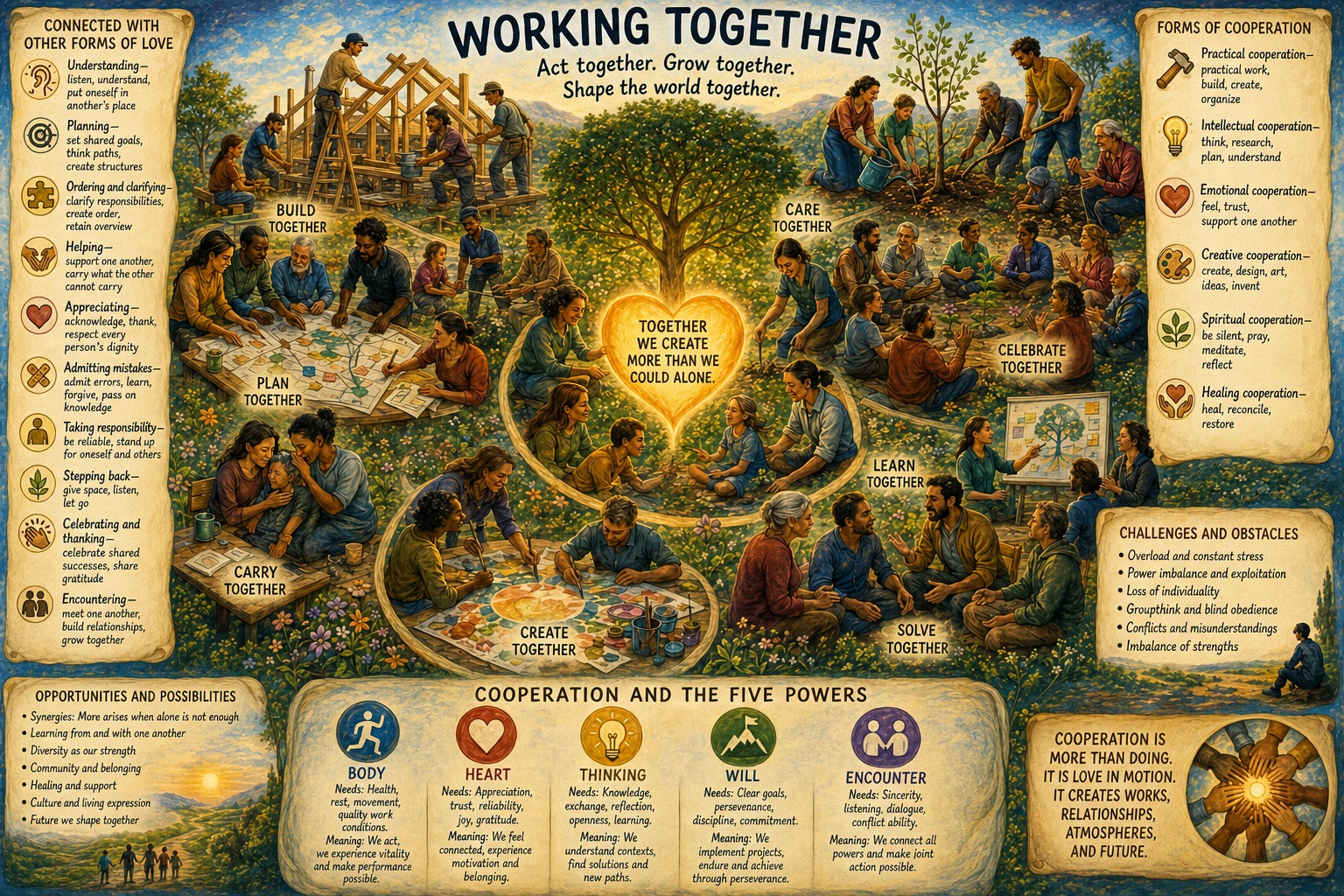
Translation note: The dense image is translated very well, including all cooperation forms, scene labels, challenges, and five powers. The opportunities line about synergy becomes the awkward `More arises when alone is not enough` instead of `More emerges than would be possible alone`. The meaning is inferable, but the sentence is not idiomatic English.
Planning with Wisdom, Flexibility, and Trust
Loving planning develops a shared vision from values, goals, resources, responsibility, and awareness of risk. The five powers contribute practical feasibility, motivation, knowledge, determination, and dialogue. Because the future cannot be known perfectly, a loving plan includes review, adaptation, pauses, gratitude, and celebration.
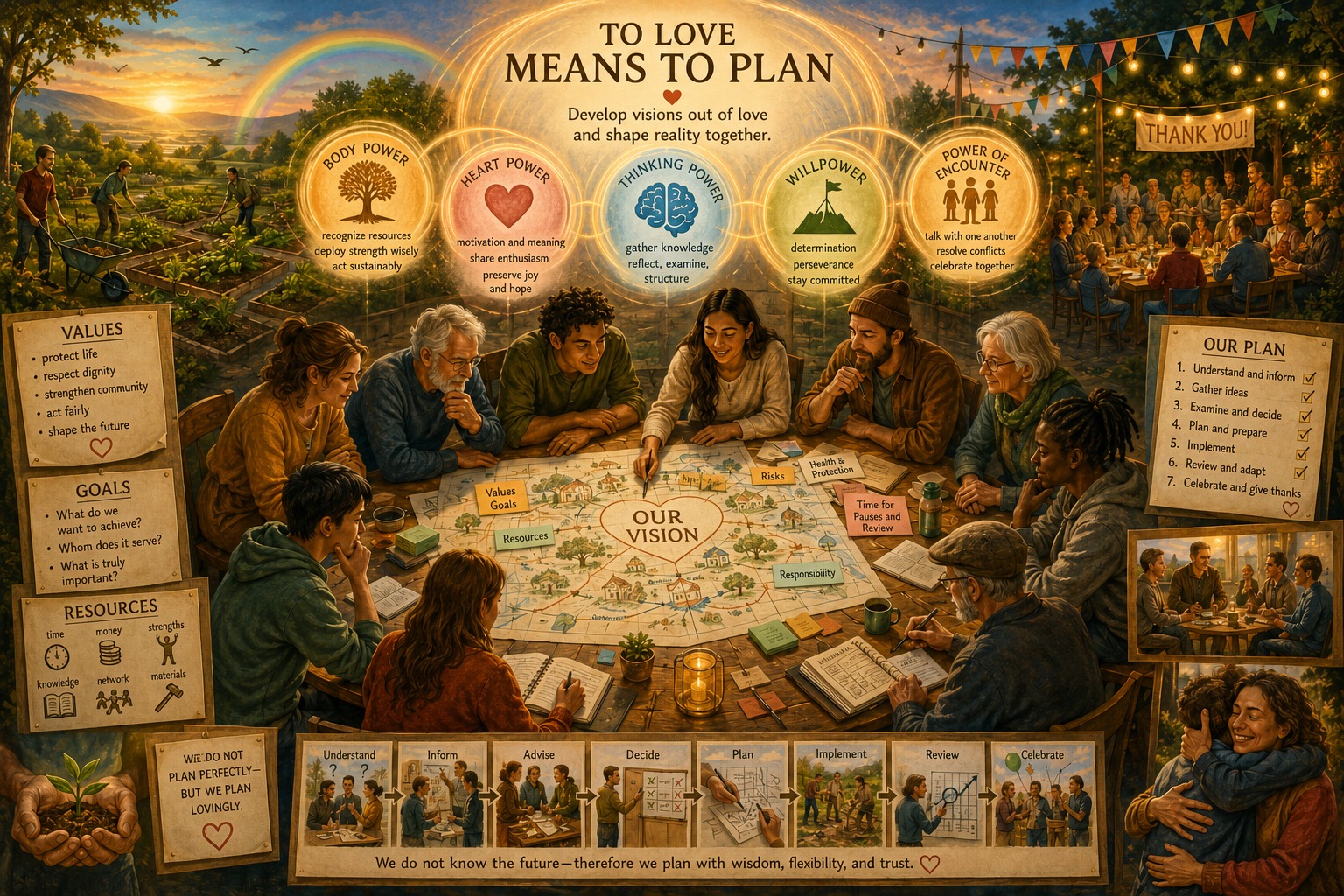
Translation note: The five powers, planning checklist, resource map, and core message are translated very clearly. In the lower process strip, `Einordnen` (put into context/classify) becomes the broader `Inform`. This weakens one intermediate step but does not change the overall planning sequence.
Ordering and Clarifying with Love
Order can create space for life when it serves the right values. It links understanding, help, protection, unfolding, rest, and encounter rather than imposing control for its own sake. Loving clarification also listens, asks, reconciles, releases what is no longer needed, and makes complex inner and outer relationships more understandable.
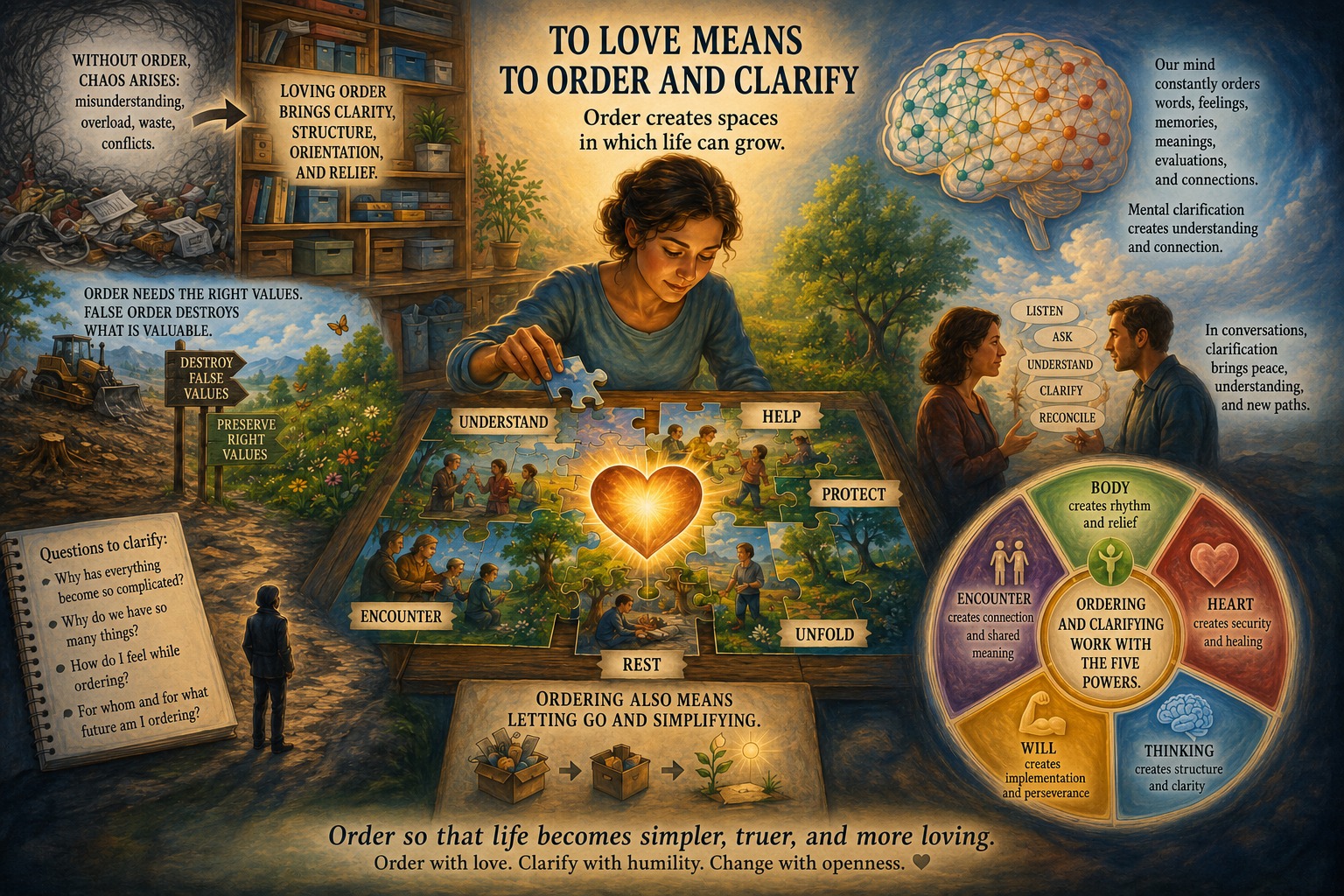
Translation note: The full composition, questions, brain text, dialogue sequence, puzzle, and five-power wheel are translated with high fidelity. Technical choices such as `mental clarification` and `implementation` are slightly formal but accurate. No significant meaning or spelling error is visible.
Lingering Deepens Experience
Lingering means staying long enough to look, listen, sense, and become aware. A brief glance can grow into wonder, a thought into understanding, an encounter into intimacy, joy into gratitude, a feeling into self-knowledge, and a moment into a glimpse of eternity. Open lingering may gradually become stillness, recollection, absorption, and meditation.
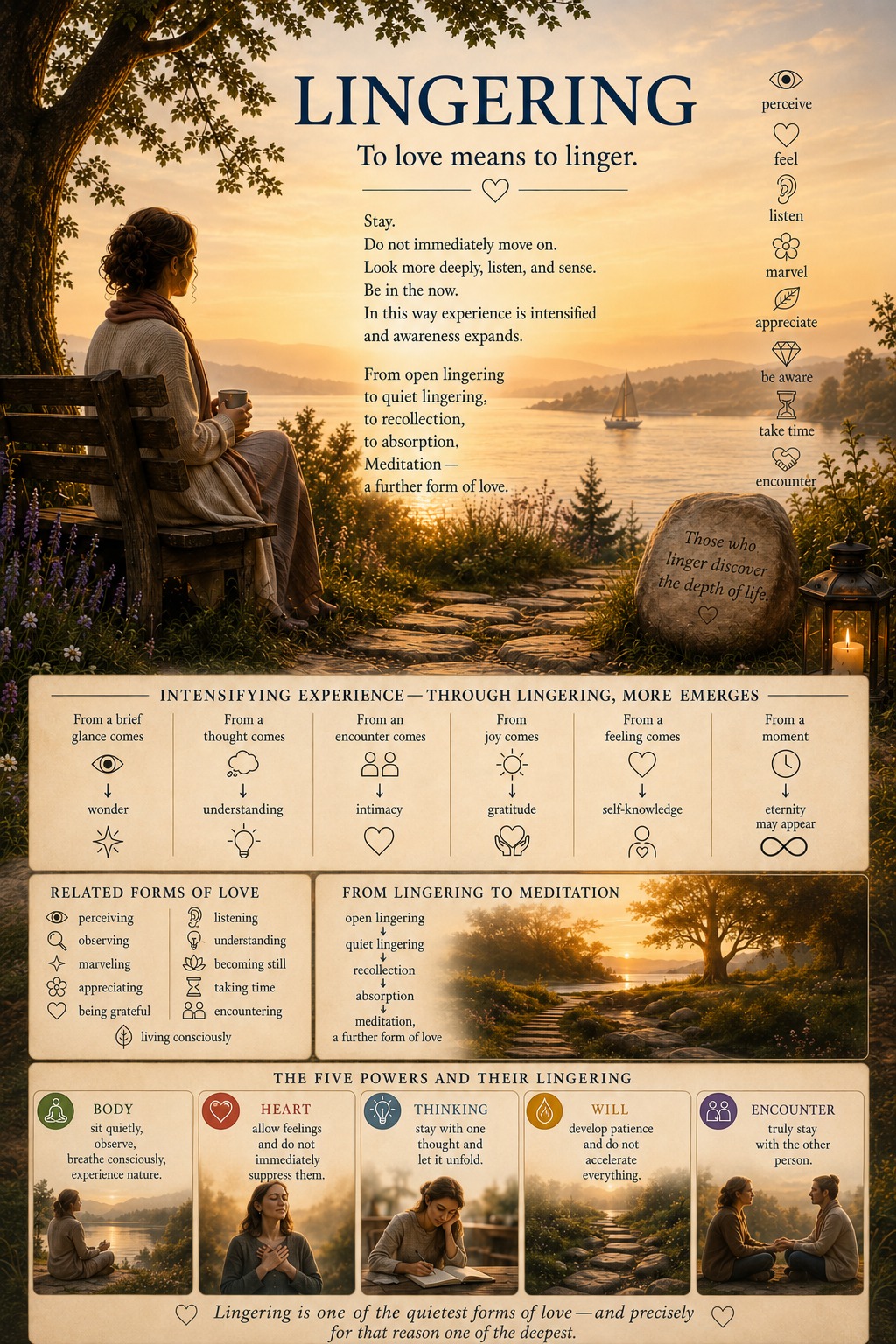
Translation note: This is an exceptionally strong translation of a text-rich portrait image. `Lingering` consistently preserves the intended meaning of `Verweilen`; it is not confused with endurance. `Recollection` and `absorption` are formal but suitable translations for `Sammlung` and `Versenkung` in the contemplative sequence.
From Rush to Deep Love
When overstimulation and hurry scatter attention, bodily movement can first discharge excess energy. Breath, perception, wonder, and lingering can then lead into greater calm and depth. The aim is not withdrawal from life but a more concentrated love that connects, heals, and widens life through fewer yet deeper encounters.
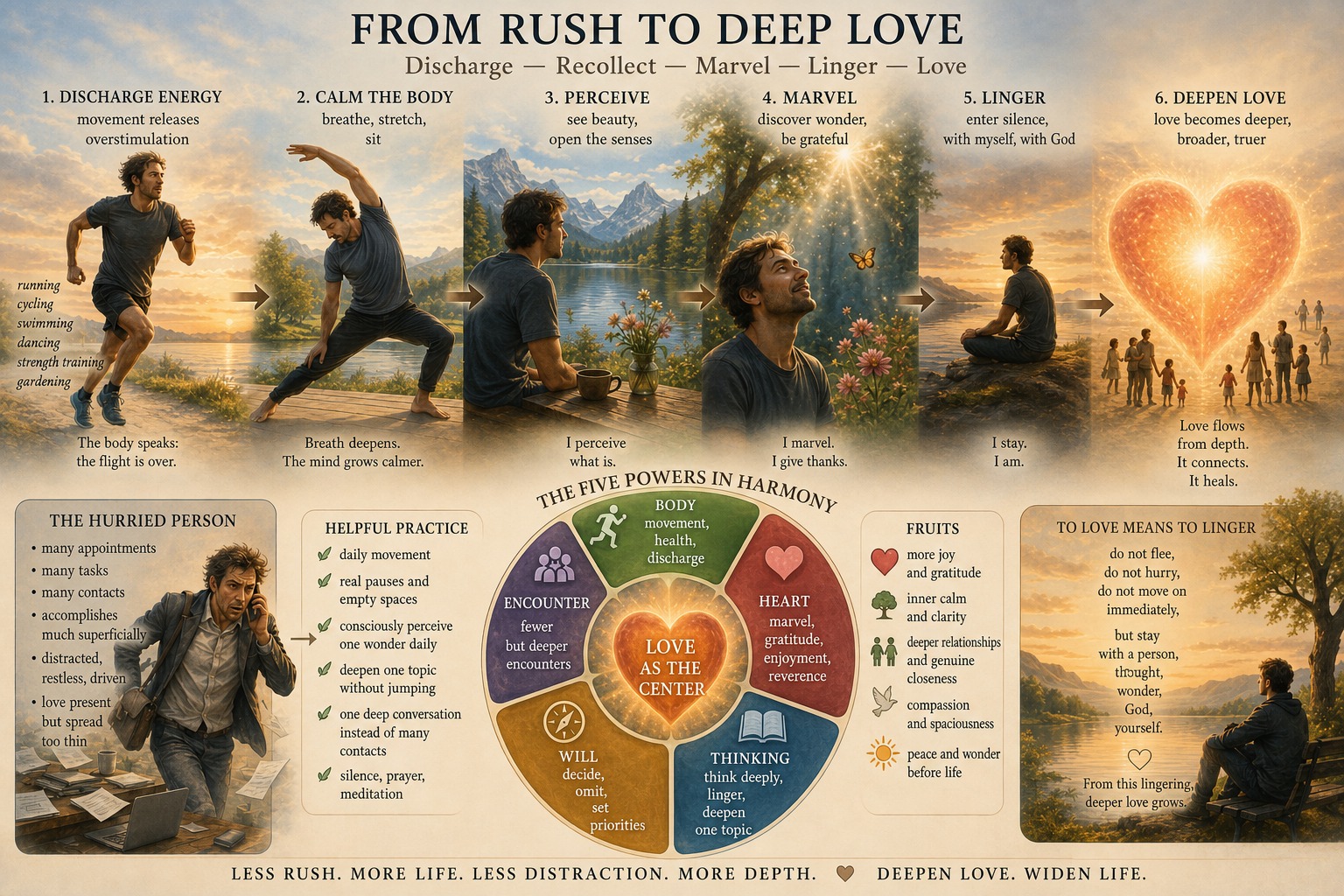
Translation note: All six stages, practical recommendations, fruits, and five powers are very clearly translated. `Discharge` is somewhat technical in English but faithfully conveys `Entladen`. Most importantly, `Verweilen` remains correctly translated as `linger`; no serious meaning error is visible.
Walking with Yourself Again
Self-love does not require becoming someone else. Small acts—walking, noticing a flower, drinking tea mindfully, tidying a room, writing to someone, smiling, or reading a poem—can begin a movement of life. Acceptance, friendship with the body, wonder, encounter, and recognition of one's own worth provide a path beyond comparison and inner struggle.

Translation note: The poetic message, small-step board, five powers, notebook, and path stones are translated very well. The stone `Wachsen statt kämpfen` becomes the grammatically rough `Grow instead of fight`; `Grow instead of fighting` would be natural. The intended contrast remains clear.
Helping Yourself and Accepting Help
Self-love joins four movements: strengthening oneself, protecting one's energy, continuing to develop, and accepting support. Rest, nourishment, boundaries, learning, mistakes, trust, conversation, and companionship are not competing paths. Together they make it possible to take responsibility without having to manage everything alone.
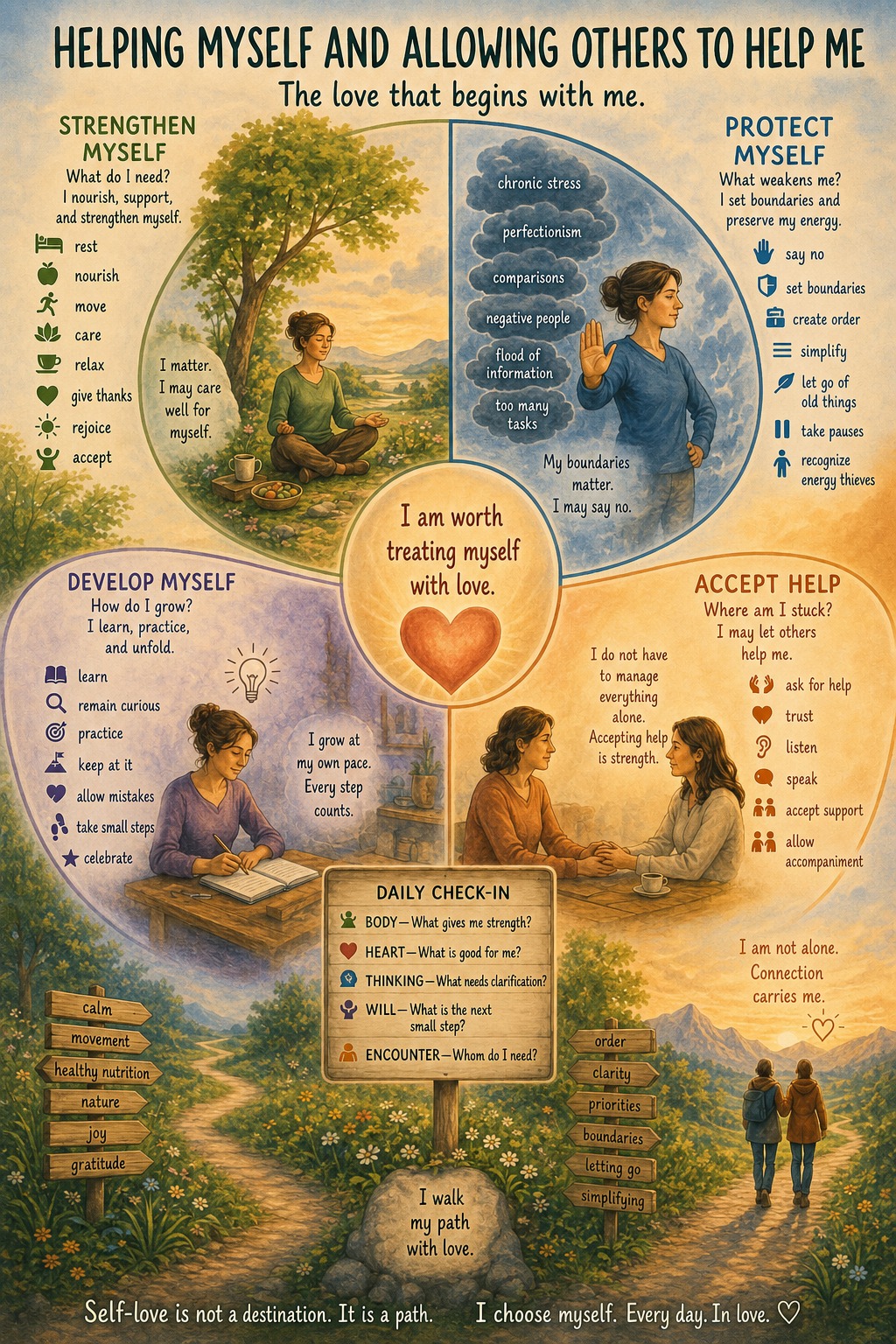
Translation note: The four-part model, daily check-in, all action lists, and path signs are translated with excellent completeness. `allow accompaniment` is a literal and awkward rendering of `sich begleiten lassen`; `allow someone to accompany you` would be more natural. No major semantic error is visible.
Caring for Yourself Through All Five Powers
Self-help becomes more balanced when it includes the body, heart, thinking, will, and encounter. Sleep, nourishment, kind self-talk, clarity, attainable goals, and the courage to ask for help reinforce one another. Responsibility for oneself is therefore not isolation; connection can help a person become calmer, stronger, and more capable of loving action.
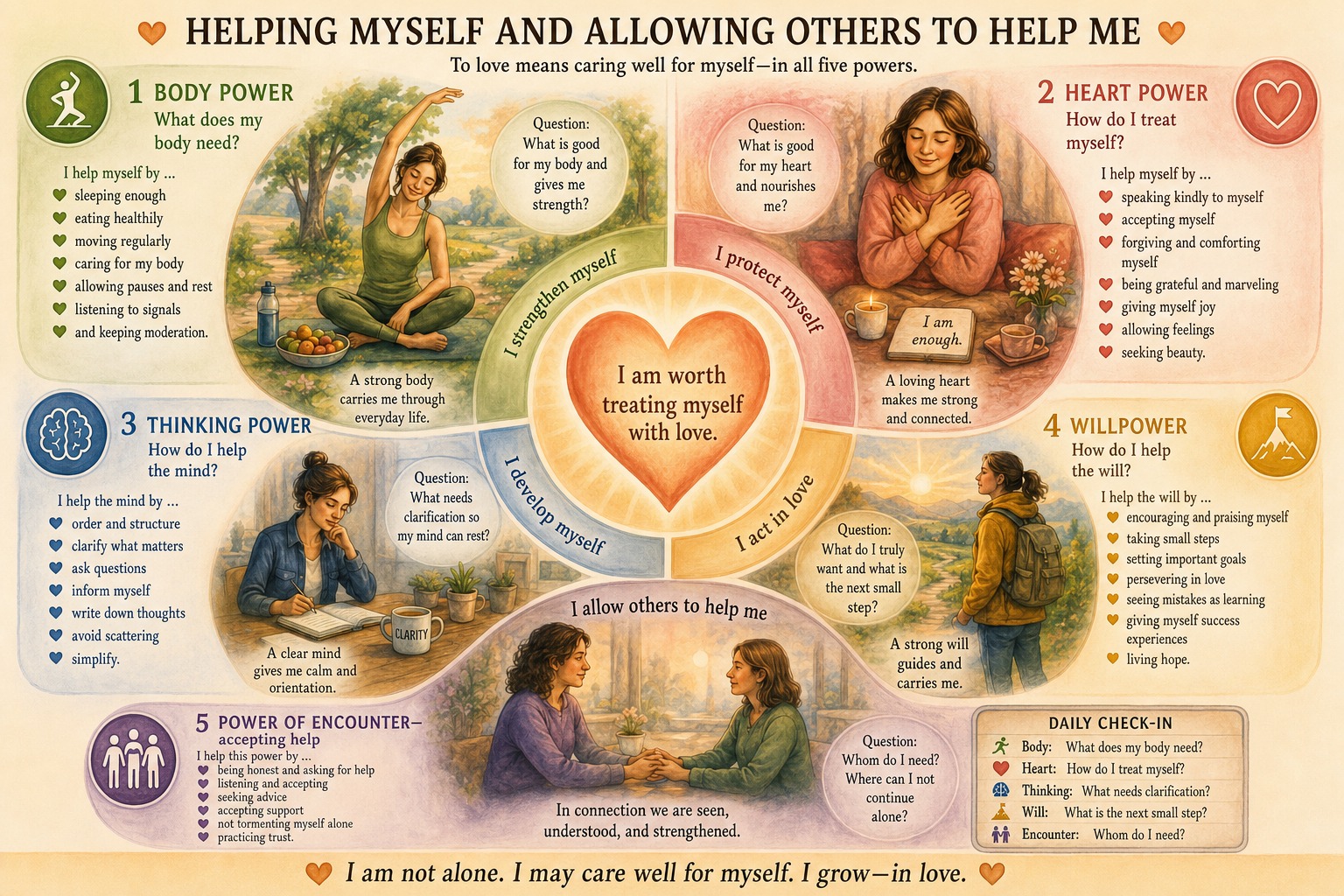
Translation note: This is an exceptionally complete translation of a detailed five-part model. All questions, action lists, arcs, captions, and the daily check-in are preserved. `not tormenting myself alone` is literal but understandable; no serious semantic or spelling error is visible.
Becoming Ever More Yourself
The relationship with oneself develops through perception, welcome, self-knowledge, friendship, responsibility, unfolding, and authenticity. It is nourished by time, rituals, honesty, boundaries, and growth. This inward relationship is not self-enclosure: when a person becomes more at home within, they can meet others with greater freedom, peace, and truth.
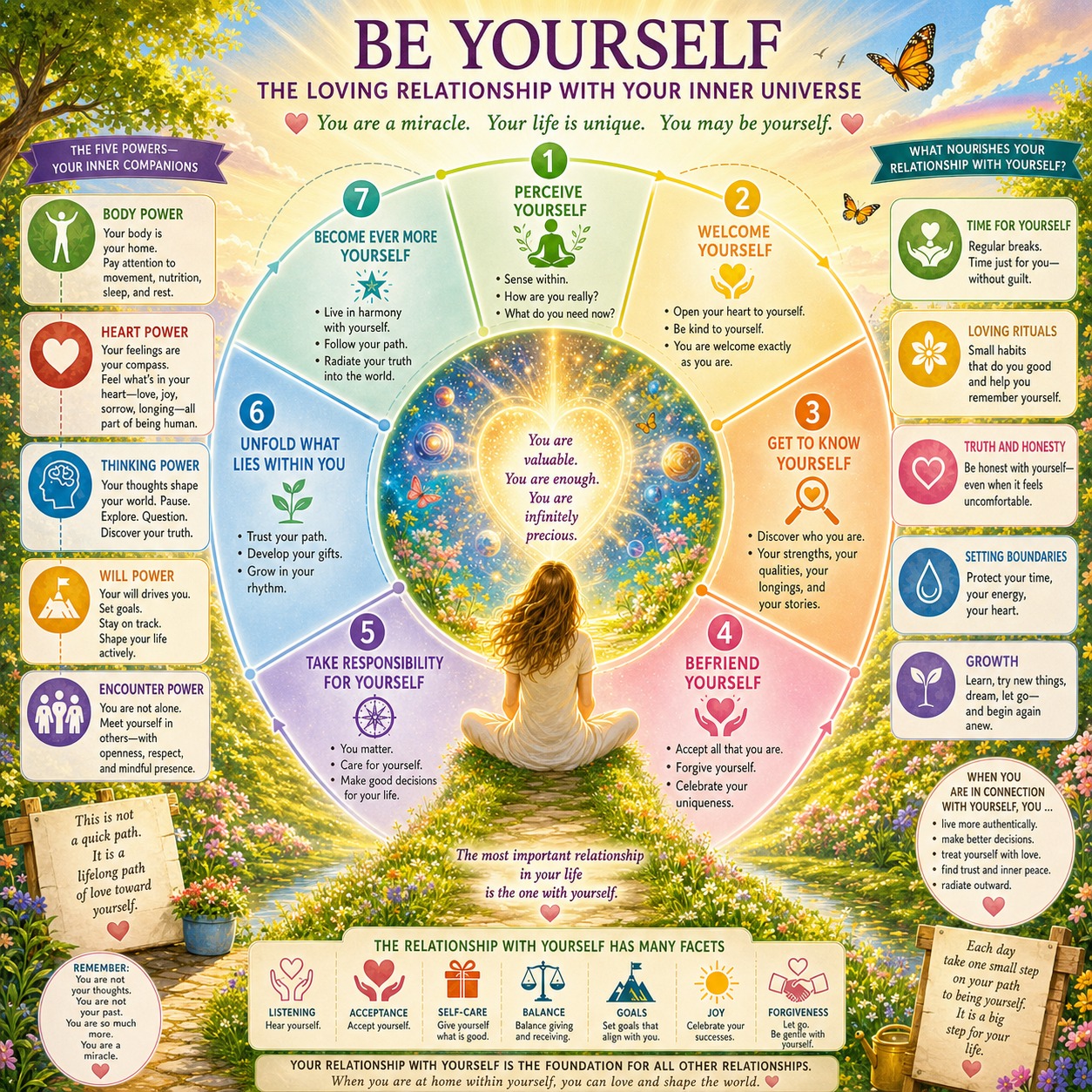
Translation note: Despite the density of the image, the seven-step wheel, five powers, nourishment column, facets, reminders, and closing statement are translated with very high fidelity. The language is natural and no material meaning error is visible.
Doing Good Without Losing Boundaries
Doing good may nourish the body, comfort the heart, clarify thought, strengthen action, and deepen encounter. It can heal relationships and support a culture of humanity, but intention alone is not enough. A loving response asks what is genuinely helpful, respects limits, remains open to correction, and avoids turning self-sacrifice or manipulation into a false form of care.
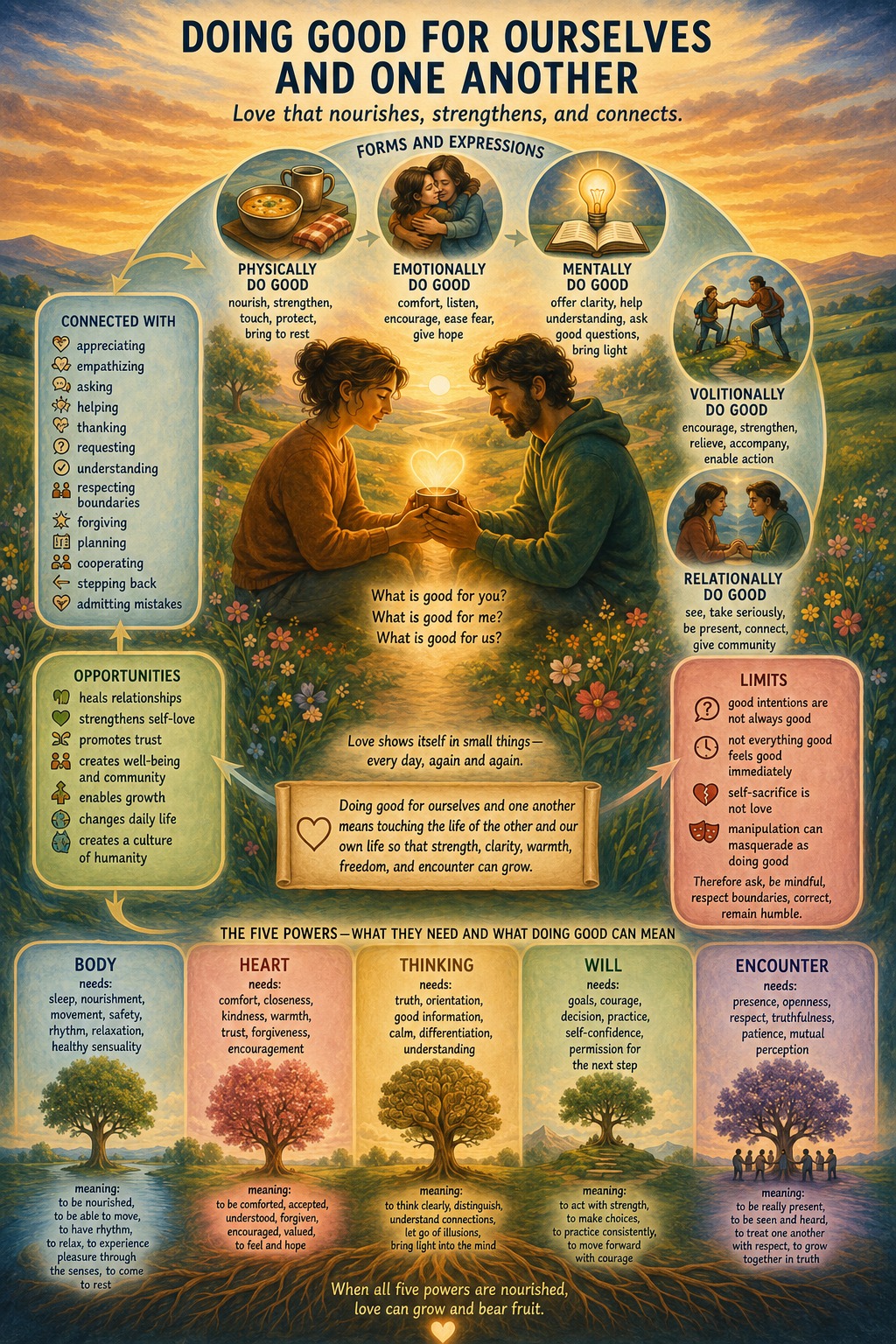
Translation note: The many connected forms, opportunities, limits, five powers, and meaning statements are all retained. `Volitionally do good` is technically accurate for `willentlich gut tun` but sounds formal and unusual in everyday English. The ethical distinction between care and manipulation remains clear.
Freedom for Oneself and Others
Loving freedom includes the right to inhabit one's body, feel and clarify emotions, question and seek truth, develop one's path, and meet others across difference. It also means releasing possession and domination: the other person may be themselves, make mistakes, and remain imperfect. Freedom grows through values, respect, justice, accompaniment, and trust.

Translation note: The five freedoms, central values, message to the other person, and contrast with domination are translated accurately. The board phrase `I set free` is poetic but grammatically incomplete without an object; `I let others be free` would be more natural. Its intended meaning is supported by the surrounding text.
Admitting Mistakes Without Self-Condemnation
A culture of learning respects truth, relationship, and a shared future more than self-image, being right, or pride. Admitting a mistake connects honesty, inquiry, understanding, criticism, clarification, help, reconciliation, gratitude, and stepping back. It takes responsibility while refusing both permanent self-blame and the claim of never being responsible.
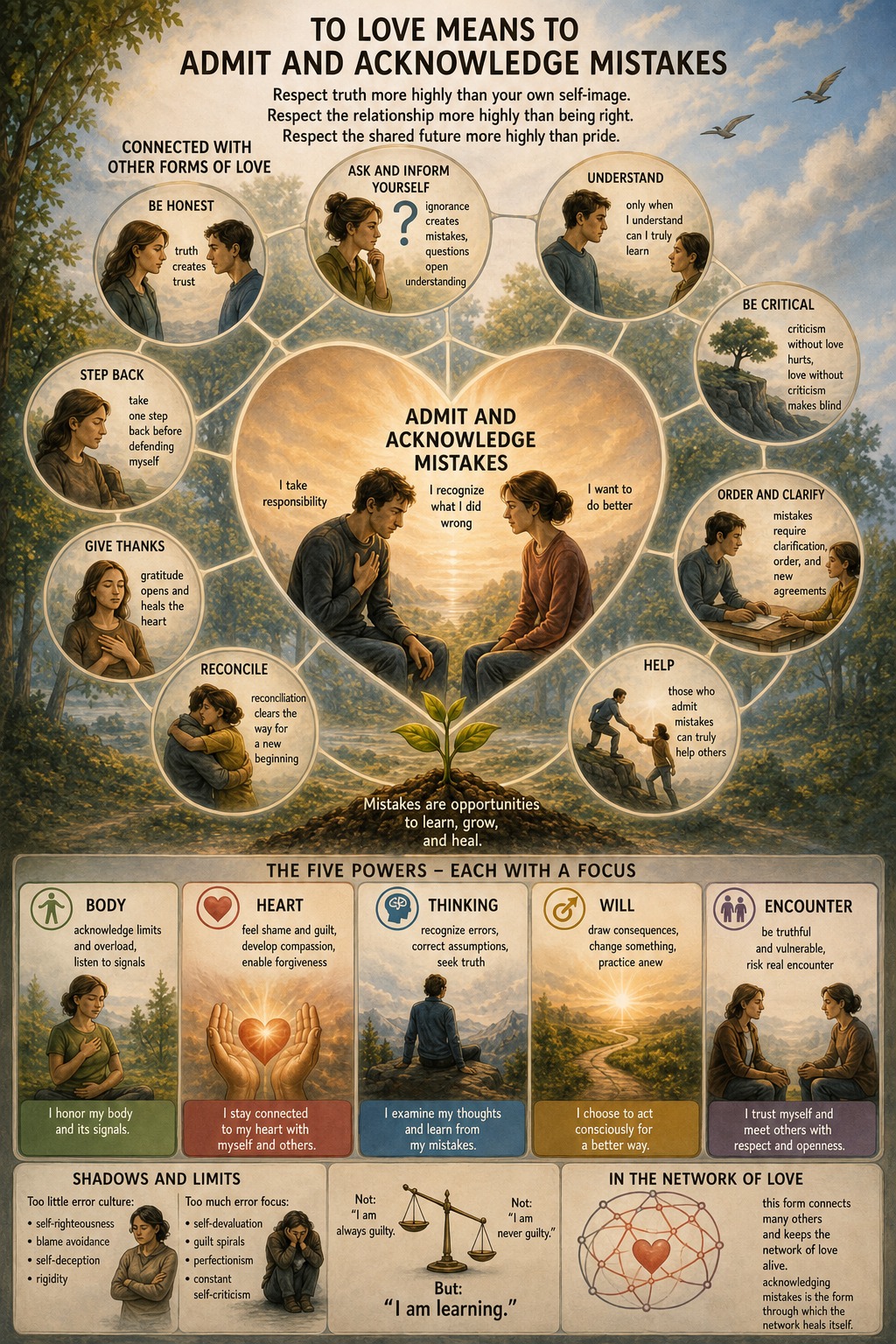
Translation note: The ethical balance, network of related forms, five powers, shadows, and learning scale are translated very faithfully. `Admit and acknowledge mistakes` is somewhat repetitive in English, but it preserves both German verbs `zugeben und einsehen`. No serious meaning error is visible.
Pauses as Bridges
Pauses give life a rhythm between action and rest. Quiet, reflection, movement, sleep, mindful meals, and creativity each offer a different kind of renewal. They also protect transitions: without a pause, old tension is carried into a new situation; with a pause, attention and space can arise.
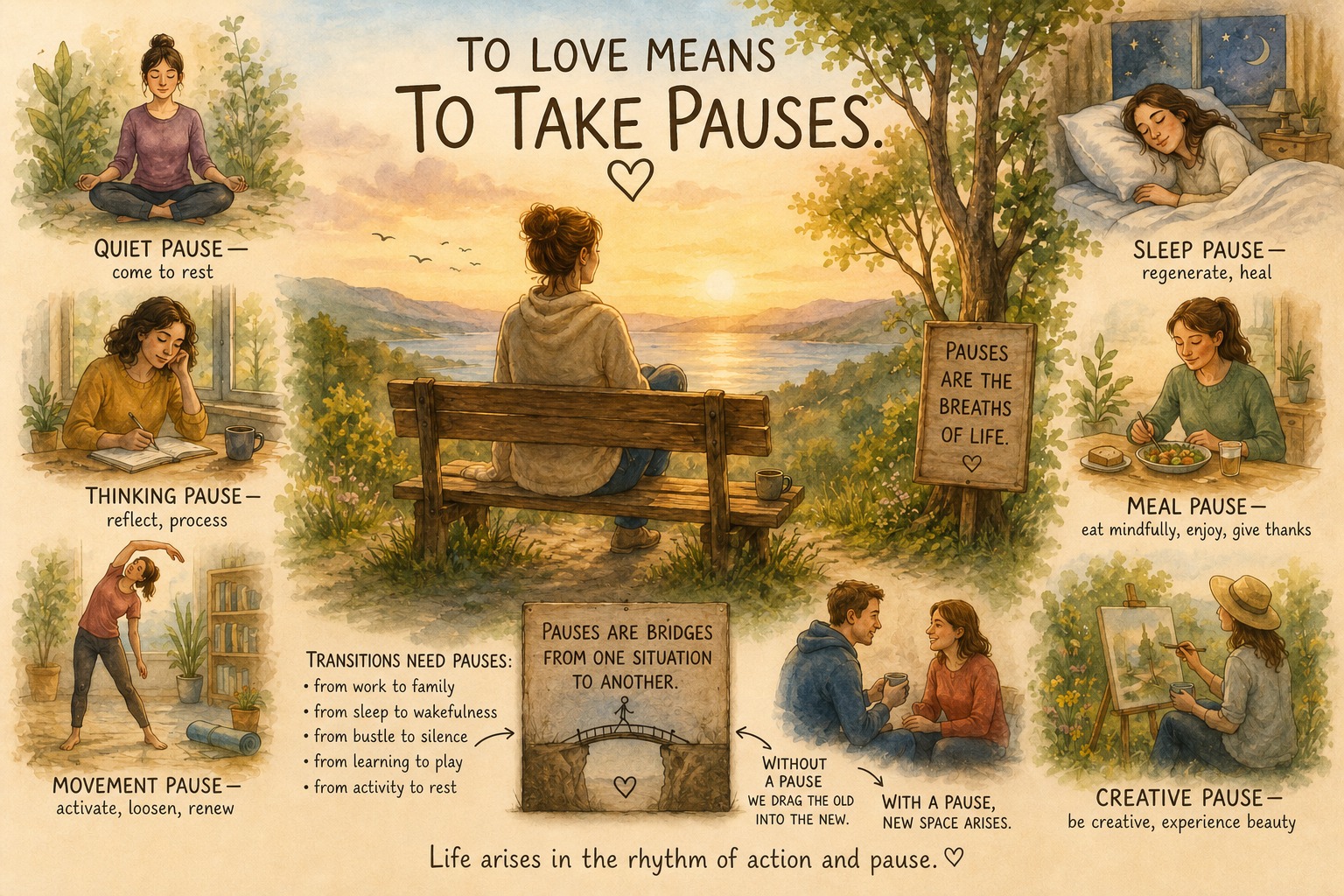
Translation note: The six kinds of pause, transition list, bridge metaphor, and closing sentence are translated very clearly. `Pauses are the breaths of life` is an exact and understandable rendering of the German metaphor. No significant meaning or spelling error is visible.