
Love
Love has many forms. The images on this page explore love as relationship, attitude, practice, and human strength. They connect older concepts with the Kolibri-Ethos love forms and invite readers to compare meanings rather than reduce love to a single definition.
Love in Antiquity — Six Forms
Ancient Greek thought distinguished several forms of love. Eros names desire and attraction, Philia friendship, Storge familial care, Agape selfless universal love, Xenia hospitality, and Philautia a healthy love of self. The image links each form with ways of loving and with five human strengths.
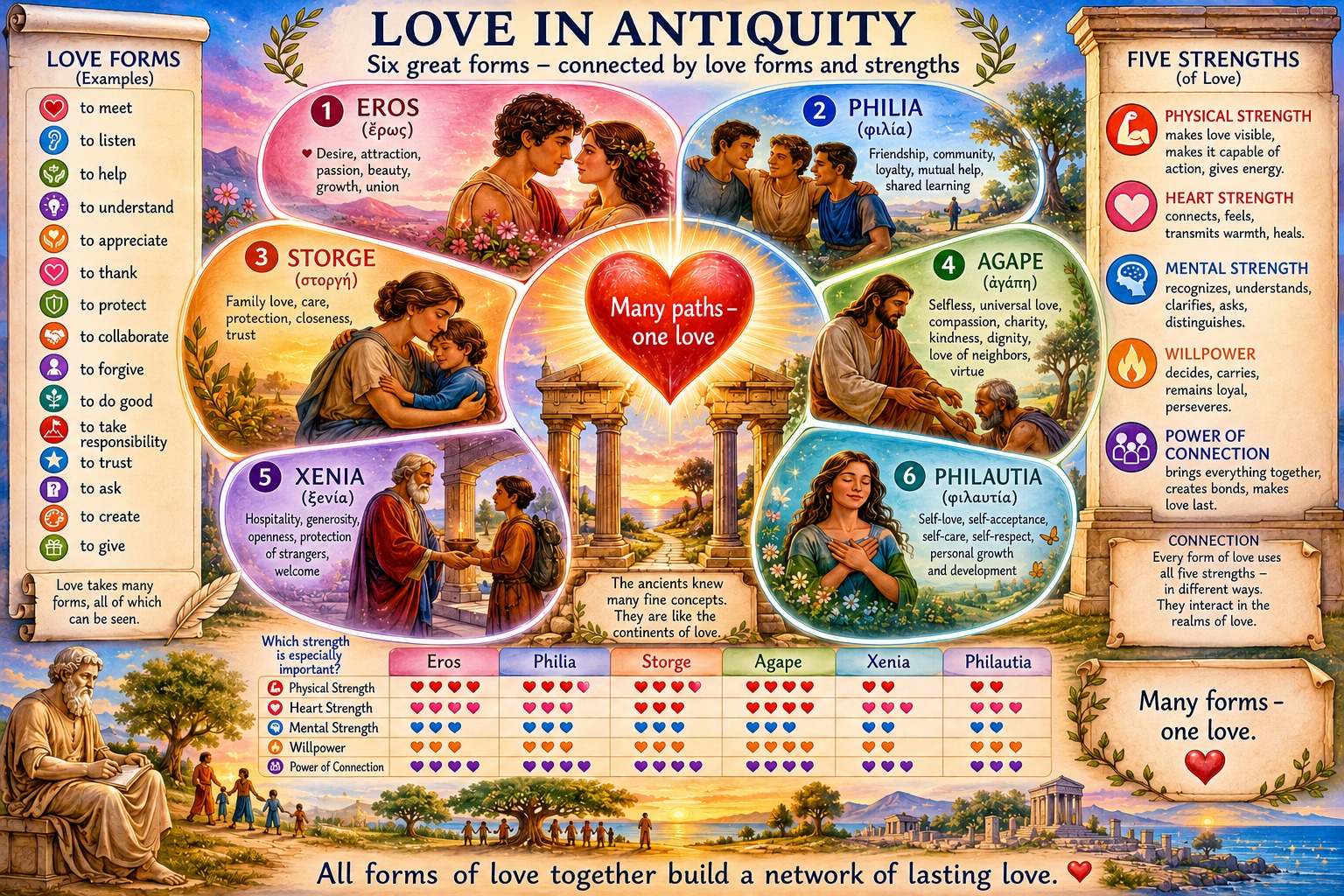
Translation note: The six Greek concepts and the central message remain understandable. In the left list, “staunen” became “to trust” instead of “to marvel,” and “vereinfachen” became “to give” instead of “to simplify.” Several labels were freely replaced, so this list should not be treated as a literal translation.
Meanings, Expressions, Risks, and Connections
This detailed overview compares the six forms through their meanings, expressions, strengths, possible distortions, spaces of love, and relationships to one another. Its network model emphasizes that forms of love overlap and need different balances of strength.
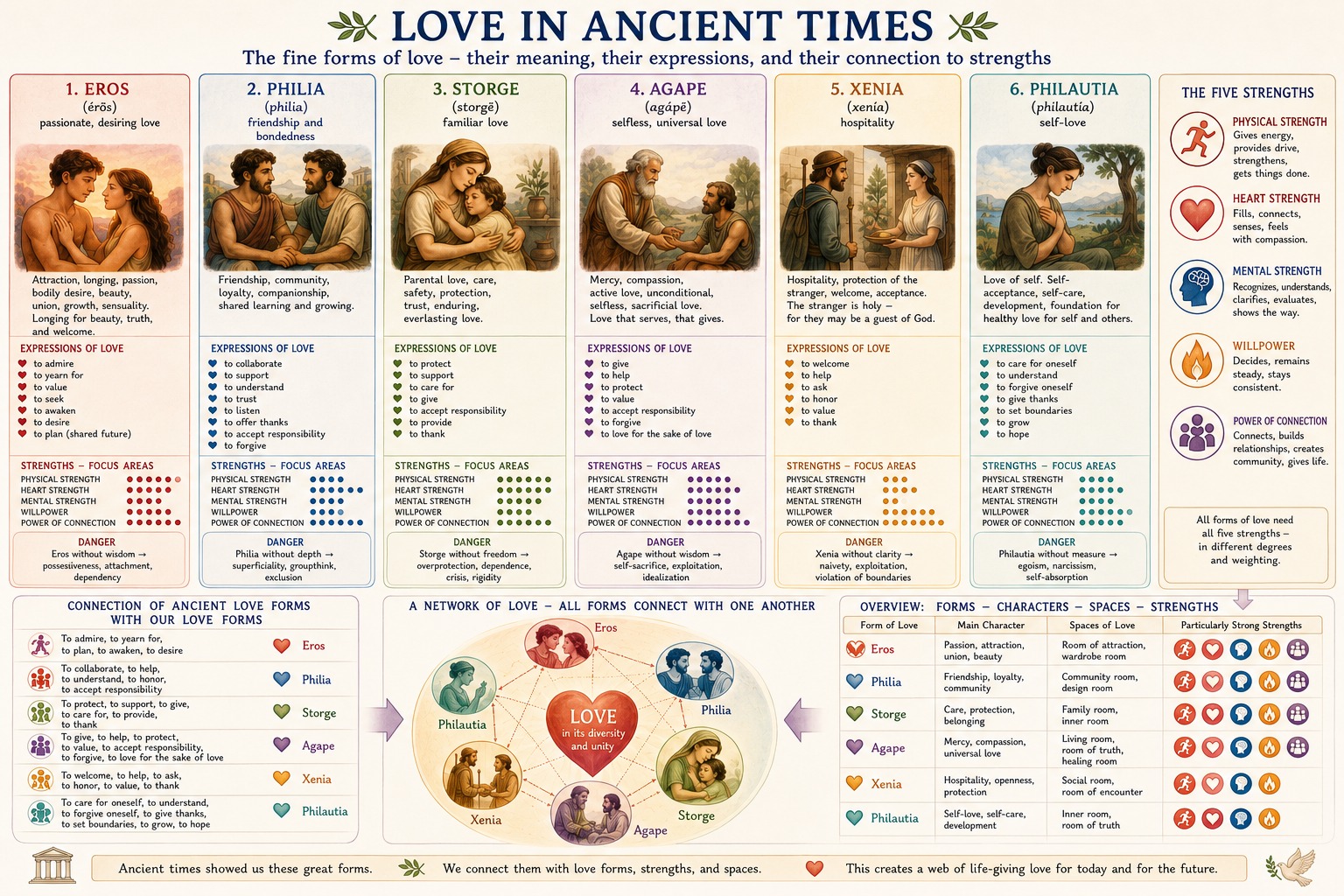
Translation note: The structure and main distinctions are preserved, but many small expressions were paraphrased. “Gefahr” is accurately shown as “Danger,” while some examples under the risks and love expressions are condensed or shifted. In the overview table, several “spaces of love” are interpretive rather than literal translations.
Love as an Art of Living
Modern ideas of self-actualization, self-efficacy, authenticity, positive psychology, mindfulness, and personal development can all be read as approaches to shaping a life. The image places love at the center: a force connecting the self, relationships, meaning, growth, and responsible action in the world.
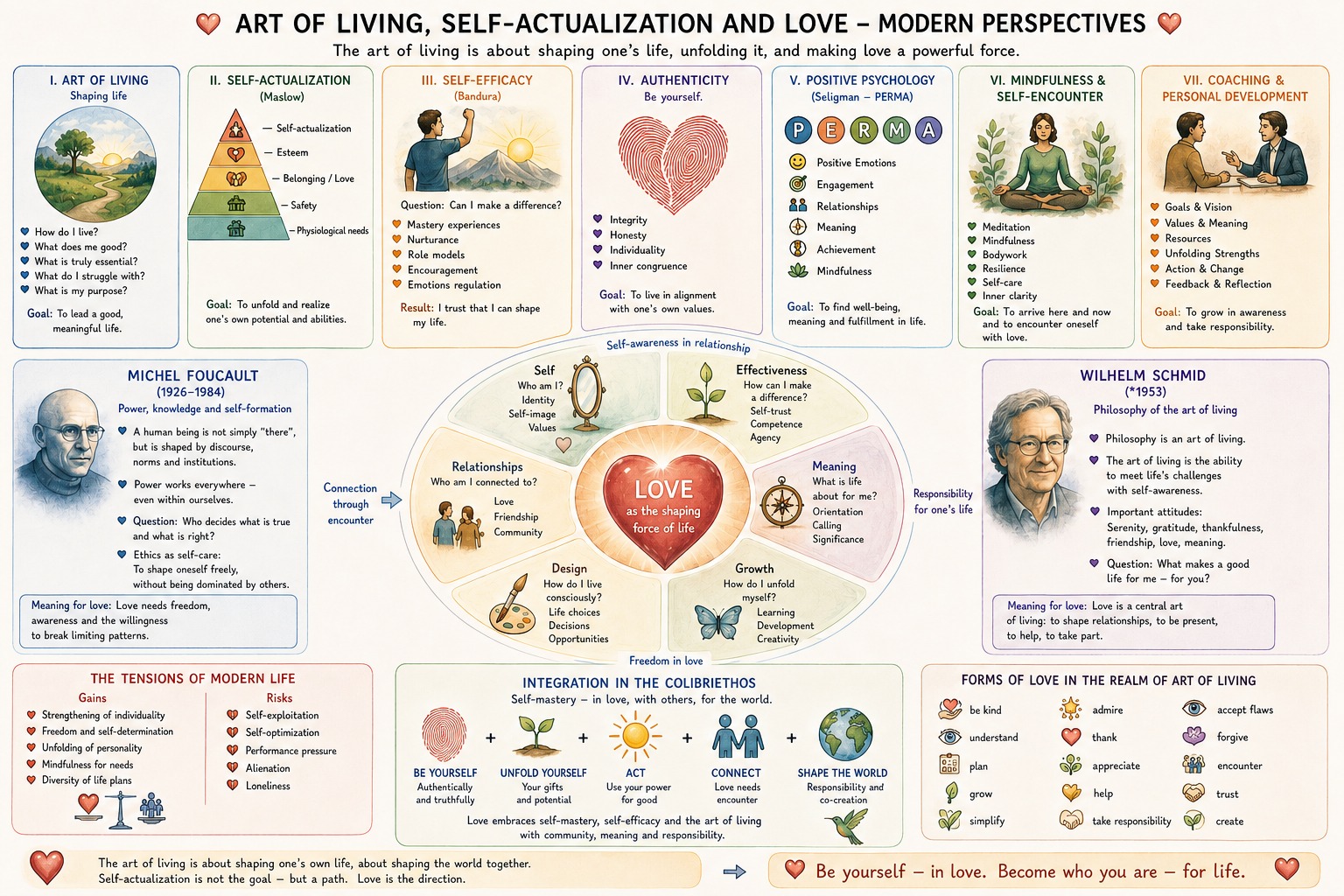
Translation note: The main structure, the two philosophers, and the conceptual links are preserved well. Some statements are freely smoothed: Foucault's “Ethik als Selbstsorge” became “Ethics is self-care,” and Schmid's question is paraphrased. “Kolibriethos” appears as the compressed spelling “Colibriethos.”
Diverse Ways of Loving
Love does not prescribe one relationship model. Solitude, life as a couple, living alone, open or diverse relationships, communities, and large networks can all become spaces for mindful, respectful, free, authentic, responsible, and connected love.

Translation note: The six contexts and central qualities are clear. The source question “Which forms of love do you realize on your path?” became “Which forms of love bring your life into being?”, shifting the focus from one's actions to the effect on one's life. “Nähe-Distanz” is retained awkwardly as “closeness–distance.”
From Inner Intention to Realized Love
A form of love can move through a recurring path: an inner willingness, an image of what could be, learning and practice, honest recognition of limits, and finally visible action. Experience then nourishes a new inner cycle. Helping, understanding, trusting, and reconciling follow the same basic path in different ways.

Translation note: The five stages and example table are translated consistently. The title changes “wirklicher Liebe” (real or genuine love) to “effective love,” emphasizing impact rather than authenticity. Several table sentences are condensed but remain understandable.
Elements of Love
Love joins inner qualities, practical processes, and values that become visible in the world. Sensitivity, openness, patience, honesty, courage, humility, gratitude, attentiveness, and strength shape how we act; understanding, helping, protecting, encouraging, listening, forgiving, appreciating, thanking, asking, and shaping connect them with shared values.
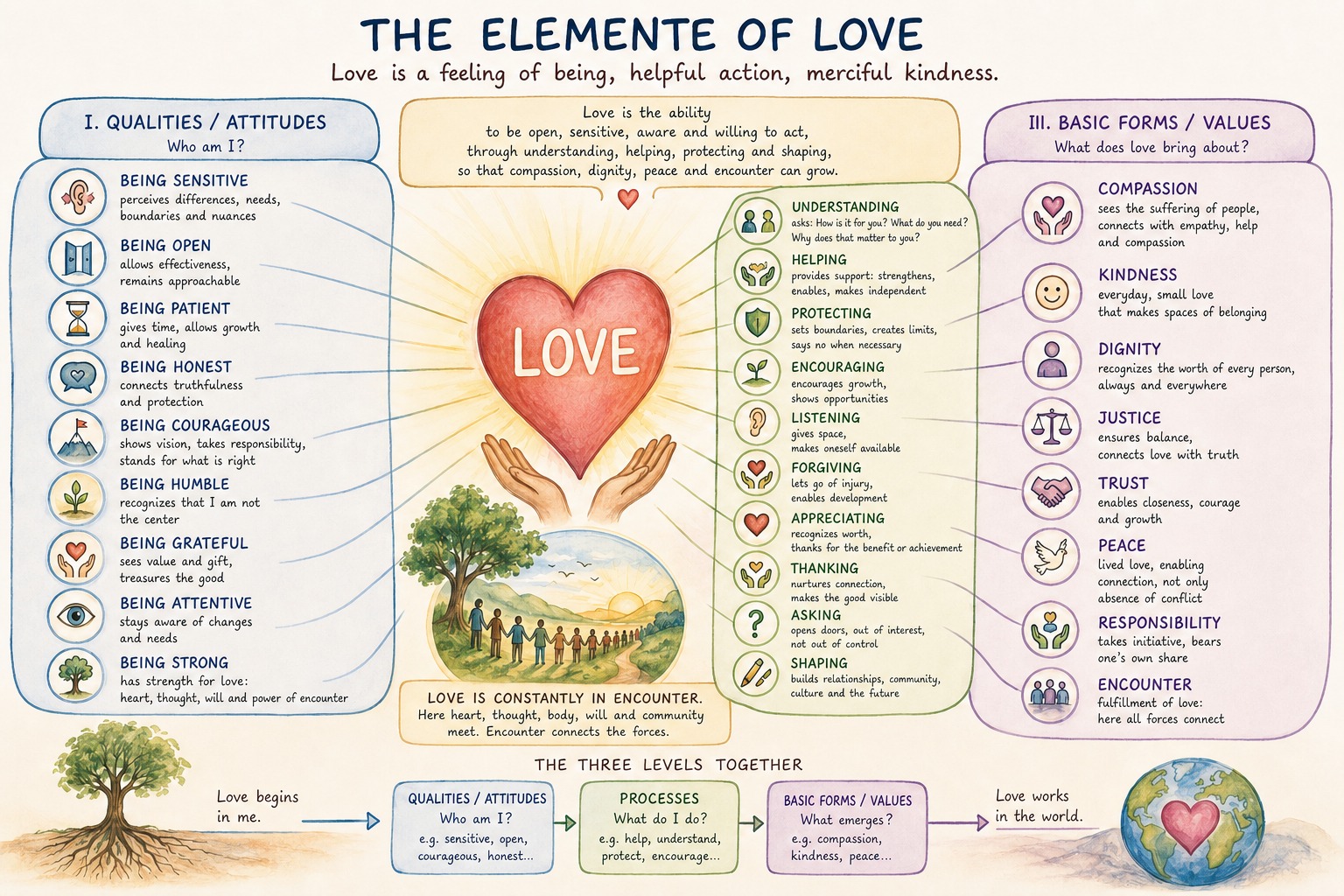
Translation note: The heading incorrectly keeps the German word “ELEMENTE” instead of “ELEMENTS.” “Love becomes complete in encounter” was changed to the unidiomatic “Love is constantly in encounter.” In the openness section, “Wirklichkeit” (reality) became “effectiveness,” which alters the meaning.
Desire as a Fundamental Energy of Life
Desire can move life, reveal needs, motivate forms of love, and open creative possibilities. Love helps direct desire toward what is good, while wisdom asks about truth, limits, and consequences. Desire may mature, become destructive, remain unfulfilled, enter dialogue, or be balanced by gratitude.
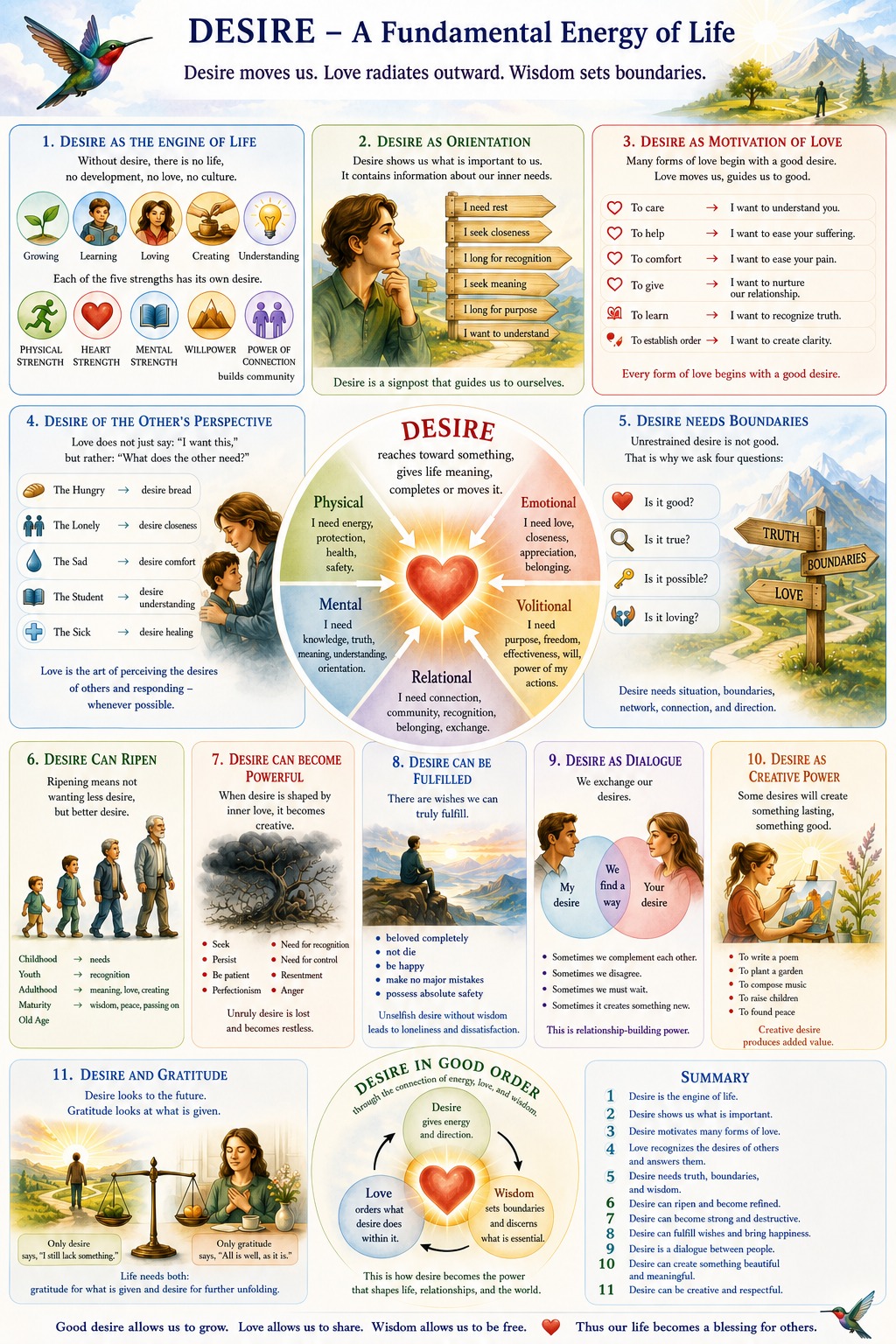
Translation note: The subtitle changes “Love directs it” to “Love radiates outward,” losing the relationship between love and desire. Section 4 shifts from perceiving another person's desire to “the other's perspective.” Some examples use unnatural wording such as “desire bread” instead of “desires bread.”
Love Needs Boundaries
Love can fail through absence, but it can also become harmful through excess. The chart places healthy forms of understanding, helping, protection, trust, forgiveness, service, closeness, truth, order, and encouragement between neglect on one side and intrusion or domination on the other. Boundaries protect both encounter and life.
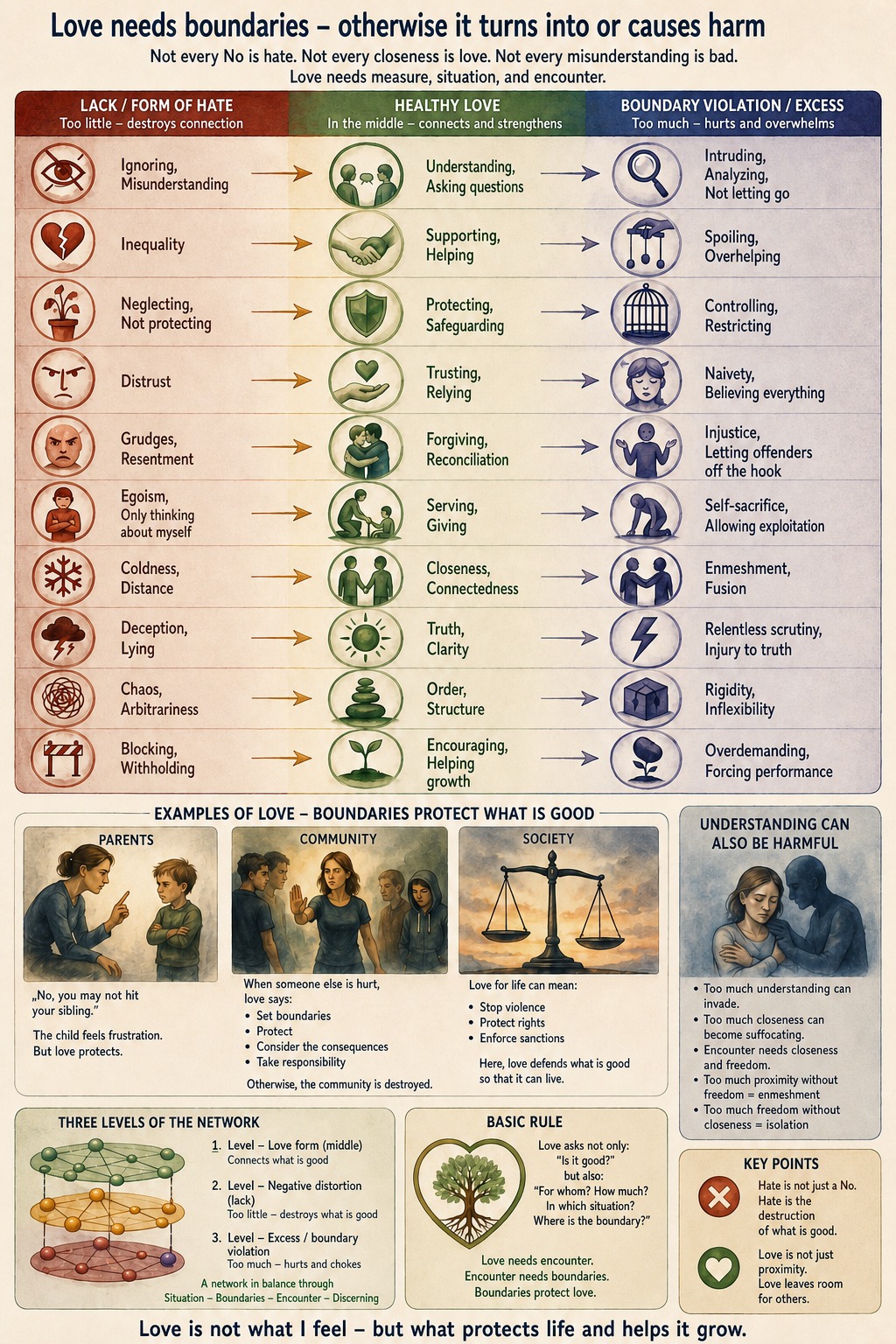
Translation note: The opening sentence omits the word “hate”: “otherwise it turns into or causes harm.” The source says “Not every understanding is good,” but the image reverses this into “Not every misunderstanding is bad.” `Gleichgültigkeit` (indifference) became `Inequality`, and `Entblößen` (exposing) became `Not letting go`.
Shadows of Virtues and Forms of Love
Following Aristotle's idea of a situational mean, virtues and forms of love can be weakened by too little or distorted by too much. The table is intended as a map for reflection, not a rigid rulebook: healthy measure depends on context and living judgment.

Translation note: The title was substantially changed to “The Shadows of Lack and the Forms of Excess,” omitting virtues and love. Several table cells shift categories: `Mutlosigkeit` (lack of courage) became `Rashness`, `Gedankenlosigkeit` became `Suspiciousness`, and multiple empathy, patience, and curiosity distortions are replaced by different concepts. The table should therefore not be used as an exact translation.
The Cycle of Love
Willing to love moves through resonance, clarity, transcendence, and realization. Receiving and acting, pausing and renewing, distinguishing and shaping, reconciliation, responsibility, and respect for boundaries connect these four fields in a living cycle.
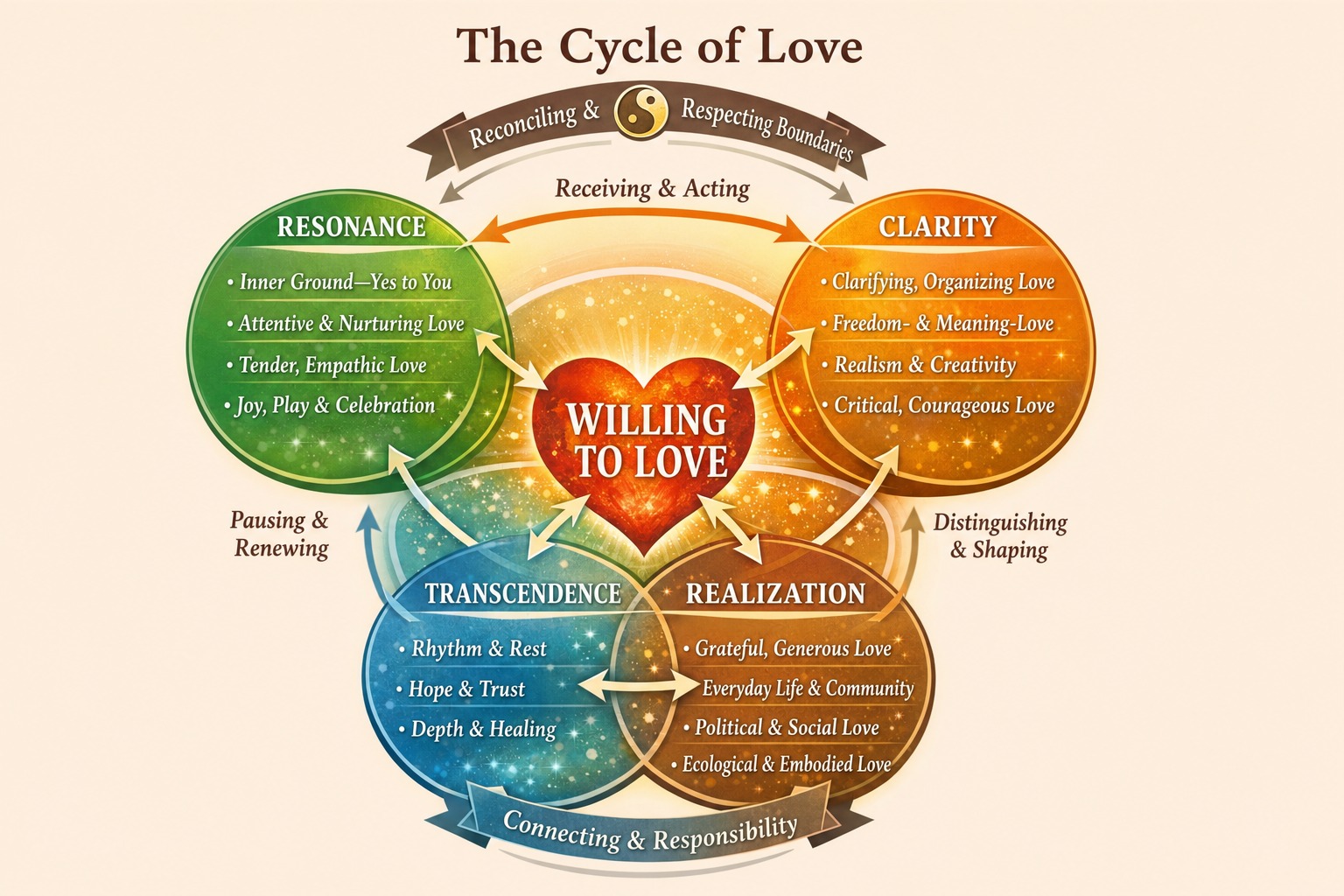
Translation note: The structure and most labels are preserved clearly. `Sinnliebe` becomes the awkward compound `Meaning-Love`; `widerständige Liebe` is softened to `courageous love` instead of resistant or oppositional love; `dienende Liebe` becomes `generous love`, losing the idea of service.
Fundamental Forms of Love
Six basic movements form a cycle around the intention to love: receiving, clarifying, realizing, releasing, resting, and balancing. Each joins two complementary actions or attitudes and leads into the next.
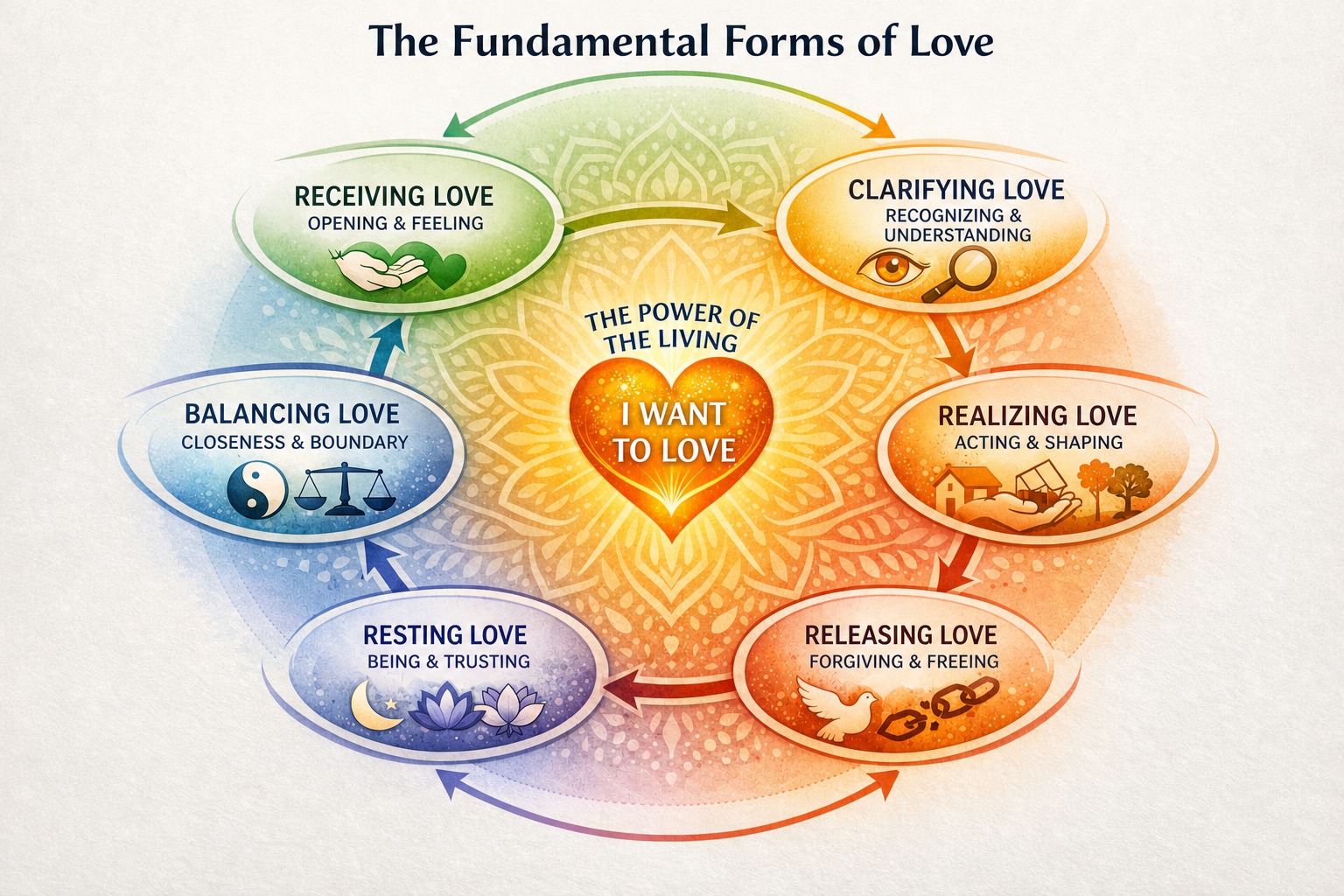
Translation note: This is a particularly strong translation. The six forms, paired actions, central intention, visual order, and arrows are all preserved. `The Power of the Living` is literal but slightly less natural than `The Power of Life`.
Empathy as Strength
Empathy means allowing another person's pain to matter while remaining emotionally stable, tolerating uncertainty, setting one's own needs aside temporarily, maintaining boundaries, finding courage, and drawing on willpower. It combines all five human strengths rather than belonging to feeling alone.
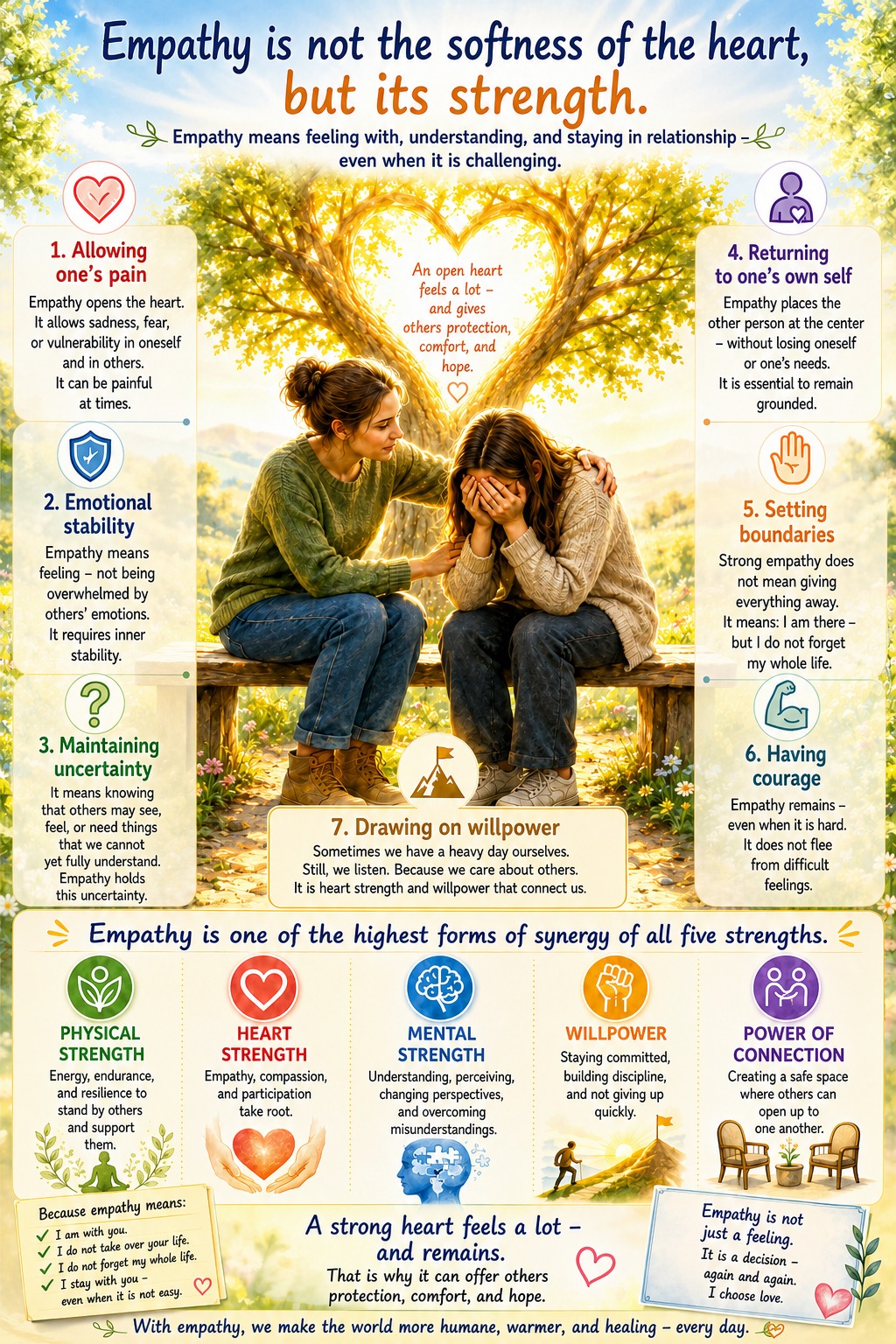
Translation note: The main message and seven principles are retained well. `Das eigene Ich zurückstellen` became `Returning to one's own self`, which points in the opposite direction; the paragraph below partly corrects this by saying the other person is placed at the center. `Willenskraft einsetzen` is accurately conveyed as drawing on willpower.
Love and Possessions
Possessions can make care, shelter, education, healing, sharing, and community possible, but they cannot replace love. A good material foundation should serve life and participation while remaining ordered, repairable, shareable, and limited by the question of what is truly needed.
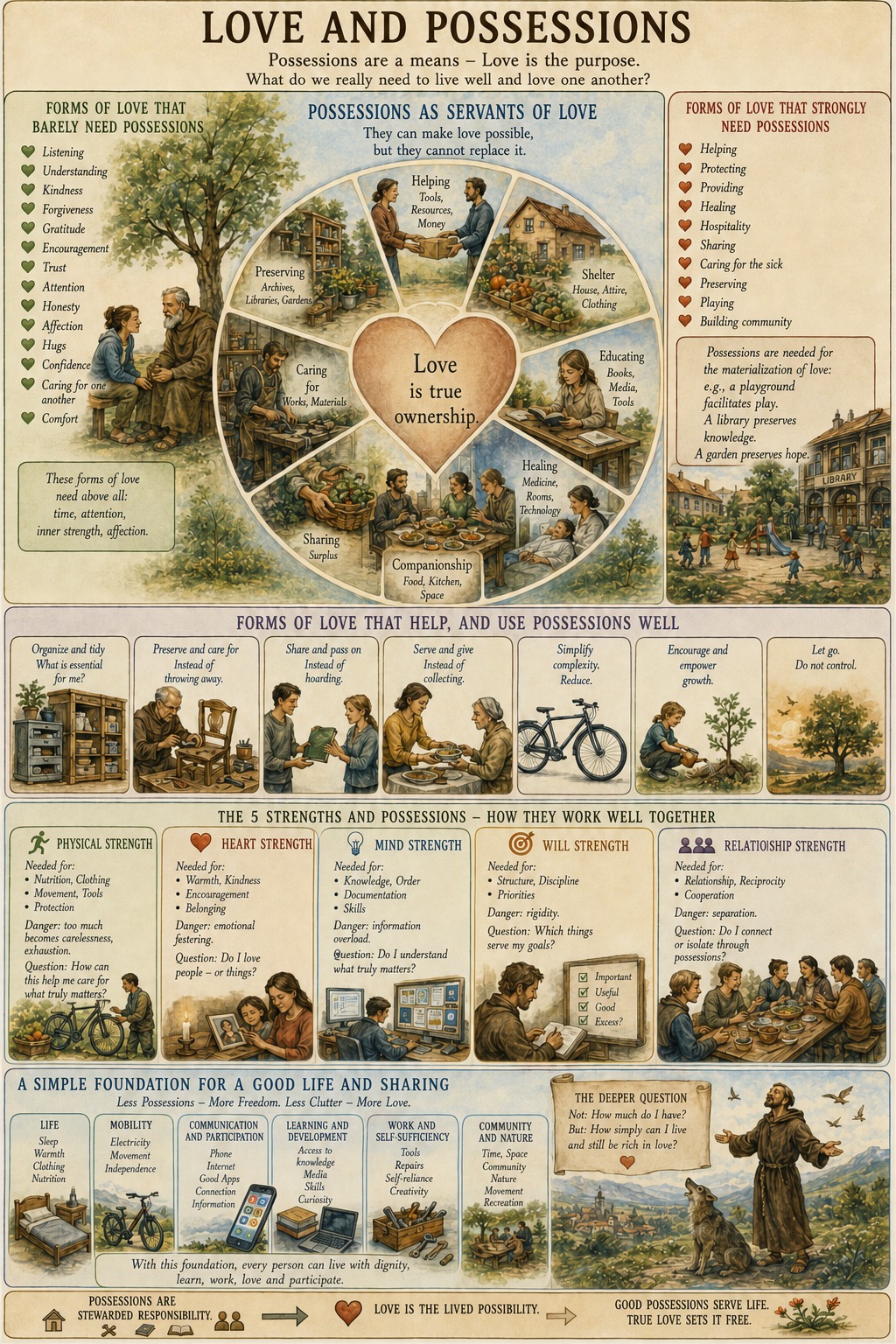
Translation note: The central image and main distinction are conveyed well. `Die Liebe ist das wahre Eigentum` became `Love is true ownership`; `true property` would be closer to the source. Several items in the left list are freely replaced, including `Vertrauen` as `Confidence`, and some of the five-strength labels differ from the established terminology.
Responsible Simplification
Modern possessions often include invisible systems, maintenance, subscriptions, data, specialist knowledge, and environmental costs. Responsible simplification means keeping what is needed and loved, sharing rarely used things, choosing durable and repairable designs, preserving knowledge, and leaving room for encounter and creativity.
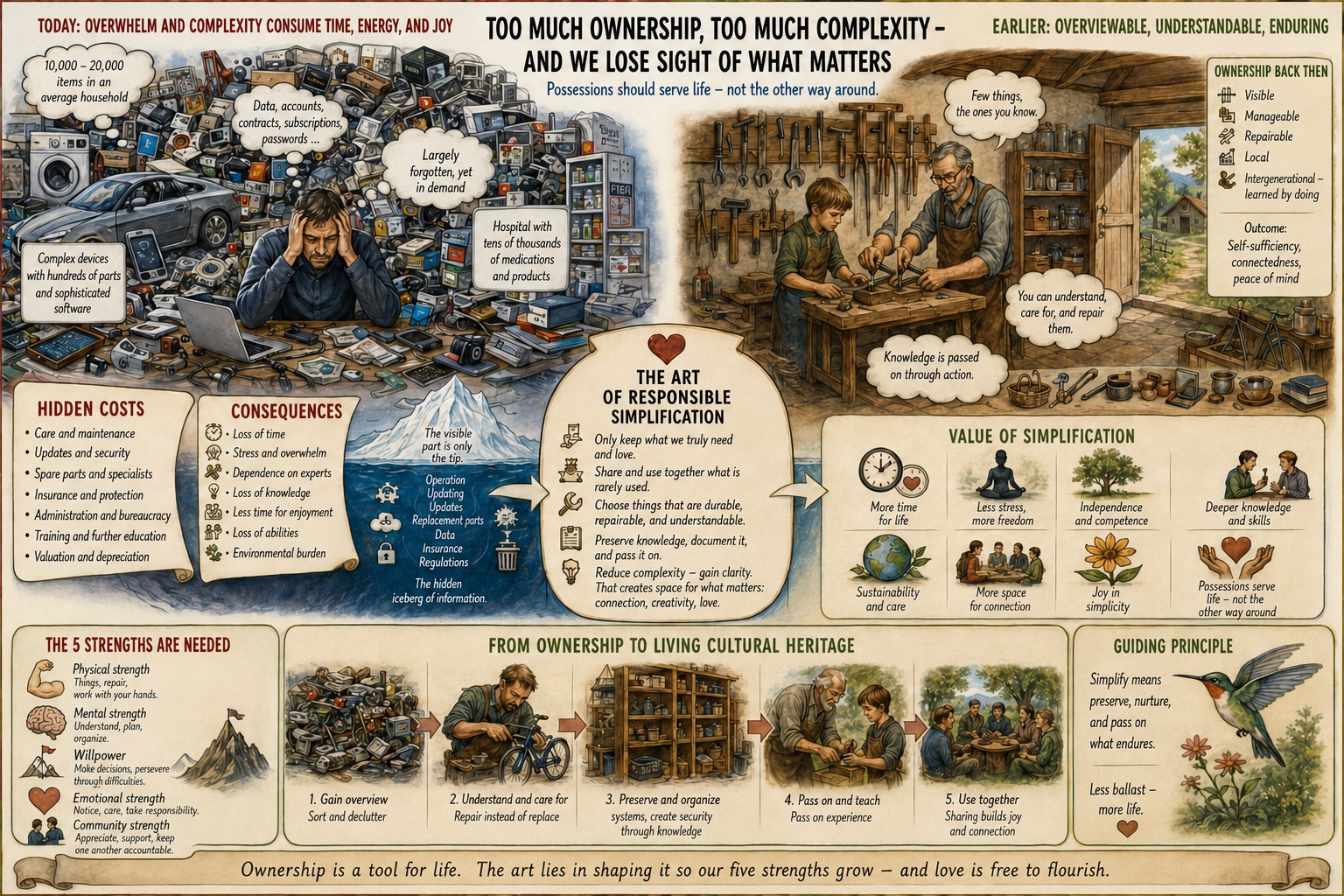
Translation note: The main comparison and practical recommendations remain clear. There is a spelling error in `understandadble`. `generationenübergreifend lernbar` became the awkward `Intergenerational – learned by doing`. The established `heart strength` and `power of connection` were replaced by `emotional strength` and `community strength`.
To Own Without Being Possessed
Ownership can serve personal intimacy, families, communities, and public commons. The image argues for a balance in which things support life without becoming identity, hoarding, or domination, and in which shared property does not dissolve personal responsibility.

Translation note: The central wordplay and four ownership layers are translated strongly. `Wem gehört mein Herz?` means `Whom does my heart belong to?`, but became `Whose heart is this?` The left action list omits `Ordnen` (organize/order), and the sentence about freedom from becoming possessed is freely rephrased.
Possession Requires Care, Protection, and Time
Private ownership brings clarity and responsibility but also defense and hidden costs. Community ownership can reduce duplication while creating coordination problems. Because possessions age and lose value, an ethics of preservation favors repair, durable and modular construction, shared workshops, knowledge transfer, and a conscious balance between having too little and too much.
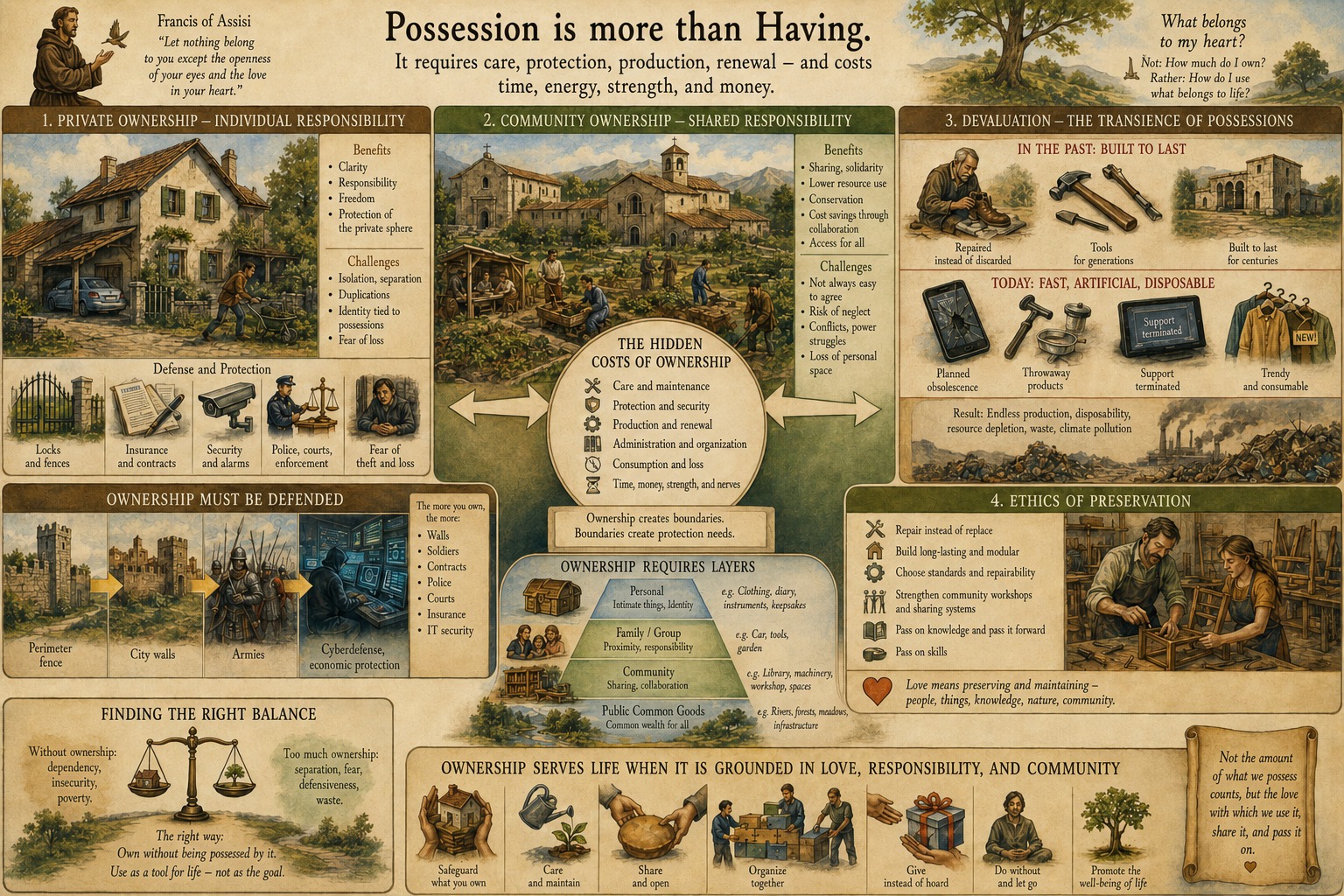
Translation note: The complex structure is translated unusually well. `Entwertung` is rendered as `Devaluation`; `Depreciation` or `Loss of value` would fit the material context better. The Francis of Assisi quotation is readable but interpretively reformulated rather than translated literally.
A Decentralized Ownership Network
A decentralized platform can document possessions while leaving them physically and legally with their owners. Search, requests, agreed forms of use, feedback, recommendations, inheritance information, and transparent costs can make sharing easier while preserving control, privacy, sustainability, and value across generations.
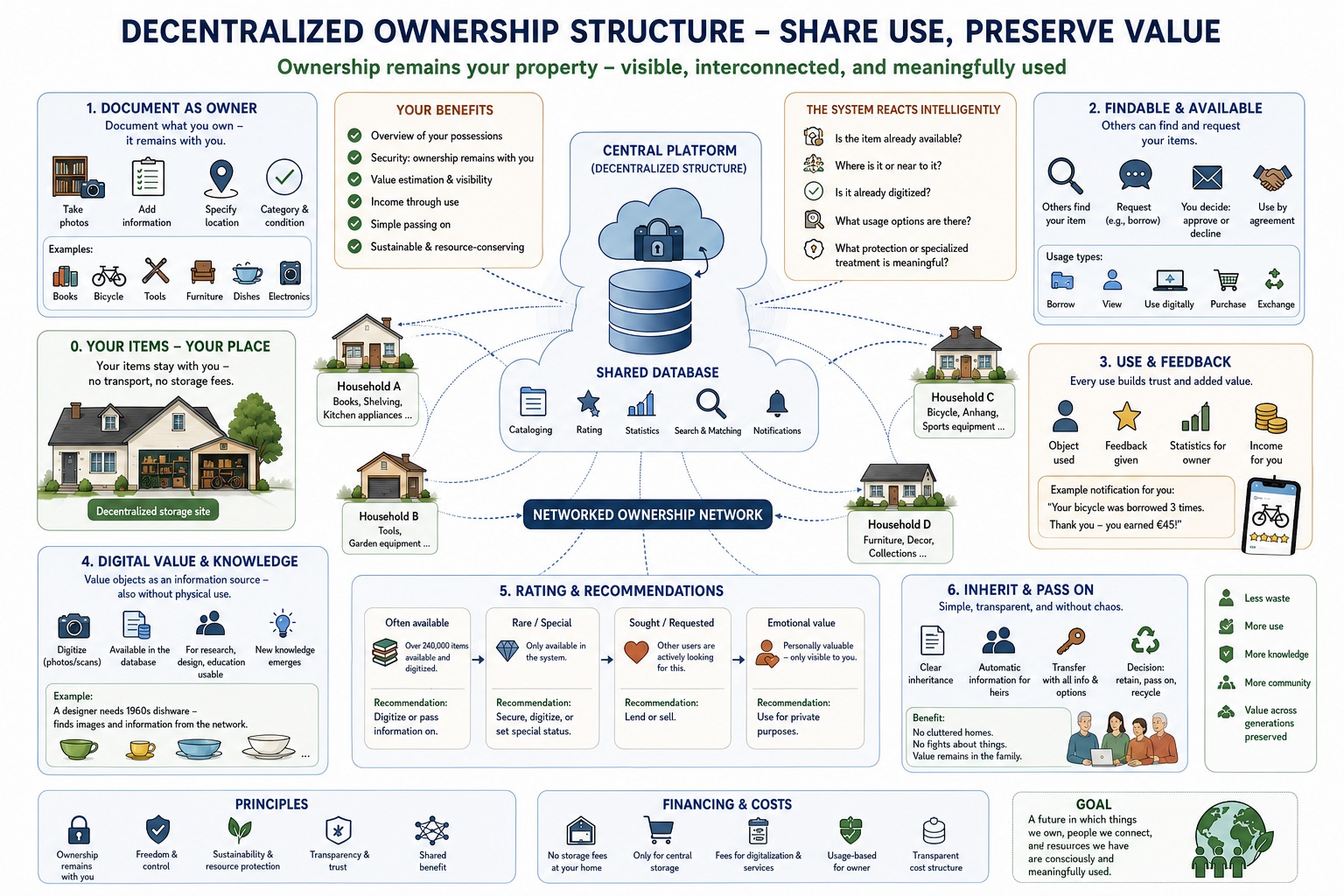
Translation note: The system architecture, steps 0–6, and most small labels are preserved clearly. The subtitle `Ownership remains your property` is redundant English, and the sample notification `Thank you – you earned €45!` is grammatically compressed. These are minor wording problems rather than conceptual errors.
Shared Use While Ownership Remains
This operational model collects, inspects, documents, values, stores, insures, repairs, and eventually releases privately owned objects for shared use. Owners retain decision-making power while users gain access without having to own everything. Fees support storage, management, insurance, maintenance, and ecological value preservation.
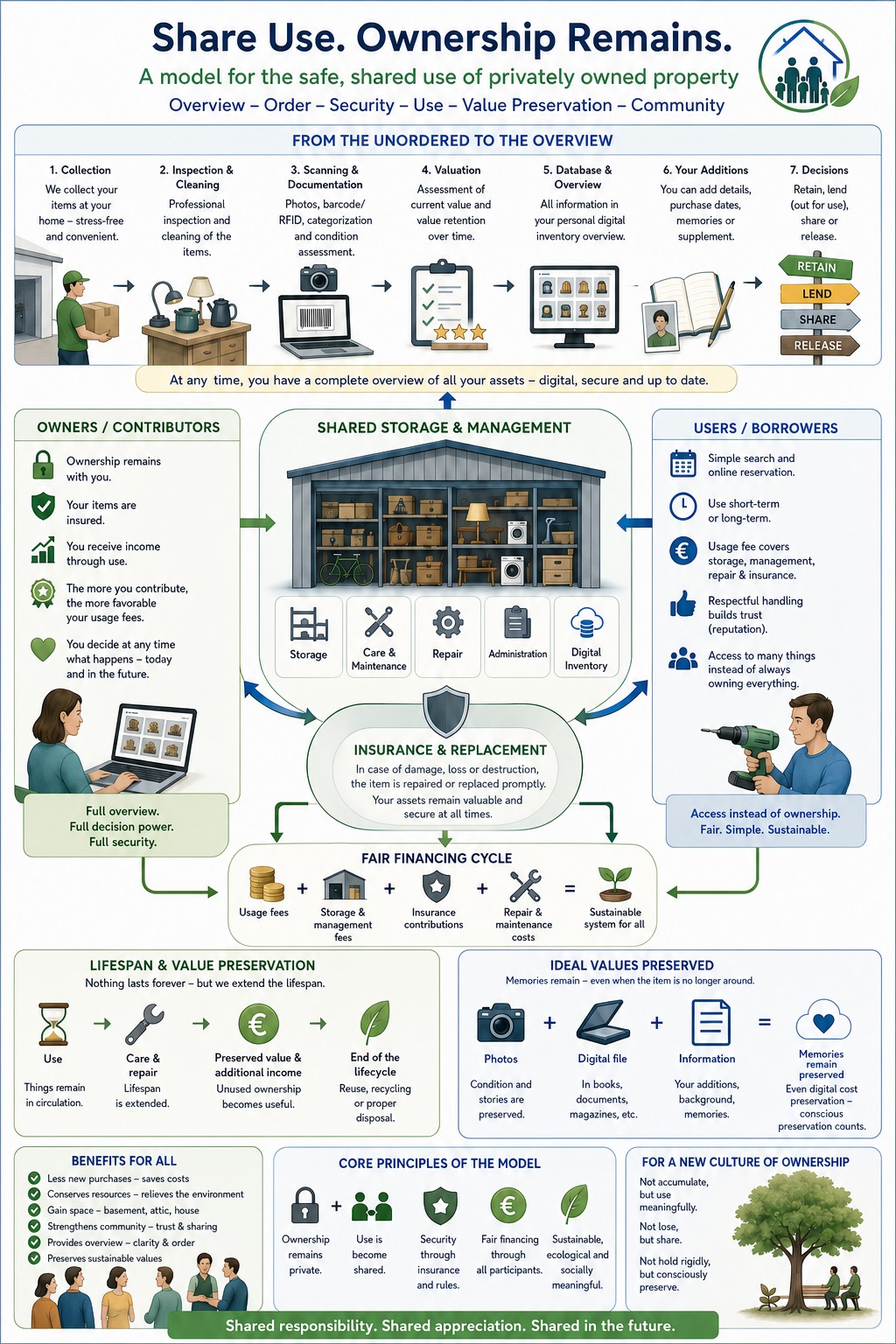
Translation note: The process and institutional roles are translated clearly. `Von der Unordnung zur Übersicht` became the awkward `From the unordered to the overview`. Step 7 changes `keep, share later, or let go` into four buttons `retain, lend, share, release`, losing the explicit later decision. `Ideelle Werte` is translated literally as `ideal values` rather than `intangible values`.
Philosophical Views of Desire
Epicurus, Plato, Aristotle, the Stoics, Augustine, Spinoza, Schopenhauer, Nietzsche, Freud, and Lacan offer different ways to understand desire: moderation, rational guidance, virtue, inner freedom, divine love, self-preservation, suffering, self-overcoming, unconscious drives, and permanent incompleteness. The image connects these perspectives with five human strengths.
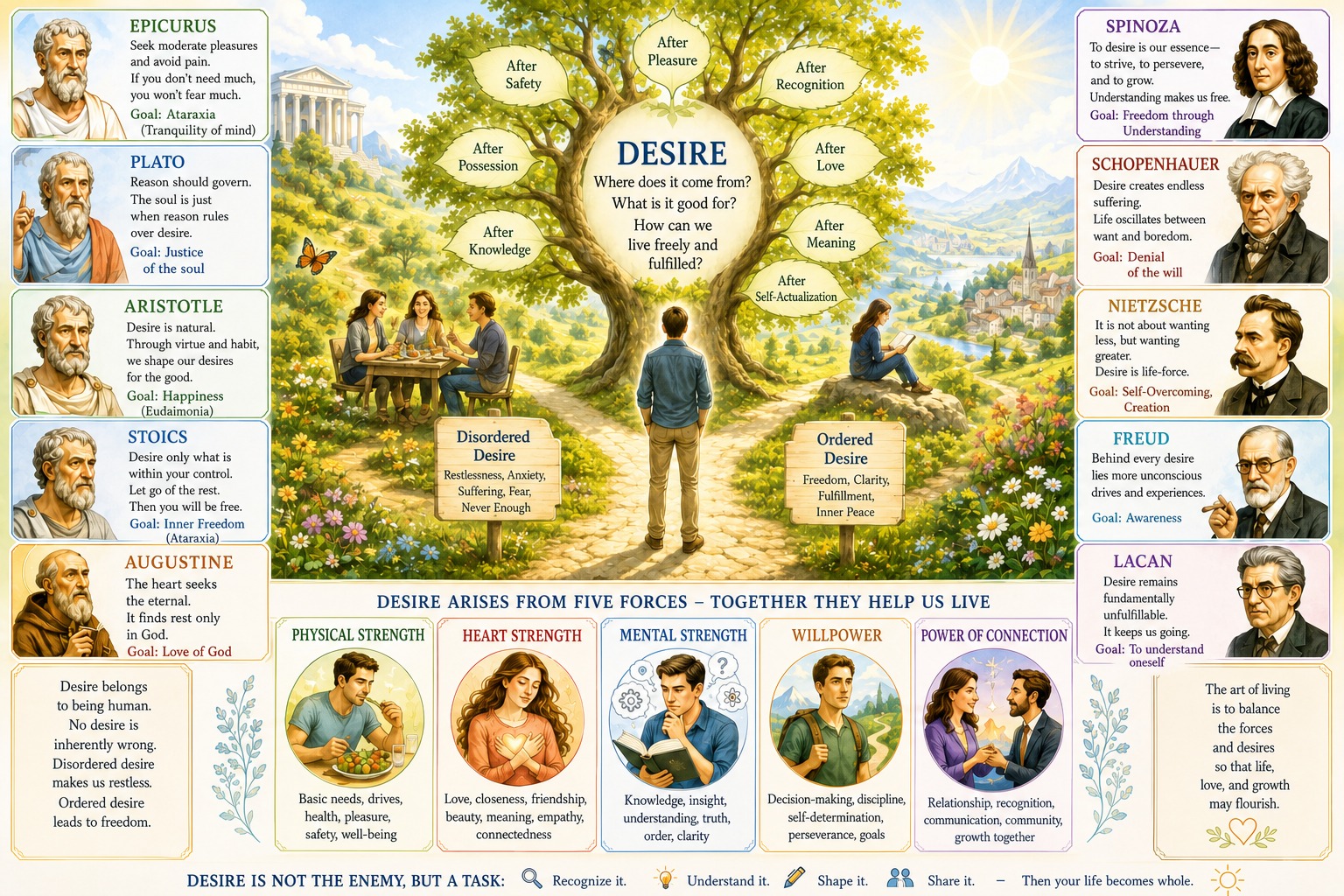
Translation note: Philosophers, portraits, main summaries, and force model are well preserved. The tree labels `Nach Sicherheit`, `Nach Besitz`, and similar phrases mean `desire for safety/possession`, but were translated as `After Safety/Possession`, a repeated grammatical and semantic error. The Stoic goal also adds `Ataraxia`, which was not written in the source panel.