Mistakes, Pitfalls, and Complexity
Mistakes are part of human learning and living. They may arise from missing knowledge, inexperience, exhaustion, relationships, harmful structures, or deliberate actions. A wise response therefore begins by asking what happened, who was affected, and what kind of help, protection, responsibility, or repair is needed.
The images on this page explore pitfalls, overload, complexity, boundaries, resilience, and a humane culture of learning from mistakes. They were translated and recreated with AI from the German source page. Small translation errors remain visible. Notes beneath the images identify important shifts in meaning and invite readers to examine the images critically.
Understanding mistakes and putting them into perspective
Before responding to a mistake, it helps to distinguish its cause, scope, and effects. Missing knowledge calls for explanation; inexperience calls for patience; overload calls for relief; harmful systems call for structural change; and culpable actions call for responsibility and repair. Wisdom neither dramatizes nor trivializes: it sees the truth, considers the people affected, and preserves love.
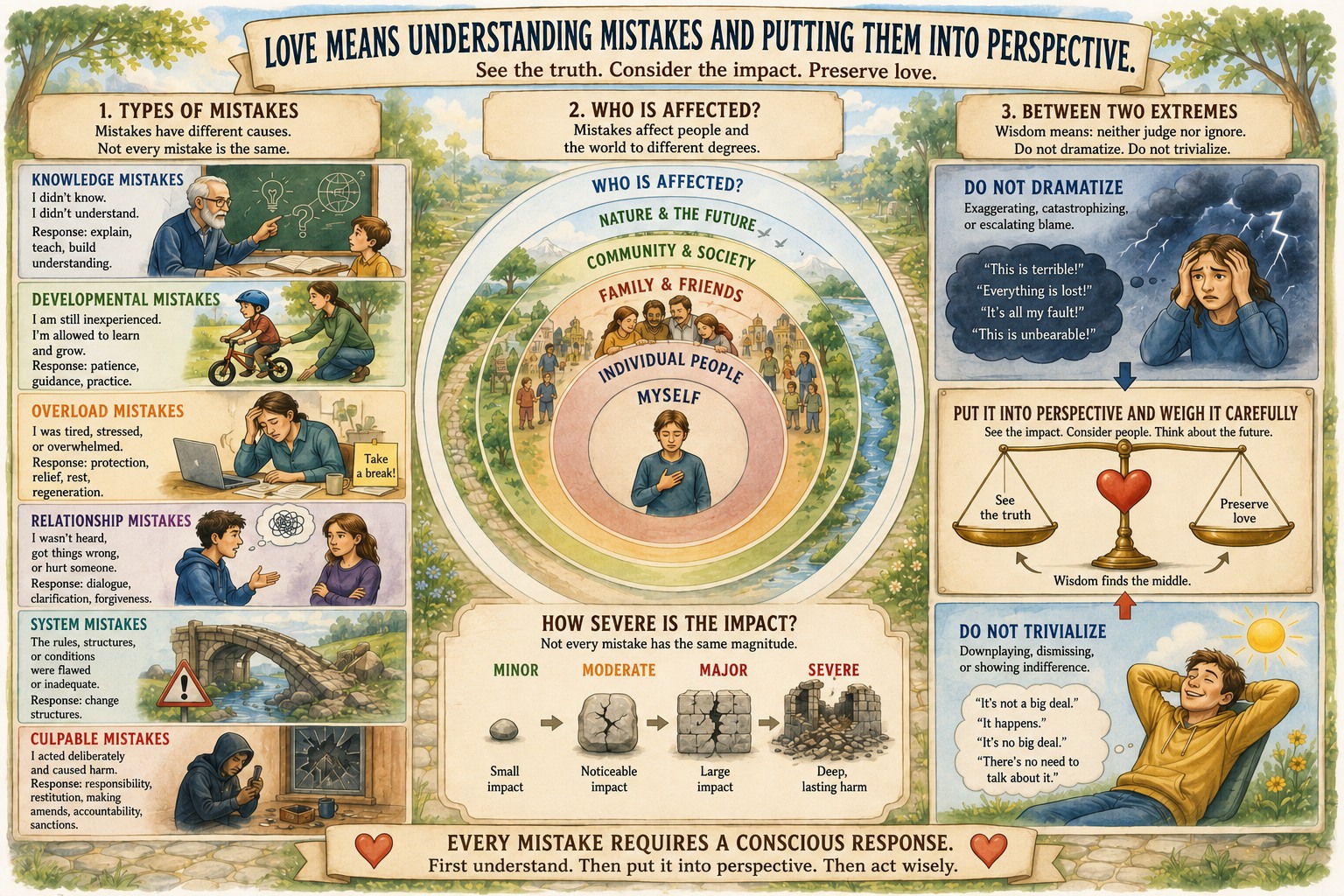
Translation note: The phrase “I am just bad” became “It is all my fault,” shifting the focus from self-condemnation to blame. The four impact levels were also simplified to “minor, moderate, major, severe.”
Why pitfalls are unavoidable
Human beings live within many connected systems: body, emotions, thought, will, relationships, technology, society, and finances. Each system offers opportunities, but each can also contain pitfalls. The important skill is not to avoid every fall. It is to notice early warning signs, build reserves, accept help, and find the strength to stand up again.
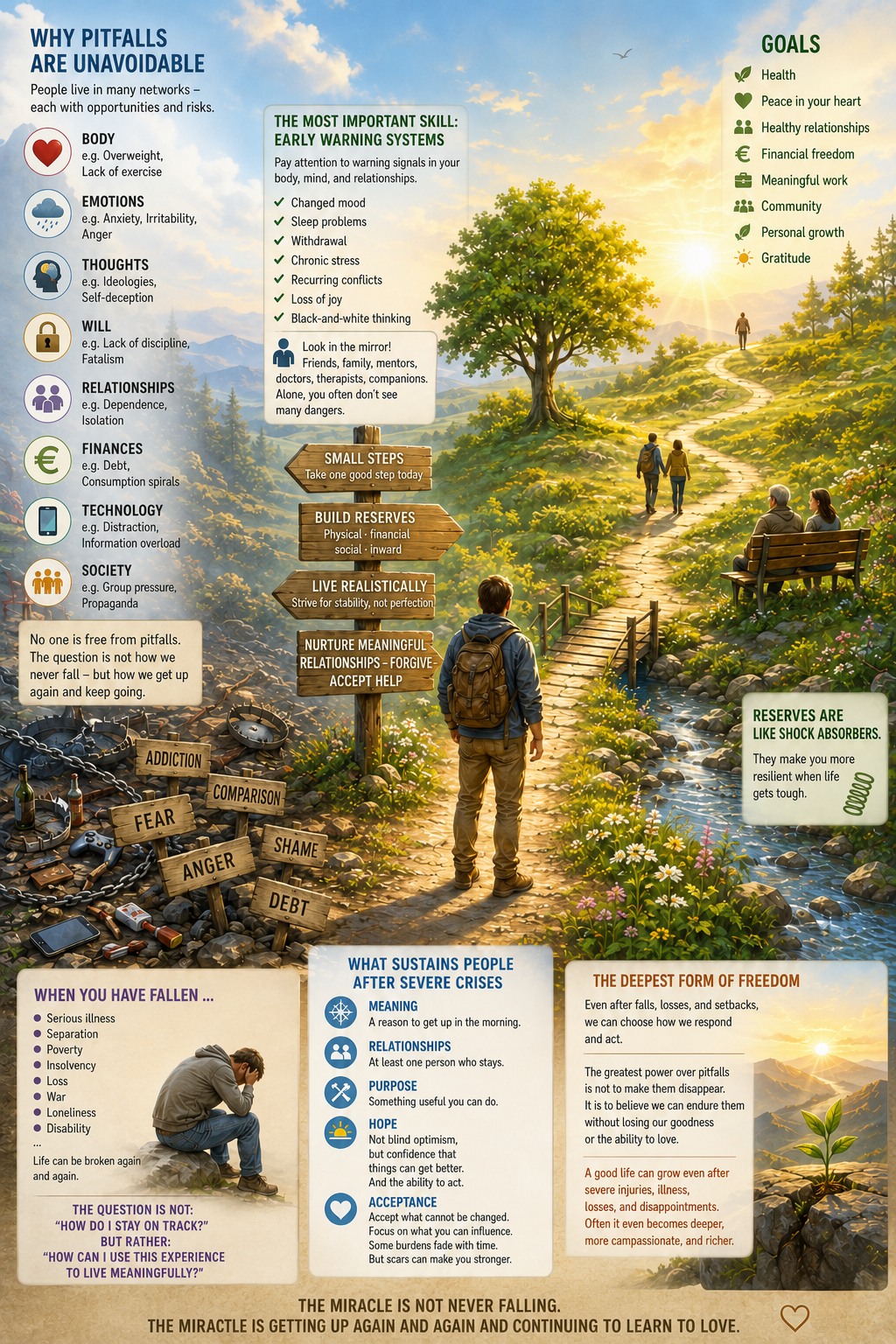
Translation note: The sentence “The old life cannot always be repaired” was changed in the image to “Life can be broken again and again.” The image remains understandable, but this sentence shifts the original meaning.
Recognizing pitfalls and understanding risks
Pitfalls differ in visibility, likelihood, and cost. Some are easy to recognize, while others slowly consume energy or narrow our view of reality. The overview encourages alertness without paranoia, caution without fear, and responsibility without the illusion of complete control.
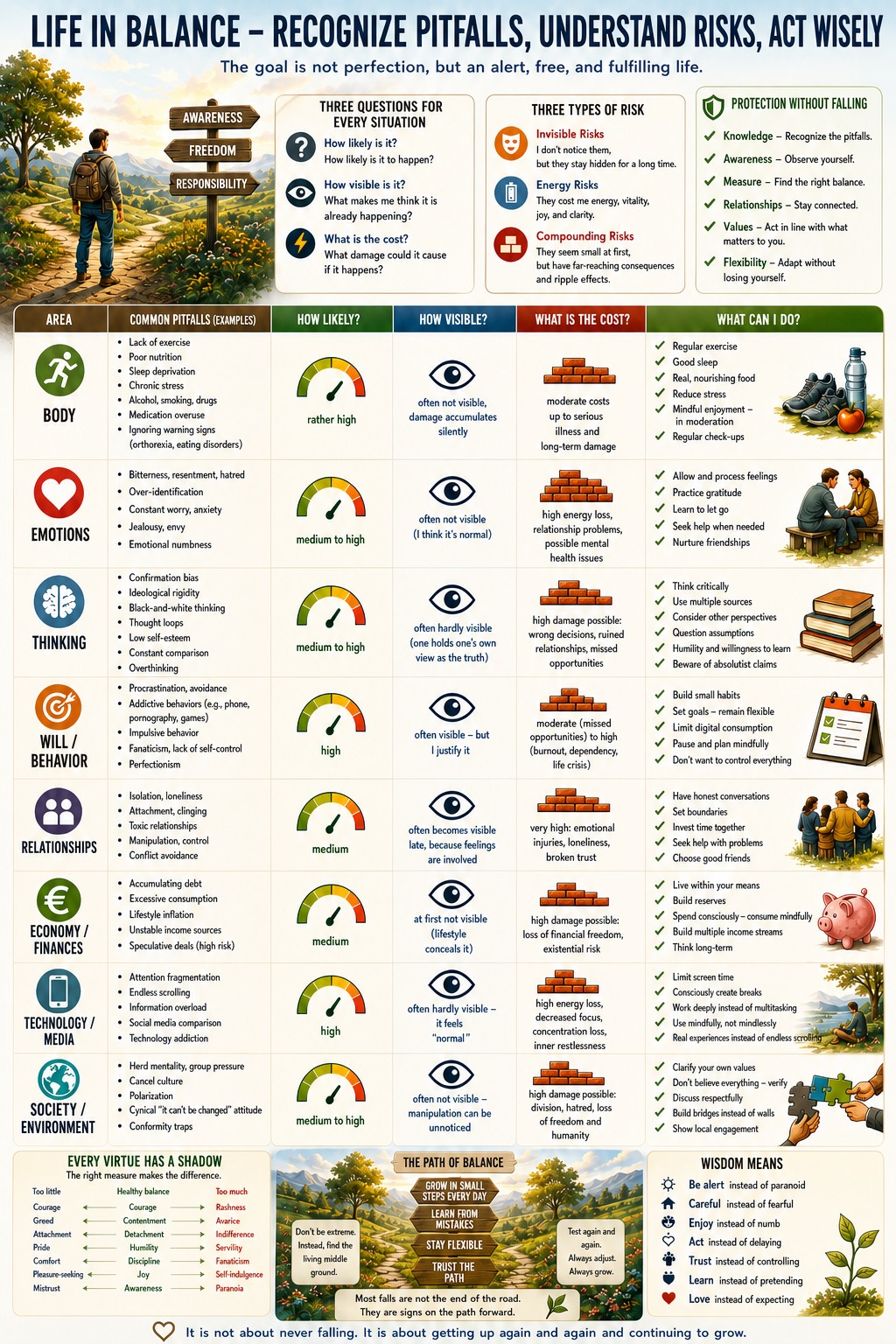
Translation note: “Protection without falling” is incomplete. The intended meaning is “Protection without falling into the opposite extreme.” Some very small table entries may also be shortened.
The guardians of caution and joy
Caution helps us see danger, think ahead, and protect life. Joy helps us notice beauty, gratitude, connection, and love. Wisdom needs both guardians: one prevents us from becoming careless; the other prevents fear from making us miss life.

Translation note: “Notice safety” sounds unusual in English; “Be mindful of safety” would be more natural. “Encounters” may also be understood more warmly as “meaningful connections.”
I am complex – and that is human
No person is only one thing. Body, thoughts, emotions, relationships, memories, culture, chance, and the expectations of others interact within us. We cannot understand everything at once. A loving response to complexity allows patience, humility, curiosity, and step-by-step learning.
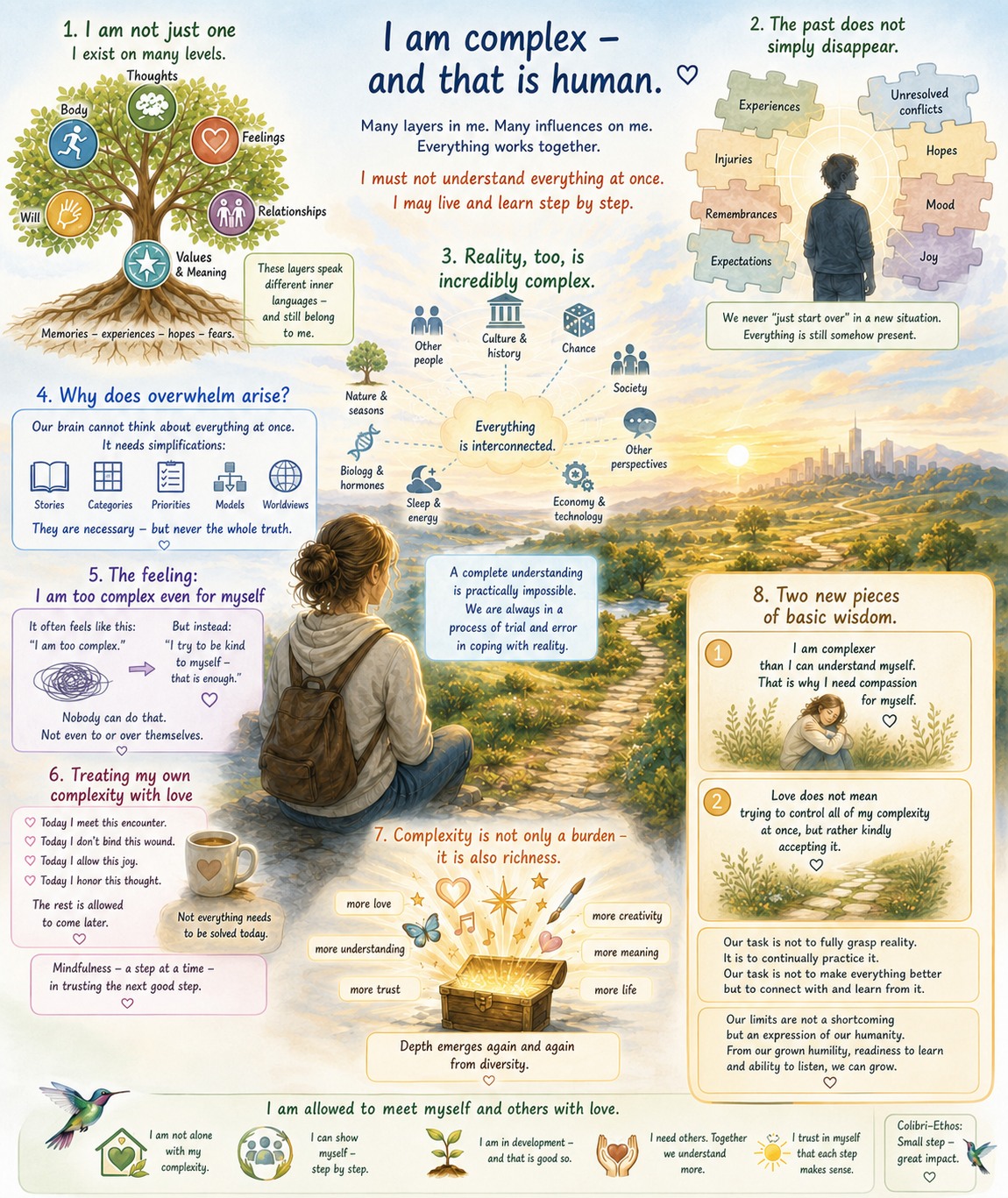
Translation note: “Mood” incorrectly replaces the German word for tiredness; “Fatigue” would be correct. “Today I meet this encounter” and “Not even to or over themselves” are grammatically unsuccessful small-text translations.
Two kinds of overwhelm – and two forms of wisdom
Some overload can be avoided by setting boundaries, saying no, sharing tasks, and planning realistically. Other forms of overwhelm belong to life itself: illness, loss, change, crisis, or a new responsibility. Then wisdom means seeking help, simplifying what can be simplified, and growing into reality one step at a time.
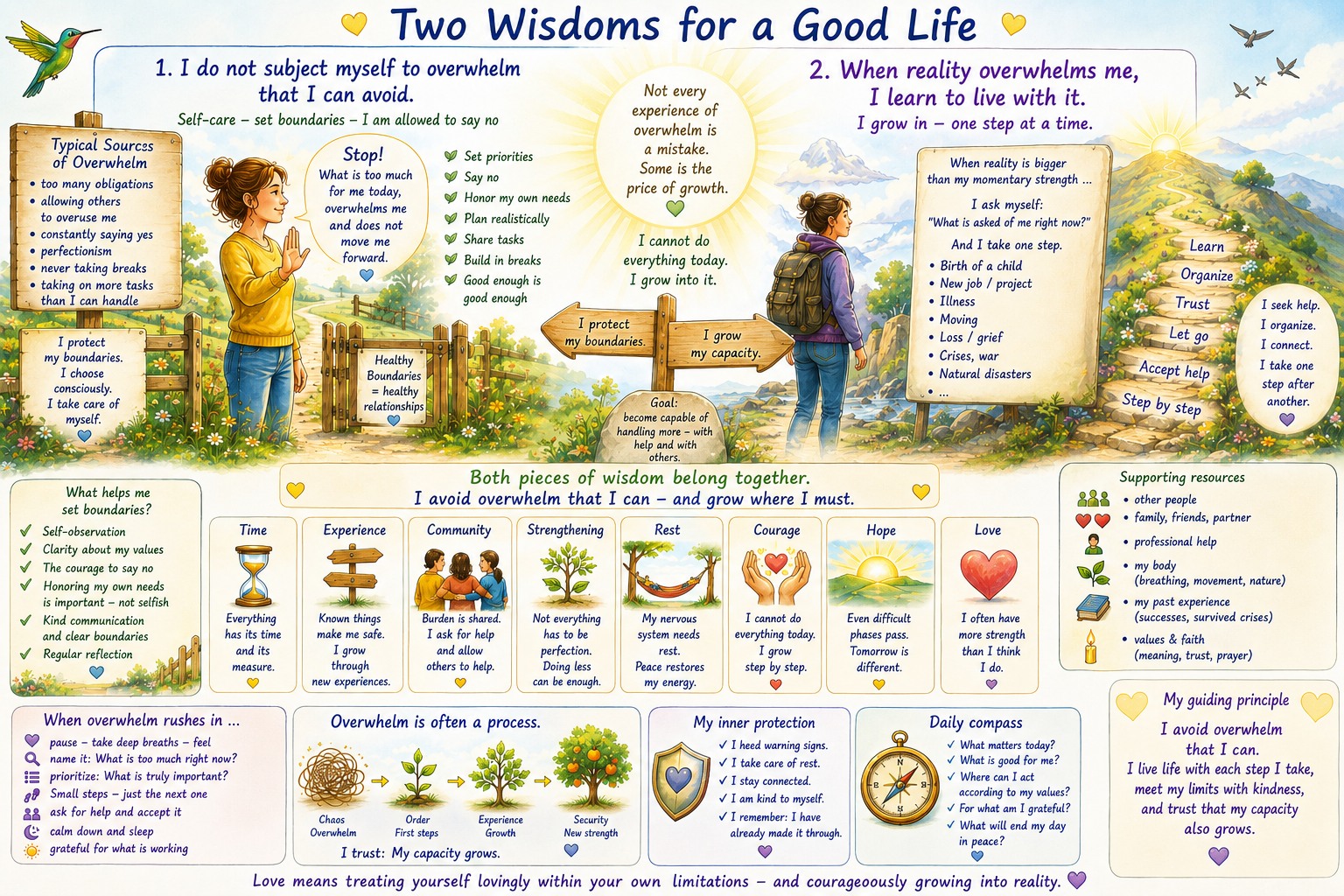
Translation note: Two resource labels are incorrect: “Strengthening” should be “Simplification,” and “Courage” should be “Humility.”
Between oversimplification and excessive complexity
Oversimplification can erase distinctions and close off questions. Excessive complexity can overwhelm us until action becomes impossible. The middle path is not a fixed compromise. It is the ability to simplify when orientation is needed and to explore complexity when depth and context matter.
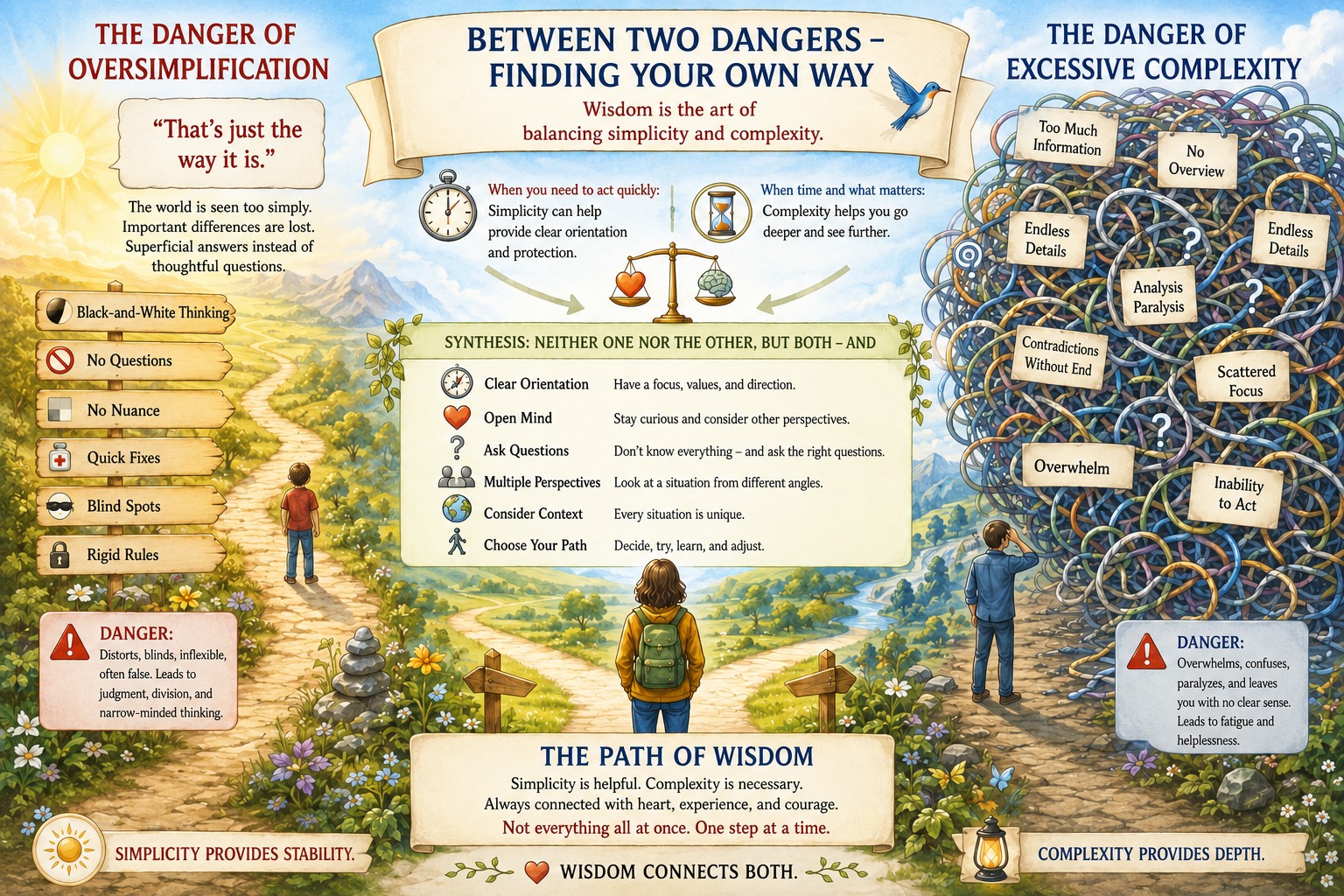
Translation note: “When time and what matters” is grammatically incomplete. The intended phrase is “When there is time and the issue matters.” The synthesis formula is understandable but slightly awkward in English.
Medicine for difficult times
We can protect ourselves from avoidable overload while learning to live with realities we cannot choose. Time, experience, community, simplification, rest, humility, hope, and love can become forms of medicine. They do not remove the difficult path, but they make it more possible to walk.
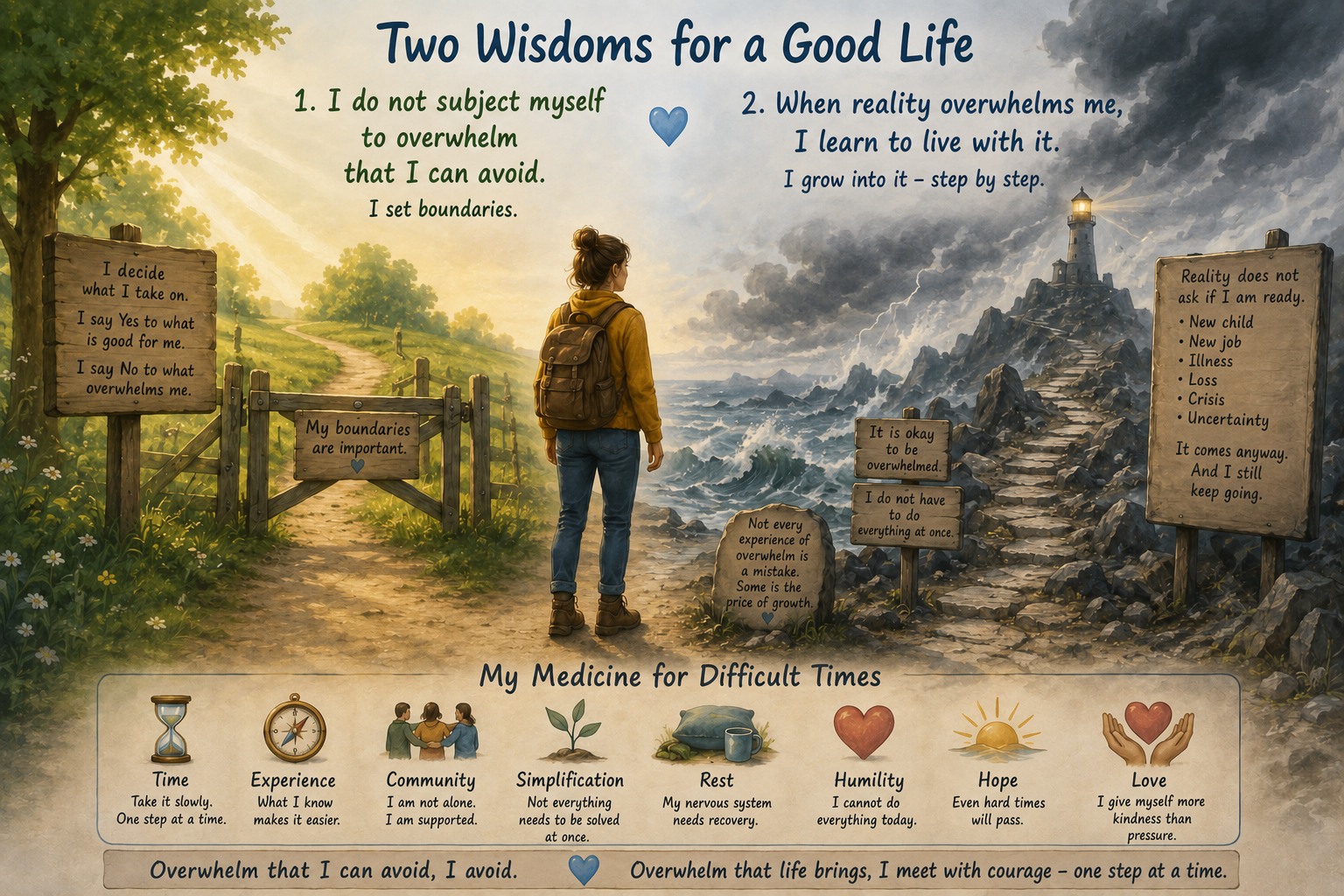
Translation note: “Uncertainty” stands here for “the unexpected.” The sentence “It comes anyway. And I still keep going” is more positive than the German original, which emphasizes being drawn into an unavoidable situation.
The Garden of Mistakes
A constructive culture of mistakes separates the value of a person from the seriousness of an action. It seeks truth without humiliation, responsibility without crushing shame, protection without dehumanization, and repair without denial. Learning from mistakes requires both clarity and love.

Translation note: “Avoidable mistakes” should be “Culpable mistakes.” “Take responsibility” replaces a section that originally asks readers to assess who is affected and how seriously. “Without excuses” should be “without shaming.”
From knowledge to wisdom – the art of learning
Mistakes and learning are closely connected. Retrieval, spaced repetition, elaboration, mixed practice, explanation, and self-generated examples turn information into usable knowledge. Knowledge becomes wisdom only when it is joined with experience, values, responsibility, and life.

Translation note: In the small “Wisdom” panel, the formula appears as “Wisdom = experience + values.” The German original also includes knowledge: “Wisdom = knowledge + experience + values.”
The images are offered as prompts for reflection, discussion, correction, and further learning. Their visible imperfections are part of that invitation.