
Forms of Love
Love becomes visible through many attitudes, actions, relationships, and recurring processes. The images on this page organize these forms without claiming that one form can replace all others. They invite readers to perceive what a situation needs and to connect feeling, understanding, strength, limits, and responsible action.
Filtering Floods of Information and Feeling
When information and emotions arrive at the same time, forms of love can serve as filters. Listening, understanding, encounter, help, cooperation, admitting mistakes, critical doubt, freedom, balanced closeness, pausing, gratitude, and protection ask different questions and lead toward a smallest possible loving action.
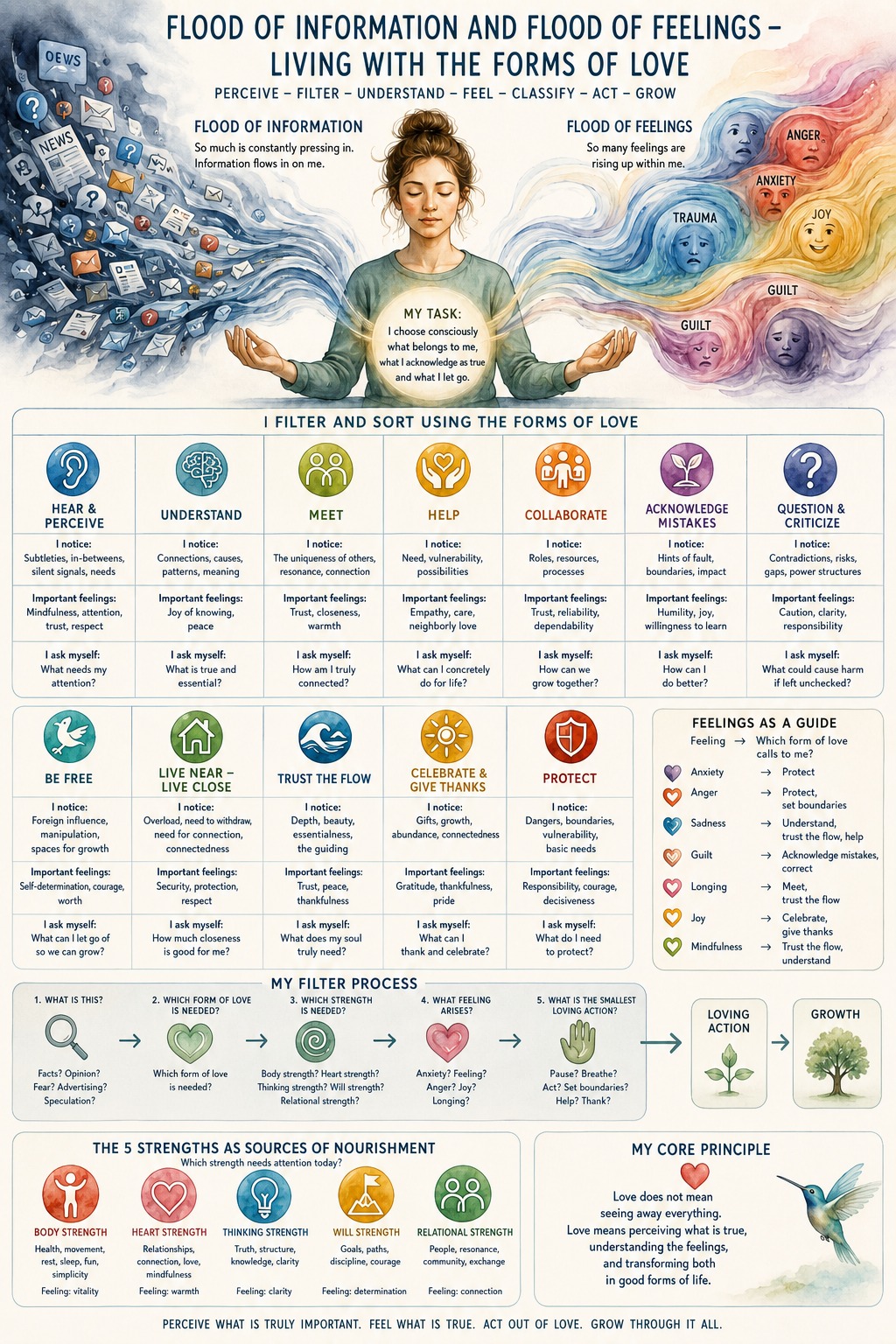
Translation note: The overall filter process remains understandable, but several emotion labels were changed: `Traurigkeit` became `Trauma`, one instance of `Wut` became `Anxiety`, and `Sehnsucht` became a second `Guilt`. `Verweilen` was changed to `Trust the flow`, and established force names became `body`, `thinking`, and `relational strength`. These changes materially alter parts of the model.
Six Fundamental Forms
Receiving, clarifying, realizing, releasing, resting, and balancing love form a circular model around the intention to love. Each movement combines two complementary attitudes and prepares the next.
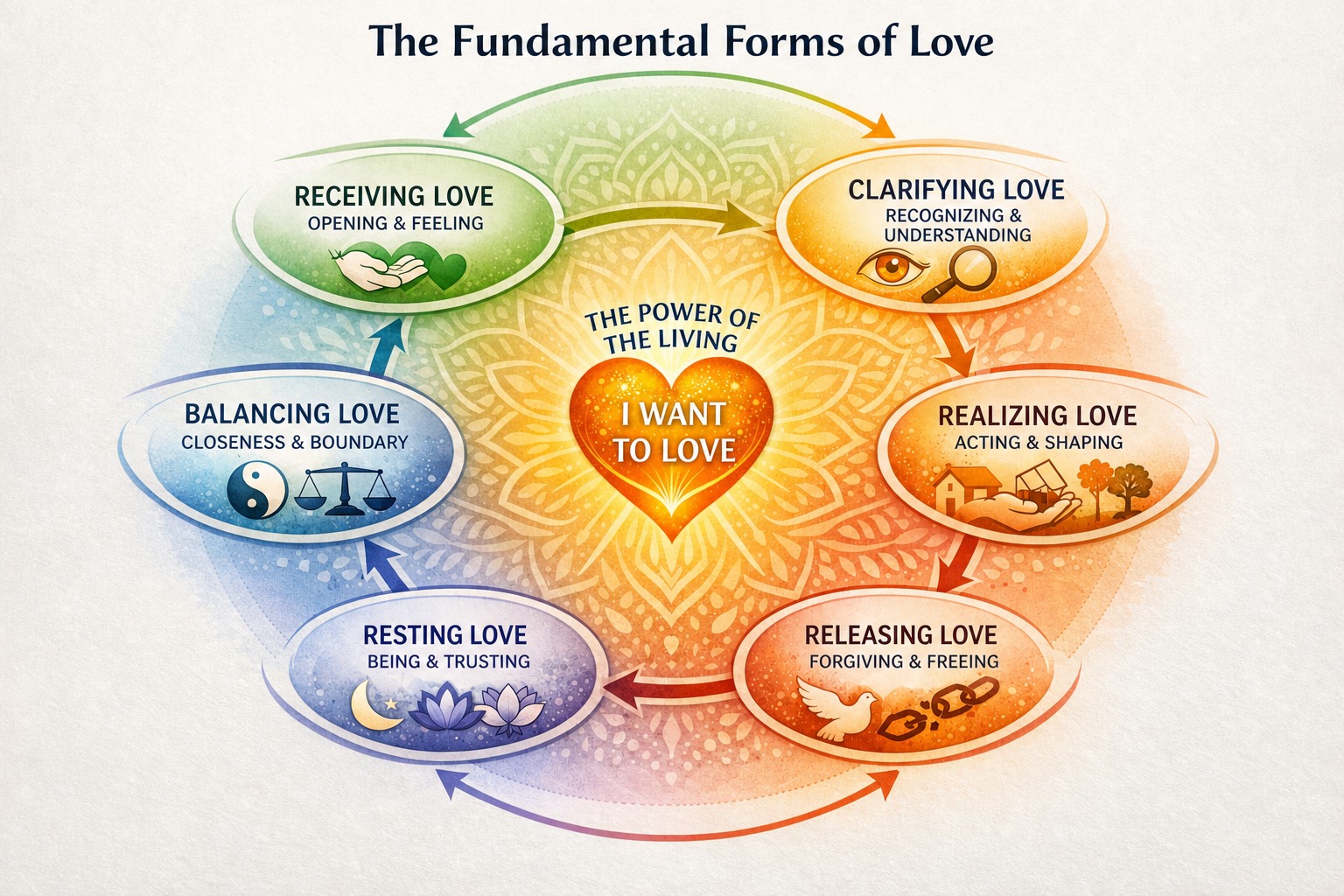
Translation note: The German source file is byte-for-byte identical to GrundformenLiebe.png` (same SHA-256 hash). The already checked English image was therefore reused under the required source-based filename. The translation is very strong; only `The Power of the Living` is less natural than `The Power of Life`.
Love Fields and Love Cycles
Ten broad fields of love connect encounter, closeness, service, truth, healing, growth, celebration, inner depth, freedom, and world responsibility. Cycles show how these fields move through recurring actions, while the lower arc presents a larger sequence from perception and encounter to protection, growth, shaping, healing, and celebration.

Translation note: The rich overall structure is retained, but several cycle verbs shift meaning. `Verweilen` is repeatedly translated as `Endure` rather than `linger/pause`; the learning cycle begins with `Endure` instead of `marvel`, and the time cycle contains repeated `Endure`. `Anwalt` is rendered literally as `Lawyer`, although `Advocate` better expresses the intended role.
Wanting to Love as a Beginning
The will to love is an entry point rather than love itself. A person can choose the path before understanding or feeling everything, then learn through understanding, feeling, encounter, action, trust, realization, and growth. Willpower gives direction and calls the other human strengths into motion.
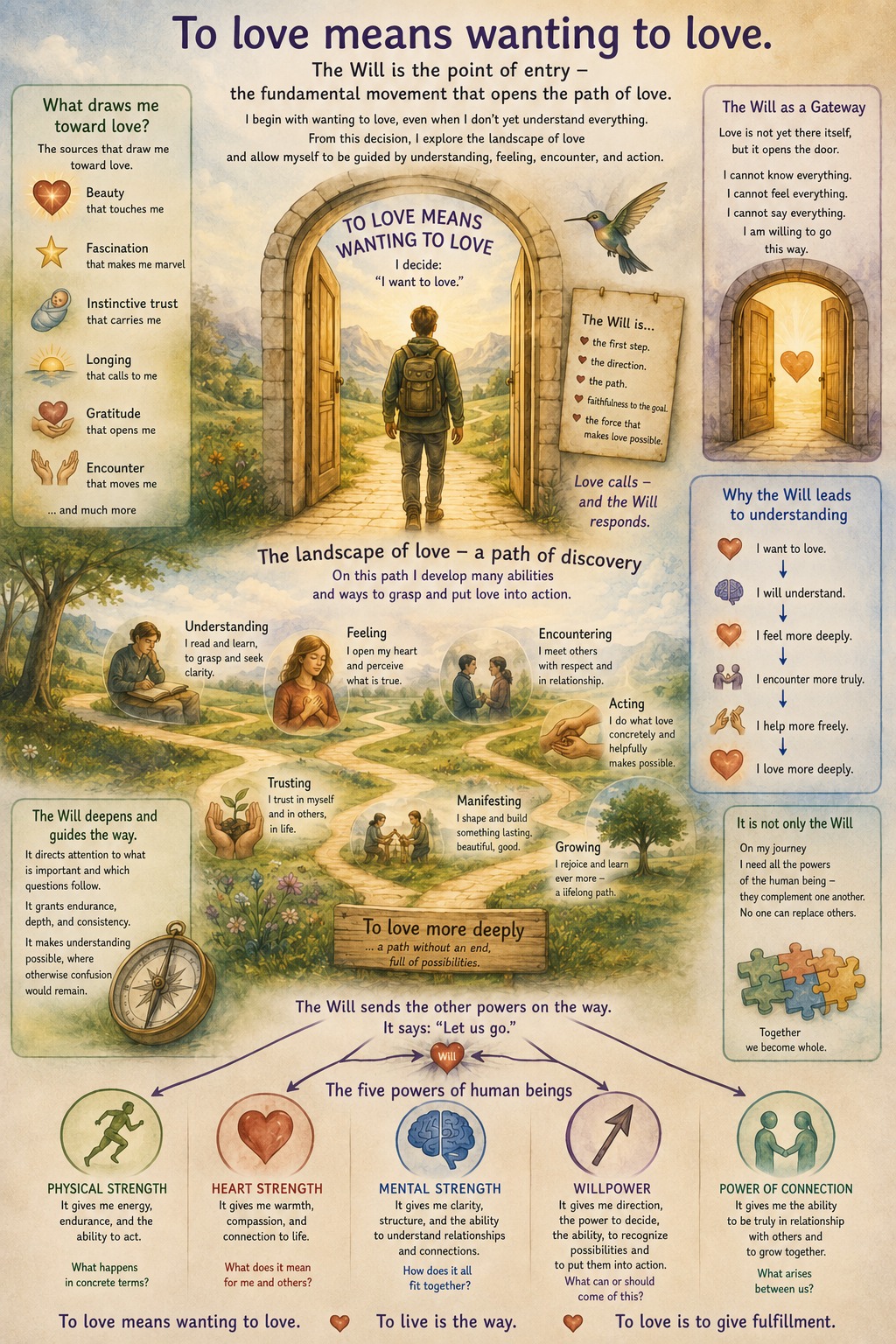
Translation note: The main distinction between will and love is preserved. In the gateway panel, `I do not have to say everything` replaces `I do not have to feel everything`. In the right process, `I act more helpfully` becomes `I help more freely`. The closing `Living love is the path` is shortened to `To live is the way`, losing the word love.
Wanting to Love Has Many Roots
The intention to love grows from what life has already given: bodily security, affection, knowledge, role models, community, freedom, meaning, hope, and courage. These sources become fruits such as understanding, help, forgiveness, listening, compassion, encouragement, gratitude, and wonder, which can then be passed on.

Translation note: The overall tree, cycle, and five strengths are translated clearly. The fruit `Staunen` (marvel/wonder) became `Show Patience`, a semantic error. `Begegnungskraft` is shortened to `Connection Strength`, and `a touched heart` is a literal but awkward rendering of `ein berührtes Herz`.
Dangers and Healing Forces
Injury, hopelessness, fear, cynicism, overwhelm, guilt, substitute goals, inner conflict, and distortion can weaken the intention to love. Forgiveness, hope, trust, wonder, rest, acceptance, reflection, clarity, and meaning can nourish it again. The central path presents love as a lifelong practice of renewed decision.
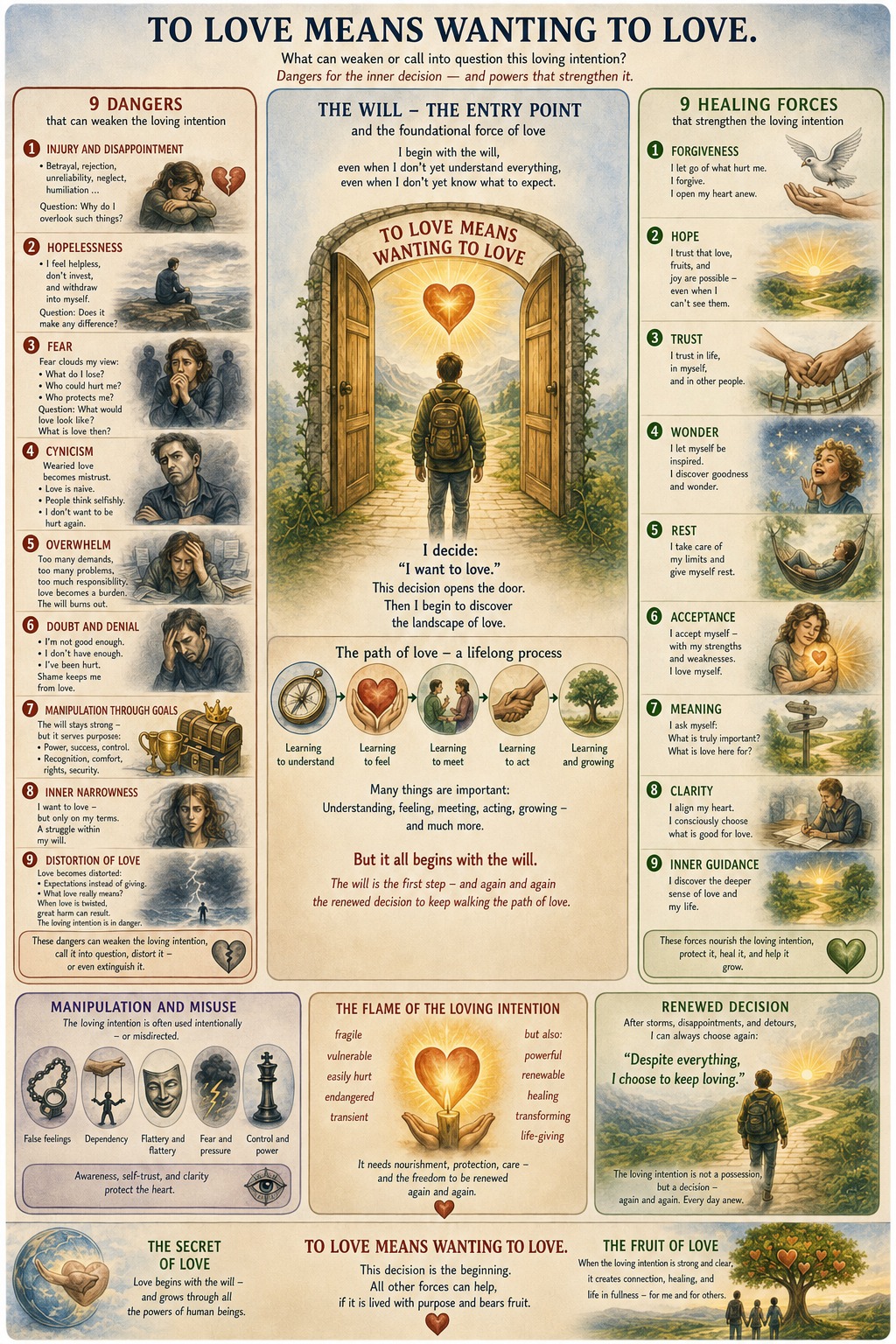
Translation note: The two nine-item columns and central argument remain understandable. `Besinnung` is rendered as `Meaning` instead of reflection/contemplation, while `Sinn` becomes `Inner Guidance`. In the manipulation panel, `Schuldgefühle` (feelings of guilt) became `False feelings`, which changes the identified risk.
The Cake of Love
The cake metaphor presents forms of love as pieces that can be chosen, enjoyed, and practiced one at a time. Understanding, empathy, listening, gratitude, forgiveness, help, encouragement, trust, wonder, and acceptance can each produce small fruits of love without turning love into performance.

Translation note: This is a strong and readable translation. The ten cake slices and central message are accurate. In the fruits section, `Versöhnung` (reconciliation) became `Comfort`, and `ein freundlicher Blick` is simplified to `a kind look`; these are local rather than structural errors.
Beauty and Limits of Love-Form Models
Models make diversity and relationships visible, but they can also fragment love, encourage perfectionism, rationalize experience, moralize people, and overlook receiving, failure, the unconscious, and the deeper sources of trust and connection. Forms of love are blossoms of a larger living source, not a checklist that produces love.
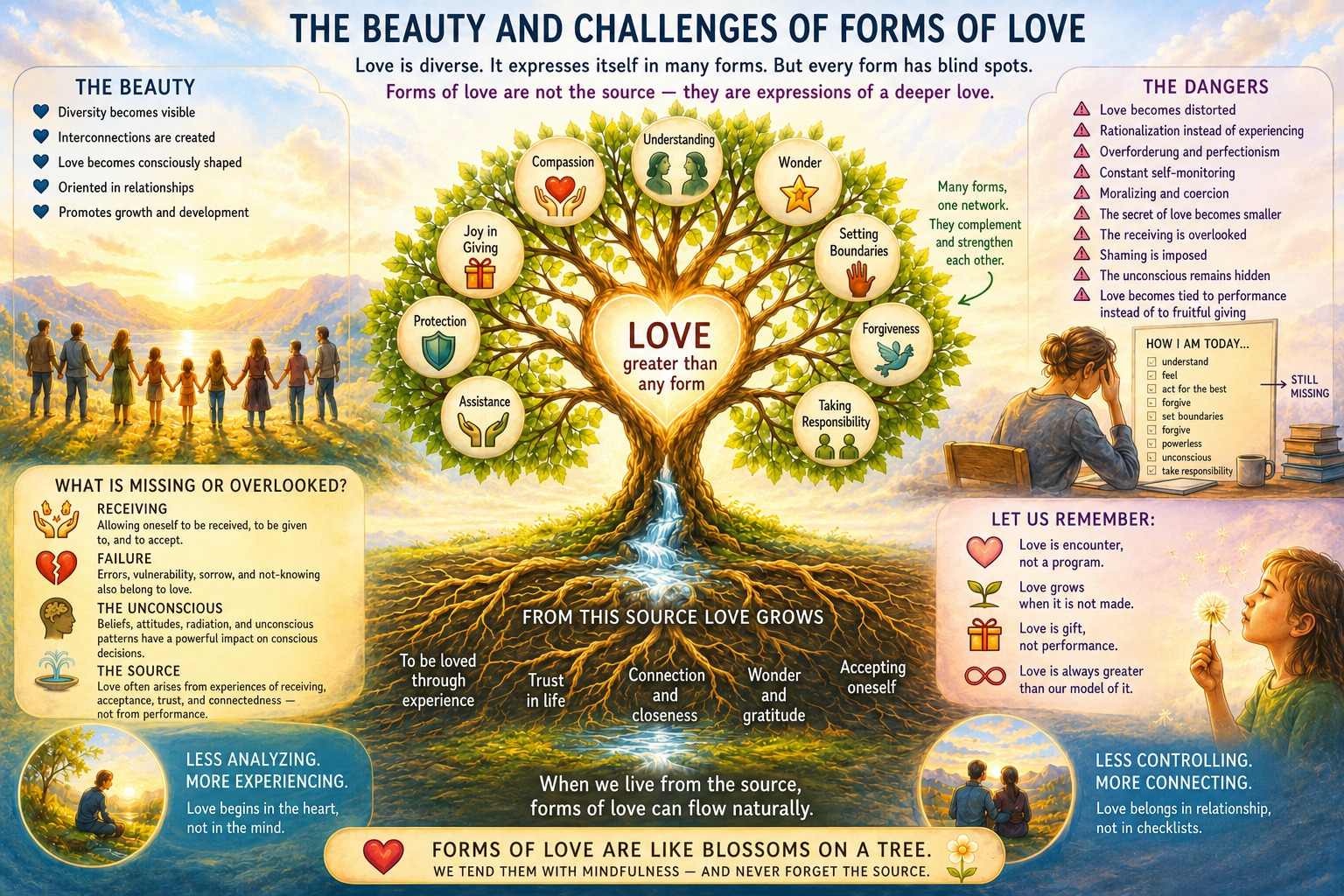
Translation note: The critical message, roots, dangers, and source panels are preserved well. The tree label `Wertschätzen` (appreciating) became `Wonder`, duplicating another concept. The checklist is substantially scrambled: source entries such as planned/responsible are replaced by `powerless` and `unconscious`, so it should be read only as an illustration of checklist pressure.
A Network of Mutually Shaping Forms
Forms of love can prepare, strengthen, limit, refine, heal, and integrate one another. The central graph shows that mature love does not depend on one dominant form; it emerges from a situation-sensitive network of understanding, trust, boundaries, rest, wonder, willingness, and action.
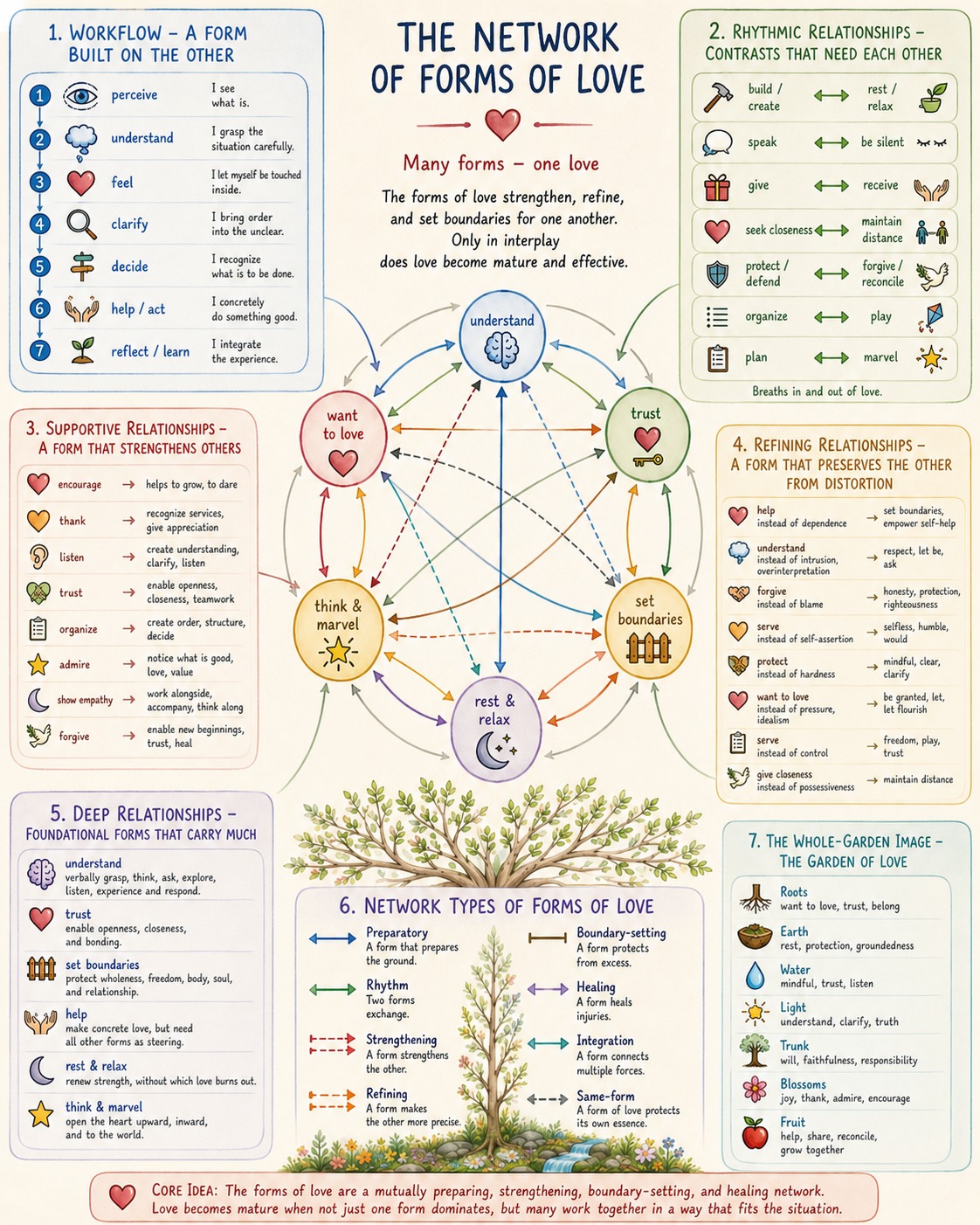
Translation note: The graph, workflow, rhythm pairs, and garden principle remain understandable. In the supportive list, `sich ausruhen` (resting) became `show empathy`, and several effects of gratitude and listening were freely replaced. In the legend, `Gegenform` (counter-form) became `Same-form`, reversing the relationship type.
Every Form Can Appear Central
The same network looks different depending on whether a person begins with help, understanding, trust, boundaries, wonder, or letting go. Going more deeply into one form can reveal all the others. At the same time, overemphasis can turn help into a helper syndrome, understanding into intrusion, closeness into enmeshment, or self-love into egoism.
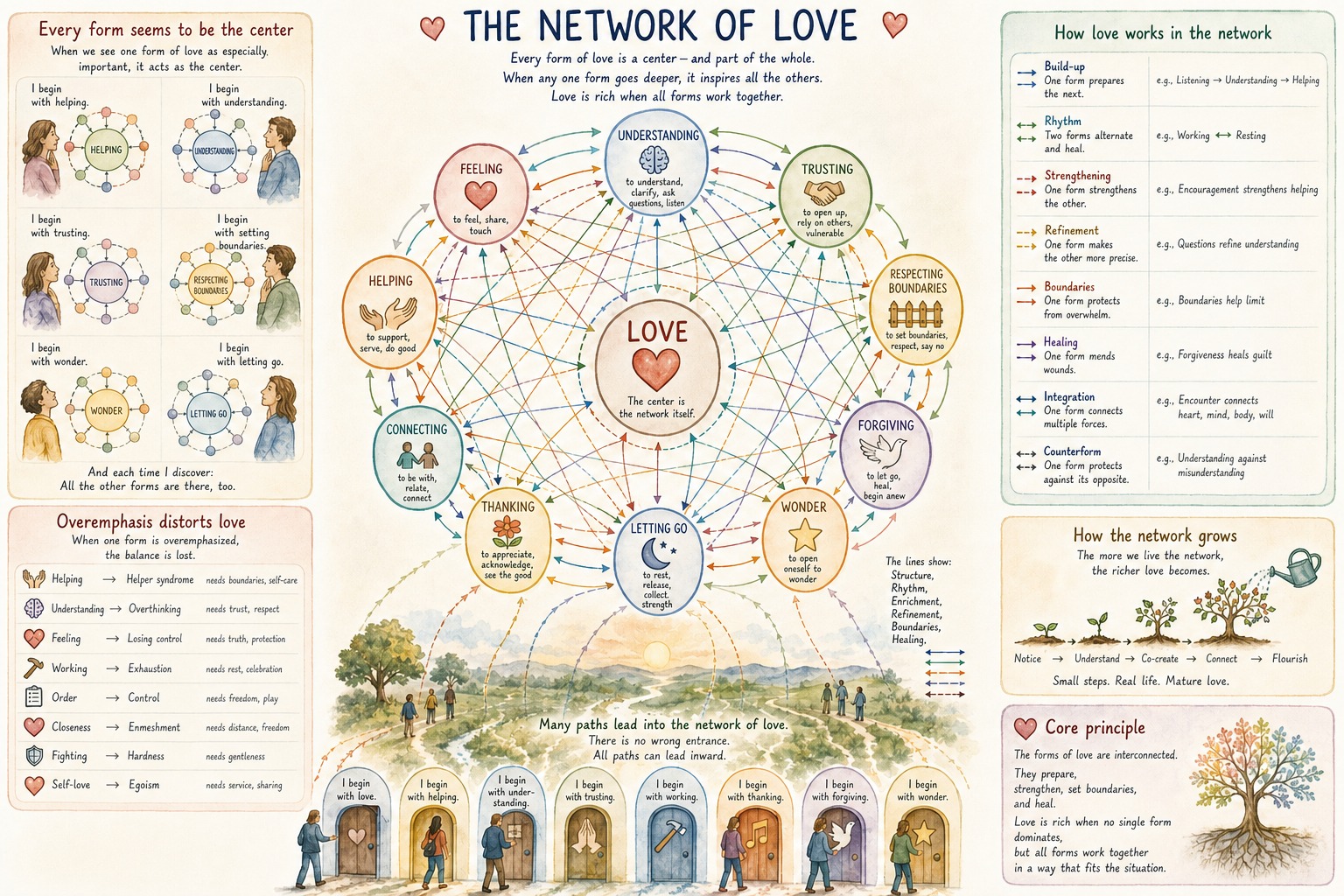
Translation note: The center-perspective idea and dense network are translated well. `Mitfühlen` becomes the weaker `Feeling`, `Begegnen` becomes `Connecting`, and `Ausruhen` becomes `Letting Go`. Some distortion remedies are changed, but the core warning against a single dominant form remains intact.
Love in the Now
Large love is built from small present actions: listening to one sentence, carrying one bag, clearing one desk, thanking for one glass of water, understanding one thought, releasing one anger, protecting one creature, or resting for three minutes. Respecting limits makes the next loving step possible.

Translation note: The central scene, next-step message, and small actions are especially clear. `Schützen` is softened to `Care` rather than `Protect`. The established `mental strength` and `power of connection` are replaced by `thinking strength` and `relating strength`; the meanings remain understandable.
Five Strengths and Forms of Love
The five strengths and forms of love answer different questions. Strengths analyze bodily, emotional, mental, volitional, and relational dimensions; forms of love ask which concrete quality of action may help. Used together, they support understanding, decision, action, growth, and responsibility across personal, relational, organizational, social, and spiritual life.
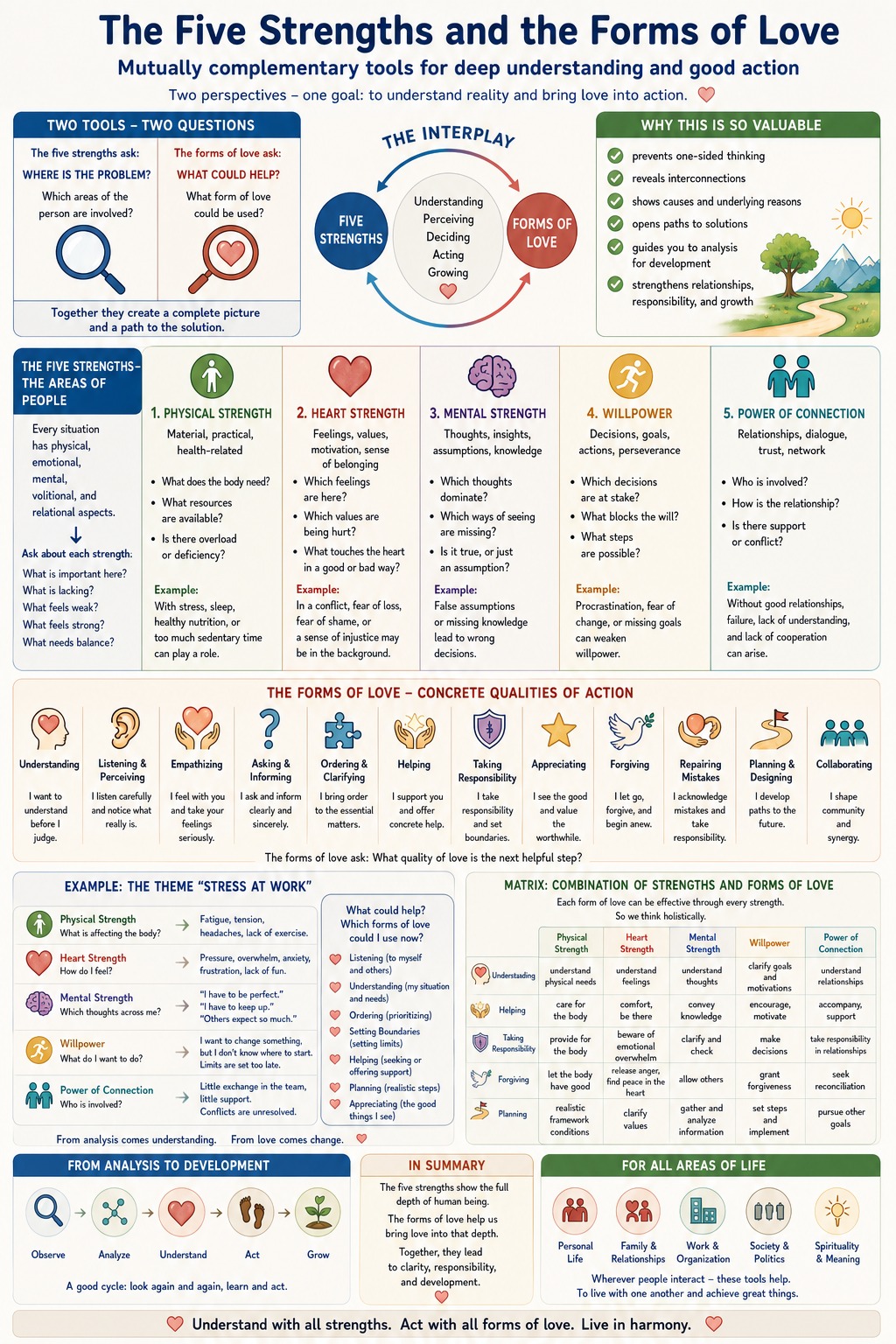
Translation note: This is a very strong translation of a highly detailed image. The five columns, forms-of-love row, workplace-stress example, matrix, and summaries are preserved. Only small phrasing choices, such as `areas of the person` for `Bereiche des Menschen`, sound slightly unnatural.
From Feeling to Loving Action
A signal feeling calls attention to what matters. A suitable form of love then calls forth further feelings and strengths, leading to action and integration. Anger may call for boundaries, fear for protection, grief for comfort, longing for connection, guilt for admitting mistakes, joy for gratitude, and doubt for inquiry.
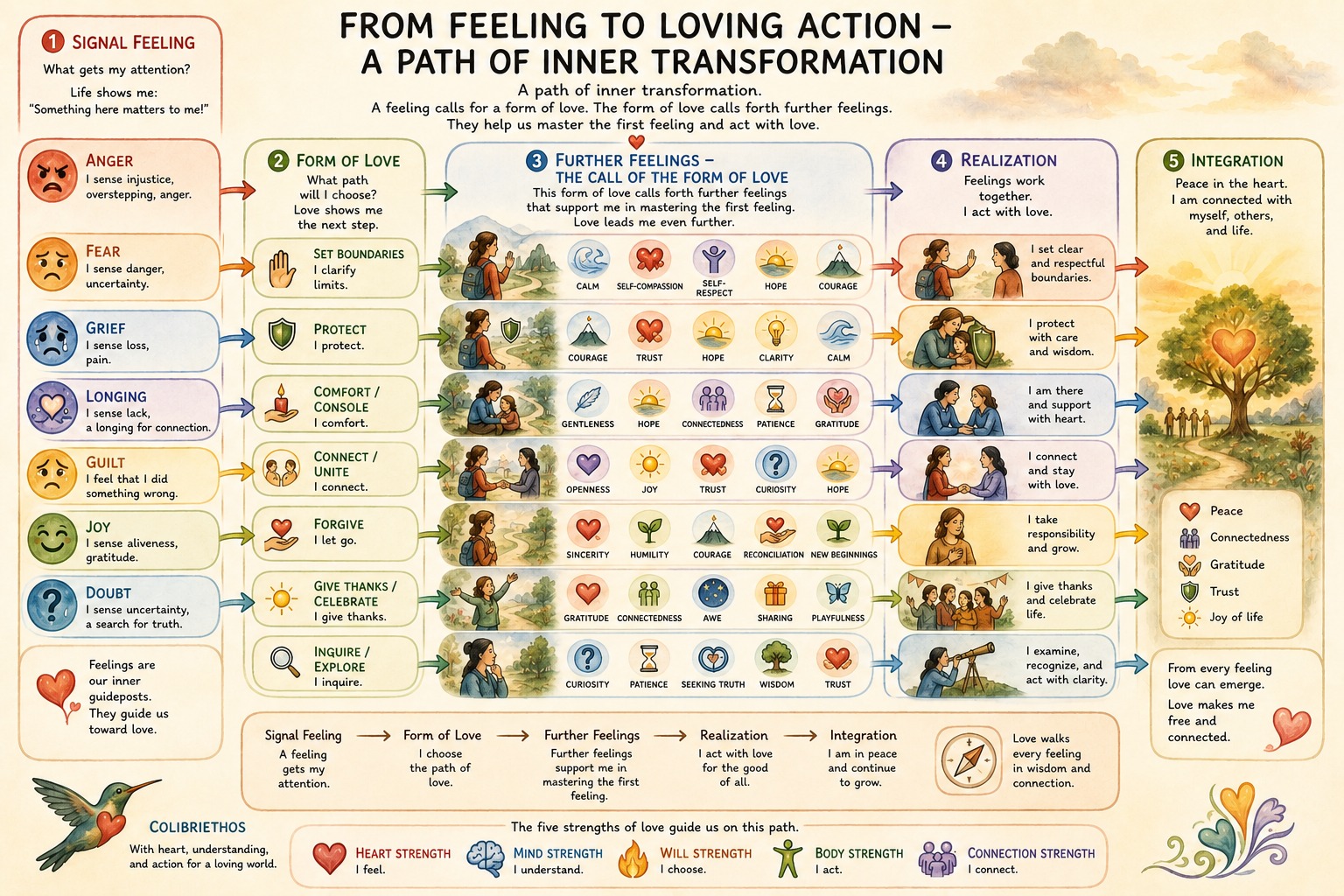
Translation note: The five-stage model and most feeling rows are translated accurately. The guilt row incorrectly changes `admit mistakes` to `Forgive`, even though the following feelings and realization still point toward responsibility and a new beginning. Established strength names are shortened at the bottom to `mind`, `will`, `body`, and `connection strength`.
Feelings Nourish Forms of Love
A first feeling can draw attention to injustice, danger, loss, longing, guilt, joy, or uncertainty. It may call forth a fitting form of love: setting boundaries, protecting, comforting, connecting, helping, cooperating, or making amends. Courage, self-respect, calm, hope, compassion, joy, trust, patience, and humility then help this response mature into a good result.

Translation note: The structure and almost all central terms are very clear. In the self-respect row, `I am valuable and may stand up for myself` is narrowed to `I value myself and may set boundaries`. The compassion sentence `I see what is human in the other` becomes the awkward `I feel with others in humanity`; the overall meaning remains recognizable.
Thinking and Feeling Call Forth Forms
Thinking and feeling offer two entrances into the same network. Perception may lead to questions, criticism, clarification, and deeper understanding; compassion may lead to helping, encounter, and further questions. Both paths require the five powers before insight becomes action, experience, and new learning.
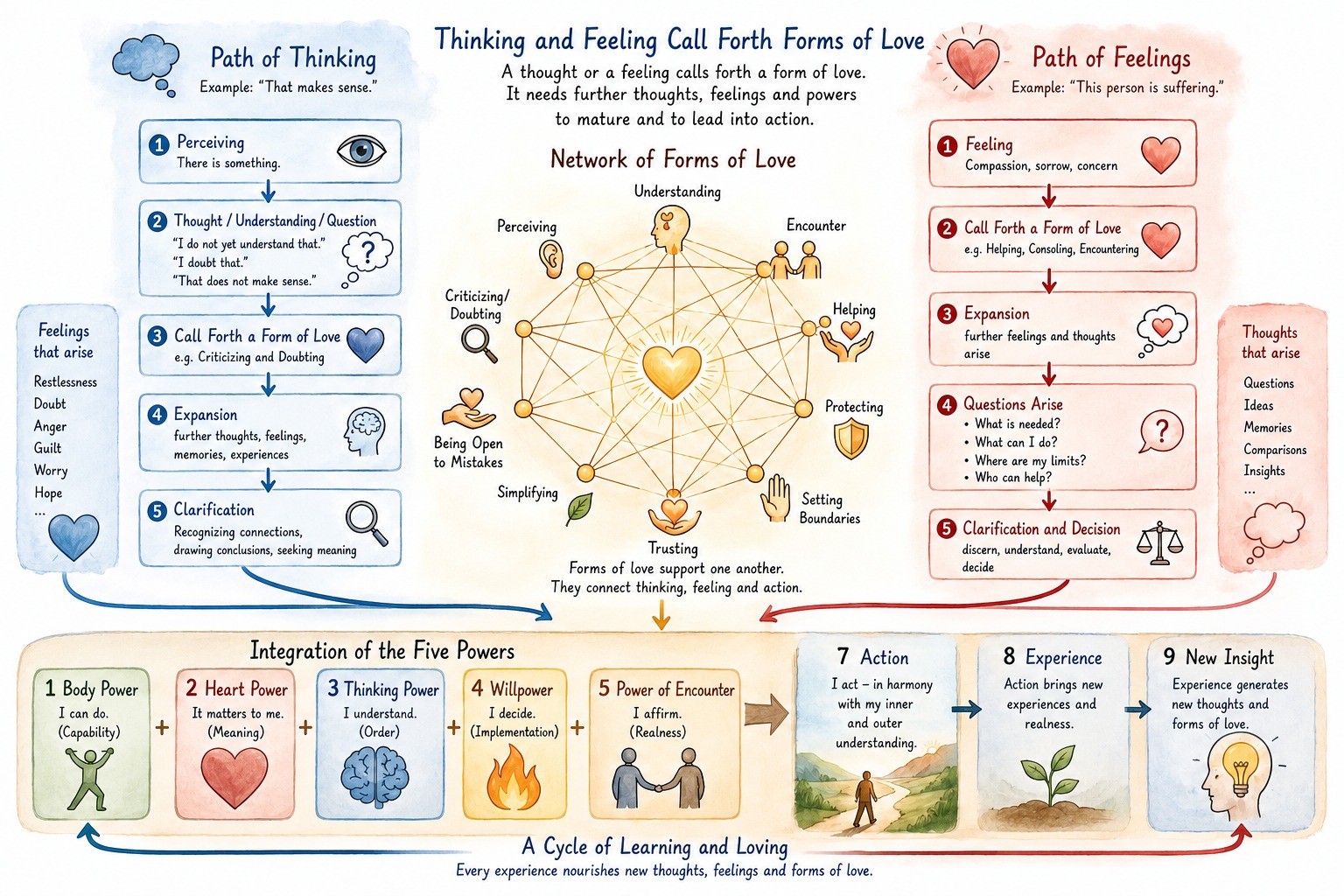
Translation note: Several visible details change meaning. The left example `Something is not right here` becomes `That makes sense`. The left feelings list replaces courage, patience, and concern with anger, guilt, and worry. `I coordinate it` becomes `I affirm`, and the action text changes outer circumstances to outer understanding. The network and the two-path learning cycle nevertheless remain understandable.
From Loving Act to Loving World
Words, feelings, forms, movements, melodies, organization, spatial design, archetypes, ethics, symbols, stories, and atmospheres interweave. A single loving act can connect with others, condense into a pattern, become embodied in a structure, and help shape a shared world. These larger structures in turn sustain and nourish new acts.
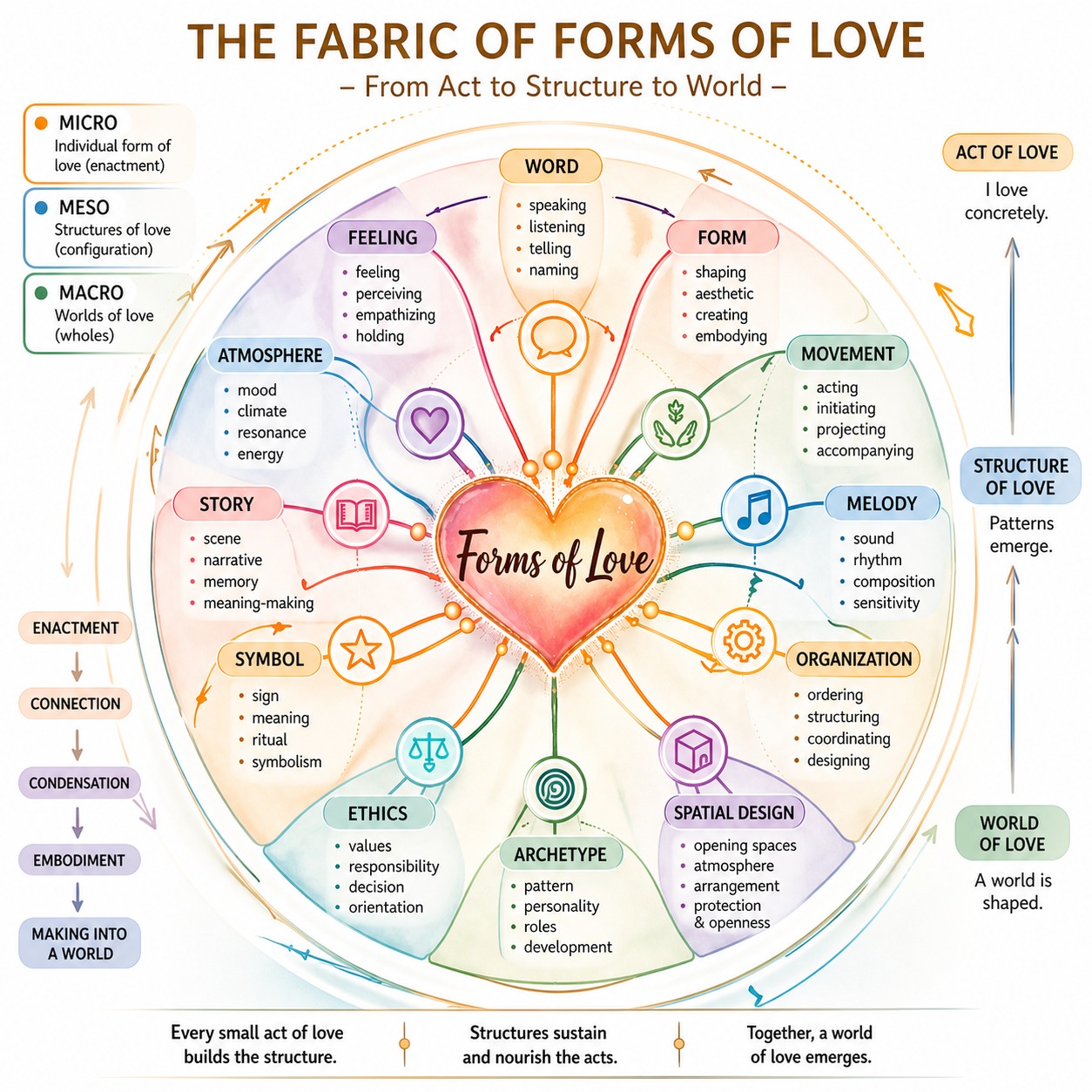
Translation note: This is an exceptionally complete and readable translation. All twelve fields, the micro–meso–macro distinction, both development sequences, and the three concluding statements are preserved. `Making into a world` is understandable but less natural than `world-making`; no significant meaning error is visible.
Micro, Meso, and Macro Forms
At the micro level, love appears in concrete words, sounds, scents, actions, and attitudes. At the meso level, these acts interact as expressive, experiential, design, process, meaning, relationship, ethical, and archetypal patterns. At the macro level, many such structures contribute to cultures, communities, living environments, institutions, and biotopes.
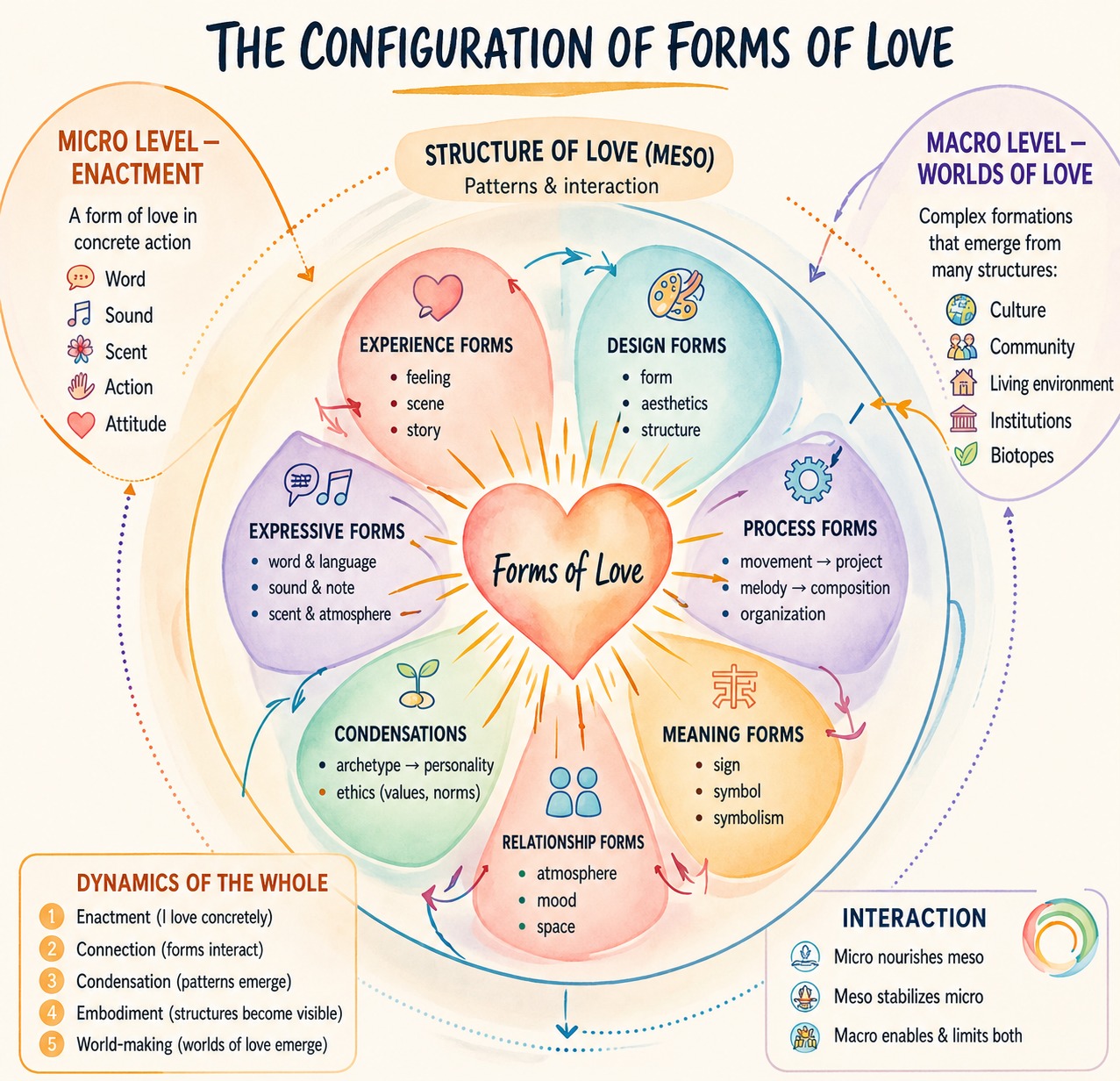
Translation note: The full model is translated with high fidelity. The umlaut in the local source name `Gefüge` was correctly normalized to the required web filename `Gefuege_EN`. The only notable choices are technical terms such as `configuration`, `condensations`, and `world-making`; they are accurate but may need explanation for general readers.