
Love, Ethics, and Religious Traditions
Religious traditions contain many languages, practices, histories, and internal interpretations of love and ethical responsibility. These images explore selected connections between love, everyday action, ritual, community, justice, mercy, learning, and encounter. They are invitations to interreligious reflection, not authoritative summaries of any tradition.
The AI-translated images come from the German source page. Translation notes identify visible changes and remind readers where specialist or community-based review remains necessary.
Nine Paths of Love in the Jewish World
The diagram gathers nine Hebrew concepts around Ahavah: loving-kindness, compassion, peace, righteous giving, faithfulness, attachment to God, honor, and trust among friends. Love is presented not only as an emotion but as action, relationship, responsibility, and communal life.
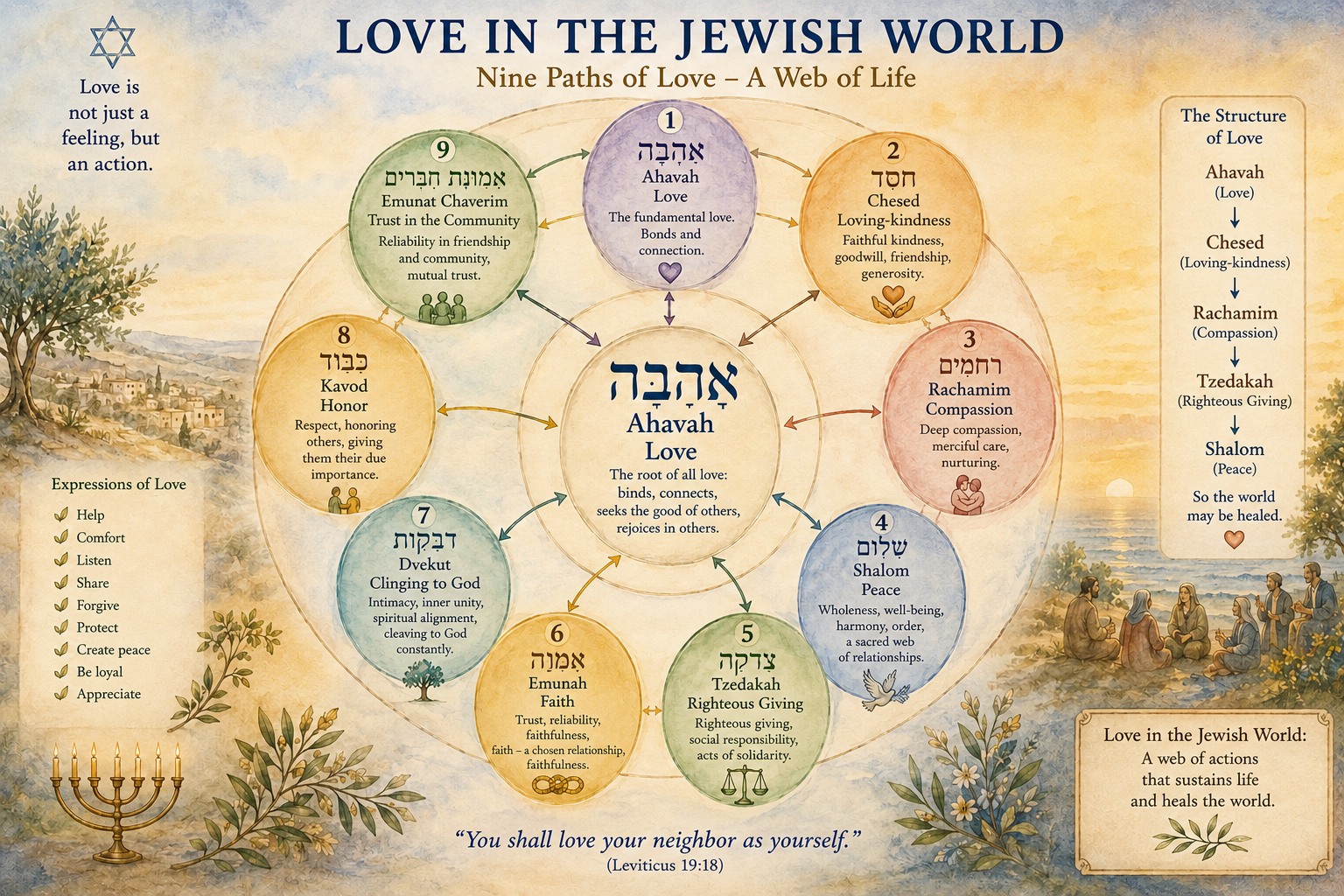
Translation note: The structure and Hebrew terms are preserved unusually well. “Cleaving to God constantly” is stronger and more literal than the German explanation of living in God's presence. The definitions are interpretive educational summaries and should not be treated as the only Jewish understanding of these concepts.
Judaism and the Web of Love
Commandments, Shabbat, festivals, study, discussion, family, and community are connected to five human strengths. The picture emphasizes sacred everyday practice, shared learning, disagreement, remembrance, rest, gratitude, and renewed relationship.
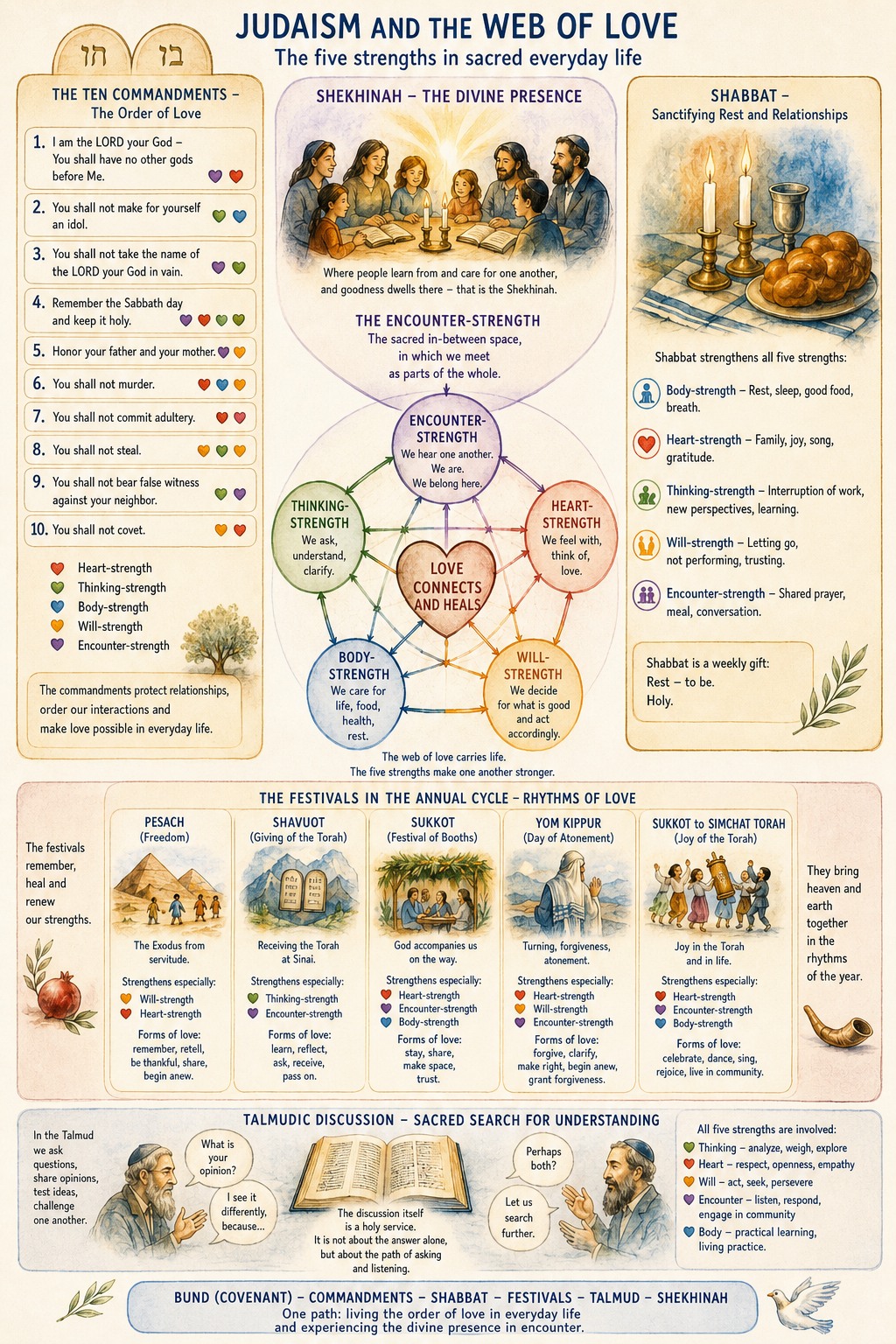
Translation note: Most religious names and the Ten Commandments remain readable and coherent. “Graven image” was simplified to “idol,” and “not having to achieve” became “not performing.” Festival-to-strength assignments are an interpretive model created by the source image, not a standard Jewish classification.
Jewish, Greek, and Hummingbird-Ethos Perspectives
The comparison places Jewish action-oriented concepts beside several Greek forms of love and then connects them with practical Hummingbird-Ethos actions. The arrows suggest resonances, not identity: concepts from different histories cannot be reduced to direct equivalents.
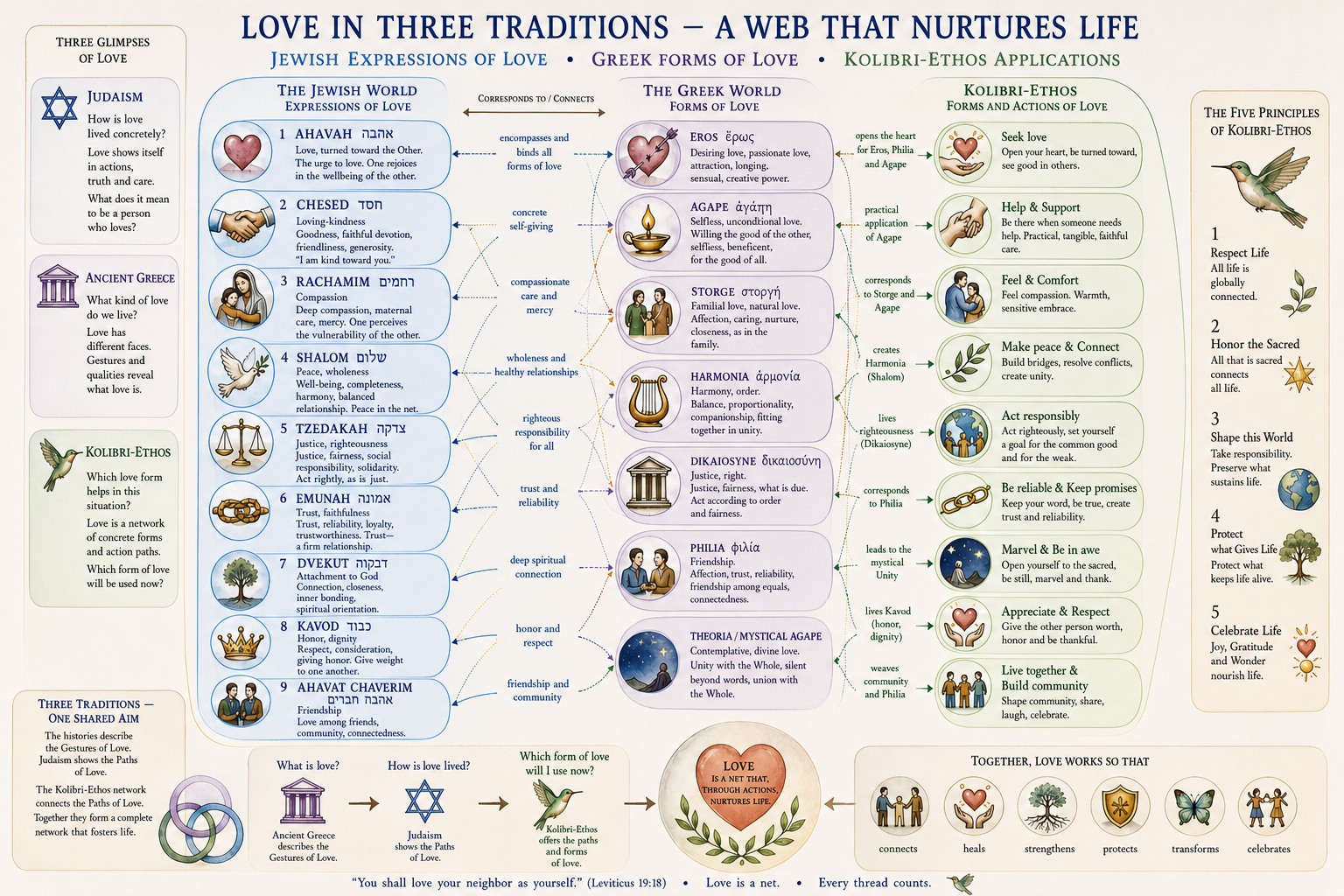
Translation note: The dense three-column structure is very well preserved. Some correspondences—especially “Theoria/Mystical Agape” and the mapping between Hebrew and Greek terms—are interpretive constructions rather than universally accepted religious or historical taxonomies.
Islamic Ethics in the Web of Love
The image connects love of God, responsibility, mercy, justice, excellence in goodness, patience, gratitude, the Five Pillars, ethical action, and stewardship of creation. Love is described as a direction for bodily discipline, compassion, thought, will, community, and encounter.
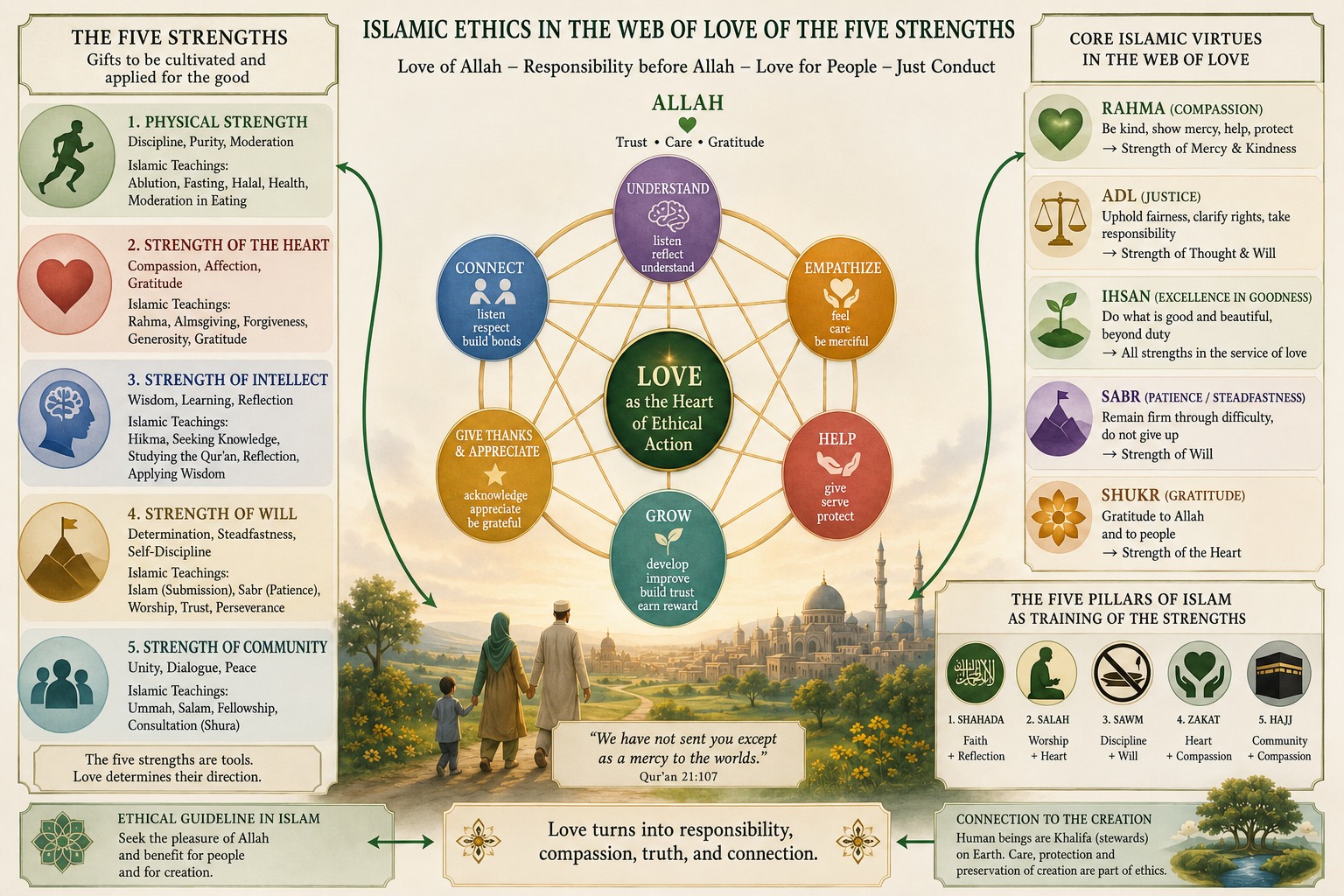
Translation note: The central Qur'an reference and major Arabic terms are preserved clearly. Several mappings were freely reworded: the source connects Rahma with heart and encounter strength, while the English says “Strength of Mercy & Kindness”; Zakat and Hajj also receive altered strength labels. These associations are an educational model, not a standard Islamic doctrine.
Bahá’í Ethics and the Five Strengths
Unity, service, consultation, education, world peace, hospitality, independent search for truth, and interreligious encounter are woven into a network of strengths and practices. The page presents consultation as a shared search rather than a struggle for victory.
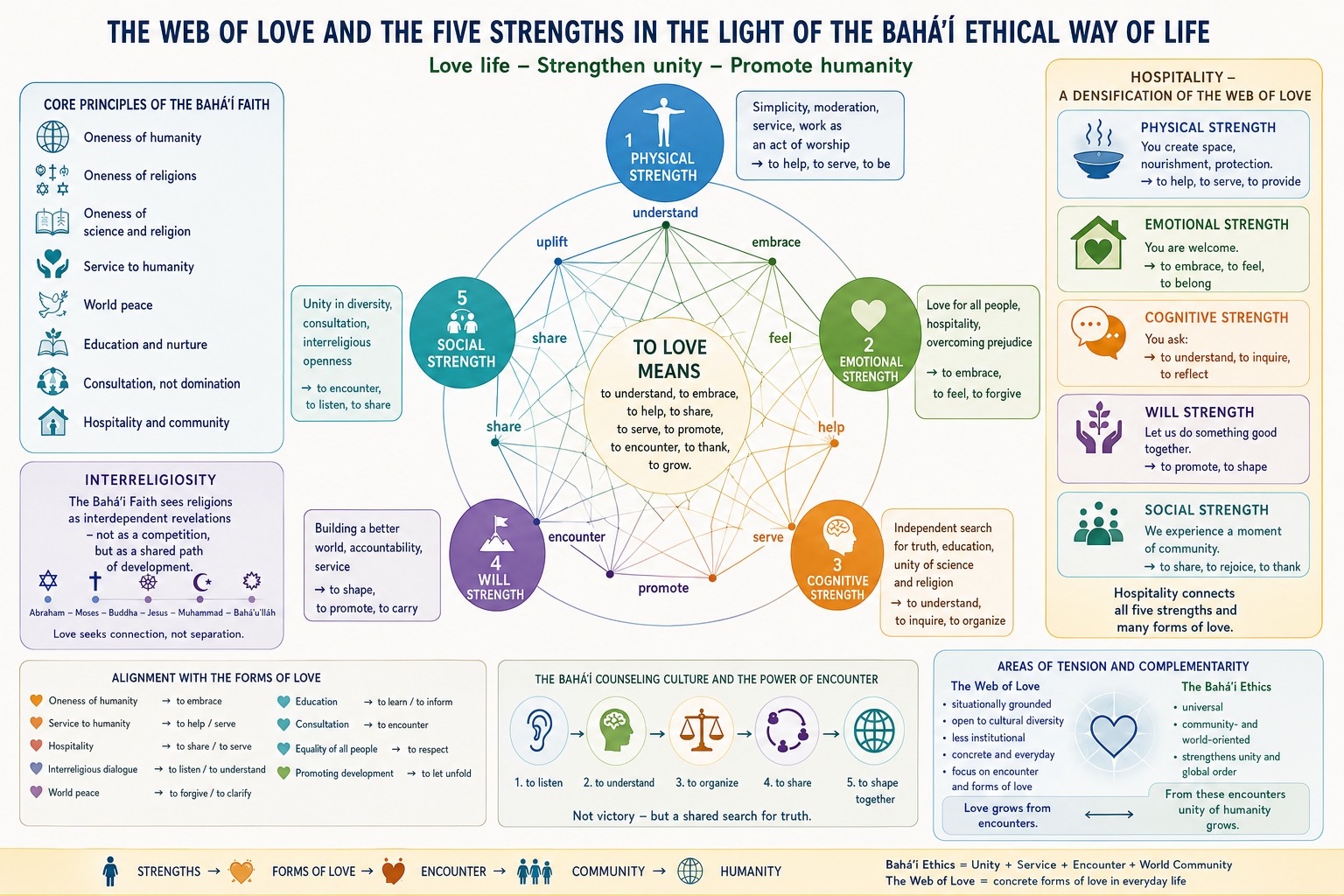
Translation note: A major conceptual weakening occurs in the upper-left panel. Three German principles say “Unity of humanity,” “Unity of religions,” and “Unity of science and religion”; the English image changes all three to “Openness.” “Encounter strength” is also generalized as “social strength.” Readers should restore “unity” when interpreting the diagram.
Yoga Virtues and the Web of Love
The Yamas and Niyamas are placed beside the love network and five inner powers. The diagram presents ethical restraint, personal practice, attentive relationships, and connection as mutually supporting paths.
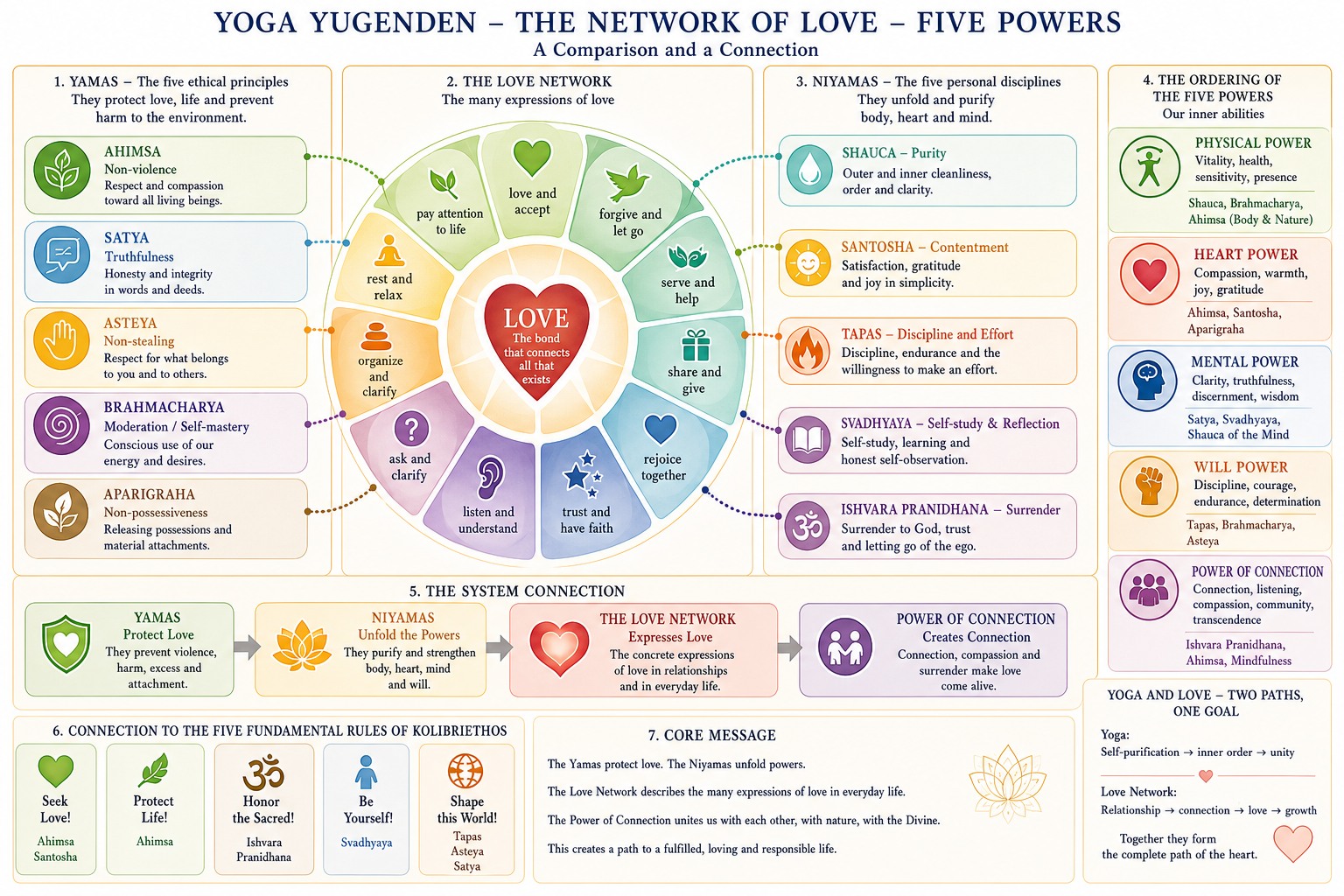
Translation note: The title contains the erroneous hybrid word “YUGENDEN”; it should read “VIRTUES.” The Sanskrit names are largely retained, but the assignments to five powers and Kolibriethos principles are an interpretive teaching model, not a universally accepted account of Yoga.
Kabbalah, the Tree of the Sephiroth, and Love
The Tree of the Sephiroth is compared with five strengths and a network of loving actions. The image invites readers to explore connections among knowledge, boundaries, relationship, embodiment, and responsibility.
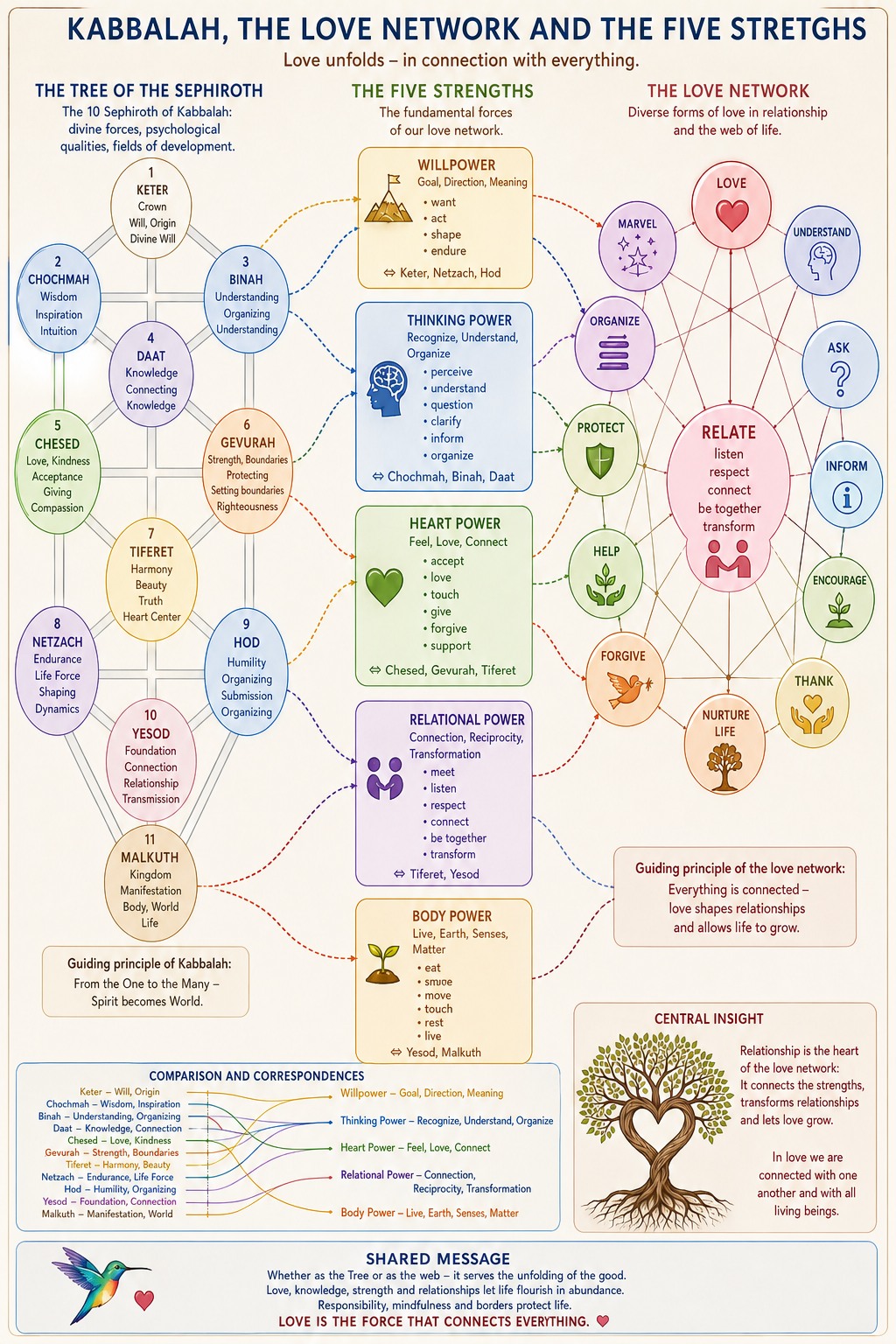
Translation note: This is a strongly interpretive comparison rather than an authoritative presentation of Kabbalah. The small body-power list contains the malformed word “smioe,” and some transliterations and correspondences should be checked against specialist sources before scholarly use.
Judaism — Roots, Influences, and Development
A three-thousand-year overview follows changing historical contexts, major periods, internal developments, and central bodies of literature. It emphasizes both continuity and the diversity of Jewish life.
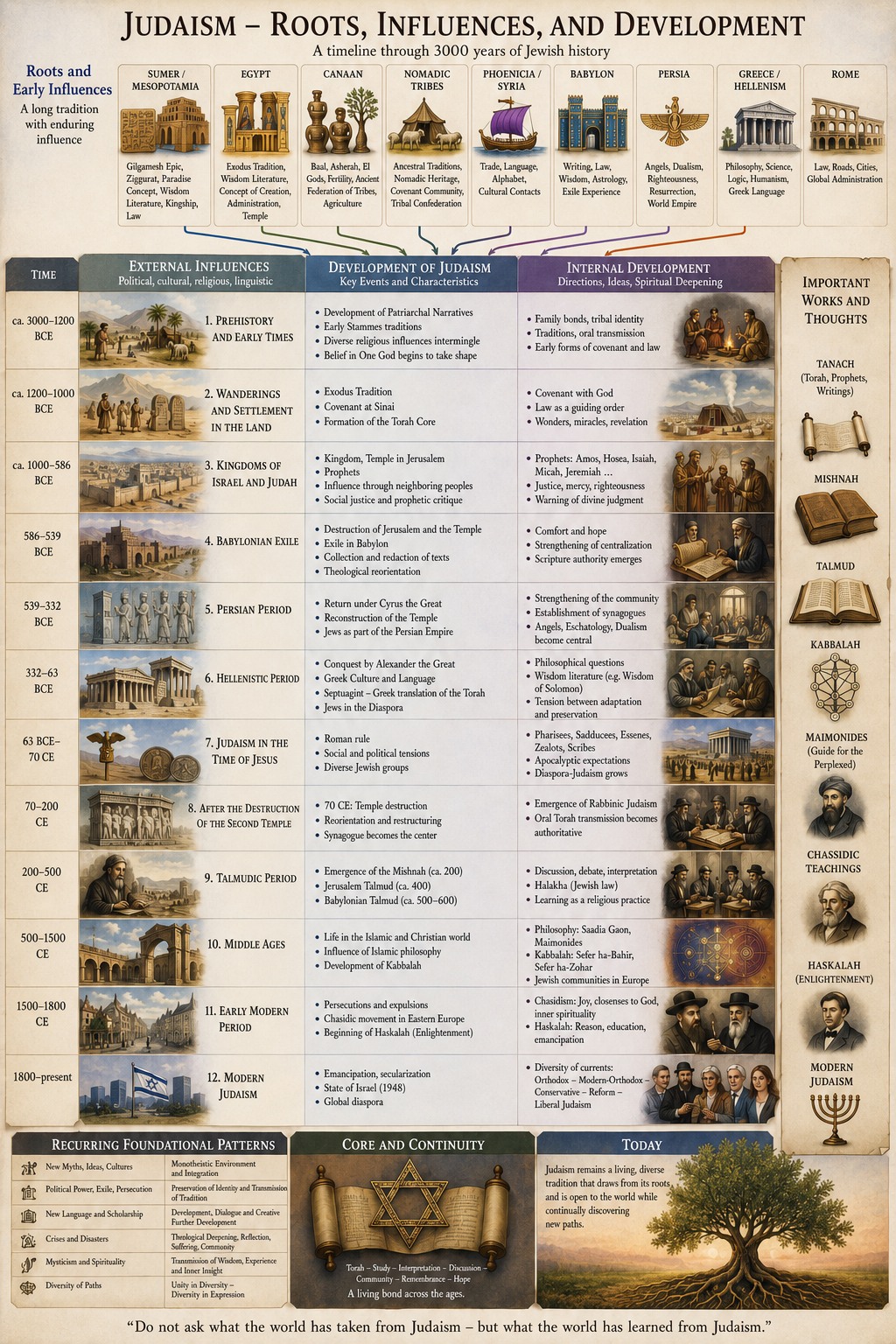
Translation note: The graphic compresses a complex and internally diverse history into a single timeline. “SUMER” in the first influence box should be read as “SUMER/SUMERIA,” several dates are approximate, and the neat period divisions can conceal overlap and disagreement. The closing quotation is presented without a source and should not be treated as a verified quotation.
Hinduism — A Stream with Many Sources
The image presents Hindu traditions as an evolving river shaped by ancient practices, Vedic and philosophical developments, regional exchange, reform movements, and modern global contexts.
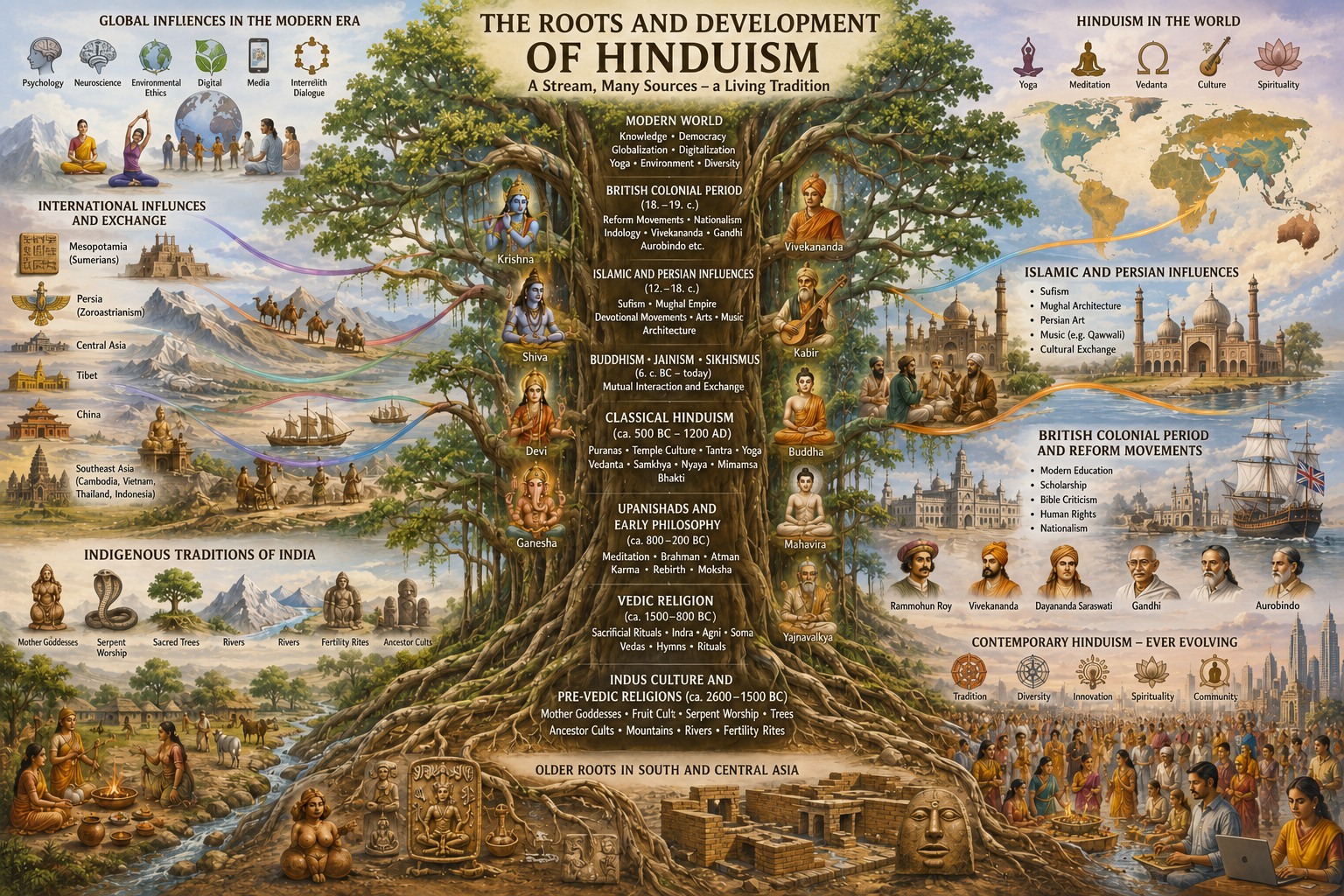
Translation note: The image successfully conveys plurality, but its single tree and linear chronology greatly simplify many regional, linguistic, philosophical, and devotional traditions. Labels such as “Indus culture and pre-Vedic religions” and lines of influence are interpretive historical hypotheses, not settled facts.
The Development of Christianity
Beginning with Jewish roots and early Christian diversity, the panorama follows regional traditions, cultural encounters, divisions, reform movements, global expansion, and contemporary plurality.
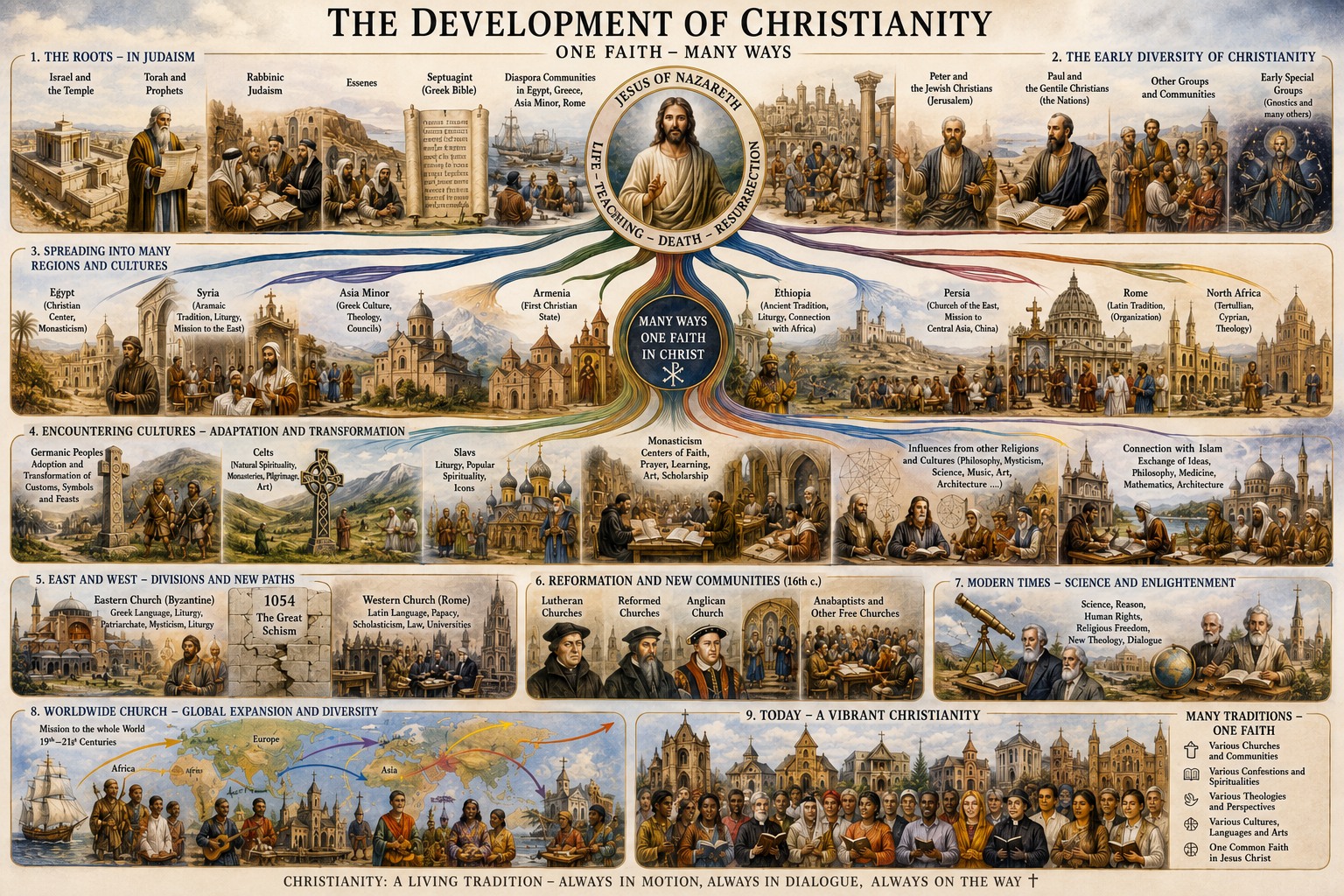
Translation note: The English is readable, but the panorama compresses contested history and theology into a harmonious visual narrative. The 1054 schism, relations with Islam and other cultures, colonial-era expansion, and the phrase “one faith” all require more context than the image can provide.
Buddhism — One Stream, Many Roots
The tree panorama brings together Indian roots and encounters across Central Asia, China, Tibet, Southeast Asia, Japan, Mongolia, and the modern world. The lower band names central Buddhist teachings and practices.
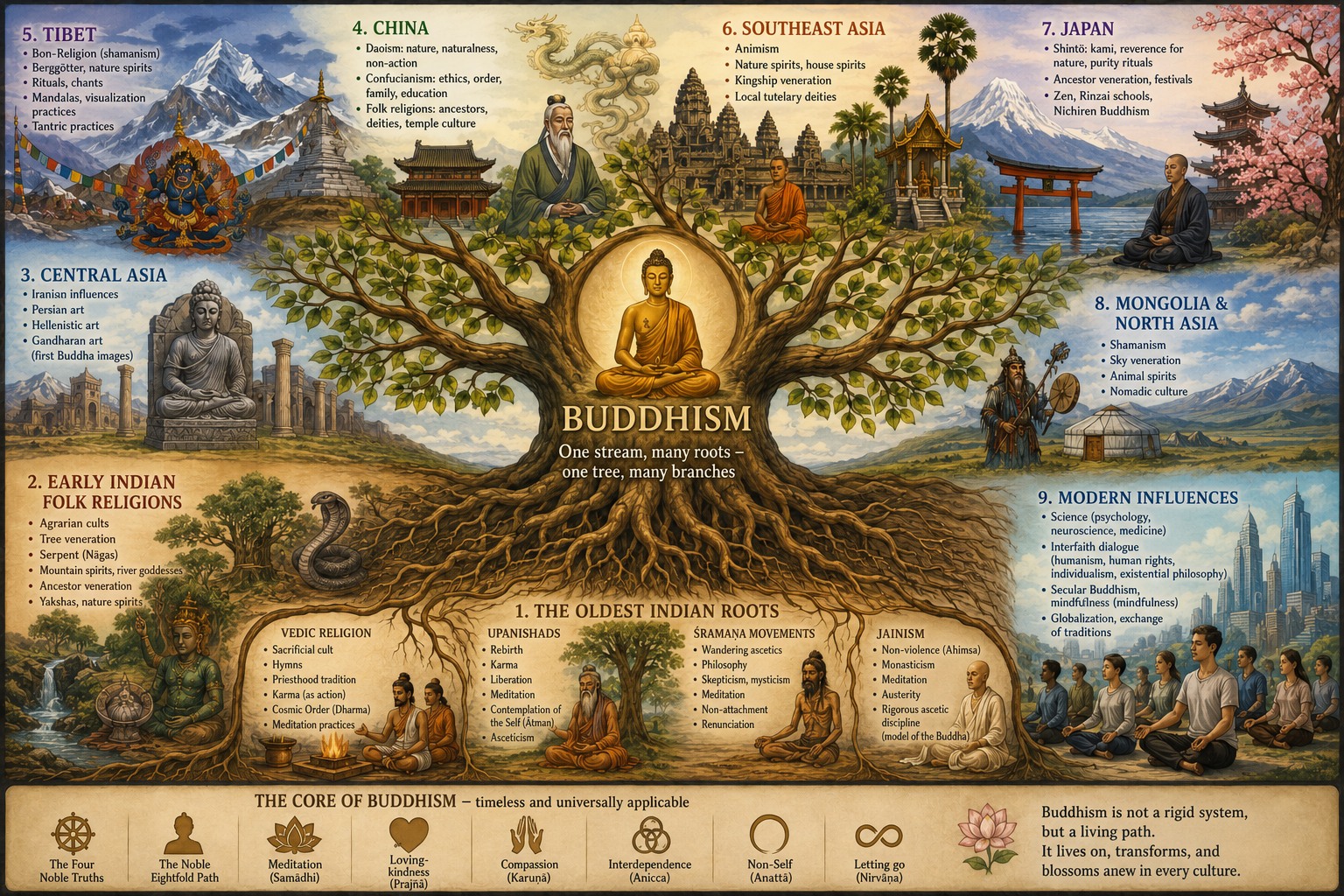
Translation note: Three important meanings in the lower band are wrong: Prajñā means wisdom, not “Loving-kindness”; Anicca means impermanence, not “Interdependence”; and Nirvāṇa is liberation, not merely “Letting go.” The single-tree model also simplifies the diversity and historical independence of Buddhist traditions.
Islam — Roots, Development, and Diversity
A river of history connects the emergence of Islam in seventh-century Arabia with earlier contexts, Qur’an and Sunnah, Islamic scholarship, regional cultures, diverse schools, and modern movements.
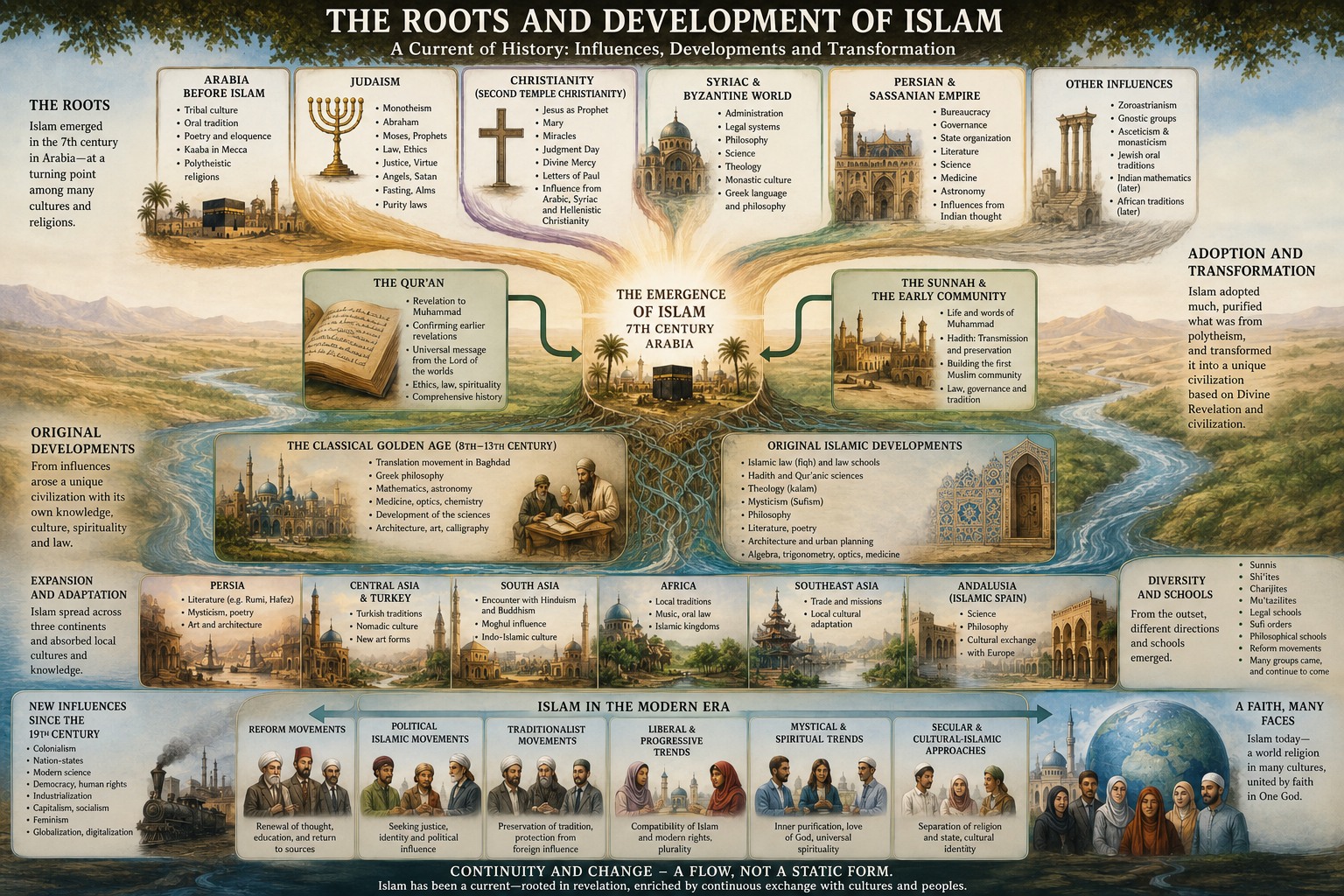
Translation note: The diagram is broad and respectful, but the Qur’an panel changes the German “Heilsgeschichte” into “Comprehensive history”; “salvation history” would be closer. The adoption-and-transformation narrative, period label “Golden Age,” lists of schools, and modern categories are substantial simplifications that deserve historical and Muslim perspectives.
Multireligiosity — A Network of Religions
The image describes the capacity to be shaped by more than one religious tradition while preserving distinct identities. It distinguishes levels and forms of multireligiosity and proposes learning, dialogue, and common growth.
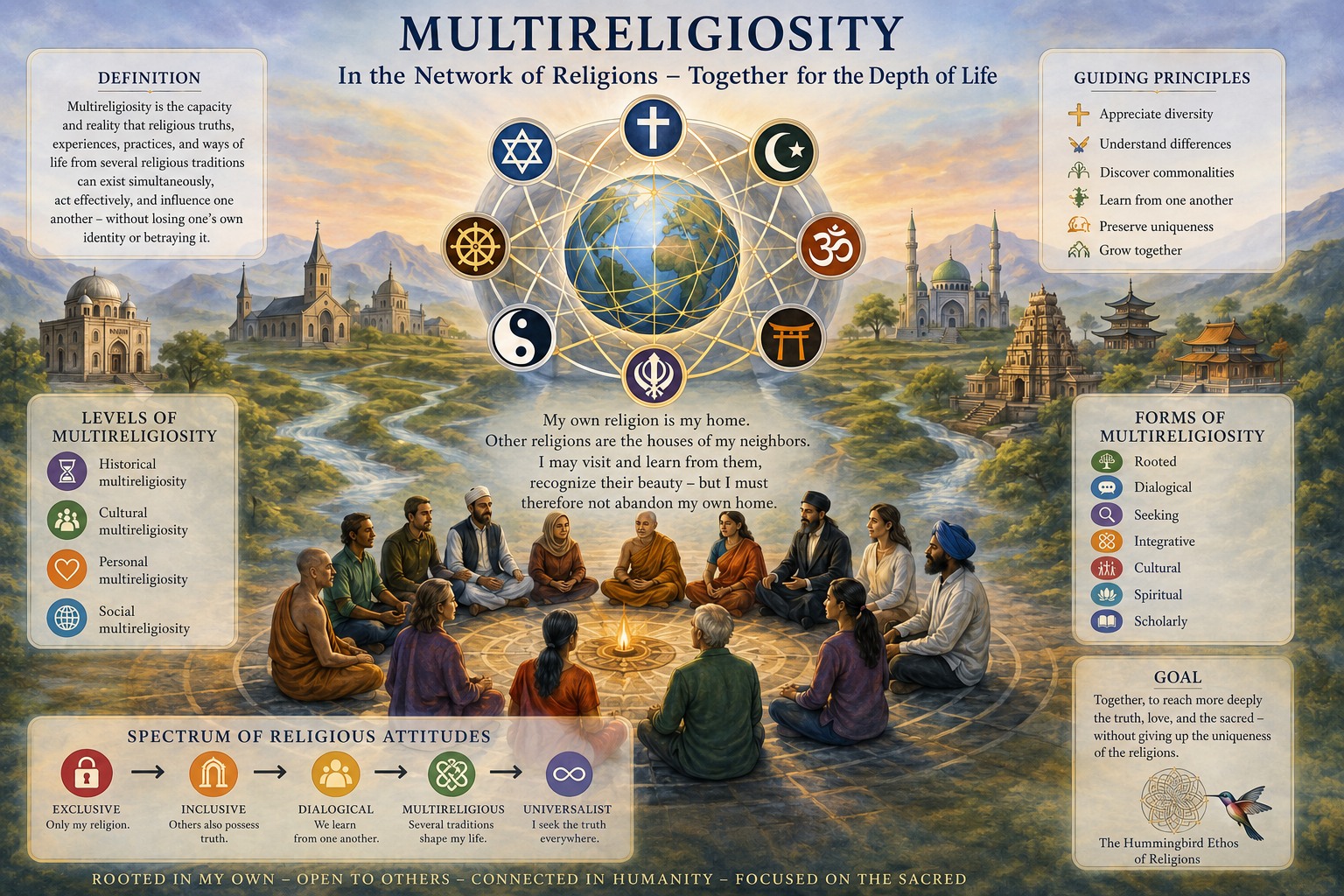
Translation note: “Multireligiosity” is a direct but uncommon English rendering; “multiple religious belonging” or “religious plurality” may be clearer in some contexts. The definition adds the stronger phrase “or betraying it” to the German idea of not losing one’s distinctiveness. The linear spectrum from exclusive to universalist is a teaching aid, not a neutral ranking of religions.
This page now includes all 13 images currently used on the German source page KI/ReligionEthik. Visible imperfections are retained as prompts for reflection, correction, and discussion.