
The Humming Bird Ethos
A human being in this world of colours,
Rewarded and vested with such spirited power,
With courage and profound consciousness,
I am placing these five basic principles
In the centre of my action:
Look out for love!
Look after life!
Worship the sacred!
Be yourself!
Be proactive in this world!
A part of this powerful mankind,
Driven by such creativity and intelligence,
I am aware of these five basic concepts
In my own questioning and answering:
The situation
The limit
The network
The encounter
The interpretation
A child of this silent universe,
Fulfilled by such light and vastness,
I contemplate and meditate the various wonders of this world
The miracle of being
The miracle of growing and becoming
The miracle of consciousness
The miracle of the universe
The miracle of love
As a child of this fertile earth,
filled with so much life and diversity,
I am deepening
The basic ways of love
The basic processes of life
The basic wisdoms and values of mankind
I am constructing bridges between cultures, religions, and world views.
I am looking after myself, the sources of my power, my structure, my harmony, and my balance.
I am contributing to the solutions of the current problems of our world.
For life und for love.
The Hummingbird-Community
We, as people of this earth,
as virtual or as local communities,
as part of the local and many cultural communities,
as part and beneficiary of many biotopes
and as part of complex and historical contexts of life
Taking responsibility, integrating our strengths and protecting our togetherness:
We share our lives, our time, our skills and our riches.
We develop a treasure trove of songs, dances, wisdom,
skills and tools, spiritual and material resources.
We build life-friendly connecting dwellings.
We advise and help each other and strive for open encounters.
We maintain an open, intensive and honest dialogue.
We strive for democracy, integration and inclusion, for good structures and processes.
We improve our cooperation, our use of resources and our manners.
We protect each other, our personal shelters, our common achievements,
our fundamental rights, our freedom, and the communities we have built and continue to build.
We limit each other and try to heal our mistakes, wounds and trauma.
We value, motivate and encourage each other, but we don't overwhelm each other.
We protect nature and the ecosystems that surround us.
We pay attention to our health and zest for life.
We fight against war and destruction, false teachings and misbeliefs
and hope for a good future for all living things on earth.
We integrate ourselves into the states, legal systems, cultures
and local structures that surround us and try to improve them.
For a brighter future and a happier today
(Anyone can benefit from the hummingbird ethos.
Any group, partnership, or community can choose to be a hummingbird community
and interpret and bring it to life on their own.)
Human Rights, Global Ethic, and Kolibri Ethos
Human rights protect the dignity and freedom of every person through enforceable standards. A global ethic seeks shared values across religions and cultures. Kolibri Ethos asks how these commitments can become everyday practices of love, responsibility, encounter, cooperation, and encouragement. The three approaches are distinct but can support one common goal: dignity, peace, and a good life for all.
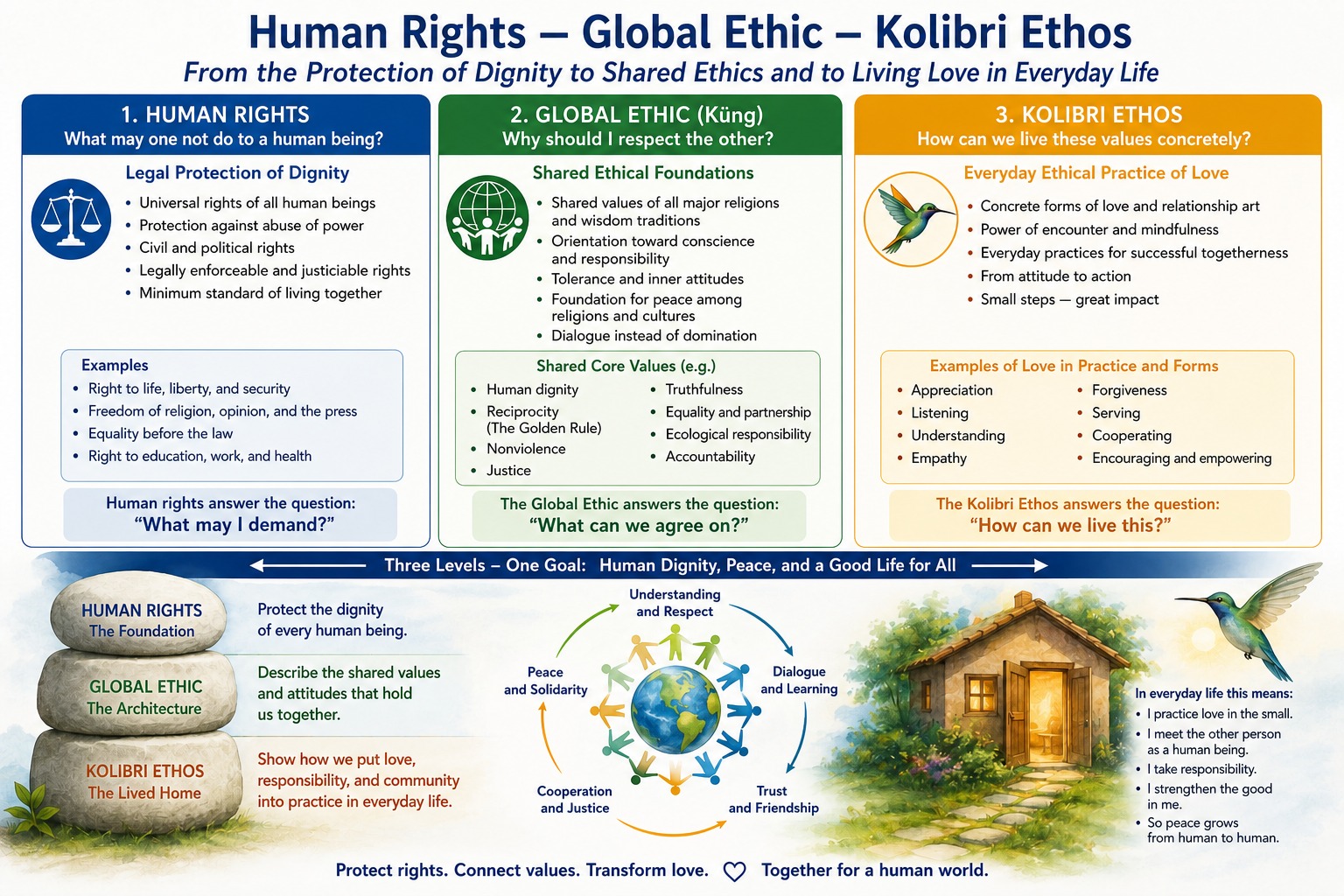
Translation note: The three levels and their functions are translated clearly. A few phrases are overly literal: “relationship art,” “successful togetherness,” and “practice love in the small.” No material change of meaning was found.
Building Bridges Between Rights and Love
Basic and human rights secure conditions in which people can live freely, safely, and with dignity. Kolibri Ethos complements this protection by encouraging the development of human powers, forms of love, awareness, and responsible participation. Legal guarantees and ethical practice meet on shared ground: equality, respect, responsibility, and solidarity.

Translation note: The rights, five principles, bridge model, and legal sources are preserved. The five powers are named inconsistently as “Physical,” “Mind,” and “Community Power” instead of “Body,” “Thinking,” and “Connection Power.” “Good togetherness” is also awkward English.
Safeguards Against Domination and Abuse
An ethos should serve life, not establish power over people. These safeguards protect dignity, freedom of interpretation, boundaries, dissent, responsibility, transparency, self-criticism, and the priority of the concrete person over every model. Love may be offered, but it cannot be forced; agreement is not the measure of a person's worth.

Translation note: Important error in rule 6: German “Intent does not excuse the effect” becomes “Consent always before any effect.” The source requires attention to intent, behaviour, effect, and feedback, including responsibility for unintended consequences. Rule 11 also loses the question about unintended pressure or hierarchies. Some wording about consent and authority is unclear.
Five Basic Concepts
Situation, boundaries, network, encounter, and interpretation offer five perspectives for ethical reflection. A situation has a concrete context; boundaries protect and orient; networks reveal interdependence; encounter creates a shared human space; and interpretation helps people understand experience without reducing a person to a model.
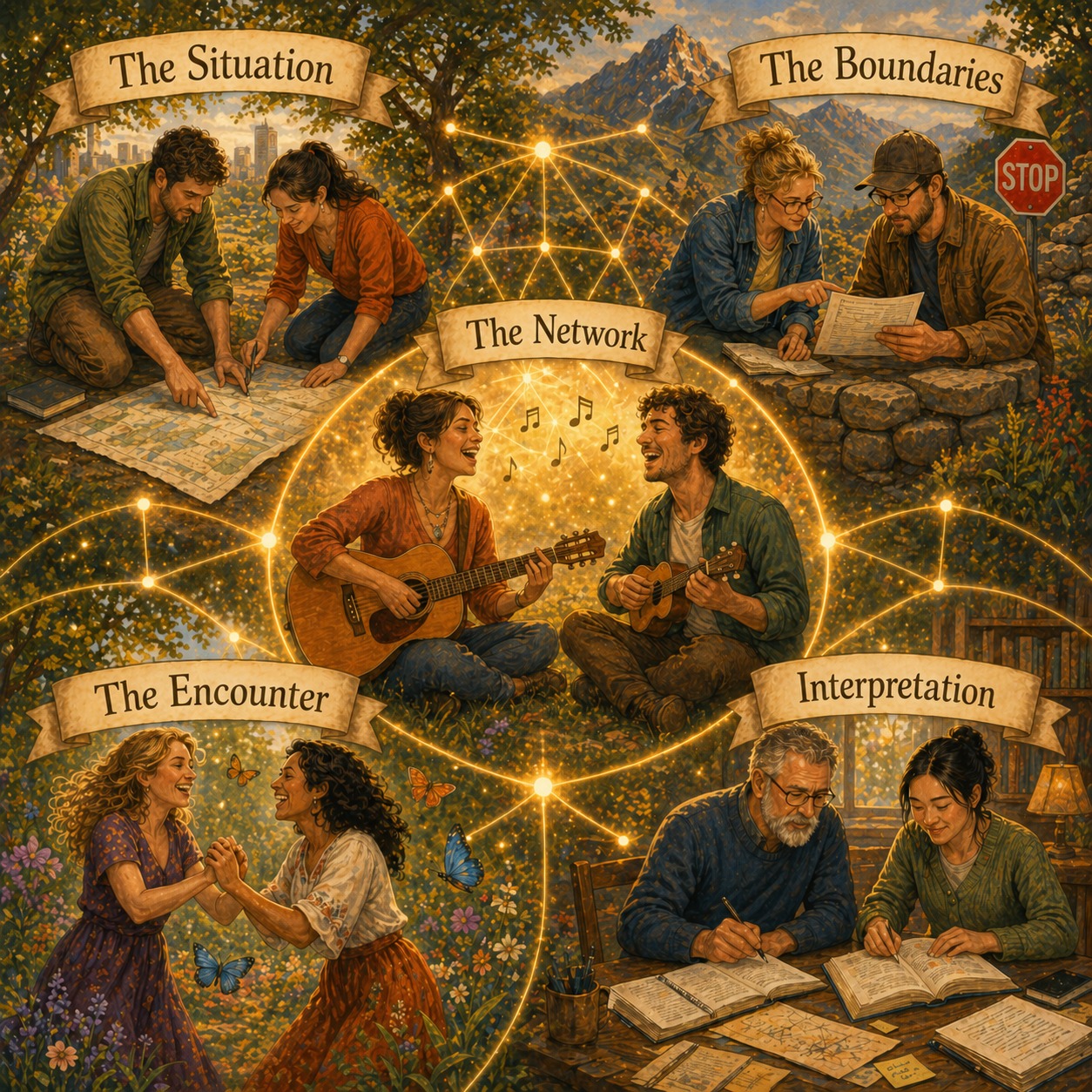
Translation note: All five labels are translated correctly, and the visual composition is preserved. No translation problem was found.
The Situation as the School of Love
A situation includes inner and outer reality, relationships and conflicts, resources and needs, local networks and global conditions, present responsibility and future possibilities. Ethical action asks what is happening, what it means, which form of love is appropriate, and how perception, understanding, decision, and action can be brought together.
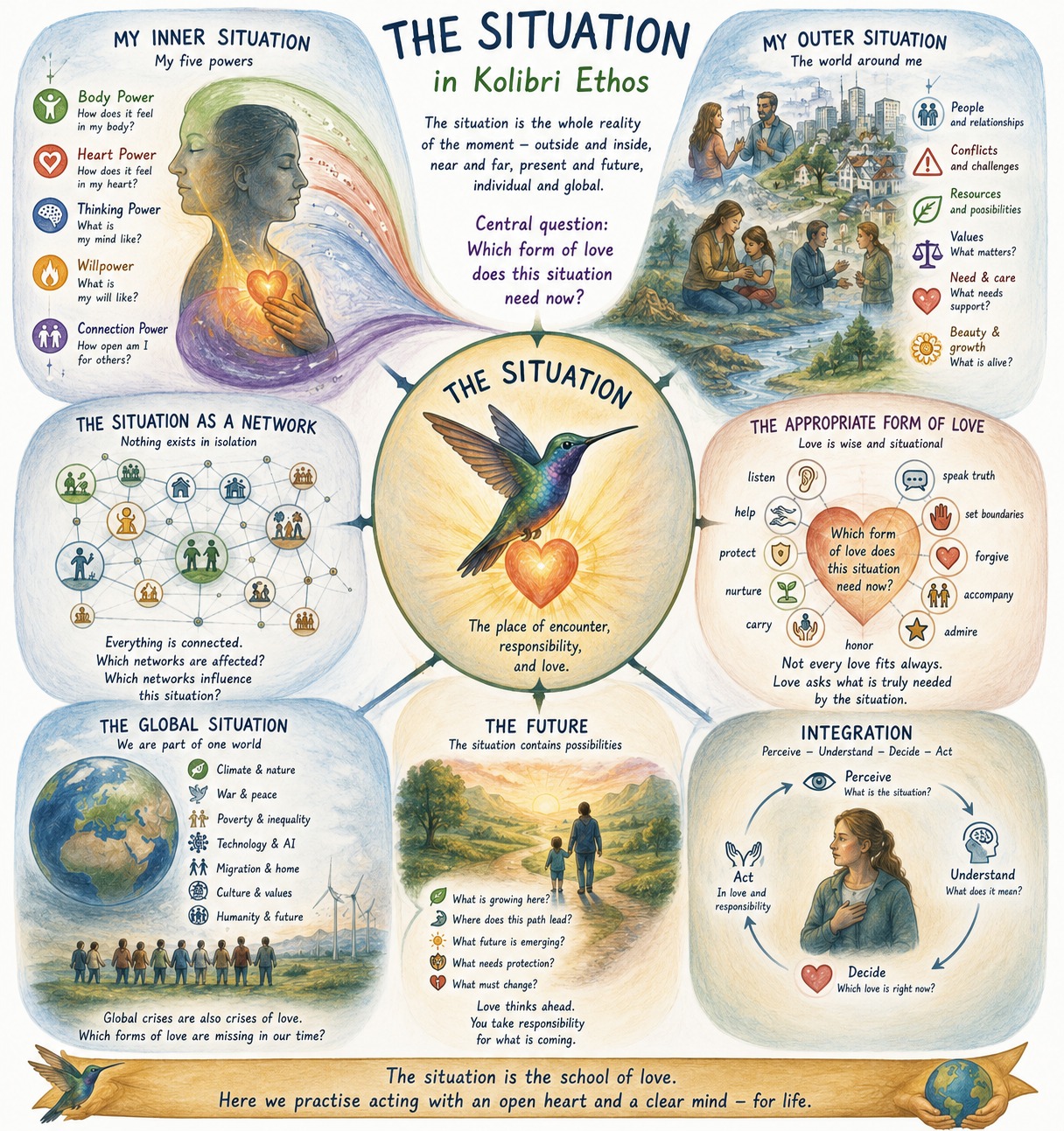
Translation note: The overall model is clear. “What remains?” becomes “What is alive?” Several forms of love shift: “wonder” becomes “admire,” “encourage” becomes “nurture,” and “endure/bear” is reduced to “carry.” “What is being destroyed?” is softened to “What must change?”
Interpretation Through All Five Strengths
Interpretation is not a task of the mind alone. Feeling, bodily perception, thought, will, and encounter each disclose different aspects of a situation. Encounter strength connects these perspectives and helps us test our filters, notice relationships and consequences, and move from perception toward responsible action. Careful interpretation remains open to correction and serves understanding rather than prejudice.
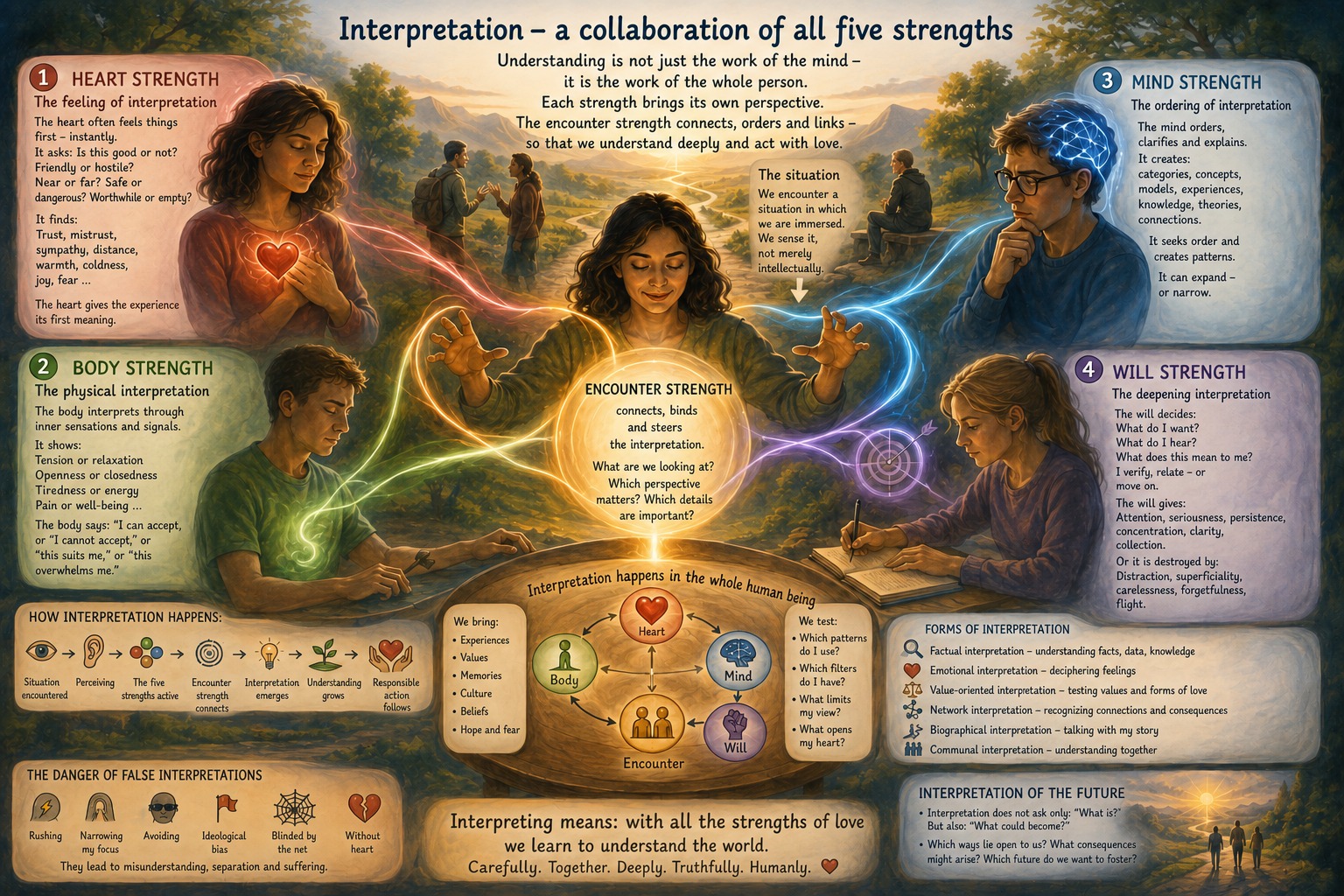
Translation note: The structure, five strengths, sequence of interpretation, forms of interpretation, and future questions are preserved. In the warning panel, “Prejudice” is mistranslated as “Avoiding.” “Rushing,” “Narrowing my focus,” and “Blinded by the net” are understandable but freer than the German terms “premature,” “one-sided,” and “blind to the network.”
Interpretation as a Path to Autonomy
Enlightenment begins when people examine interpretations imposed by media, upbringing, groups, fear, habit, or authority. Autonomy does not mean isolation: it means perceiving, feeling, thinking, choosing, meeting others, taking responsibility, and shaping the world with love. A mature interpretation remains self-critical, listens to others, and accepts responsibility for its effects.

Translation note: Important error: German “We are interpreted instead of interpreting for ourselves” becomes “We are laid down, instead of laying ourselves down,” so the central contrast is lost. “Prejudices and enemy images” becomes “Distorted and distorted images.” “Free yourself from fear and conformity” becomes “Release fear and adjust,” reversing part of the meaning. “Compassion and connectedness” also becomes “Gratitude and trustfulness,” and some labels such as “Willing” or “rests on” are unnatural.
Interpretation Shapes Our Shared World
Every perception passes through memories, values, culture, fears, hopes, roles, beliefs, and prejudices. Factual, emotional, value-oriented, network, biographical, and communal interpretations can illuminate different aspects of experience. Because interpretation influences feelings, relationships, decisions, and the future, it should be undertaken slowly, jointly, and responsibly.
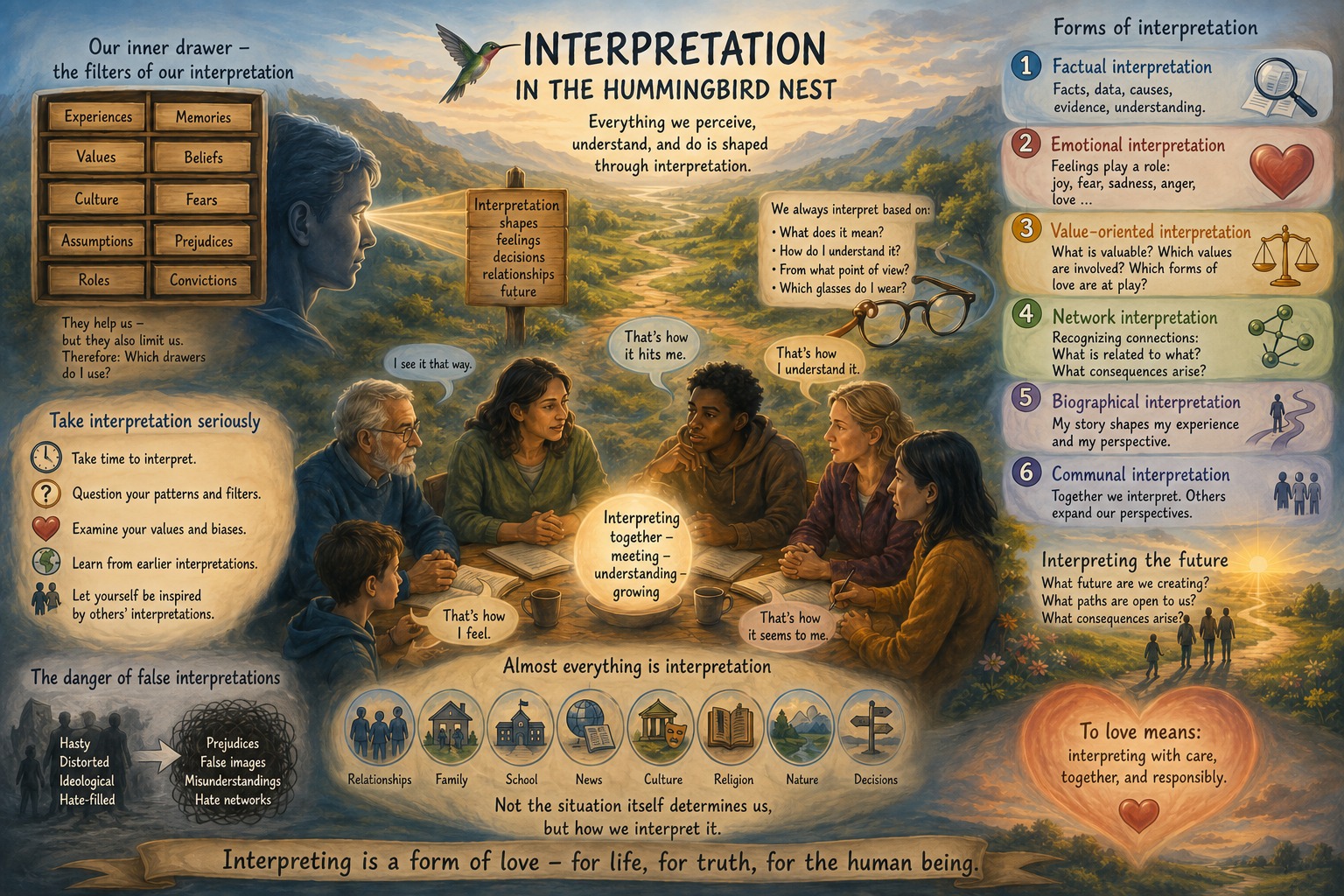
Translation note: The six forms, perspective filters, dangers, areas of life, and future questions are nearly complete and very legible. “Kolibriethos” is incorrectly translated as “Hummingbird Nest” instead of retained as the proper name “Kolibri Ethos.” “Hopes” becomes “Assumptions,” and “Therefore: Which drawers do I use?” is awkward English.
Boundaries Protect and Enable Encounter
Boundaries create spaces in which identity, freedom, responsibility, orientation, and protection can develop. They may be physical, emotional, cognitive, volitional, or relational. Boundaries that are too rigid can isolate; boundaries that are too weak can expose people to overload or misuse. Ethical encounter therefore requires recognising, communicating, respecting, and sometimes responsibly crossing boundaries.
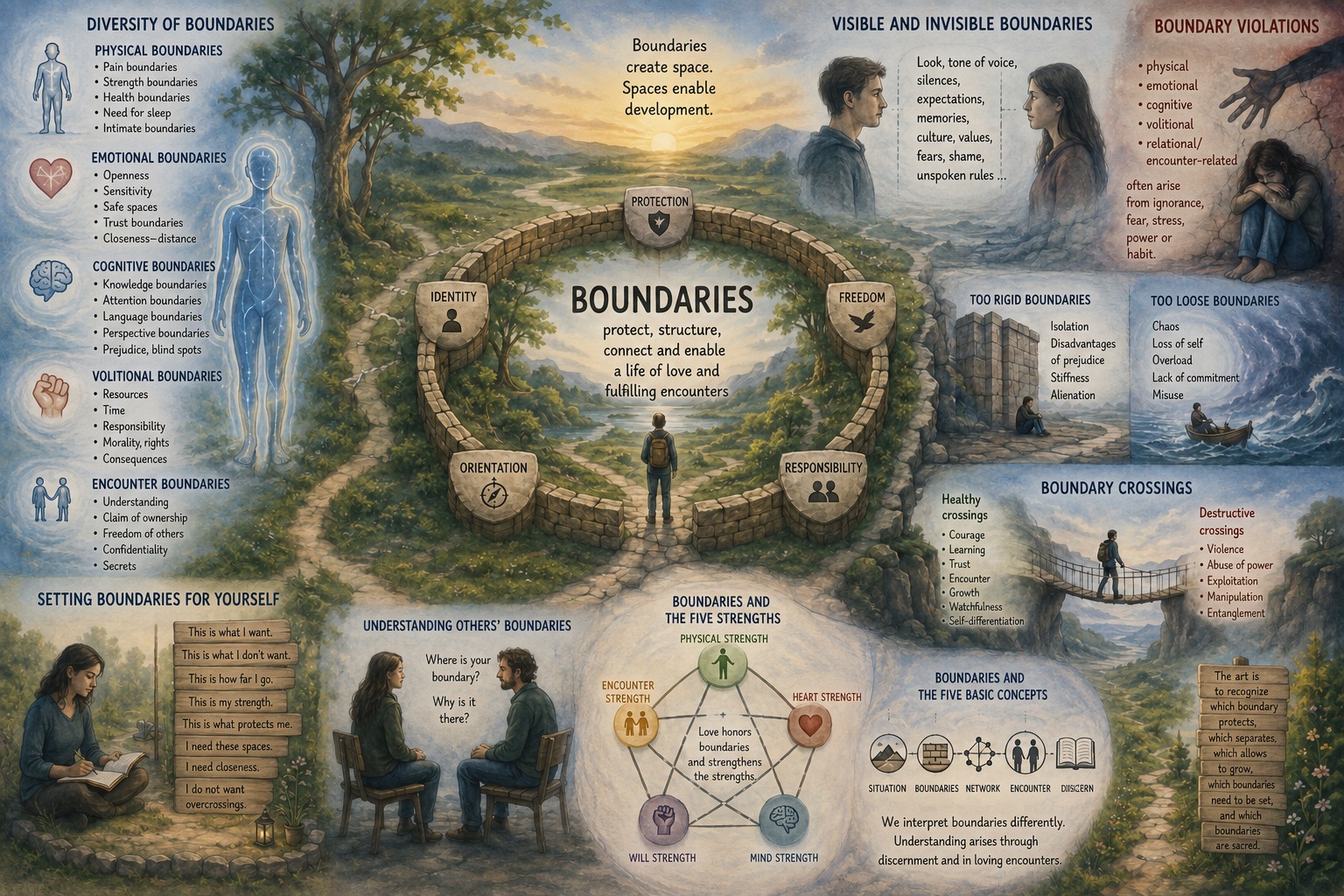
Translation note: The boundary types, violations, personal boundary-setting, and five-strength model are preserved. “Volitional Boundaries” and “Encounter Strength” are technical but understandable; “Interpretation” is shortened to “Discern” in the five-concept model. “Sacred crossings” becomes “Healthy crossings,” and “fear of strangers” becomes “Alienation,” changing the source meaning.
The Network as an Ethical Concept
Human beings are nodes in many overlapping networks: family, friendship, work, culture, media, economy, technology, and ecosystems. Every connection carries resources and responsibilities, but it can also carry pressure, manipulation, misinformation, or exclusion. Ethical participation means consciously building, caring for, examining, limiting, and sometimes leaving relationships while considering the effects on the whole network.
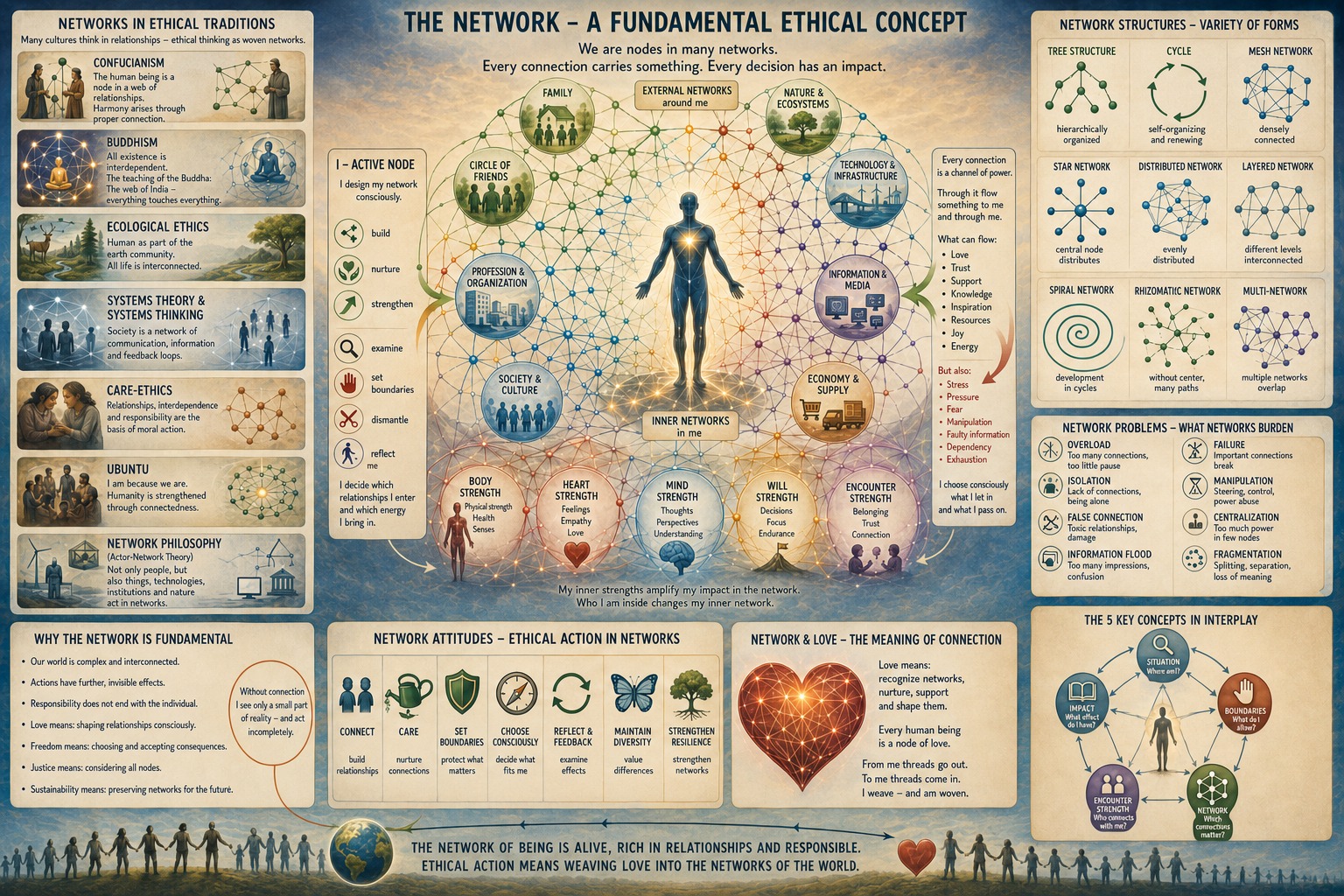
Translation note: Ethical traditions, personal networks, network forms, burdens, actions, and the concluding idea are largely preserved. “Every connection is a channel of power” may suggest domination rather than transmitted strength. “Withdraw” is mistranslated as “reflect me.” The very small labels in the five-concept model at lower right are partly difficult to read and abbreviated.
Three Networks as a Living System
Thoughts, feelings, and forms of love form interdependent networks. Thoughts organise experience and give direction; feelings create resonance and energy; forms of love shape relationships and action. Encounter connects the three, receives feedback from the world, and begins a new cycle of learning. The five strengths help turn this process into a conscious, loving, and effective life.
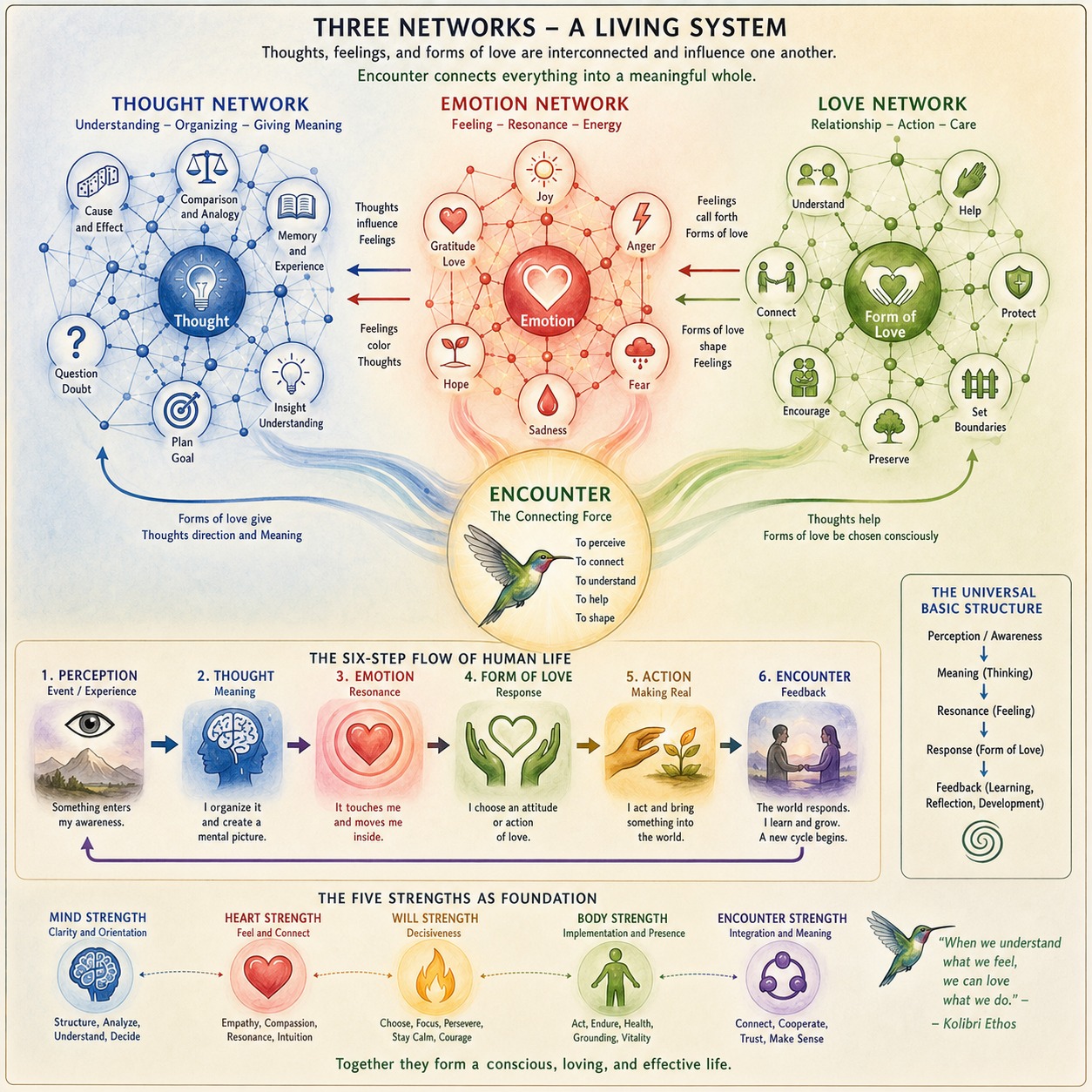
Translation note: The three networks, six stages of human life, universal structure, and five strengths are complete and very legible. “Basic movement of human existence” is freely rendered as “Six-step flow of human life.” “Forms of love be chosen consciously” lacks “can,” and “empathize” is reduced to “help” in the encounter field.
Understanding and Healing Network Problems
Network problems can arise through missing nodes, absent or harmful connections, imbalance, fragmentation, reinforcing cycles, chaos, or hardening. A useful diagnosis asks which network is affected, which disturbance is present, and which counterforce could restore balance. Reality, thought, emotion, love, and body networks need different forms of attention, yet healing in one can strengthen them all.
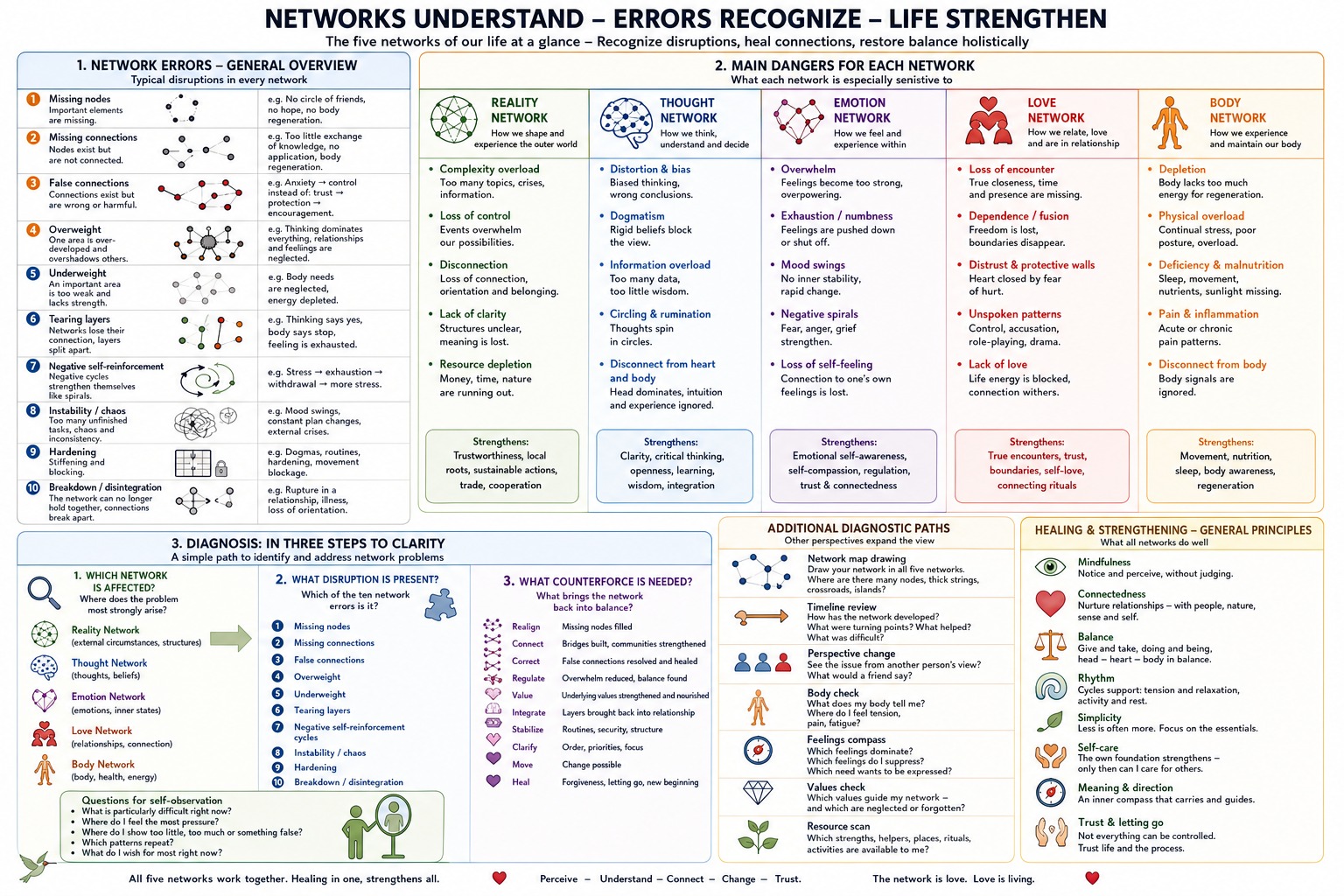
Translation note: The ten general errors, five networks, diagnostic path, additional perspectives, and healing principles are nearly complete. The main title is grammatically wrong: “Networks Understand – Errors Recognize – Life Strengthen.” “Self-alienation” becomes “Loss of self-feeling.” “Overweight” and “Underweight” may suggest body weight rather than over- and underemphasis.
A Comparative Map of Network Problems
The same structural problem can appear differently across reality, thought, emotion, love, and body networks. Scarcity, false connections, overload, blockage, contamination, entanglement, isolation, exhaustion, and negative cycles therefore require attention to context. Comparing the five networks can reveal patterns that remain invisible when only one part of a person's life is considered.
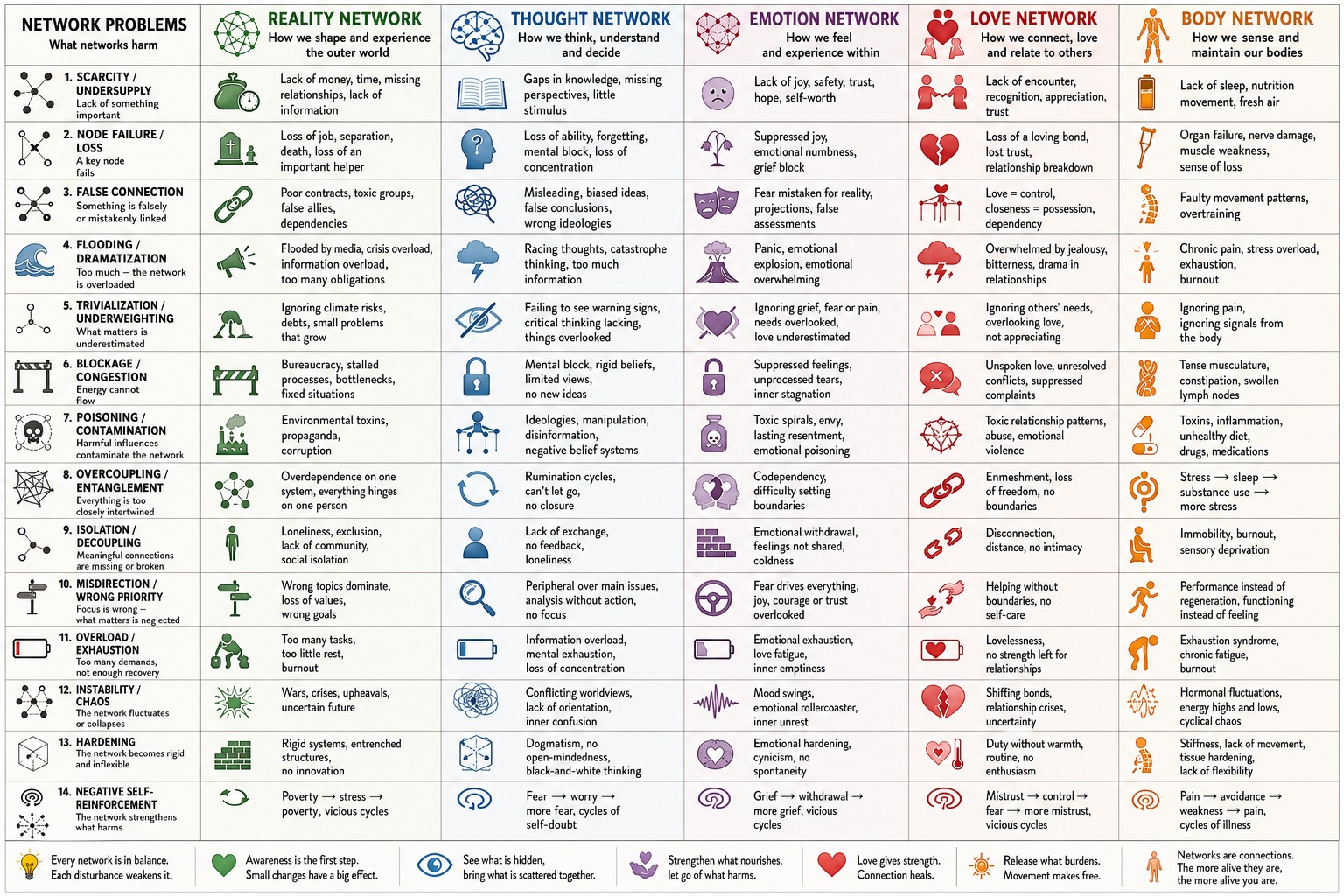
Translation note: All 14 problem types, five network columns, examples, and most footer statements are preserved. Important error in the footer: “Every network strives for balance” becomes “Every network is in balance,” turning an aim into a false factual claim. In the Body Network under “Flooding,” faulty posture, movement patterns, and overtraining are replaced by chronic pain, stress overload, exhaustion, and burnout. “Underweighting” is understandable but less natural than “underestimating.”
The Network of Being
Cosmos, matter, life, culture, economy, technology, knowledge, and relationships are not isolated domains but interwoven networks. Human beings participate as receiving, giving, shaping, responsible, free, and loving nodes. Our inner networks of body, feelings, thoughts, will, memories, values, dreams, and encounter connect personal experience with the wider web of life.
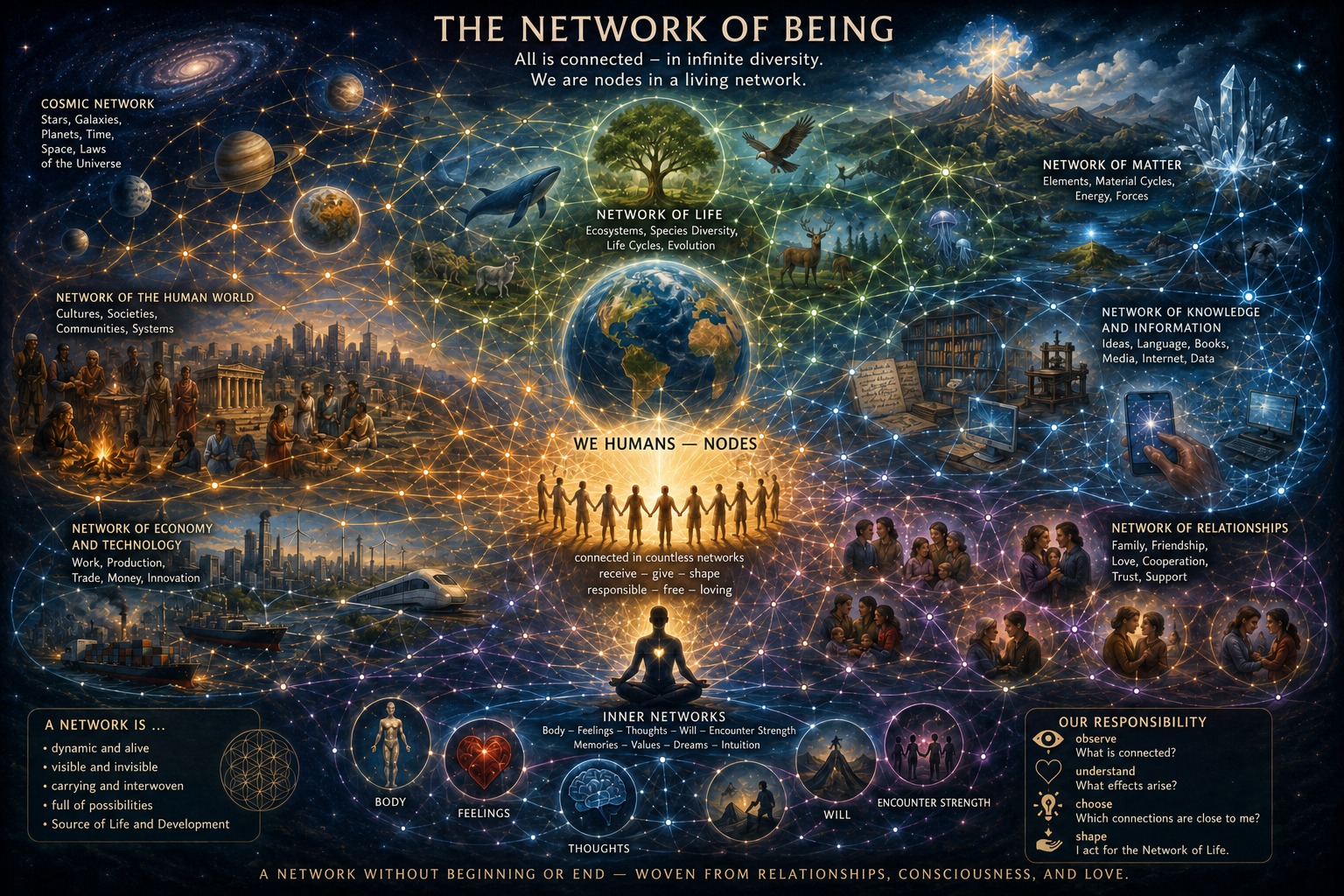
Translation note: All major networks, human nodes, inner networks, responsibility, and the concluding statement are complete, precise, and very legible. No material translation error was found. A small weakening occurs where “I participate in shaping the network of life” becomes “I act for the Network of Life,” making active co-creation less explicit.
I as an Active Node
People can consciously build, care for, examine, limit, and release connections. Healthy networks may nurture friendship, family, support, cooperation, and shared projects; harmful networks may carry manipulation, information overload, toxic relationships, or conflict. Responsibility includes deciding where attention and energy flow, protecting one's boundaries, and reflecting on how one's networks affect oneself and others.
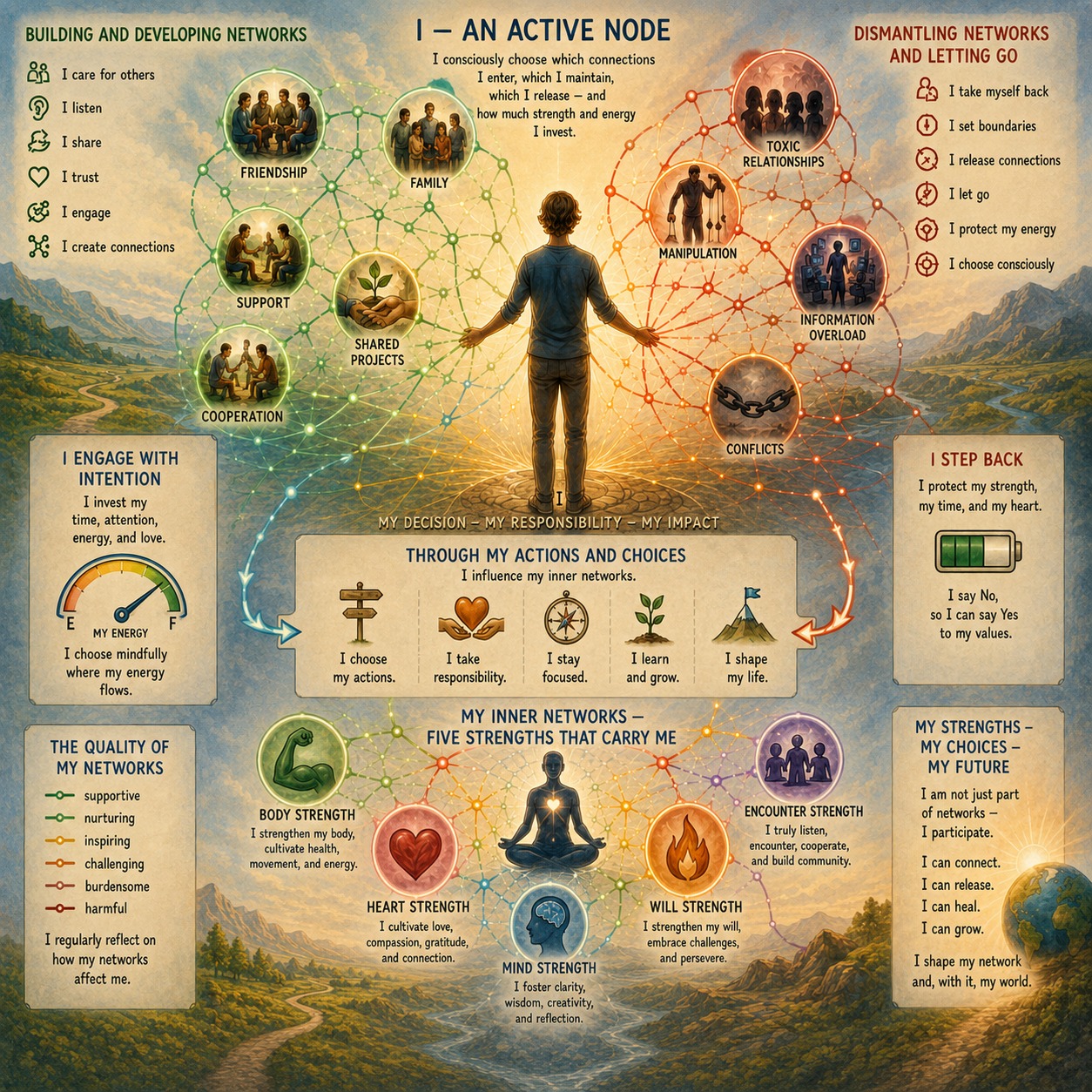
Translation note: Building and dismantling networks, conscious energy use, action fields, network quality, and the five inner strengths are complete. “I withdraw” is awkwardly translated as “I take myself back.” “I approach others” becomes “I care for others,” replacing movement toward encounter with the broader idea of care.
A Node in Many Networks
Every person is connected to overlapping networks of family, friendship, work, society, knowledge, information, nature, spirituality, and inner life. These networks offer support, learning, love, growth, and inspiration, while also creating responsibilities. Awareness means asking which networks carry, nourish, challenge, weaken, or deserve care and boundaries, and choosing mindfully what to receive and transmit.
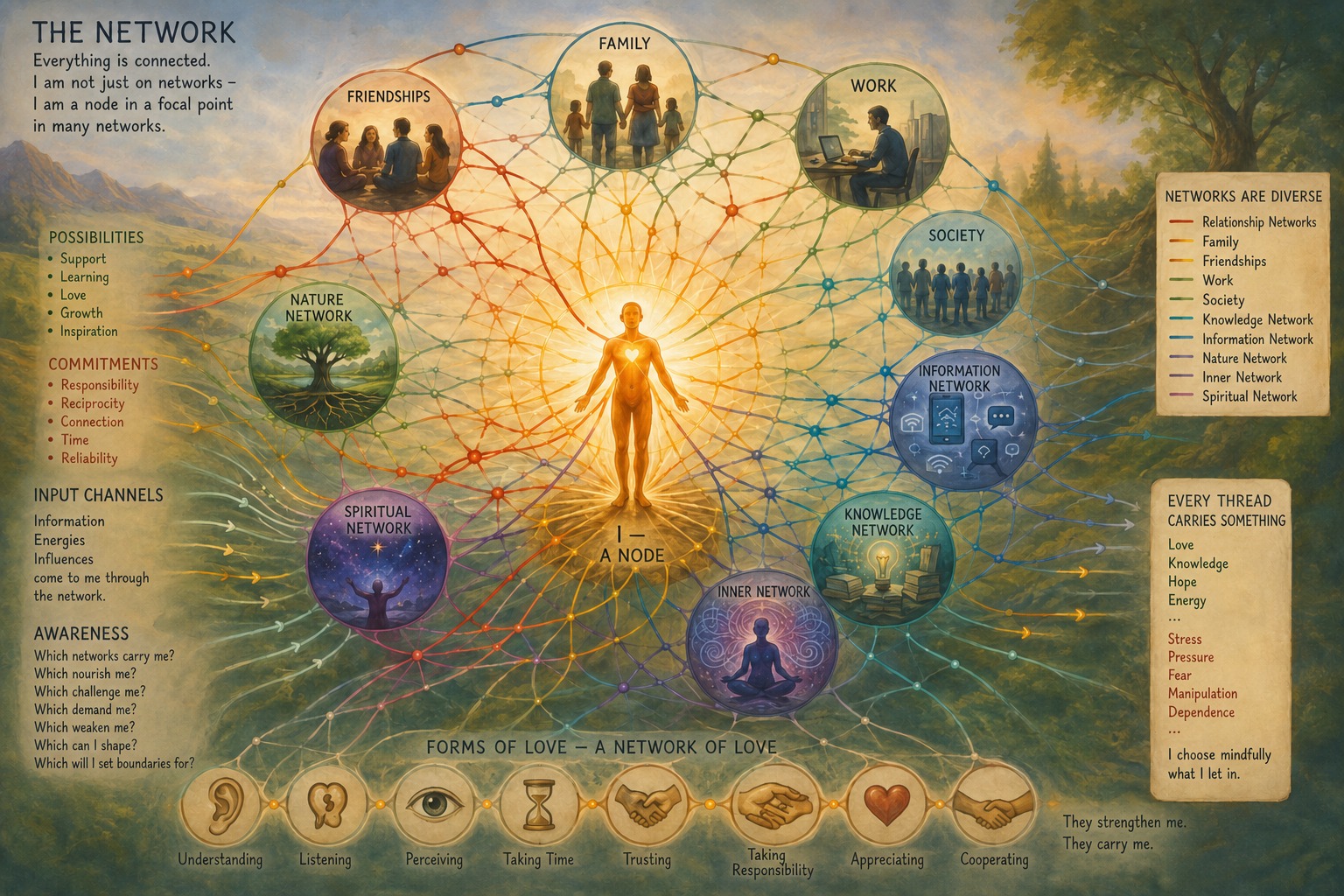
Translation note: Network types, possibilities, commitments, input channels, awareness questions, thread contents, and eight forms of love are complete and very legible. The opening sentence contains a grammatical meaning error: “I am a node in a focal point in many networks.” “Consideration” becomes “Reciprocity,” “Commitment” becomes “Connection,” and “Which challenge me?” becomes the awkward “Which demand me?”
The Five Basic Rules of Kolibri Ethos
Seek love. Protect life. Revere the sacred. Be yourself. Shape this world. These five concise rules connect personal dignity, care for living beings, openness to what transcends utility, authentic selfhood, and responsible participation in the shared world.

Translation note: The title, all five basic rules, and the small self-acceptance text are translated completely, correctly, and very legibly. The proper name “Kolibri Ethos” is retained. No translation or meaning error was found.