
Encounter
Encounter begins when two realities are allowed to remain distinct while a shared space becomes possible. Attention, boundaries, resonance, communication, and responsibility shape whether this space supports freedom and growth or becomes narrowed by pressure and projection.
Two Universes and One Shared Space
We cannot create or remake another person's history, feelings, or inner world. We can decide how we meet them: with attention, clear boundaries, protection of life, and respect for freedom. The shared space between two people is not possession. It grows through communication, agreement, trust, and a willingness to recognize both closeness and difference.
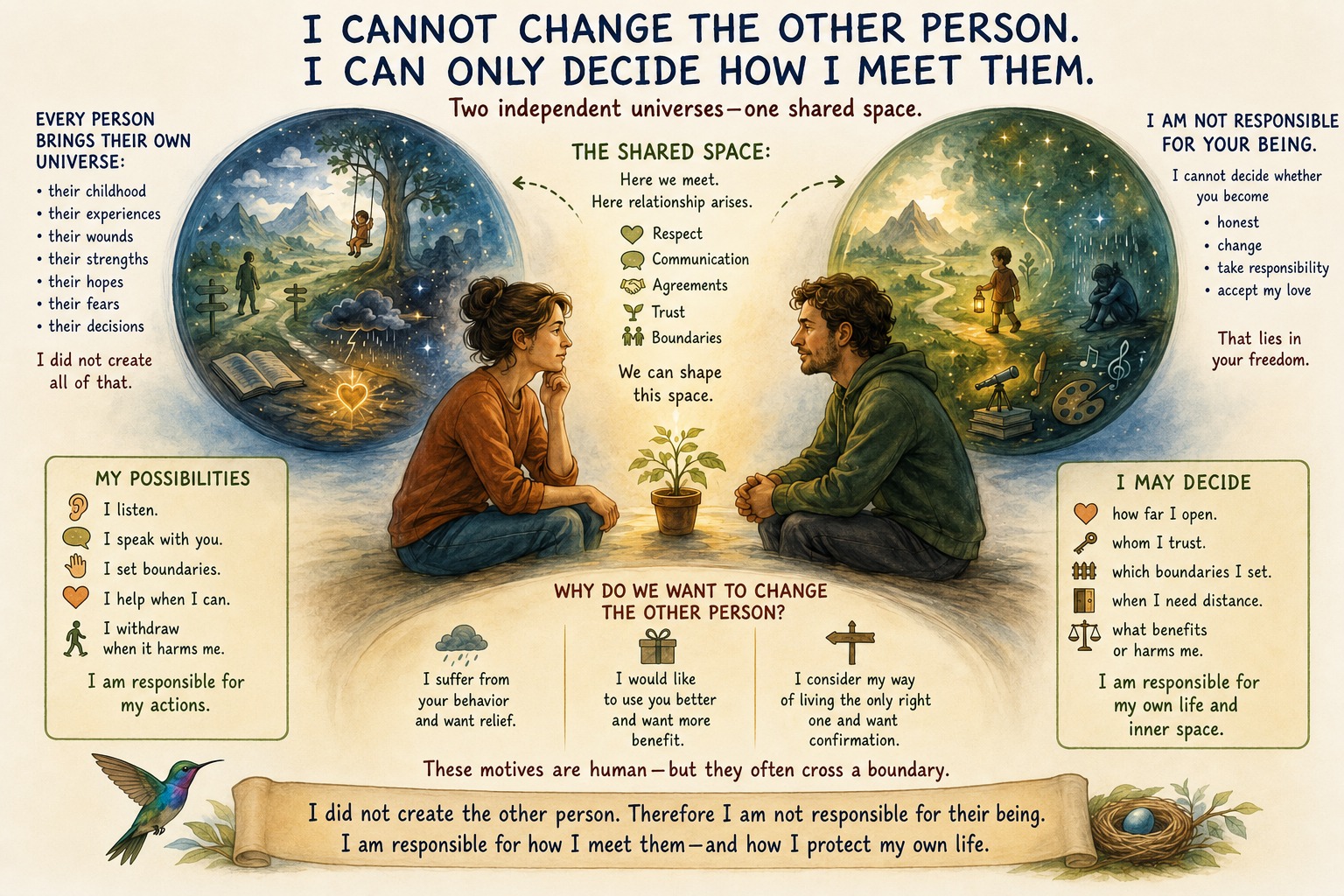
Translation note: The two-universes metaphor, the limits of changing another person, the shared-space model, boundaries, and practical orientation are translated with high fidelity. No significant semantic or spelling error is visible.
Attention Shapes Encounter and Life
Attention is a living direction of our inner being. Biology, emotion, society, spirituality, and technology can pull it, while heart, mind, and will help us choose where it flows. Its depth ranges from fleeting to wholehearted. Because attention gives part of our lifetime to a person or purpose, conscious attention can open paths toward knowledge, relationship, creativity, growth, and service.
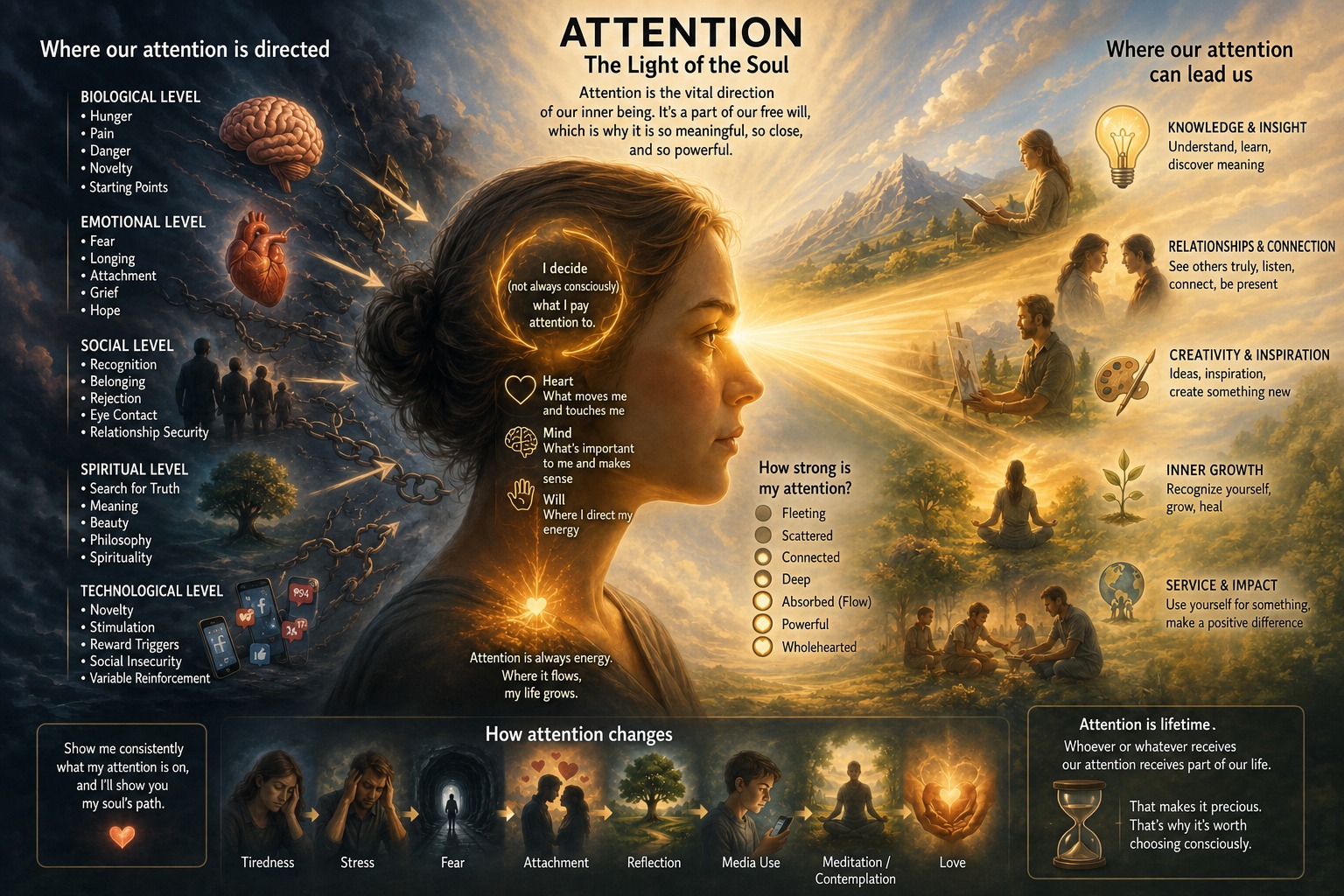
Translation note: The full composition and almost all dense text are legible and coherent. Three labels shift meaning: German `starke Reize` (strong stimuli) becomes `Starting Points`, `Verliebtheit` (being in love/infatuation) becomes `Attachment`, and `Reifung` (maturation) becomes `Reflection`. The central and closing statements remain accurate.
Many Forms Work Together
Attention can be visual, auditory, bodily, emotional, social, loving, moral, logical, practical, temporal, strategic, creative, spatial, protective, psychological, or spiritual. These forms rarely act alone. Their cooperation can deepen clarity, safety, empathy, wise decisions, and freedom; their competition can create distraction. Mindfulness does not narrow life to one form, but helps them work in a fitting relationship.
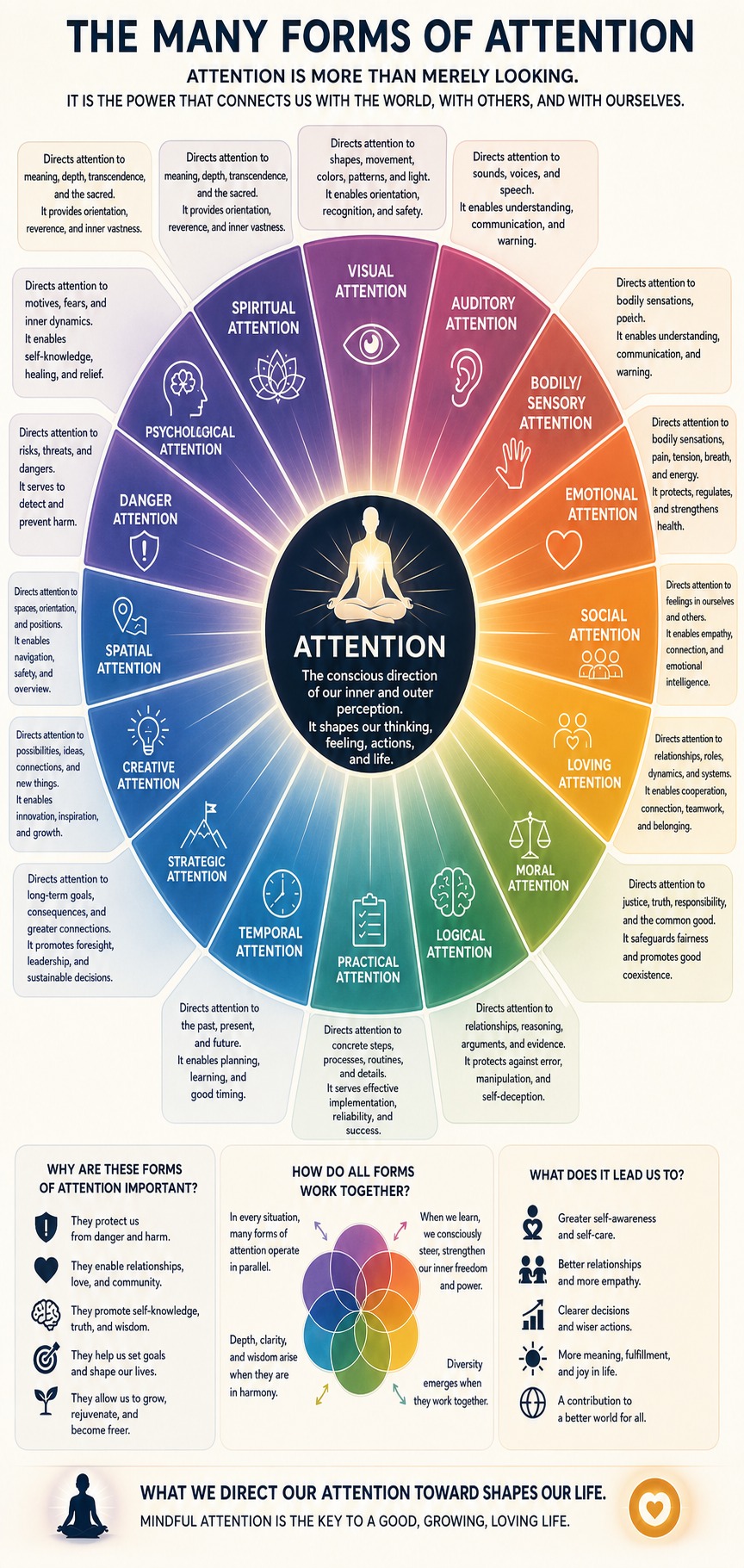
Translation note: The circular spectrum, headings, center definition, explanatory boxes, three bottom panels, and footer are exceptionally complete. One bodily-attention box contains the malformed word `poech`, apparently a rendering error. The intended reference to bodily sensations remains understandable from the neighboring text and icon.
Resonance Is Responsive, Not Forced
Resonance arises when living realities touch without losing their boundaries. Perception, attention, openness, trust, authenticity, and freedom make mutual response possible across body, feeling, thought, will, values, meaning, and action. Conflict does not end resonance if genuine listening and respect remain. Between individuals or groups, it grows through practice, fair rules, shared projects, forgiveness, and time.
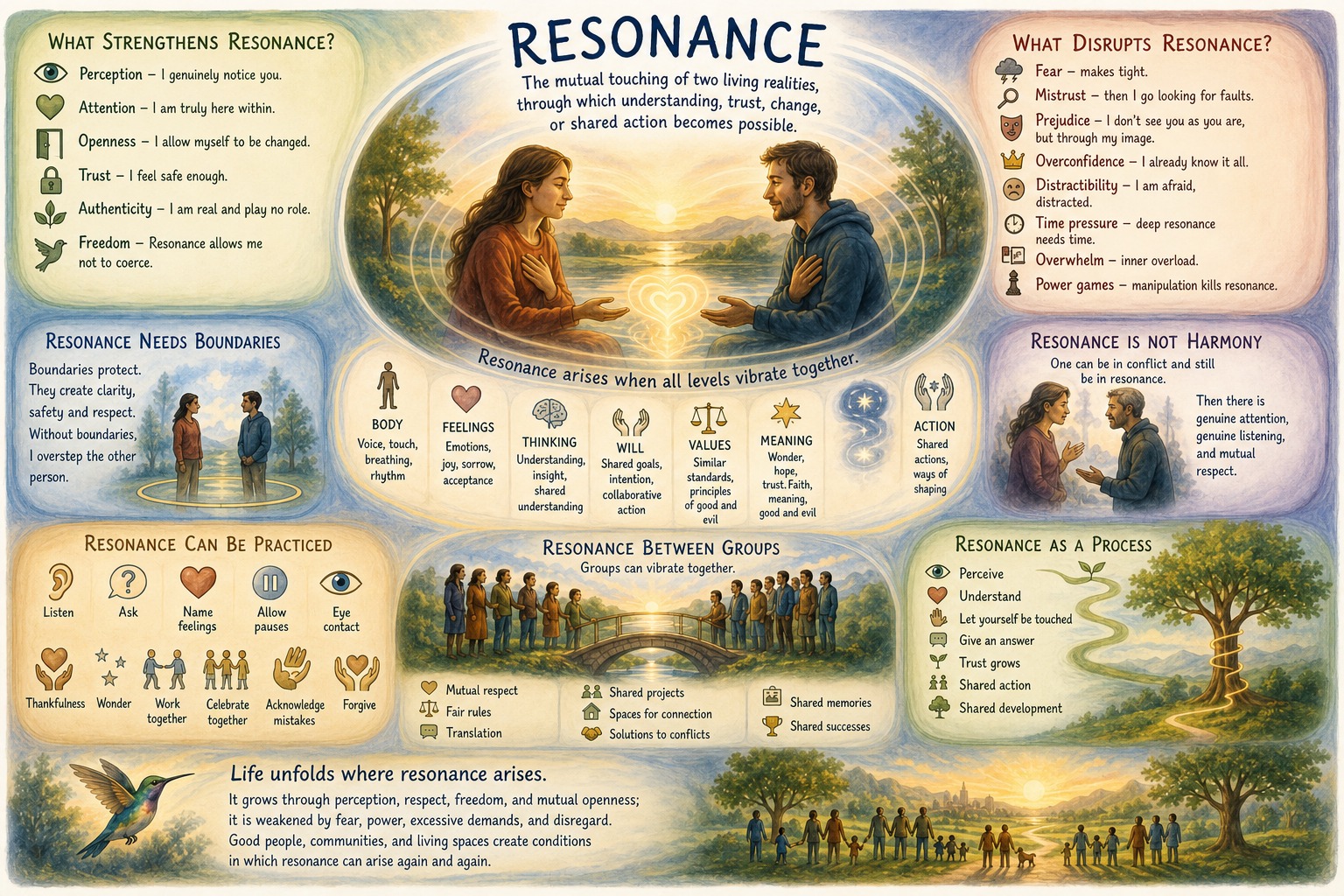
Translation note: The watercolor structure, principal definition, seven levels, practice panel, group bridge, process, and footer are translated very well. German `Beschämung` (shaming) is incorrectly rendered as `Distractibility`; `Übersetzer` (translators/mediators) becomes the abstract `Translation`; and the freedom line is awkwardly phrased as `Resonance allows me not to coerce` instead of `Resonance cannot be forced`.
Blind Spots Separate Intention from Impact
People usually see their own intentions, feelings, and reasons, while others experience body language, repetition, and impact. This gap can turn qualities such as confidence, care, caution, order, or closeness into arrogance, overprotection, mistrust, control, or enmeshment. Real understanding becomes possible when intention, behavior, impact, and feedback are all allowed into the conversation.
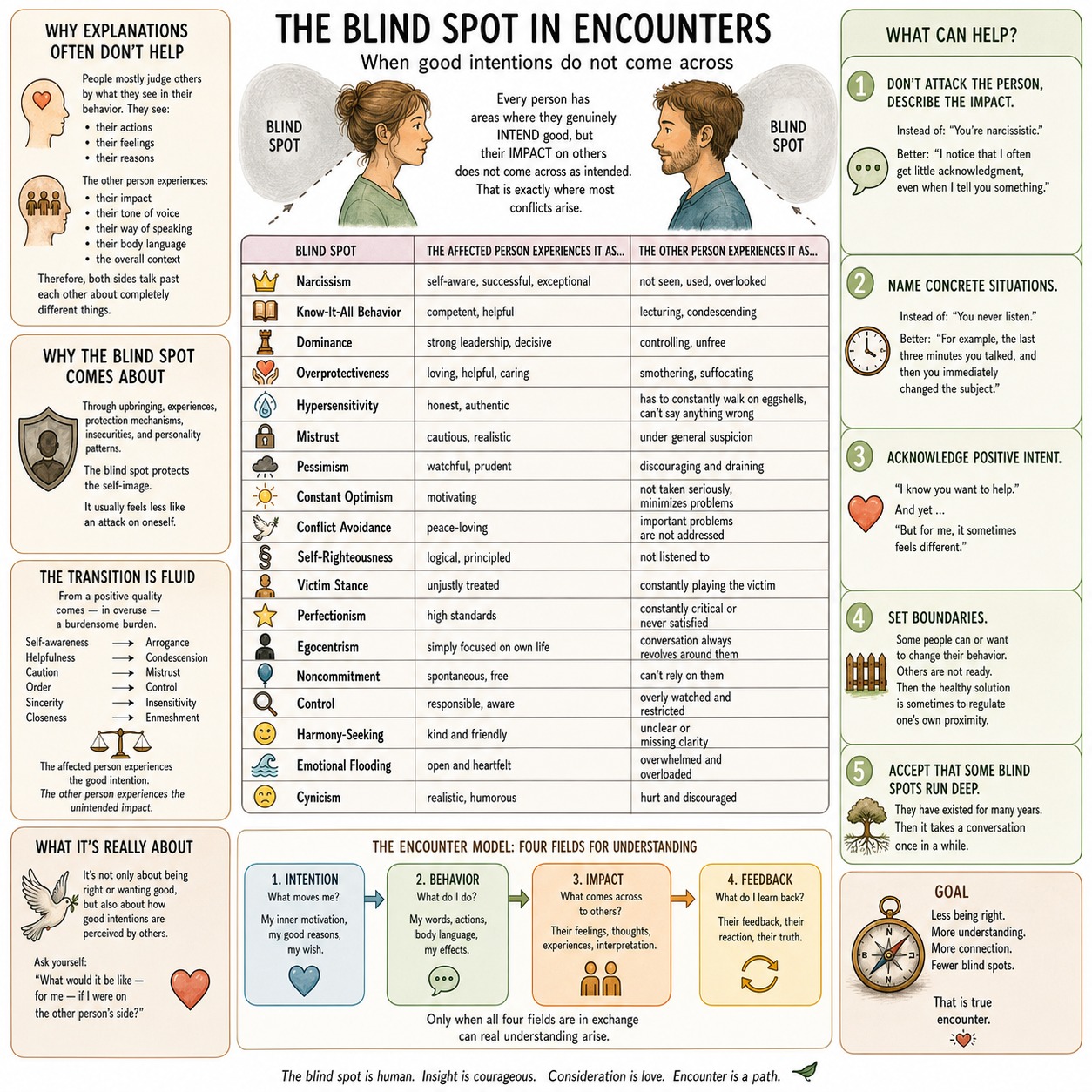
Translation note: The two-perspective model, 18-row table, transition list, five practical steps, four-field cycle, and closing goal are translated with exceptional completeness. The repeated table headings reflect the source's distinction between self-experience and the other's experience, though the English headings could be clearer. No material semantic or spelling error is visible.
Expressing a Concern Without Passing on Pressure
An important need can create inner pressure, but the other person should not have to carry that pressure. A concern can be stated clearly while leaving room for a different view, time to think, or a genuine no. Separating concern, pressure, behavior, impact, and feedback helps preserve both freedom and connection.
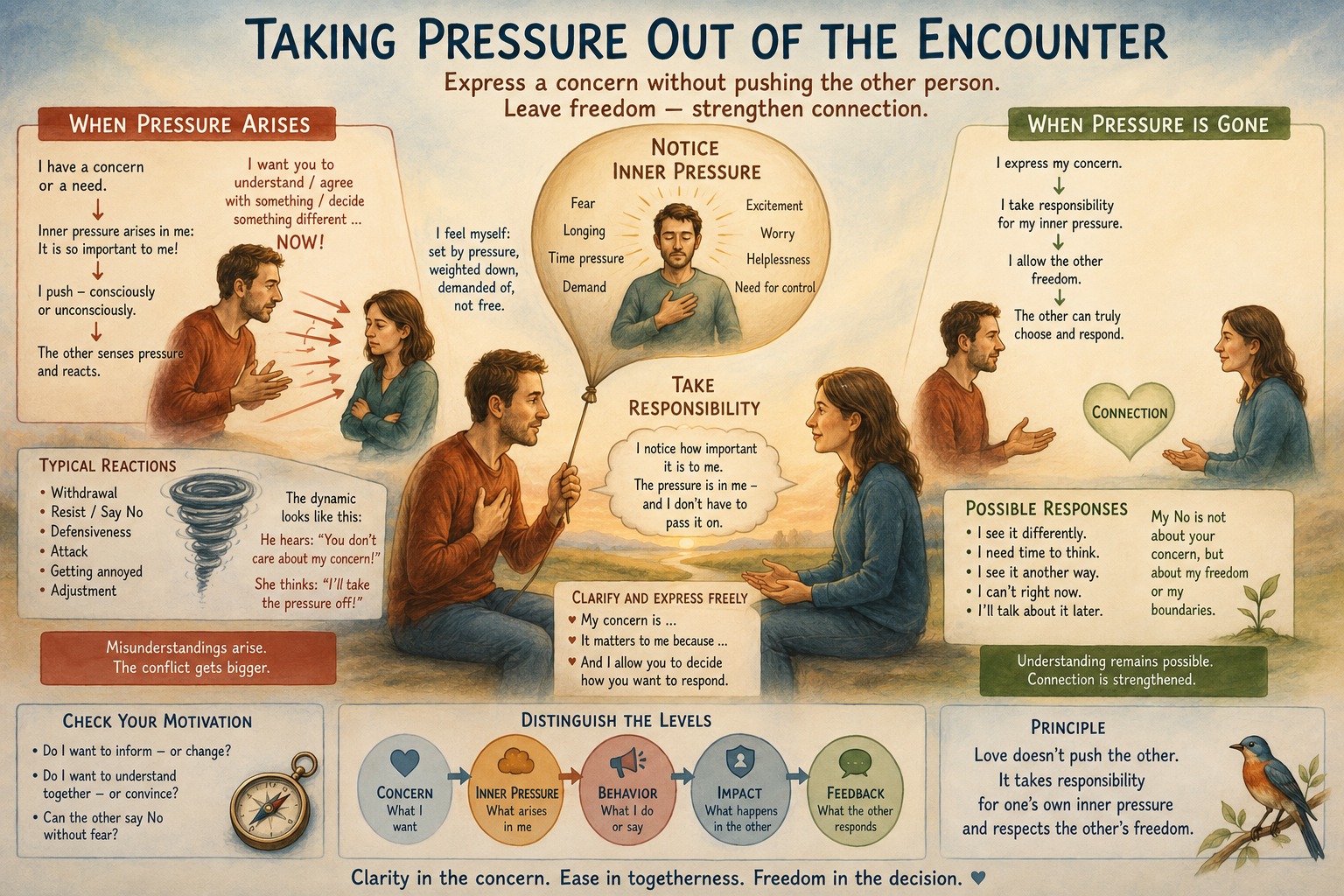
Translation note: The pressure cycle, reactions, responsibility statement, possible responses, motivation questions, five-level model, and principle are translated very clearly. In the balloon, German `Überforderung` (overwhelm/excessive demands) becomes the weaker `Demand`; the surrounding statements still convey inner pressure accurately.
Giving Third Forces Their Proper Place
Every relationship is influenced by people, communities, ideas, activities, and inner memories or fears. Such third forces can enrich and connect, or drain attention and replace direct encounter. Healthy boundaries keep the couple's shared decisions in an inner circle while respecting outside influences without making them decisive.
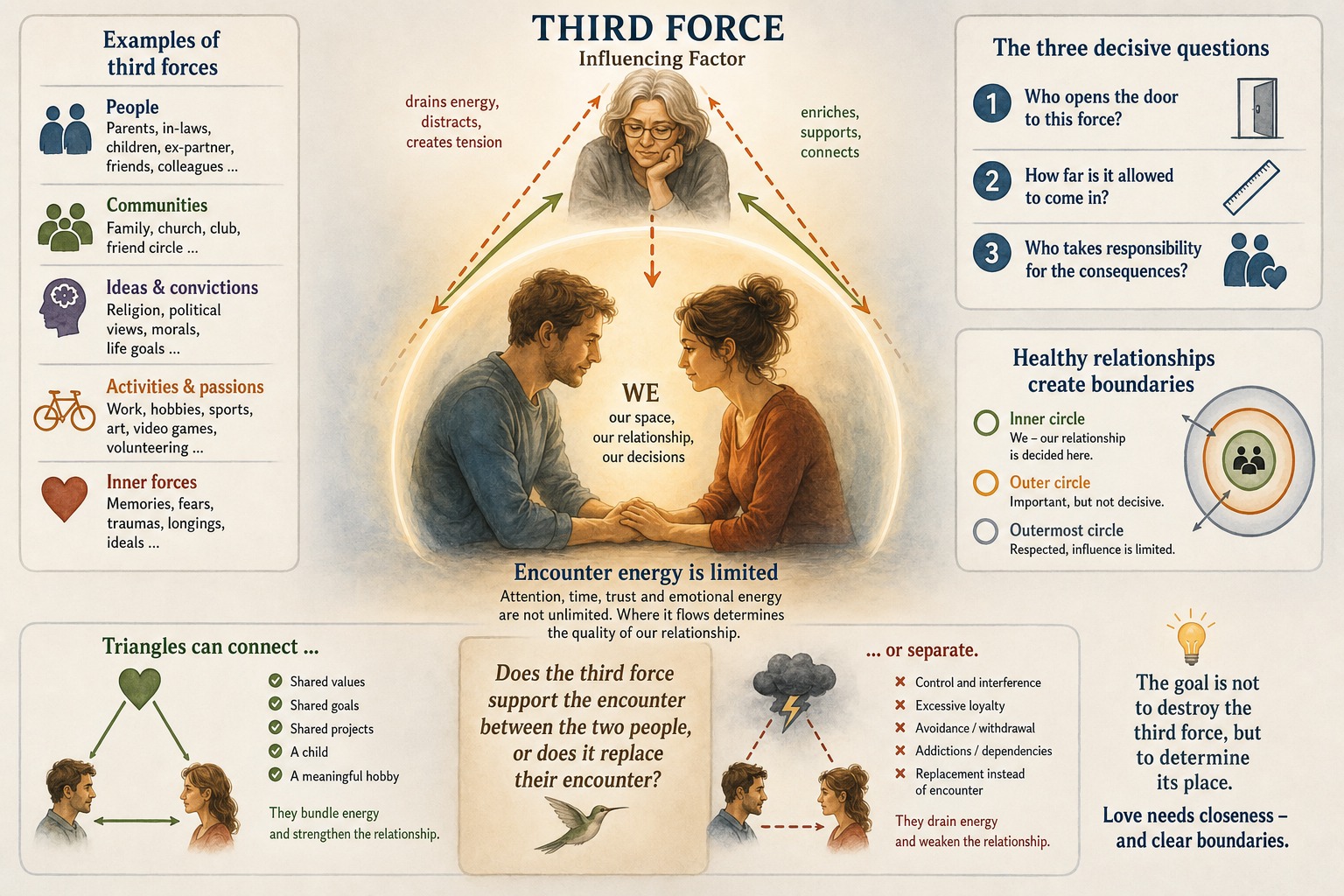
Translation note: The examples, triangle arrows, three decisive questions, three boundary circles, limited-energy statement, positive and negative lists, central question, and closing principle are all translated accurately. No significant semantic or spelling error is visible.
Encounter Is a Cycle of Learning
Intention moves outward through words, actions, timing, and attitude. Its impact arises in another person's distinct inner universe and returns as feedback. If feedback is heard with mindfulness, honesty, courage, respect, and humility, it can change the next intention. Encounter is therefore not a one-way act but a recurring spiral of learning and growth.
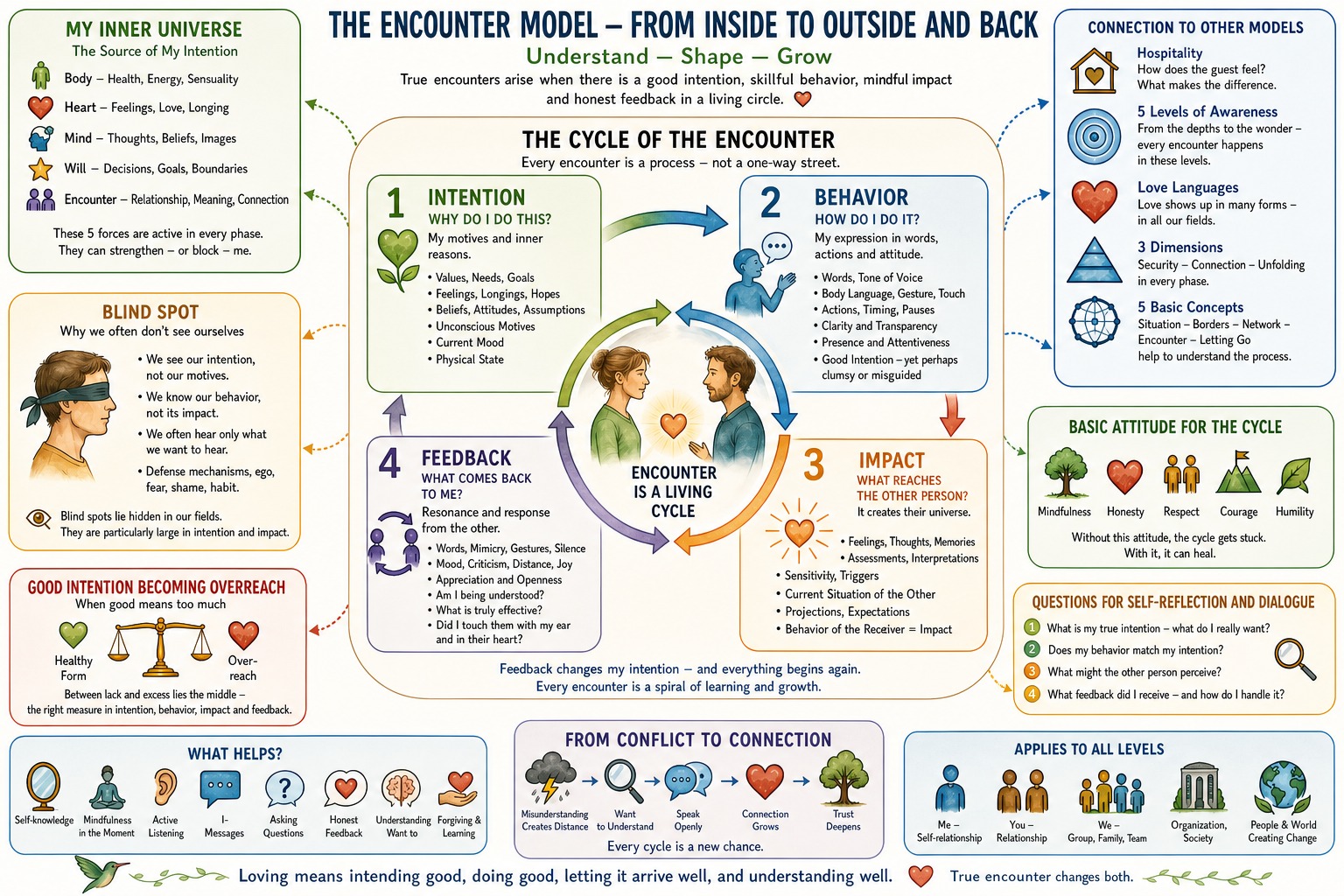
Translation note: The four-stage cycle, five inner forces, blind-spot and overreach panels, links to other models, reflection questions, conflict-to-connection path, levels, and footer are preserved with unusually high fidelity. `They can strengthen — or block — me` adds a personal object where the source leaves it general, but does not alter the model materially.
Building Bridges Across Difference
Connection does not require erasing differences. Shared spaces, mutual help, equal dignity, respectful dialogue, intergenerational learning, and shared responsibility can build bridges across neighborhoods, wealth, gender, culture, and religion. The bridge is sustained by listening, trust, protection, and the willingness to grow together.

Translation note: Every social group, the central bridge values, all eight steps of the basic formula, and the chalkboard message are translated correctly and legibly. `Give dignity` is deliberately close to the German wording and sounds slightly unusual in English, but its meaning is clear. No material error is visible.
Choosing Between Separation and Connection
Fear, power, propaganda, surveillance, prejudice, and enemy images can organize society around separation. Trust, free media, democratic participation, education, cultural dialogue, justice, and solidarity support connection. The bridge between these worlds begins in the human heart through truth, courage, compassion, listening, and responsibility.
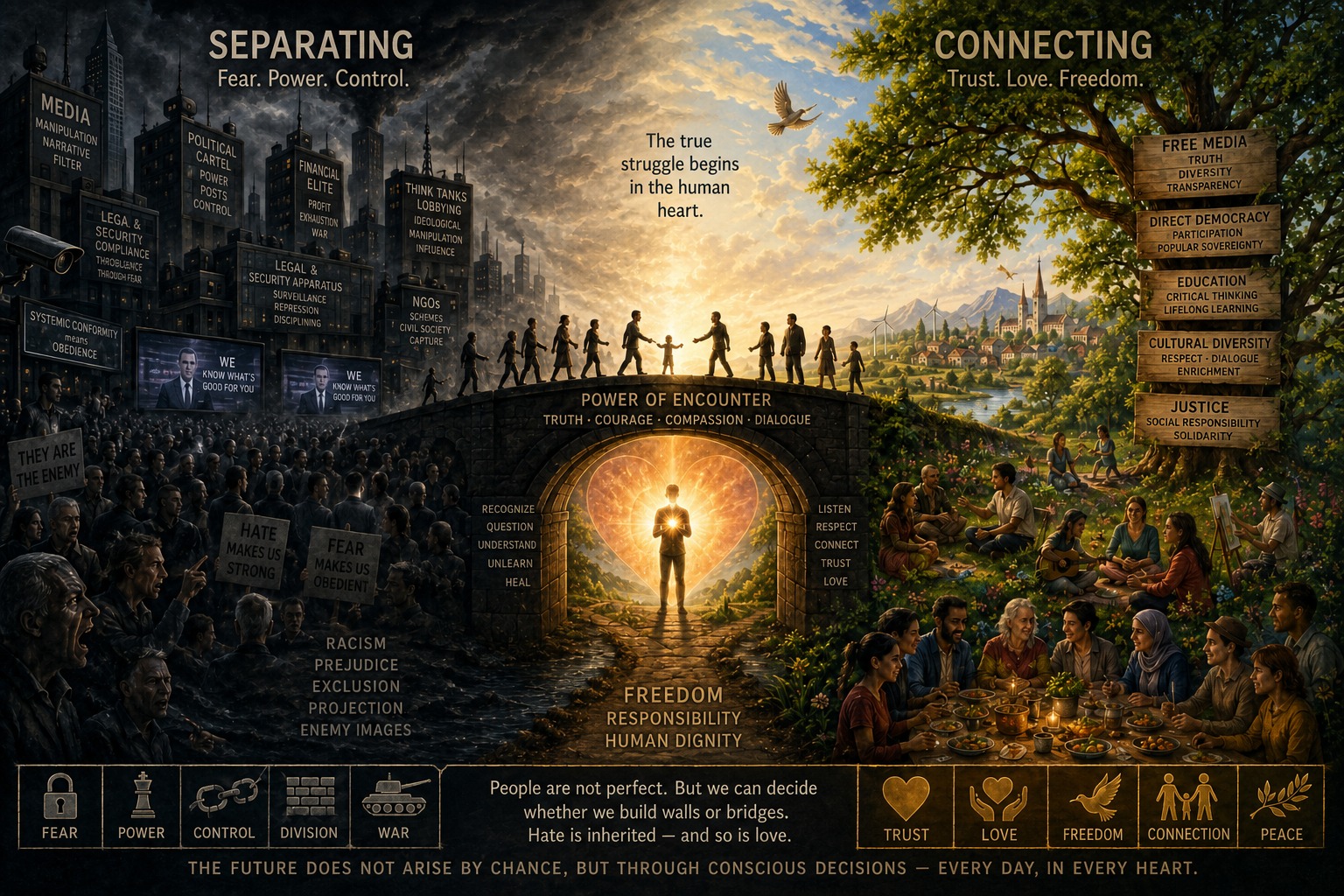
Translation note: The dark/light contrast, institutional labels, propaganda signs, bridge values, civic signposts, lower concepts, icon strip, and footer are translated with high fidelity. The source `Schein-Zivilgesellschaft` (sham/pseudo civil society) is rendered more freely as `schemes / civil society capture`, which adds a stronger political interpretation; the principal contrast remains clear.
Openness Makes Mature Judgment Possible
Judgment becomes harmful when labels replace the person. Openness does not mean abandoning discernment; it creates a pause in which perception, curiosity, compassion, respect, and boundaries can cooperate. Mature judgment observes and distinguishes without fixing a developing person permanently in place.
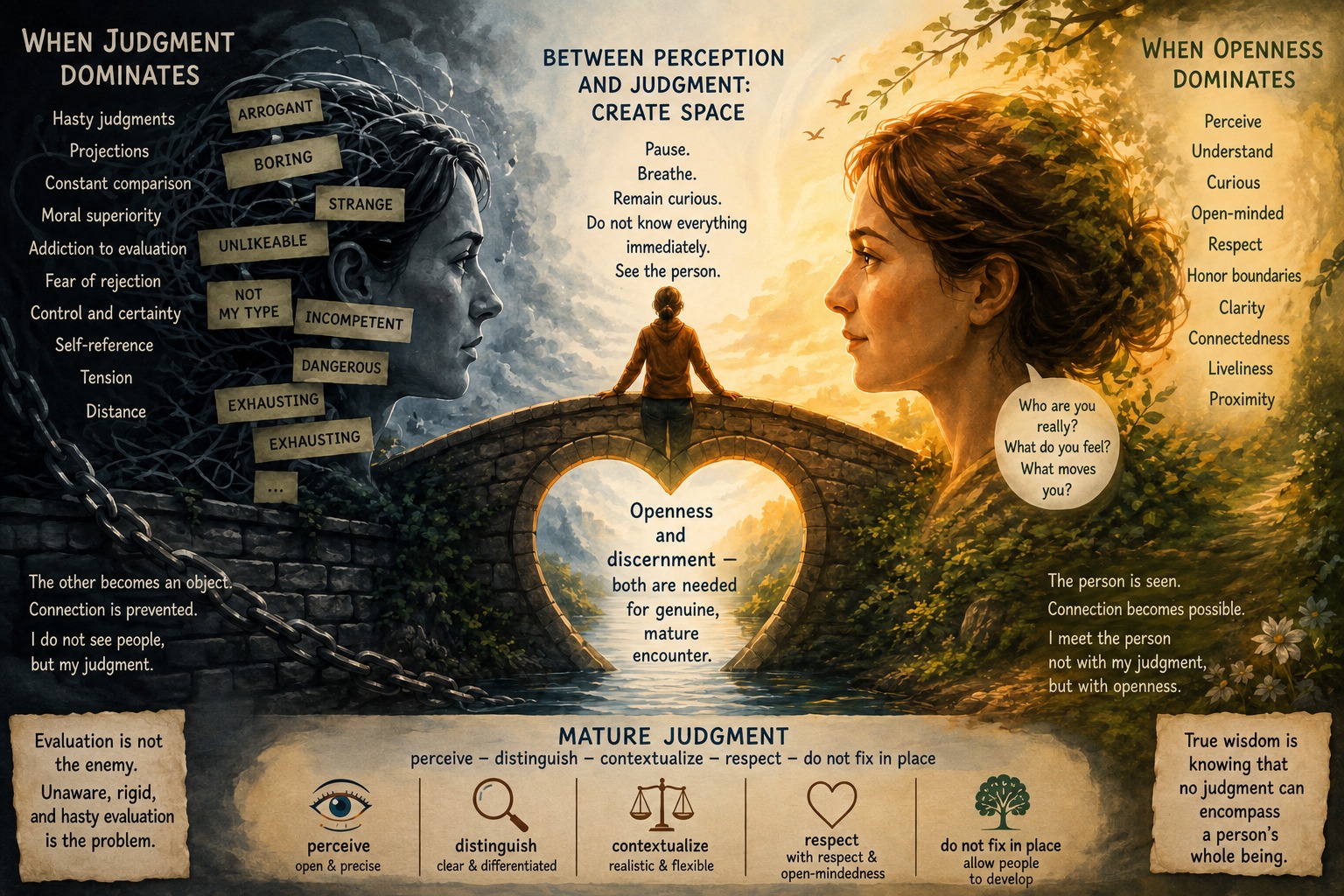
Translation note: The dark and light lists, labels, bridge, questions, side conclusions, five-step model, and wisdom statement are translated clearly. In the openness list, German `Mitgefühl` (compassion) is incorrectly rendered as `Open-minded`; one `EXHAUSTING` label is also duplicated. The overall distinction between rigid evaluation and open discernment remains intact.
Communication Moves Through Two Inner Worlds
Every message is perceived through words, voice, body, timing, distance, silence, memories, values, mood, and expectations. Before a response emerges, protection, action, factual understanding, relationship meaning, and self-disclosure interact in an inner encounter space. A respectful answer requires clarification, regulation, deliberate timing, and an expression suited to both person and relationship.
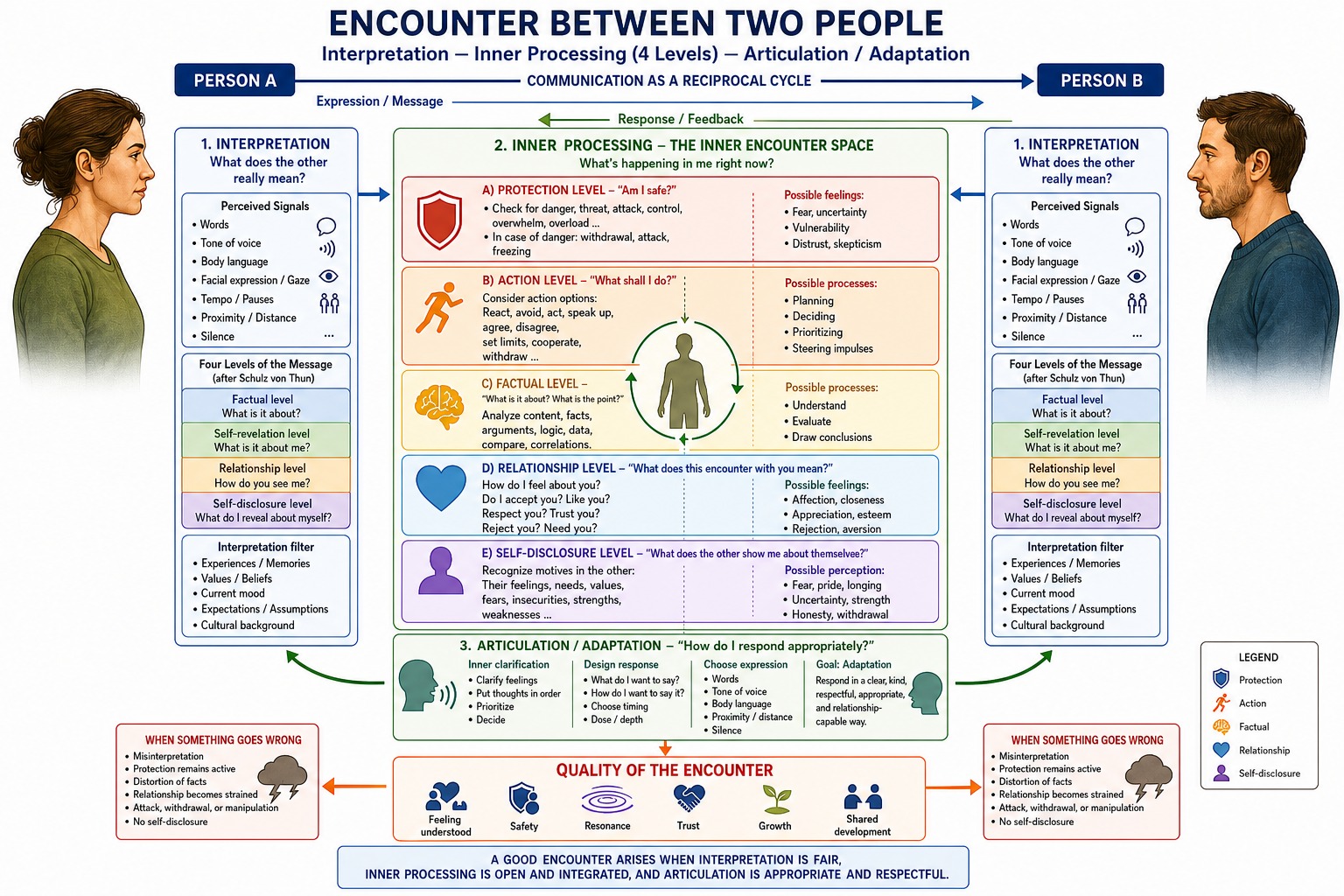
Translation note: The reciprocal arrows, mirrored interpretation panels, five central processing levels, articulation/adaptation choices, quality indicators, failure boxes, legend, and footer are translated with exceptional precision. The source itself says `4 levels` in the subtitle while showing levels A–E; the English intentionally preserves that internal inconsistency rather than silently changing it.
Expectations Point in Four Directions
Expectations may be optimistic or pessimistic and directed toward oneself or toward others. Each stance offers strengths while hiding limits, danger, opportunity, or relationship. A balanced attitude recognizes personal strengths and limits, remains realistic about human love and disappointment, and stays open to what actually comes.
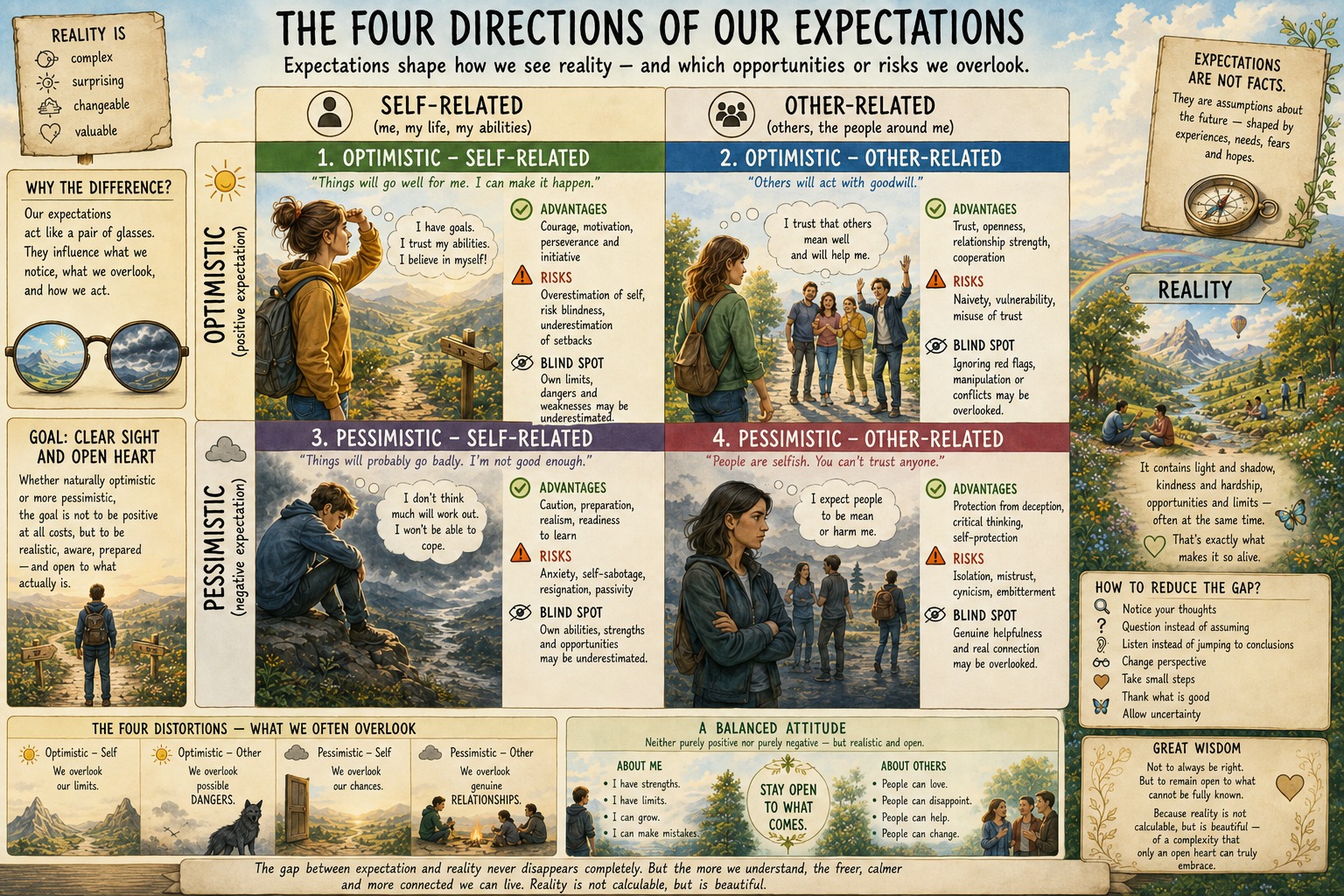
Translation note: All four quadrants, their quotations, benefits, risks and blind spots, the side explanations, distortions, balanced attitude, wisdom panel, and footer are translated accurately and legibly. No significant semantic or spelling error is visible.
Recurring Communication Patterns Matter
No single difficult act proves a diagnosis. Concern becomes warranted when recurring patterns over time erode freedom, truth, trust, dignity, stability, and one's confidence in perception. Manipulation, blame, control, emotional blackmail, inconsistent public and private behavior, and refusal of responsibility call for clarity, boundaries, support, and sometimes leaving.
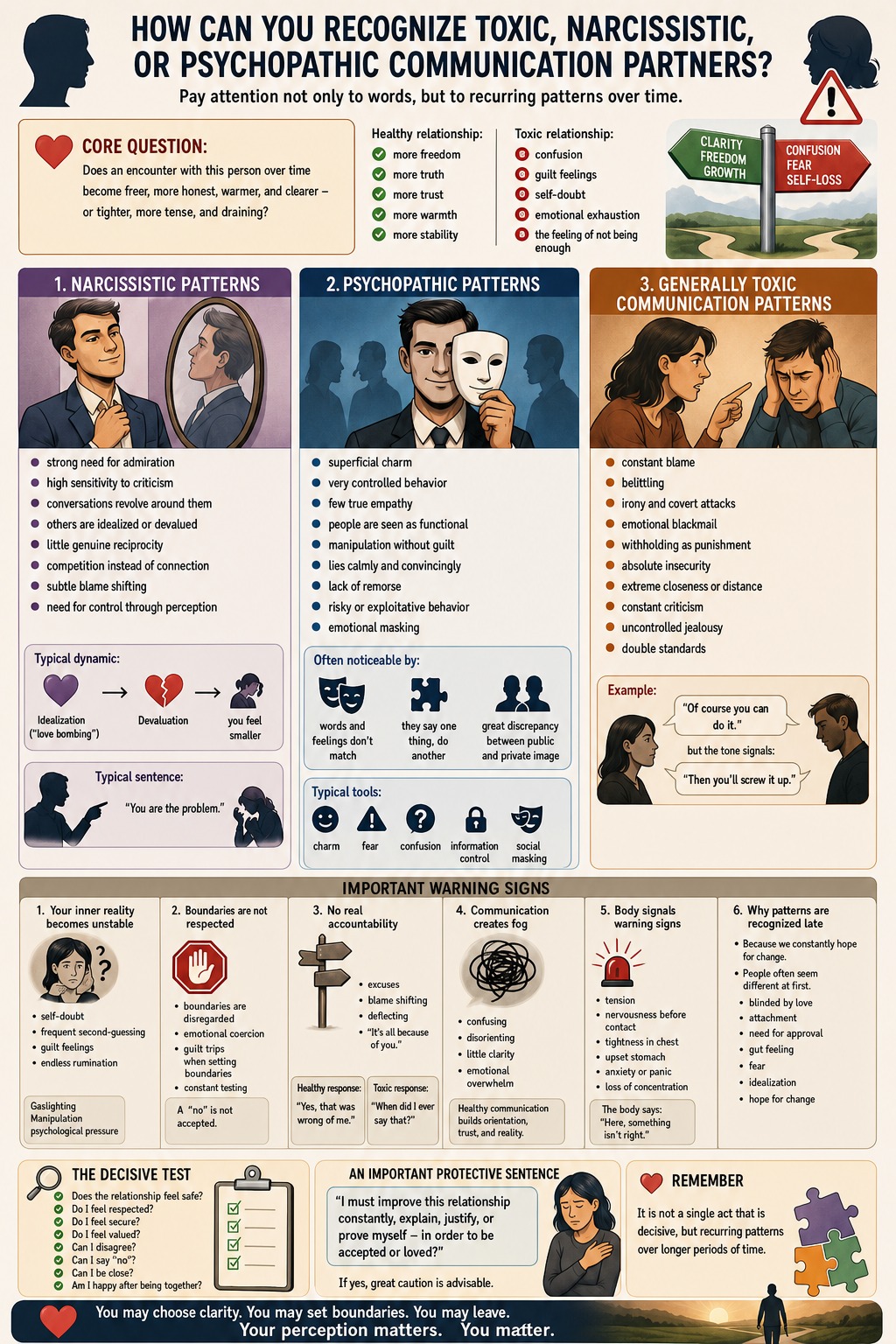
Translation note: The three pattern columns, relational contrast, examples, six warning panels, bodily signals, and closing reminder are translated very well, without adding a diagnosis. However, the decisive test is materially altered: source questions about reactions to criticism, boundaries, weakness, loss of power, losing, apologizing, closeness, and another's joy become general safety/respect questions. The protective source phrase `to be allowed to exist peacefully` also becomes `to be accepted or loved`.
Communication Can Move Between Four Spaces
A conversation can move from separation through curious approach and conflict toward deep encounter. Each space changes how attention works: it may be absent, intensely gathered, narrowed into combat, or open and calm. Deep understanding does not erase difference; it lets body, heart, mind, and will cooperate with trust and resonance.
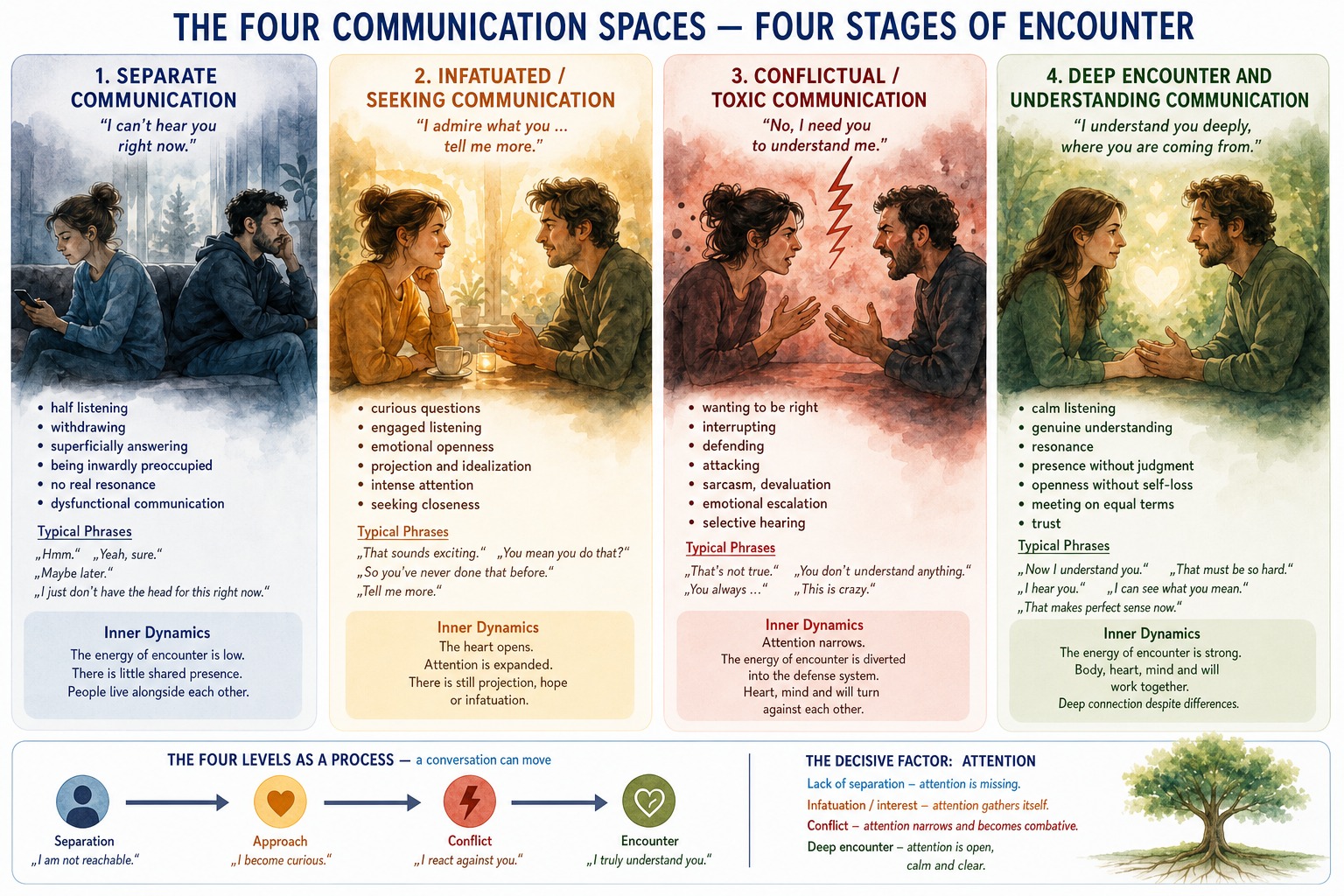
Translation note: The four panels, detailed lists, typical phrases, inner dynamics, process arrows, and most attention statements are preserved. Three prominent phrases change meaning: seeking `I sense what you mean` becomes the incomplete `I admire what you ...`; conflict `I must disagree` becomes `I need you to understand me`; and German `Getrenntheit` (separation) is incorrectly rendered as its opposite `Lack of separation`.
Encounter Happens Beyond Words
People continuously read posture, face, gaze, voice, movement, tension, openness, attention, and ways of relating. Speech is only one channel. Resonance also moves through relationship, learned structures, memory, unconscious protection, and a deeper sense of being. Slowing down and noticing the unspoken can turn a moment into a path of mutual development.

Translation note: The channels, five depth levels, resonance arrows, effects, reasons, backpack, principles, development path, and footer are translated with remarkable completeness. `Encounter is a path — not a snapshot` becomes `Encounter is movement — no moment of arrival`; this is related but does not preserve the photographic snapshot contrast exactly.
Safety Lets Unfinished Thoughts Emerge
A safe conversation allows uncertainty, mistakes, silence, difference, and gradual trust. It is supported by genuine interest, confidentiality, mutuality, loving interpretation, calm presence, respect for boundaries, and questions before judgments. Hasty evaluation, ridicule, interruption, superiority, unsolicited advice, and time pressure close this space.
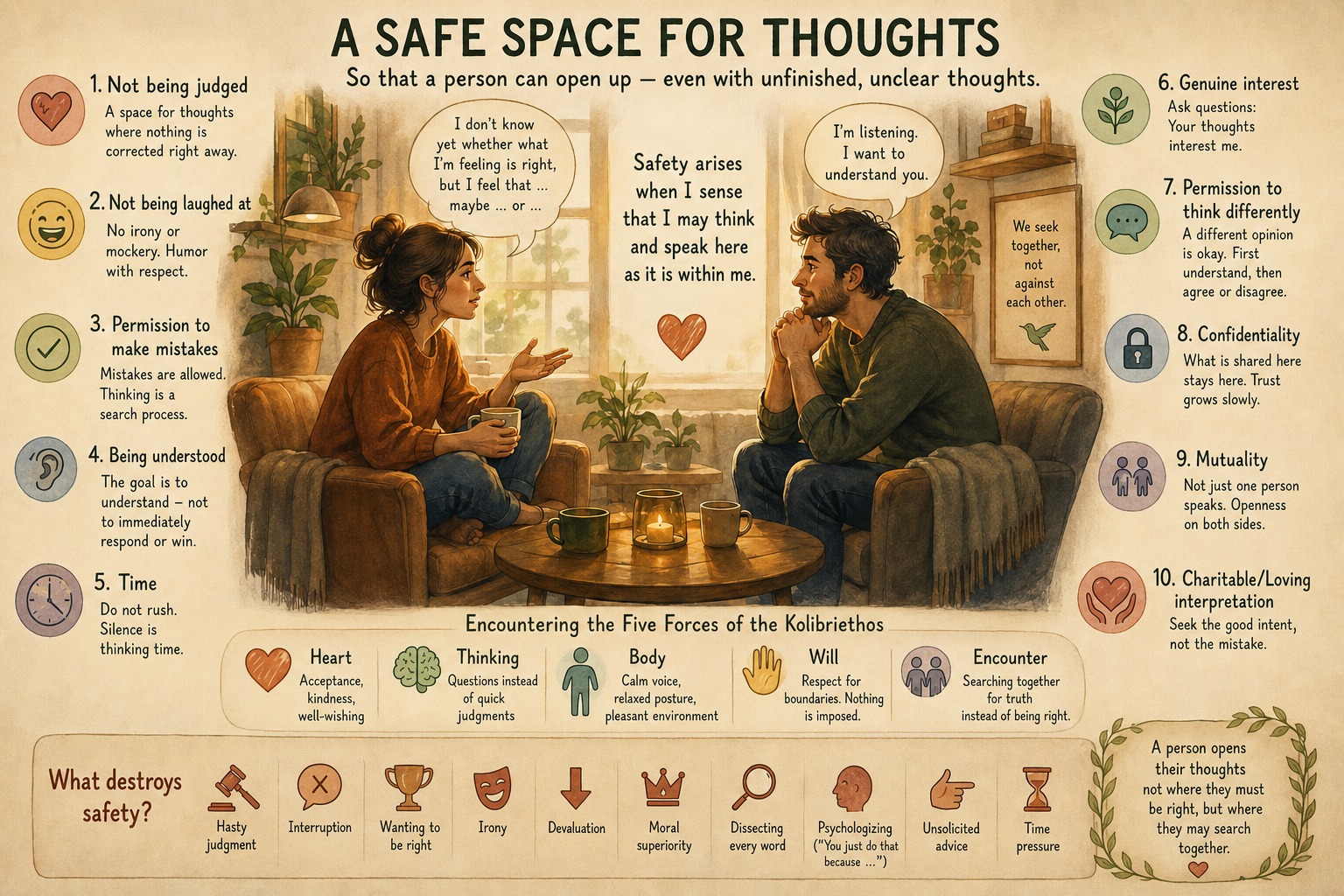
Translation note: All ten principles, central dialogue, five Kolibriethos forces, ten threats to safety, and closing sentence are translated accurately. In principle 7, German `einordnen` (contextualize/classify) is freely rendered as `agree or disagree`; the main permission to think differently remains clear.
Precious Time Should Give Strength
Another person's time includes organization, emotional availability, rest, responsibility, planning, and sometimes life force. The ethical question is not whether we deserve that time, but whether the encounter leaves the person calmer, freer, strengthened, and more fully themselves. Flexibility and pressure-free attention can make even a brief encounter nourishing.

Translation note: The main question, time resources, relational test, practical principles, central card, and footer are translated very clearly. The source sentence `Therefore, what I give her must be truly valuable` is omitted and replaced by a duplicate of `Sometimes an hour of peace is more precious than a perfect evening`.
Mindful People Become Oases
Speed, distraction, superficial priorities, exhaustion, and overload can weaken perception until relationships feel flat and emptiness deepens. Slowness, mindfulness, lingering, perception, and listening create a different world in the same moment. Encounter needs time, presence, and inner calm, and people who practice them can become oases for others.
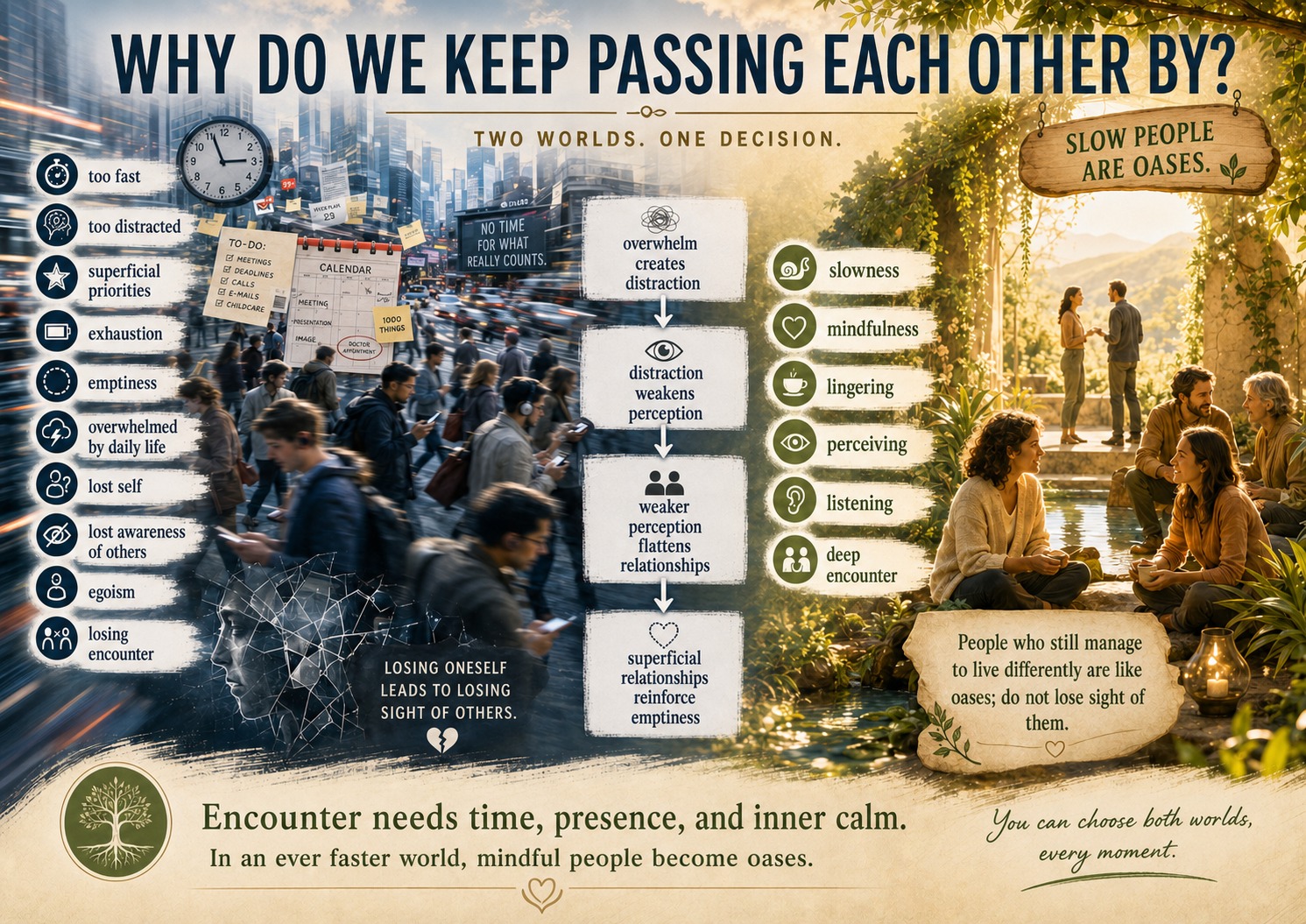
Translation note: The split-world composition, ten left-side conditions, full causal chain, six practices, all quotations, signs, and footer are translated faithfully and legibly. No significant semantic or spelling error is visible.