
Ethics
Ethics asks for good reasons for action and coexistence. Different traditions emphasise duties, consequences, character, self-determination, social structures, responsibility, care, religion, nature, or political and economic order. These perspectives do not have to exclude one another: they can illuminate different dimensions of a good life while remaining open to criticism and correction.
Logos, Ethos, Pathos, and Kairos
Ancient rhetoric distinguishes reasoned argument, credibility, emotional resonance, and the fitting moment. Kolibri Ethos extends these four dimensions into a practical test for conversations, projects, relationships, and decisions. Good action needs clarity and knowledge, conscience and responsibility, motivation and feeling, and sensitivity to place, situation, readiness, and timing. None of the four dimensions guarantees certainty or success on its own.

Translation note: The four dimensions, ancient core, modern extension, shadows, limits, practical help, and fourfold test are complete and legible. The source's approximate date “4th century BC” is incorrectly changed to “Book 4, Ch. 1.” “Conscience” becomes “knowledge.” In the Pathos test, “Can it carry us through resistance?” becomes “Does it also meet resistance?” Ancient Logos also shifts from reasoning and justification toward “Foundation, Certainty.”
An Overview of Ethical Approaches
Deontological ethics asks what duties apply; consequentialism examines effects; virtue ethics cultivates character; individual ethics stresses self-responsibility; social ethics examines institutions and justice; responsibility ethics considers long-term consequences; and care ethics begins with relationships and dependency. Political, religious, and environmental ethics add further questions about freedom, equality, solidarity, transcendence, suffering, living beings, and future generations.
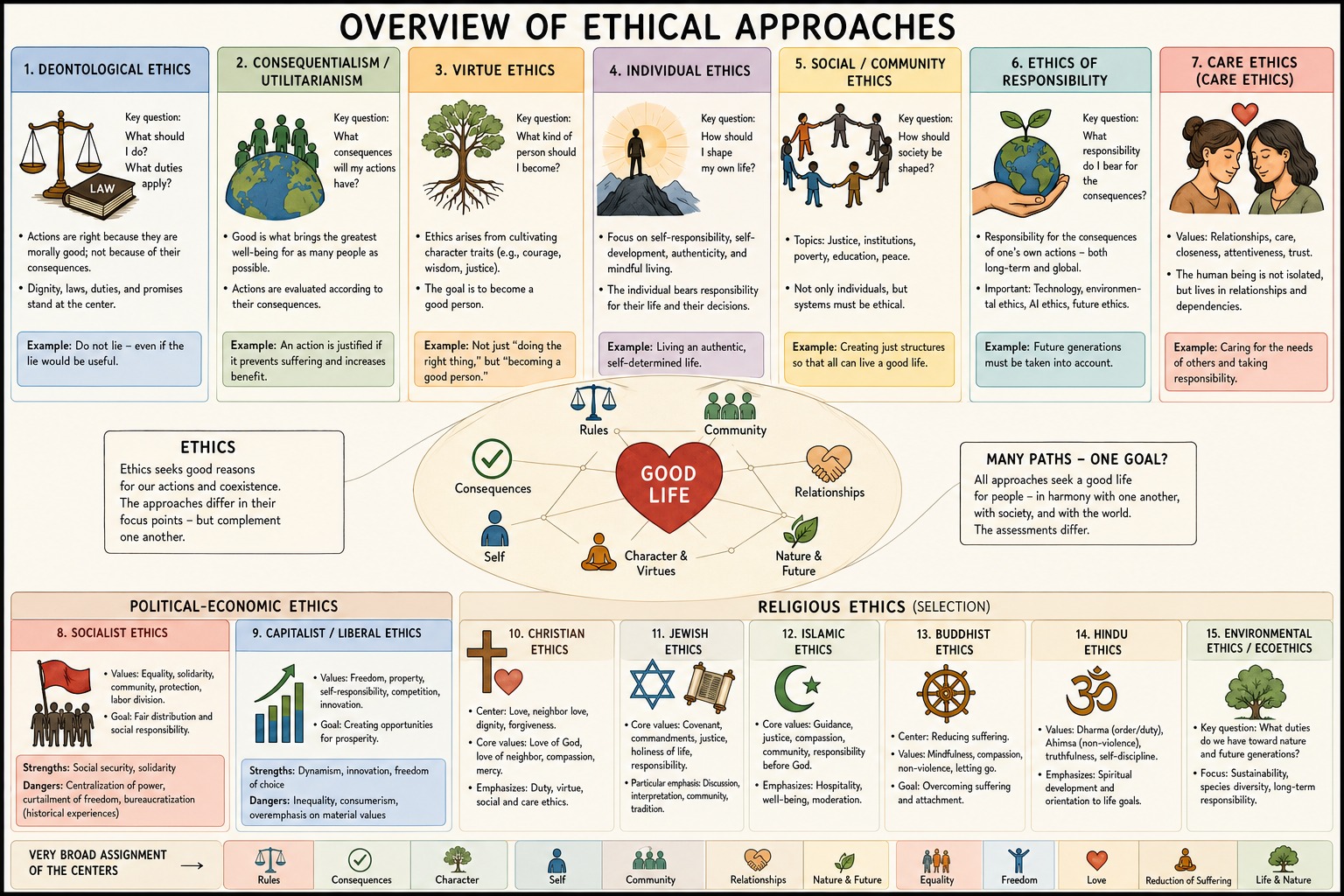
Translation note: All 15 approaches, questions, examples, strengths, dangers, and the Good Life model are complete and very legible. In Care Ethics, “dependency” and “compassion” are omitted and replaced by “attentiveness” and “trust.” In Islamic Ethics, “devotion” is mistranslated as “Guidance.” Jewish “sanctification of everyday life” is generalized to “holiness of life.”
When Ethical Strengths Become Distorted
Every ethical approach draws on forms of love, but a value can become destructive when isolated, exaggerated, narrowed, or made absolute. Duty can harden into legalism; concern for consequences can sacrifice minorities; virtue can become superiority; community can suppress dissent; care can become self-sacrifice or paternalism; and religion can become coercive absolutism. Ethical renewal requires awareness, humility, dialogue, forgiveness, encounter, and correction through other forms of love.
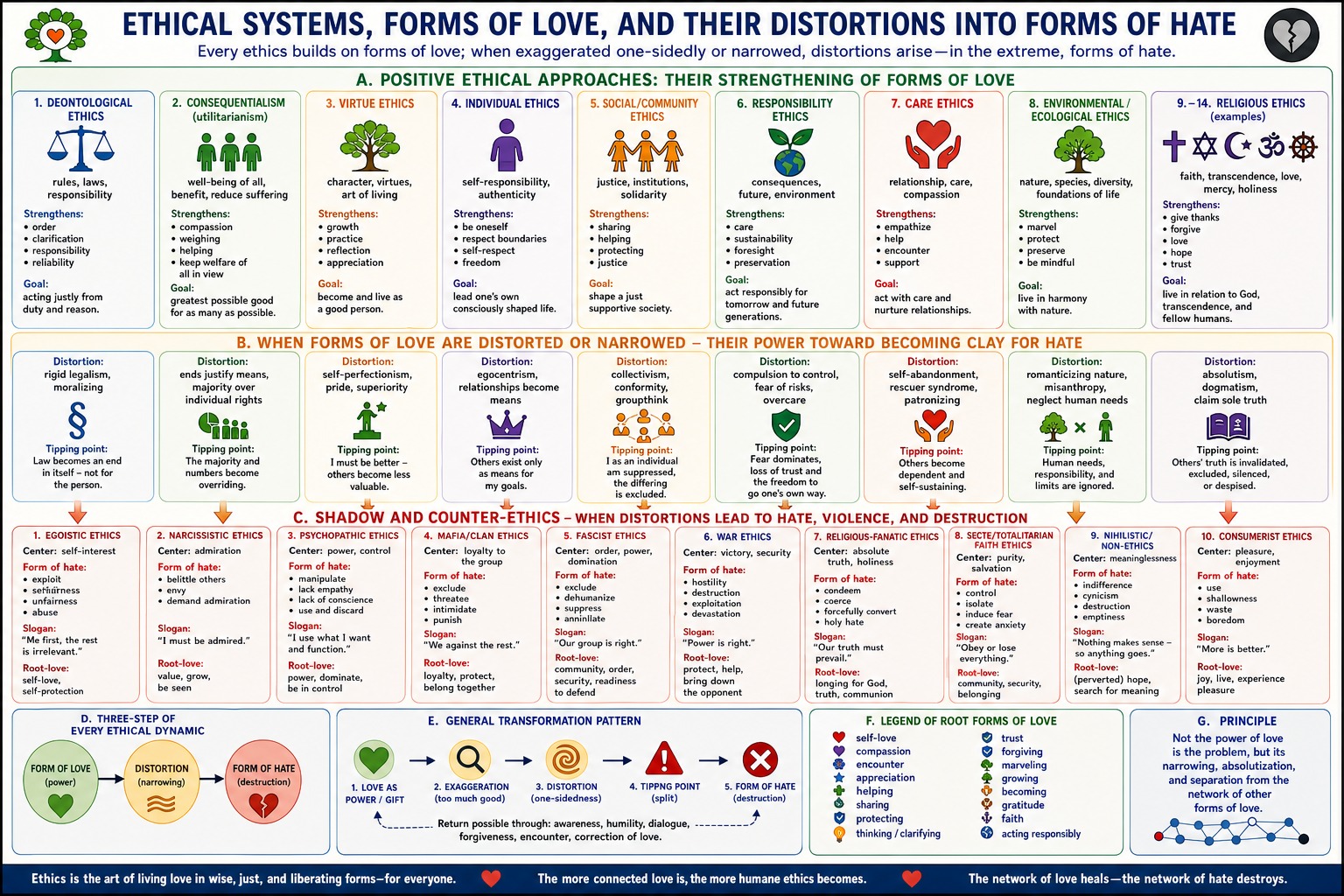
Translation note: Positive approaches, distortions, ten counter-ethics, transformation pattern, legend, and footer are complete and legible. Major error under Psychopathic Ethics: the root-love “acting wisely and retaining the ability to act” becomes “Desire to dominate, power-hungry.” Under War Ethics, “make sacrifices” becomes “bring victims.” In the return path, “humility” becomes “Courage” and “encounter” becomes “Compassion.” The motto about narrowing, absolutizing, and separating love from other forms of love is also substantially distorted. “Wonder” is omitted under Environmental Ethics.
Aloha, the Love Network, and the Five Strengths
Aloha describes love as attentive presence, respect, warmth, patience, and care for the whole person. The Love Network makes these attitudes concrete through listening, helping, protecting, forgiving, clarifying, sharing, and many other forms. The five human strengths contribute embodiment, feeling, understanding, perseverance, and genuine encounter.

Translation note: The composition, five Aloha principles, Love Network, five strengths, shadows, and integrated conclusion are preserved very clearly. The subtitle changes `holistic love` to `universal love`; `mitfühlen` becomes the broader `support`; and `Aloha schafft das Herzensklima` is rendered somewhat freely as `Aloha creates a heart climate`.
Erich Fromm and a Fundamental Ethos of Love
Fromm understands love as an active human capacity grounded in care, responsibility, respect, and knowledge. The Fundamental Ethos widens this inner path into a diverse network of practices in relationships, communities, and the world. Both perspectives connect maturity with freedom, responsibility, dignity, and movement beyond isolation and narcissism.

Translation note: Fromm's four elements, the contrast between having and being, the five strengths, and the central relationship diagram remain complete and highly legible. The German subtitle `The Art of Living` is retained although the cited 1956 book is correctly titled `The Art of Loving`; some examples in the Love Network are smoothed rather than literal.
The Human Being in the System
Roles give systems structure, but no role contains the whole person. Systems can create stability through rules, expectations, rewards, habits, power, and sanctions, while also resisting necessary development. Love and ethics ask whether a system serves life, respects boundaries, preserves freedom, and remains open to encounter and correction.
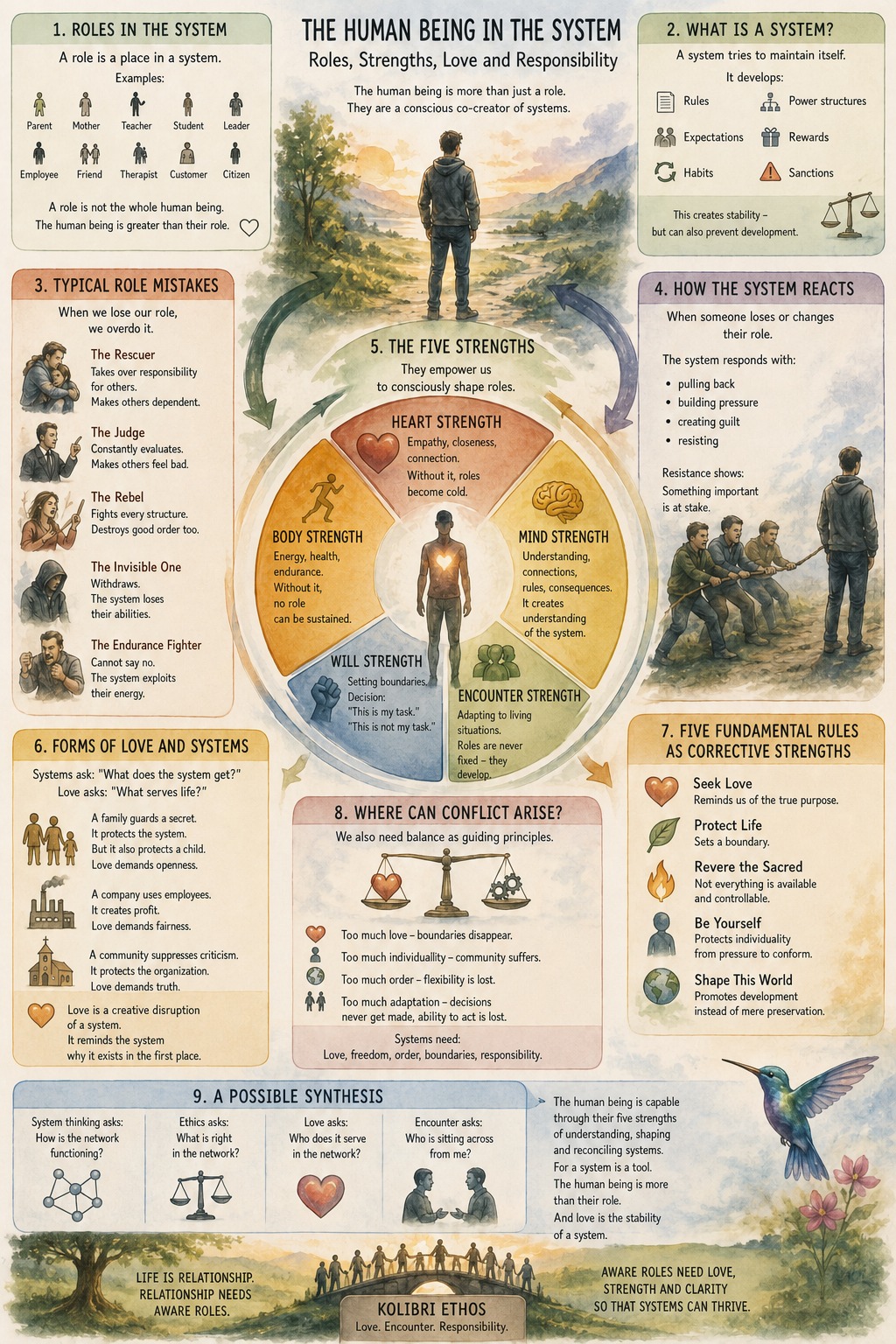
Translation note: The nine-part structure, role examples, typical role errors, five strengths, corrective rules, conflicts, and synthesis are very complete. Important reversal in the final paragraph: source `Love is more than the stability of a system` becomes `Love is the stability of a system`. The source explicitly places love beyond mere systemic stability.
Prussian Virtues and the Love Network
Reliability, conscientiousness, discipline, diligence, order, honesty, and perseverance can support a stable life. Without compassion and encounter, however, duty can become pressure, discipline rigidity, order control, and sacrifice self-loss. The Love Network adds gratitude, joy, forgiveness, listening, reconciliation, and community-building.
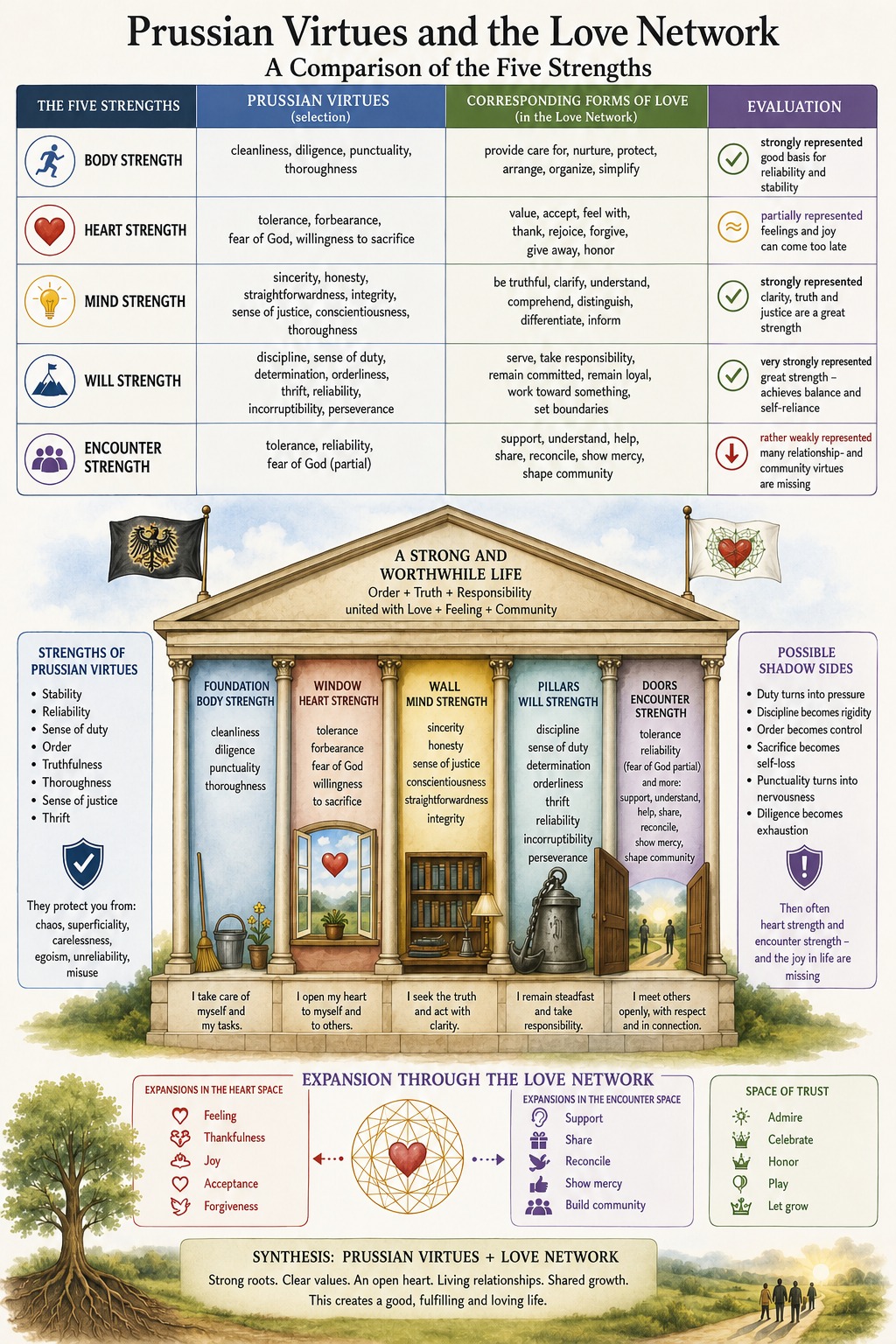
Translation note: The comparison table, building metaphor, strengths, shadow sides, and Love Network additions are translated with exceptional completeness. `Mitgefühl` is shortened to `Feeling` in the heart-space addition, and `Würde` in the central formula becomes the more general `Feeling`; the critical balance remains clear.
French Culture as an Ethos of Love
French cultural traditions bring together refinement, pleasure, conversation, philosophy, art, public institutions, memory, celebration, and critical inquiry. Liberty, equality, and fraternity contribute an ethical horizon, while colonial history, elitism, centralism, individualism, and overconsumption require continuing self-criticism.
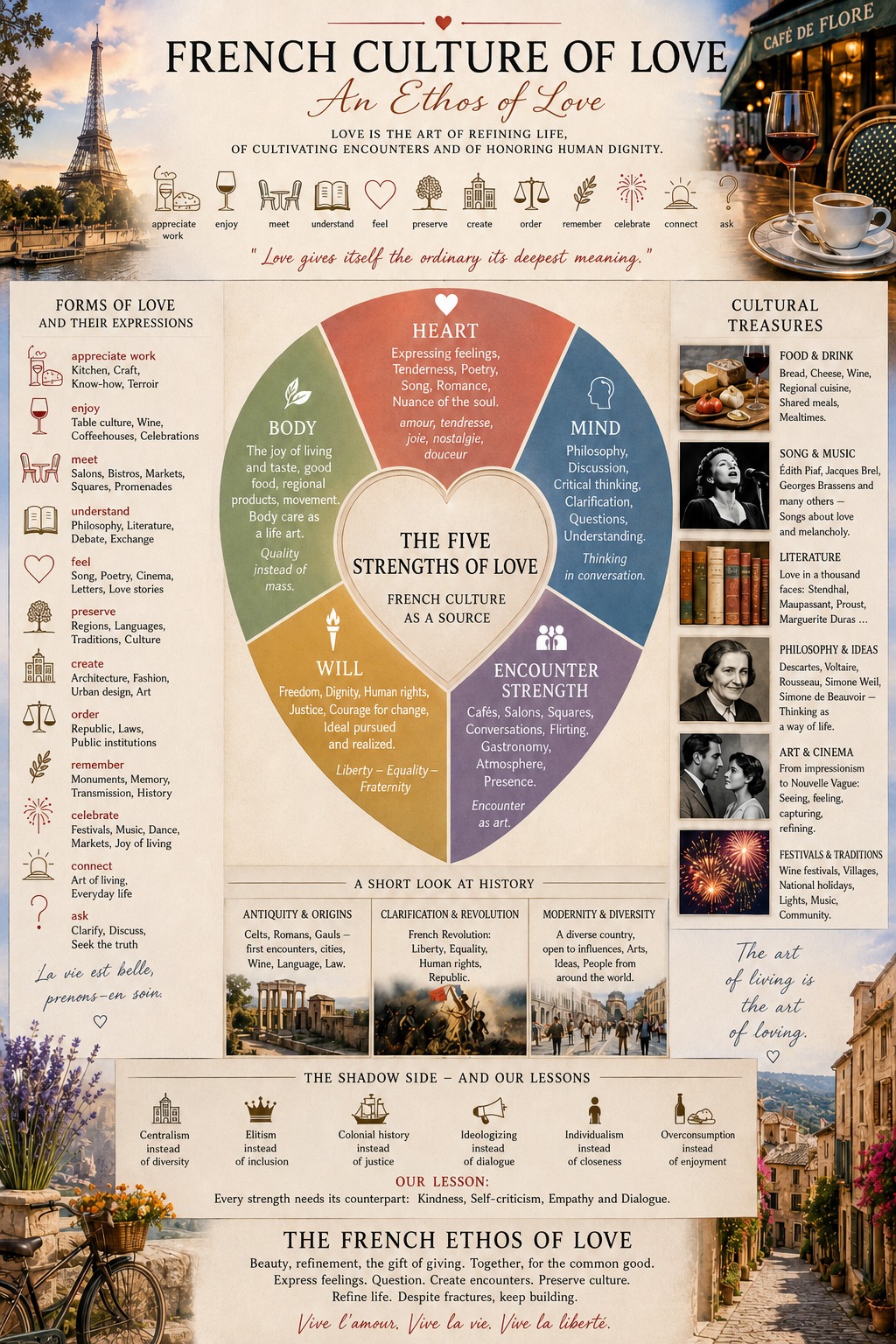
Translation note: The twelve love expressions, five strengths, cultural treasures, historical panels, shadows, and conclusion are highly complete. `Aufklärung` in the historical panel is narrowed to `Clarification` rather than `Enlightenment`, and `Begegnung` in the icon row becomes `meet`; the central cultural distinctions remain intact.
The German Ethos of Love in Cultural Perspective
German cultural traditions emphasize order, planning, inquiry, protection, craftsmanship, responsibility, scholarship, and long-term work. Music, Romanticism, forests, associations, and community life add heart and encounter. The model also names bureaucracy, perfectionism, emotional distance, overwork, and technological detachment as risks requiring balance.
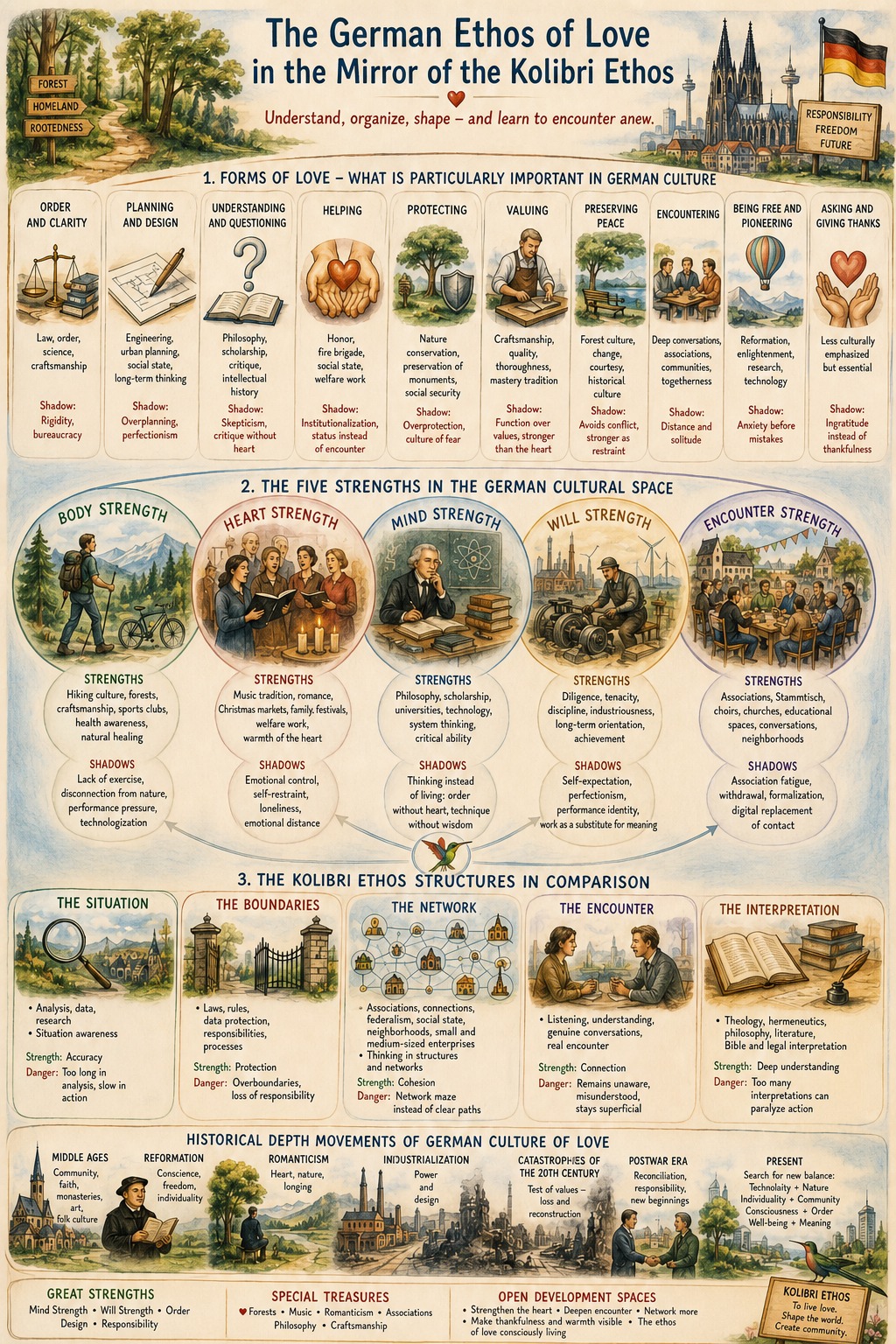
Translation note: Ten love forms, five strengths, five basic structures, historical movements, treasures, shadows, and development spaces remain exceptionally complete. `Auslegen` is translated as `Interpretation`, while `interpretation can paralyze action` slightly condenses the source warning that too many interpretations may inhibit action.
From Cultural Achievement to Historical Responsibility
Poetry, philosophy, science, community, and closeness to nature created a rich cultural inheritance, yet fear, exclusion, bureaucracy without conscience, obedience, ideology, and dehumanization helped make catastrophic crimes possible. Remembering, understanding without excusing, accepting responsibility, practicing moral courage, and strengthening humanity remain essential.

Translation note: The six destructive movements, Holocaust statement, five lessons, five principles, five strengths, mission, and concluding hope are preserved soberly and clearly. The heading `How could the downfall happen?` becomes the more abstract `How could it come to absurdity?`; `The guilty become irreplaceable` in the obedience panel is a mistranslation of `Orders are orders` being used to replace conscience.
India in the Mirror of the Kolibri Ethos
Indian traditions connect love with devotion, knowledge, disciplined practice, nonviolence, hospitality, community, consciousness, and the search for wisdom. The Kolibri Ethos adds explicit attention to equality, individuality, boundaries, everyday practices, and encounter across differences.
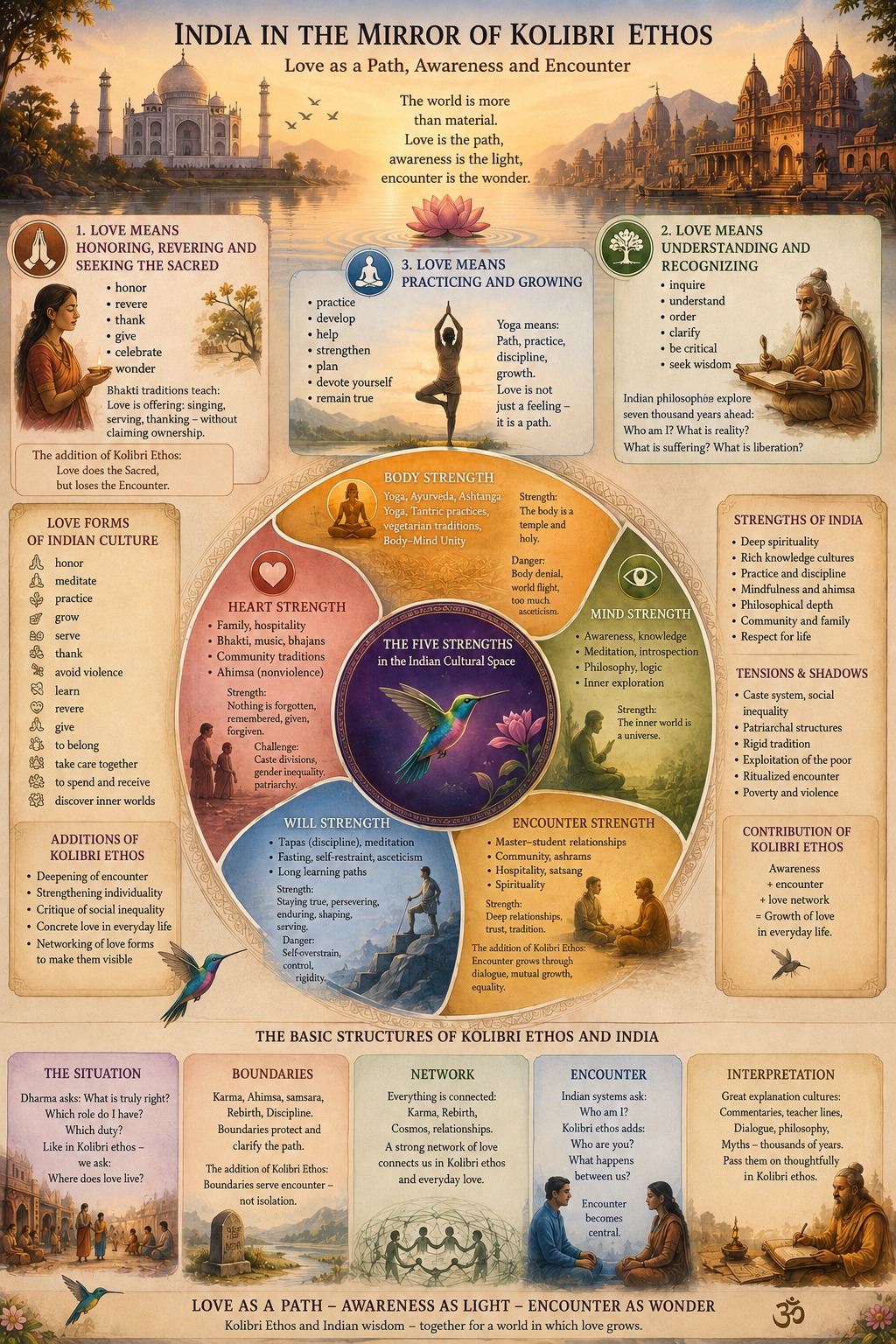
Translation note: Bhakti, Yoga, Ayurveda, Ahimsa, the five strengths, cultural tensions, and five basic structures are very complete and legible. In the Bhakti panel, `without possession` becomes the stronger `claiming ownership`; `sich hingeben` is translated as `devote yourself`, which is accurate but narrower than the source's broader surrender or dedication.
The Ethos of Love in Classical Russian Culture
The model presents pre-1917 Russian culture through soul, compassion, community, prayer, beauty, endurance, literature, and reverence for the sacred. It also names poverty, hierarchy, authoritarianism, suffering elevated into an ideal, and limited self-determination as dangers that should not be romanticized.
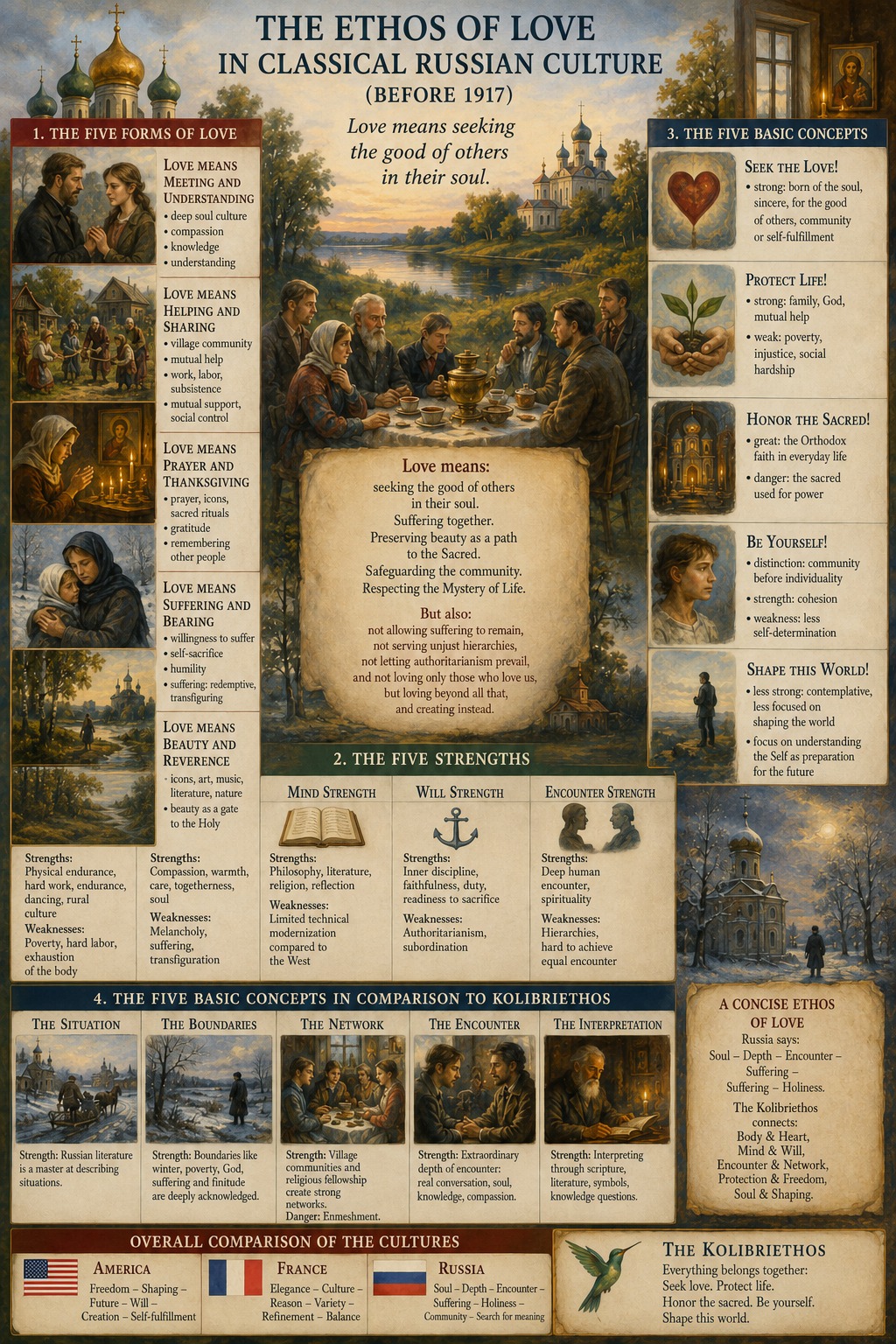
Translation note: The five love forms, central synthesis, five rules, cultural comparison, and five basic concepts remain understandable. The headings `Body Strength` and `Heart Strength` are omitted above the first two columns of the five-strength table, although their contents remain present. `das Heilige` is sometimes narrowed to `the good of others`.
The Ethos of Love in Soviet Culture
Soviet history joined large educational, scientific, industrial, cultural, and antifascist achievements with solidarity and shared projects. It also included one-party rule, censorship, repression, forced labor, hunger, coercion, conformity, and deep personal suffering. Ethical remembrance must hold achievement and pain together without collapsing either into propaganda.

Translation note: The historical overview, achievements, suffering, five love forms, five strengths, five rules, basic concepts, legacy, and cultural comparison are exceptionally complete. The fifth basic concept is incorrectly headed `Outcome` instead of `Interpretation`; the underlying text still describes the interpretation of history.
Cultures of Love and America
American cultural strengths include creativity, courage, freedom, volunteerism, diversity, innovation, practical initiative, and confidence in change. The image sets these beside loneliness, polarization, consumerism, inequality, racism, exploitation, environmental destruction, and performance pressure. Love asks that freedom and will be connected with care, encounter, responsibility, and shared limits.
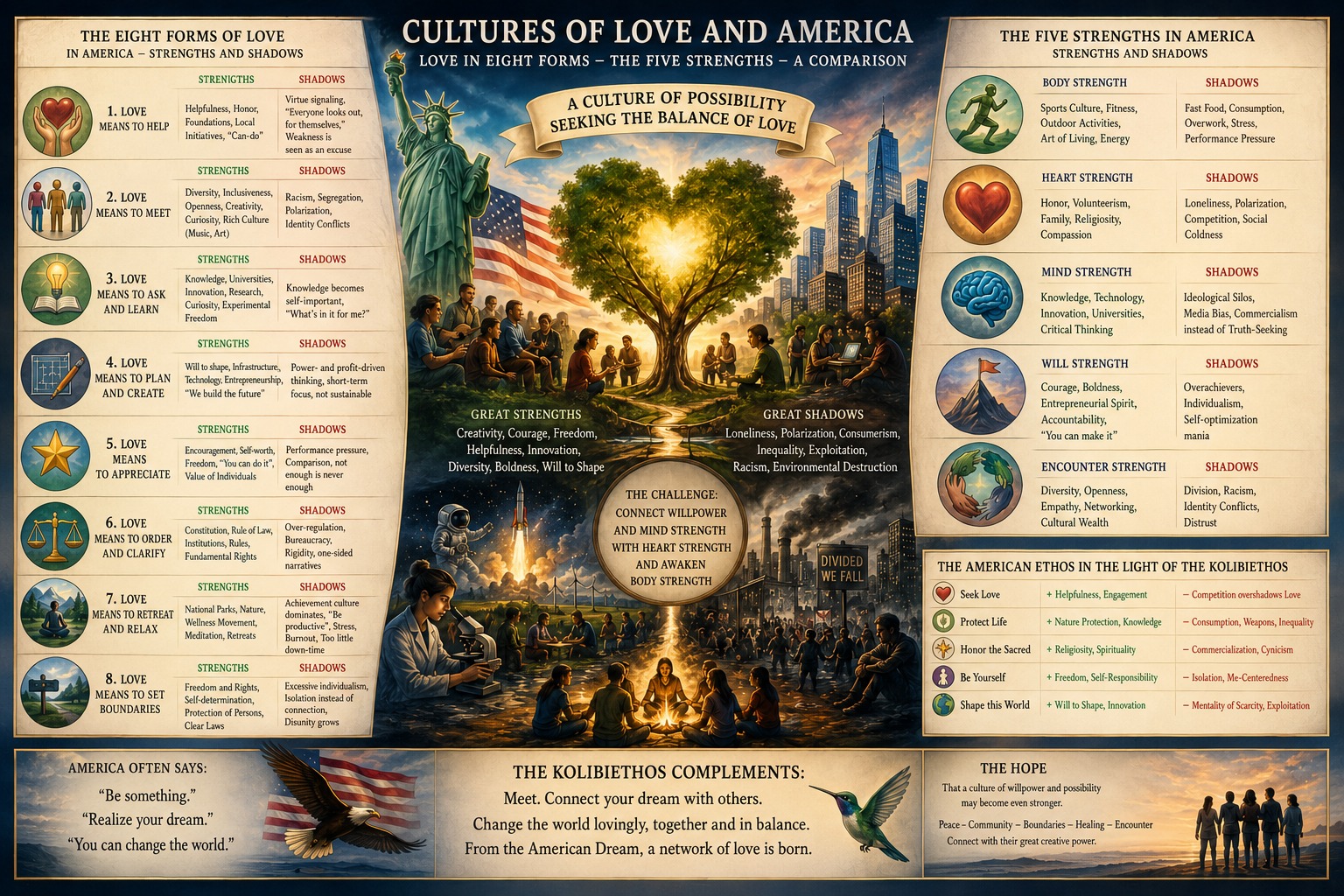
Translation note: Eight love forms, five strengths, positive and negative comparisons, Kolibri Ethos rules, central challenge, and hope are very complete. `Wertschätzen` becomes `appreciate`, while the fifth form's encouragement is generalized into appreciation; a few economic shadows are condensed but remain recognizable.
China's Culture of Love and the Kolibri Ethos
Order, harmony, long-term thinking, learning, family loyalty, hospitality, and cultivated relationships form one side of this comparison. Freedom, diversity, personal development, open encounter, and the many forms of love provide complementary movements. The goal is not to replace one culture with another, but to explore balance and mutual correction.

Translation note: Seven love forms, the harmony–love symbol, five strengths, five rules, five concepts, strengths, and shadows are translated clearly. `ausruhen und loslassen` becomes `harmonizing and letting go`, shifting rest toward balance; `Gesicht wahren` is preserved in quotation marks as `saving face`.
Harmony, Encounter, and Love
The master card places harmony and power in a dynamic relationship joined by encounter. Mind seeks wisdom, will shapes, body realizes, heart gives meaning, and encounter connects. Tension is not simply eliminated; it can become material for awareness, responsibility, dialogue, and growth in love.
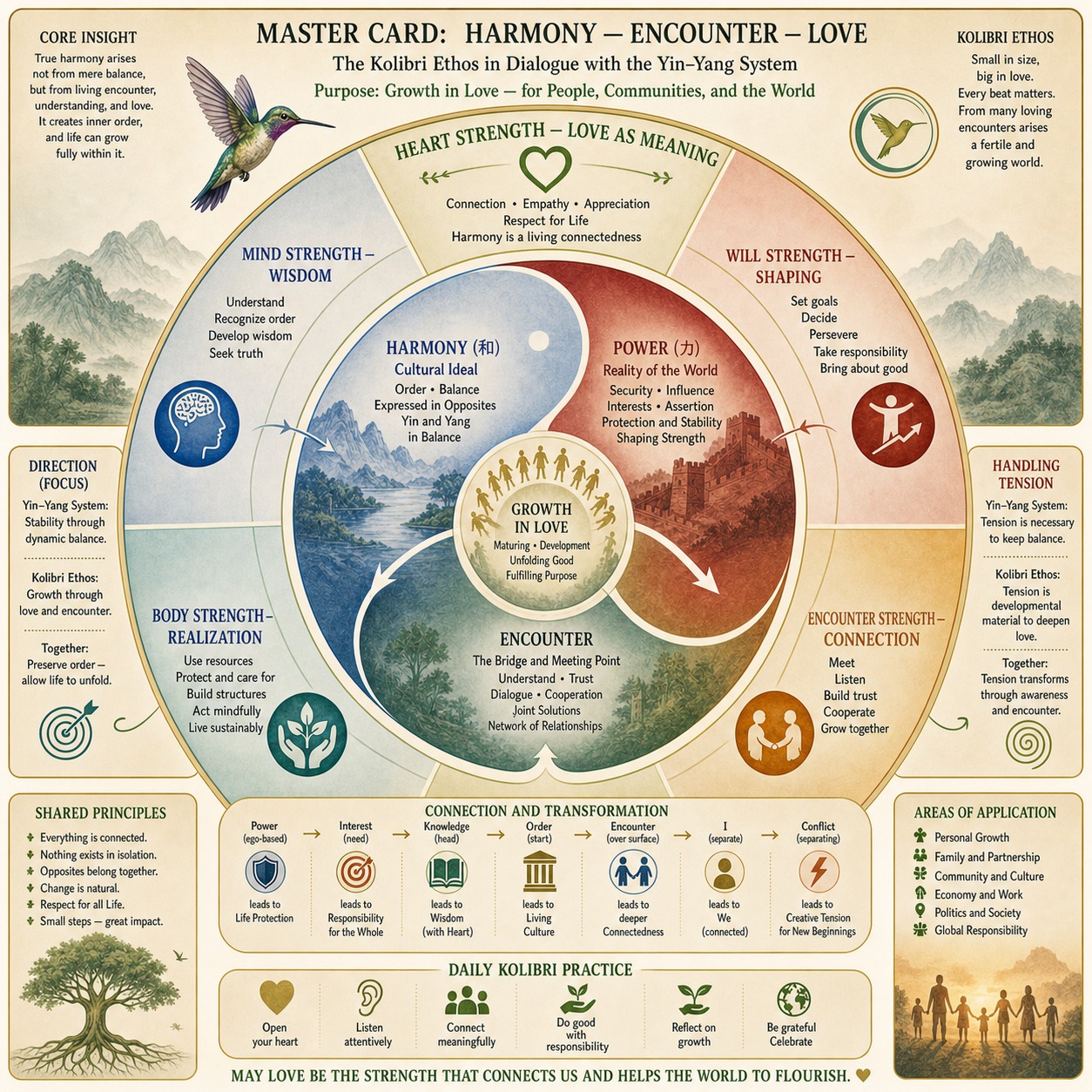
Translation note: The complete circular model, Chinese concepts, five strengths, transformation path, shared principles, daily practice, applications, and footer are exceptionally clear. `Macht` is correctly rendered as `Power`; `Ich (getrennt)` in the transformation row becomes the more relational `I leads to We`, condensing the explicit separated-self stage.
Competition: Destructive or Development-Promoting?
Competition can provide energy, discipline, selection, and development, but its ethical quality depends on its goal, rules, transparency, and effects on relationships. When directed only toward victory, status, and superiority, it becomes exploitative and alienating. Embedded in fairness, encounter, and responsibility, it can serve shared growth.
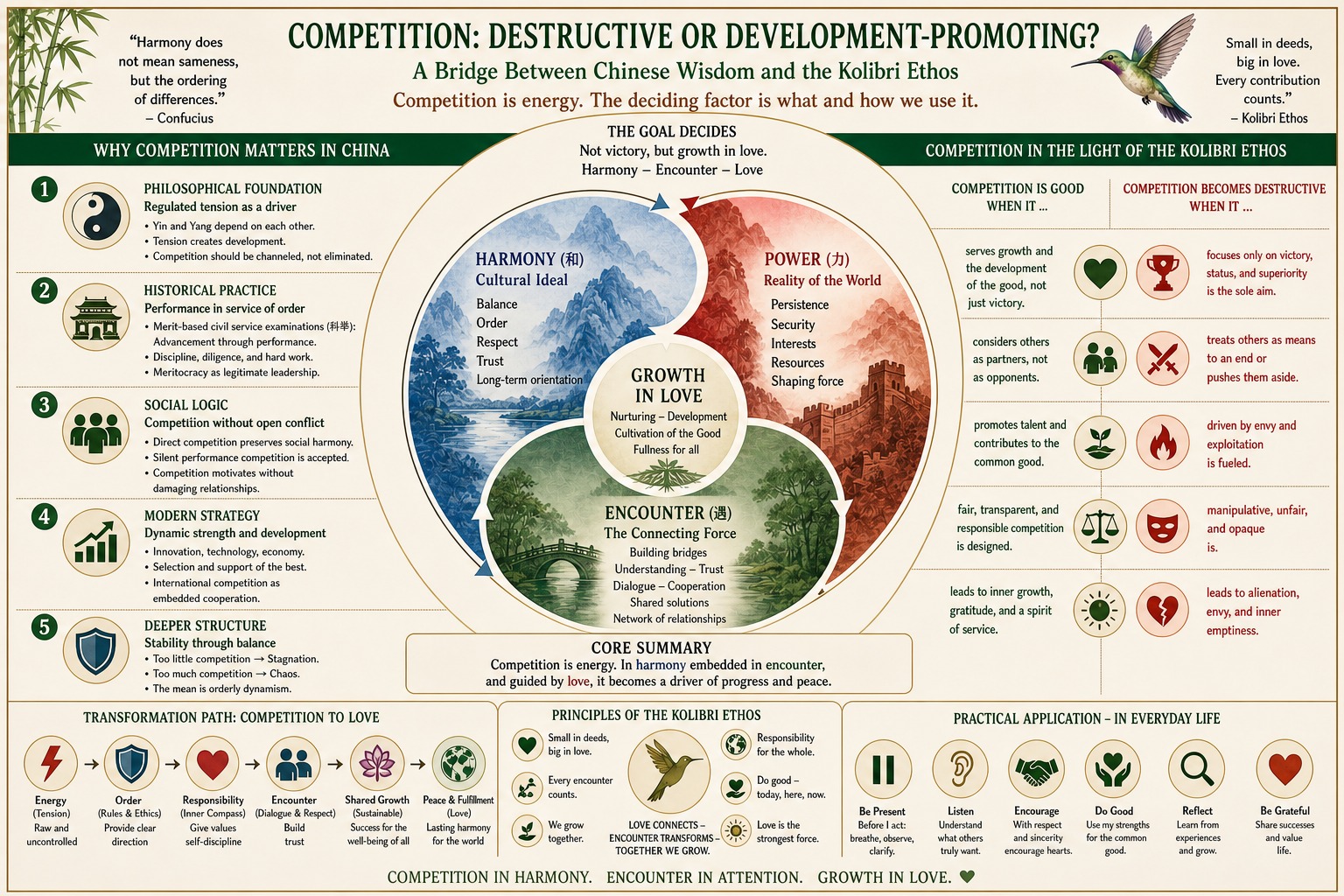
Translation note: The five historical and social factors, harmony–power–encounter model, positive and destructive paths, transformation sequence, practices, and summary remain complete. The Confucius statement is presented as a direct quotation, although the source gives it without a precise work reference; it should be read as a traditional formulation rather than a verified verbatim edition.
Competition, Encounter, and Growth at School
Education should develop knowledge, skill, character, compassion, health, creativity, responsibility, and relationship. Achievement can foster perseverance and excellence, but a child's worth must not depend on grades. Teachers, parents, and students all help transform competition into disciplined cooperation and growth.
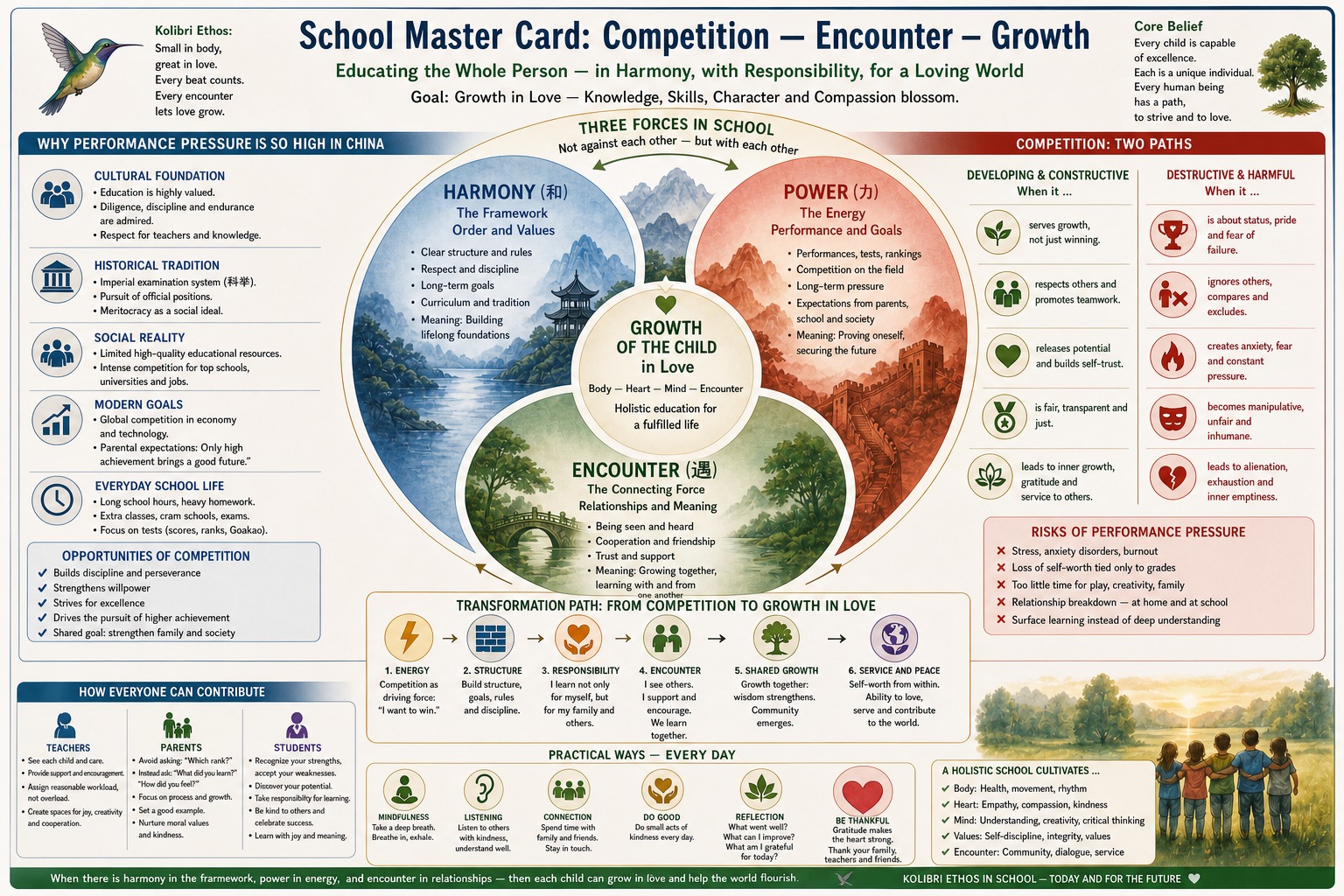
Translation note: Performance-pressure causes, opportunities, contributors, three-force model, two competition paths, risks, transformation path, practices, holistic-school model, and footer are highly complete. `Every child is more than their performance` becomes the more absolute `Every child is capable of excellence`, changing the core message from unconditional worth to capability.
Virtues and Ethical Questions in The Lord of the Rings
The story world can be read through loyalty, friendship, humility, courage, mercy, responsibility, self-control, service, hope, and care for nature. The image compares virtue ethics, Christian ethics, responsibility ethics, and environmental ethics while asking how power, guilt, means, hope, mortality, and compassion shape action.
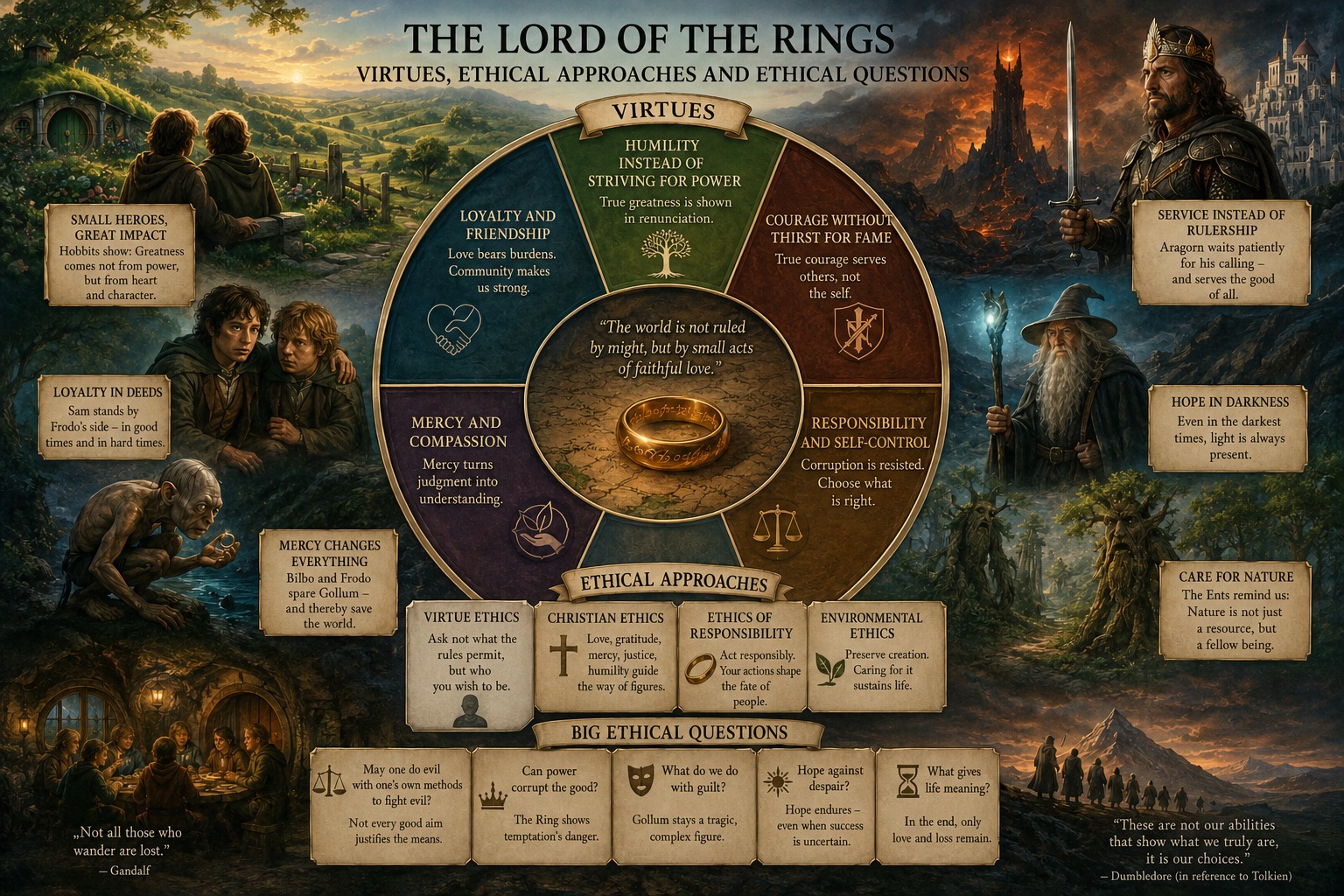
Translation note: The virtue wheel, characters, ethical approaches, five questions, side panels, and landscape contrast are preserved with strong fidelity. Several central statements are interpretive summaries rather than verified Tolkien quotations. The final Dumbledore sentence is explicitly marked as being `in reference to Tolkien` and is not a Tolkien quotation.
Ethics at Its Core: A Modern Cosmic Myth
This original science-fiction ethics graphic asks how human beings use power, love without possession, judge deeds and intentions, pursue good without harmful means, and remain humane under pressure. Courage, compassion, self-control, wisdom, humility, hope, responsibility, sacrifice, forgiveness, and patience are contrasted with fear, possessiveness, domination, hatred, and short-sightedness.
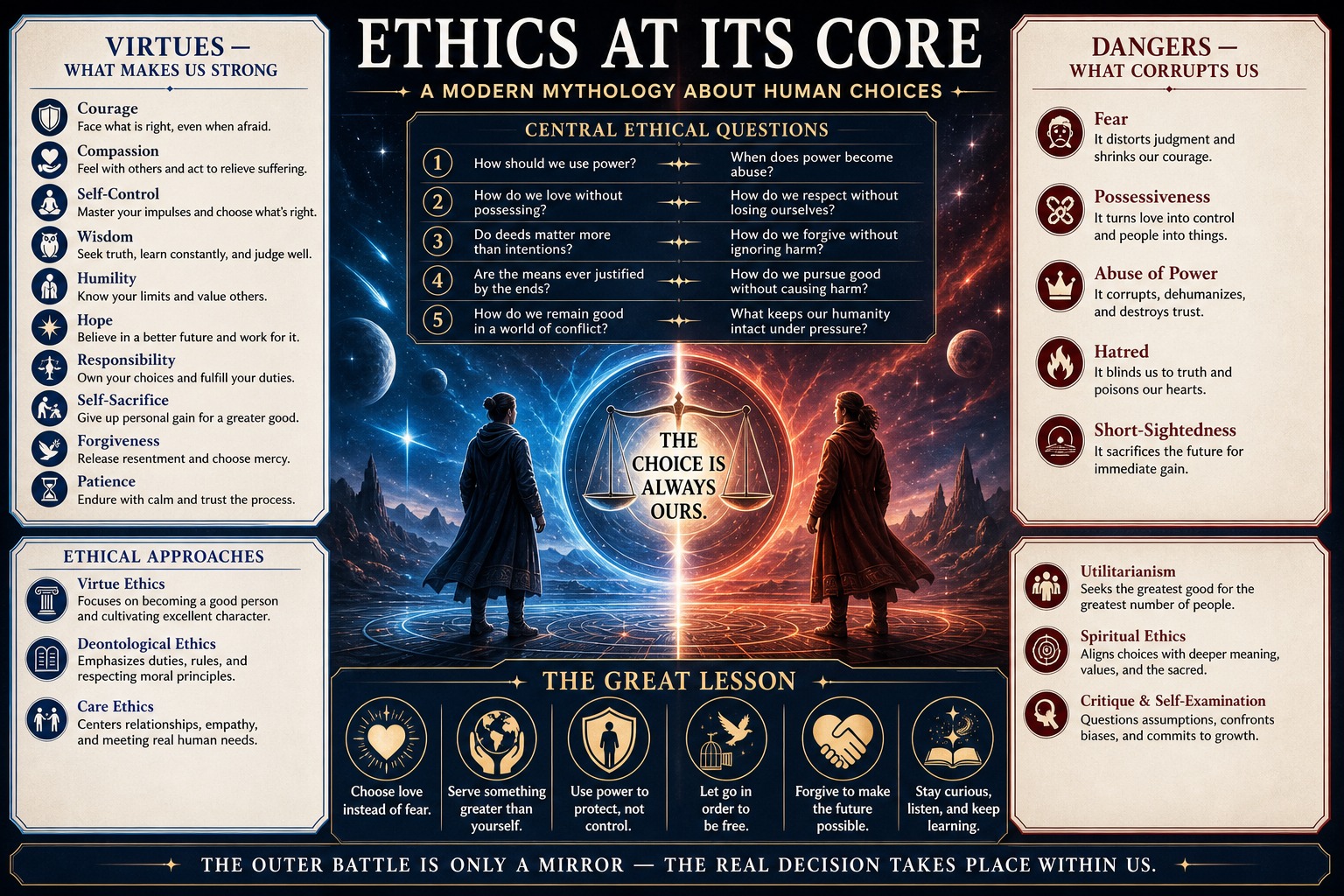
Translation note: The original German source used a specific film-saga setting. Two direct localization attempts were rejected by the image system, so this final version is a newly composed, brand-neutral cosmic ethics infographic. It preserves the major ethical categories, five question pairs, central choice, and six concluding lessons, but it is not a layout-faithful translation of the original illustration.