
Forms and Practices of Love
Love becomes visible in many different practices. It may protect freedom, stay present with another person's feelings, recognize value, seek understanding, help, give thanks, rest, remember mistakes, or support learning. No single gesture contains love completely; together these forms can become a living and responsible relationship.
These AI-translated images come from the German source page. Translation notes identify places where generated English changes, simplifies, or reverses the intended meaning.
To Love Means to Be Free
Freedom in love rejects possession, coercion, surveillance, and domination. It allows each person to think, feel, grow, make mistakes, and follow their own path. At the same time, freedom needs truth, responsibility, boundaries, trust, protection, and encounter—especially where adults care for children.

Translation note: Most of the complex contrasts are preserved. “I don't want to … make you look good” mistranslates the German “beaufsichtigen,” which means supervise or monitor. The stone originally says “The goal is not obedience”; the AI changed this to “A goal is not ownership.” Both changes alter the argument.
To Love Means to Empathize
Empathy begins with presence and listening. It accepts that another person's feelings cannot be reproduced exactly and that support does not require immediate evaluation or large words. Healthy empathy also keeps boundaries, protects inner space, and recognizes that shared emotion can comfort but also overwhelm.
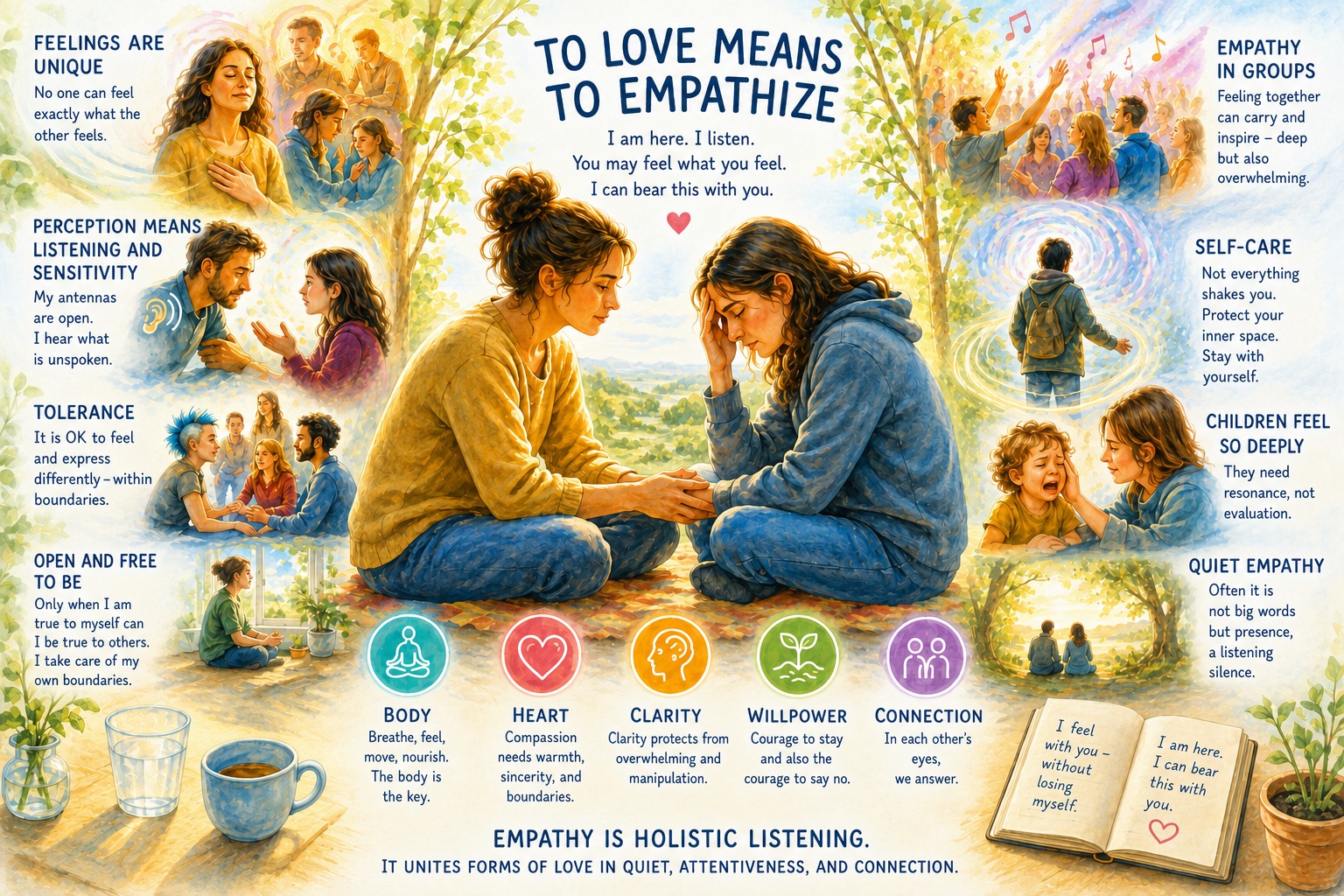
Translation note: The main meaning is preserved very well. The five-force labels were simplified: “thinking strength” became “clarity” and “power of encounter” became “connection.” “Not everything shakes you” is less precise than the German instruction not to resonate with everything.
To Love Means to Appreciate
Appreciation notices dignity, effort, feeling, insight, growth, and the small things that might otherwise remain unseen. It can nurture what is valuable while still allowing careful criticism. Boundaries matter: valuing a person does not require tolerating every action.
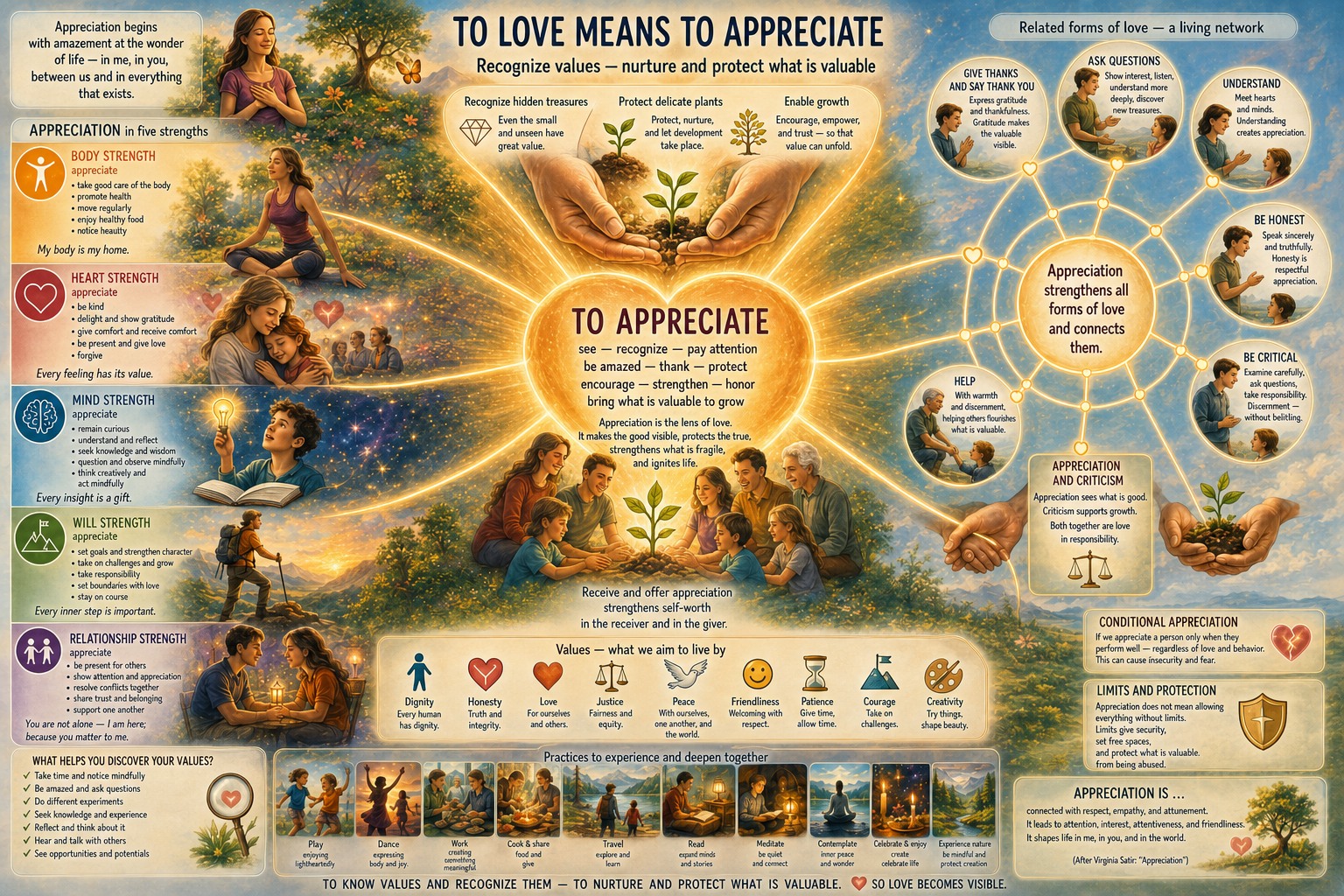
Translation note: A major reversal appears in the lower-right panel. The German heading is “Unconditional appreciation,” but the English image says “Conditional appreciation.” Its following sentence is also damaged. The intended point is that every person has value regardless of performance and behavior, while conduct may still be evaluated.
Master Map of Six Forms of Love
The master map presents love as a cycle of receiving, clarifying, actualizing, releasing, resting, and balancing. Each form has an inner structure and a motivating longing. The cycle connects openness and feeling with understanding, action, forgiveness, trust, closeness, and boundaries.
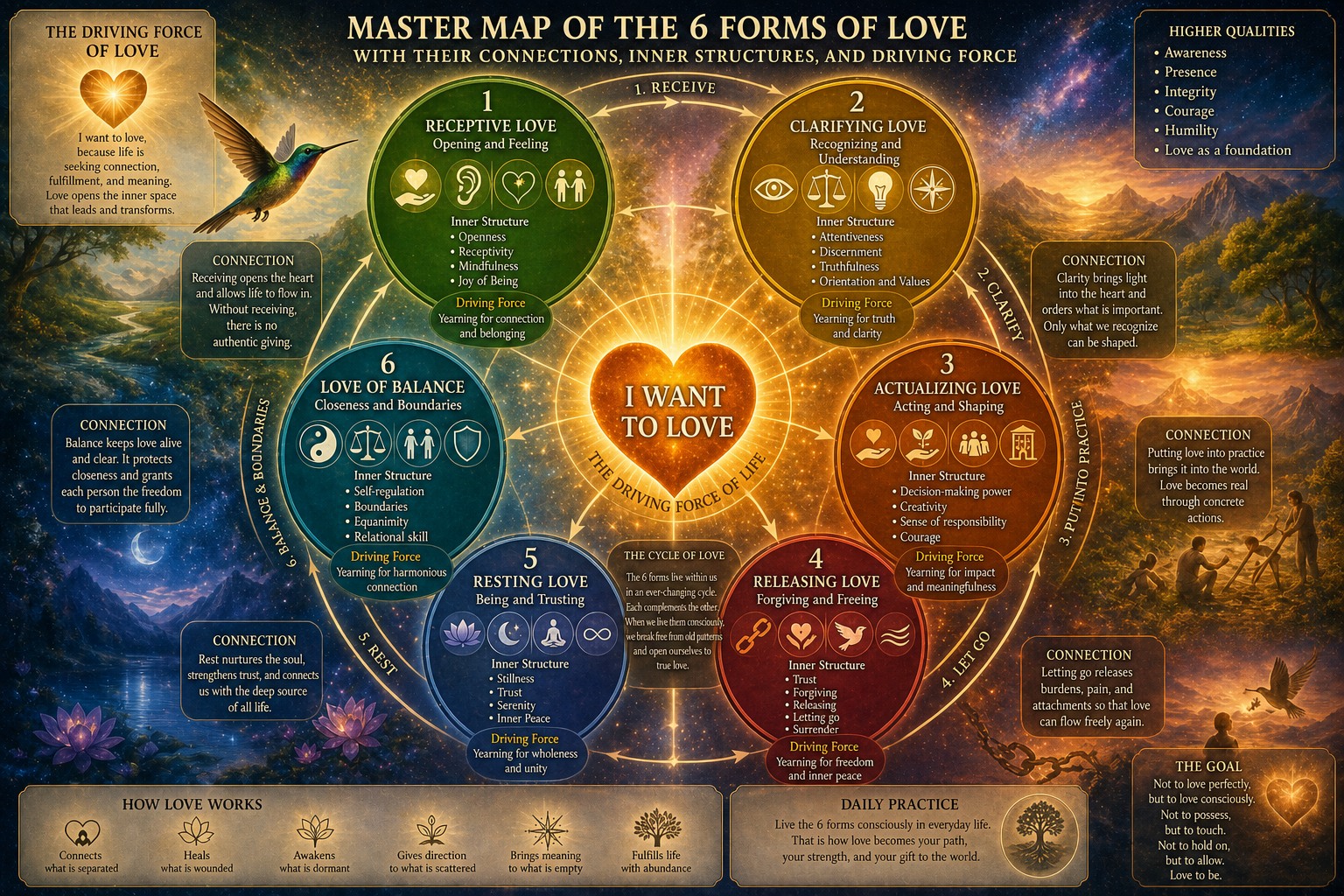
Translation note: The six-part structure and almost all fine text are exceptionally well preserved. “Higher qualties” contains a spelling error (“qualities”), and a few phrases such as “The 6 forms live within us” are slightly unnatural, but no central structural error is visible.
To Love Means to Ask and Inform Oneself
Questions can interrupt prejudice, rumor, half-knowledge, emotional reaction, and premature judgment. Loving inquiry checks sources and contexts, welcomes several perspectives, asks others and oneself, and shares knowledge. It also respects privacy and avoids questioning as intrusion or control.

Translation note: The process and boundaries are preserved clearly. The German image quotes Kant's “Dare to be wise and use your own understanding.” The AI replaced it with Kant's different humanity formula about treating persons as ends rather than merely means. The replacement is valid Kant, but it is not a translation of the source text.
To Love Means to Help
Helpful action can relieve immediate distress, strengthen capacities, enable development, create shared work, build networks, protect boundaries, and promote self-reliance. Help becomes unhealthy when it creates passivity, feeds a compulsion to rescue, or intrudes into another person's choices. Good cooperation shares tasks and accepts limits.

Translation note: The overall five-part structure is preserved very well. “Acute help—not to harm” mistranslates “Not lindern,” which means “relieve distress.” In the motivation stage, “I help out of will” should mean supporting another person's will and encouraging them.
To Love Means to Ask and Thank
Asking acknowledges limits, needs, wishes, vulnerability, and trust. Thanking recognizes gifts, contributions, relationships, and what is often taken for granted. Both practices benefit from slowness: first noticing inwardly, then finding a fitting time and form for expression without coercion.
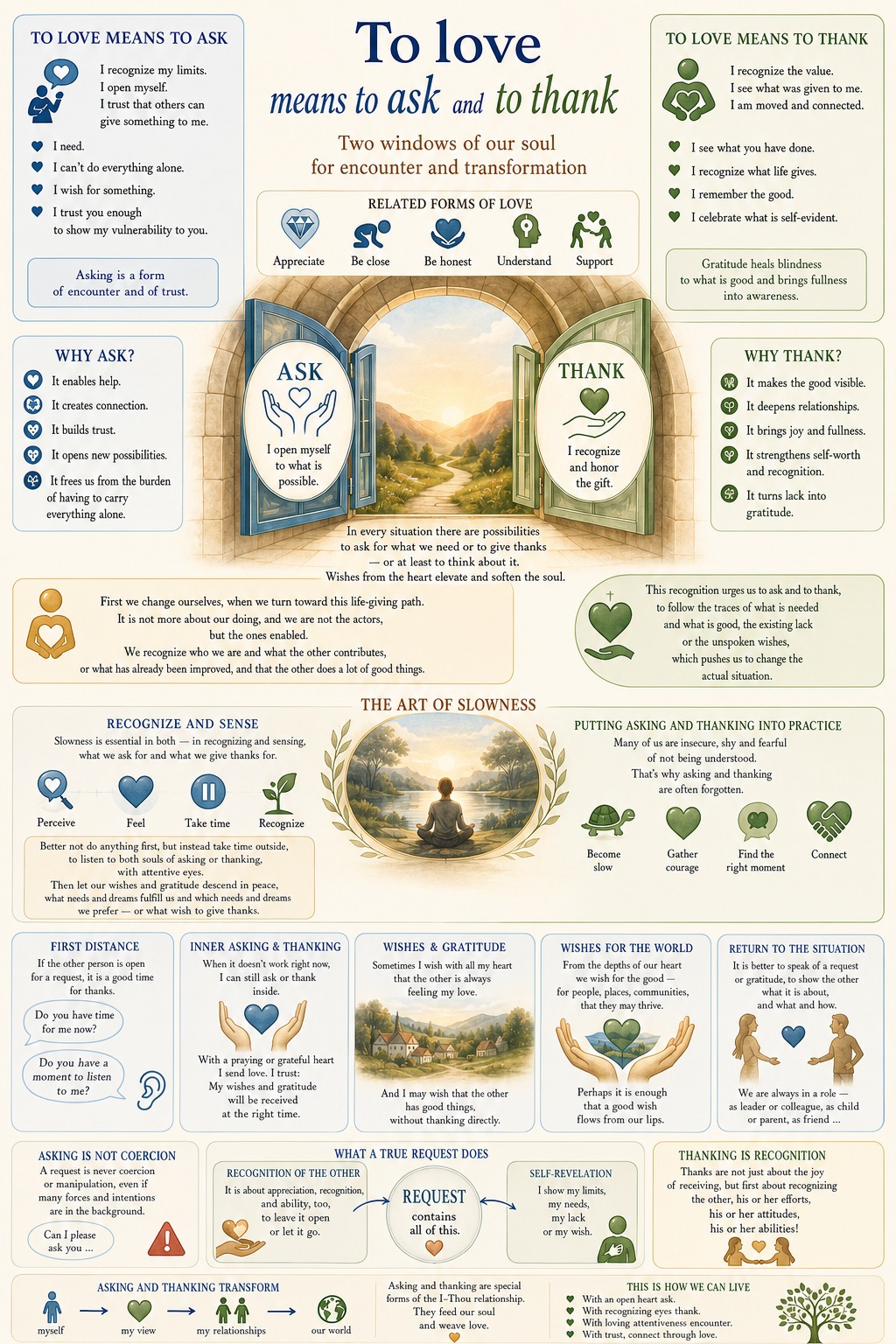
Translation note: Most small text remains legible and meaningful. In the related forms, “Demütig sein” (“be humble”) became “Be close.” “Take time outside” misreads the German advice first to do nothing outwardly and remain inwardly attentive.
To Love Means to Rest
Rest is not merely an interruption of love and life; it can restore the body, soften the heart, clarify thought, loosen rigid effort, and make encounter possible again. The image also distinguishes rest from avoidance, numbing, resignation, or permanent withdrawal.
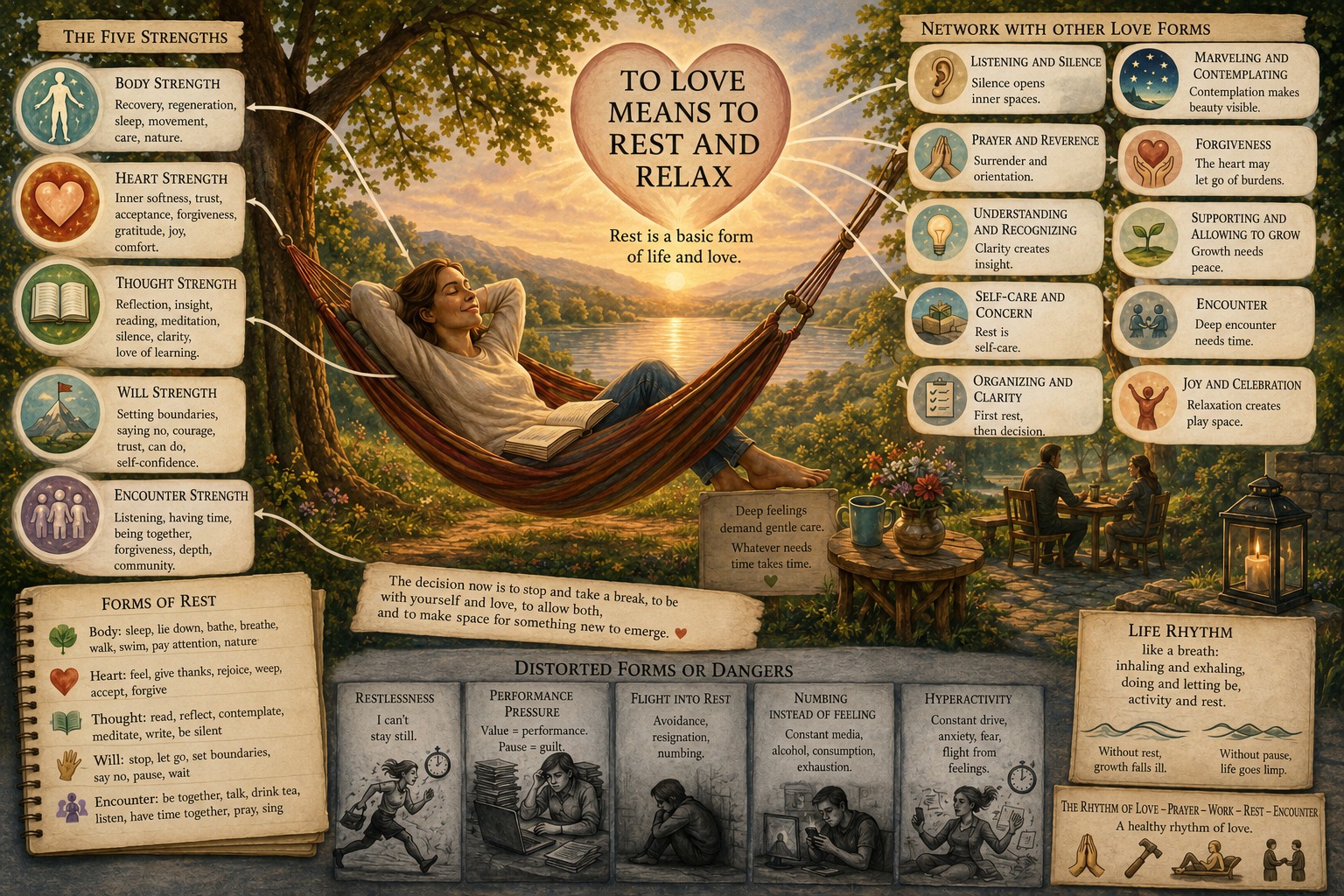
Translation note: The meaning is preserved with unusual completeness. “Relaxation creates play space” is understandable but slightly mechanical English, and several force labels are literal. No major reversal or omission is visible.
Admitting Mistakes as a Community
Groups protect identities and distribute responsibility, so collective mistakes can be harder to acknowledge than individual ones. Communities, organizations, sciences, religions, and nations can nevertheless seek facts, practice humility, accept consequences, learn, reform, remember victims, and pursue reconciliation without reducing a group to either pure innocence or pure evil.
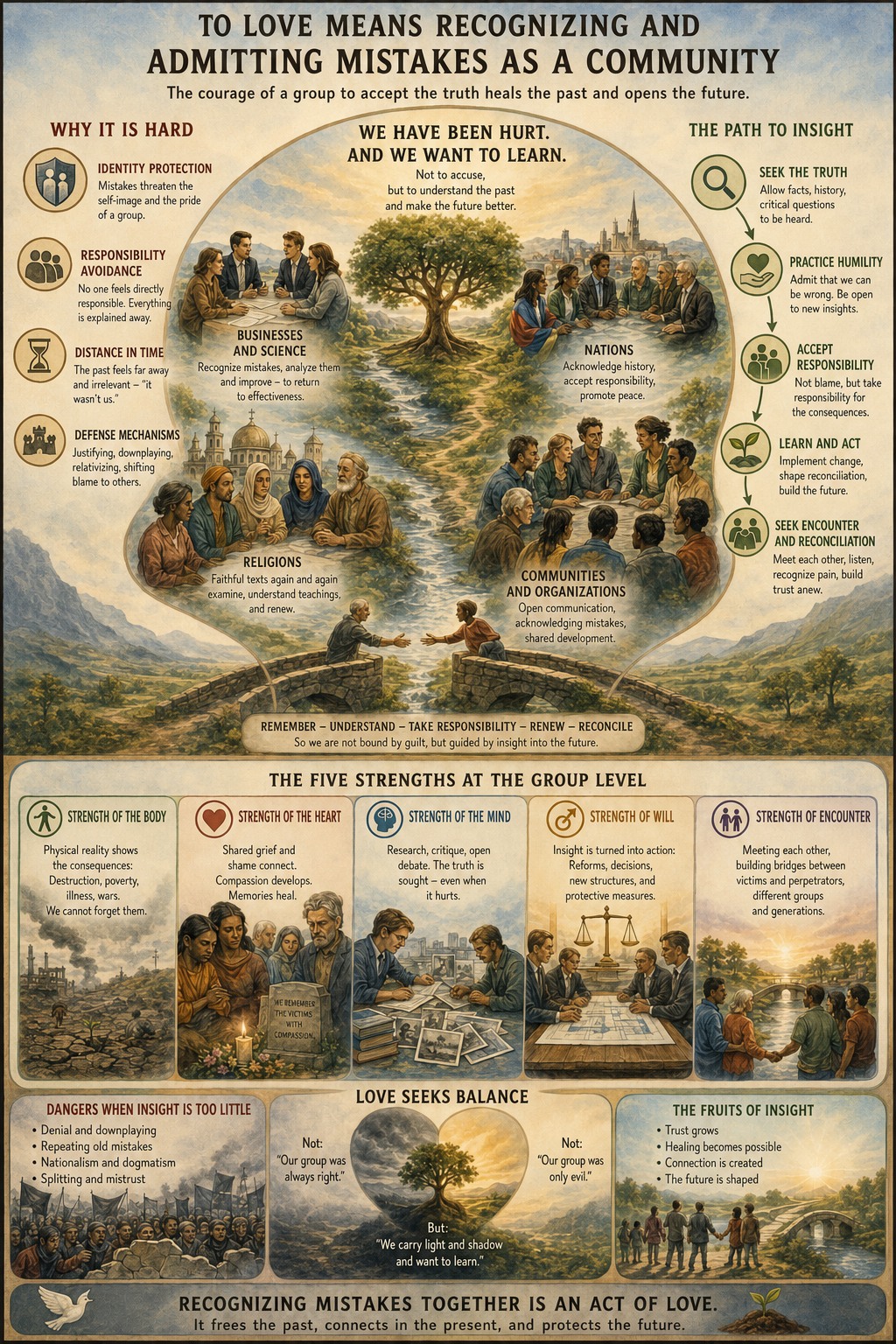
Translation note: The central German sentence “We were mistaken, and we want to learn” was changed to “We have been hurt, and we want to learn.” This shifts the group from responsibility toward victimhood and is a serious reversal. “Sacred texts” also became “faithful texts,” and the science panel emphasizes effectiveness instead of feedback from reality.
Remember, Understand, Learn
Historical remembrance asks how exclusion, prejudice, dehumanization, law, institutions, violence, and indifference developed—and how they can return. The image remembers groups persecuted before and during National Socialism, recognizes democratic and legal progress, and stresses that antisemitism, racism, anti-Roma prejudice, queerphobia, social contempt, and online hate still require daily opposition.
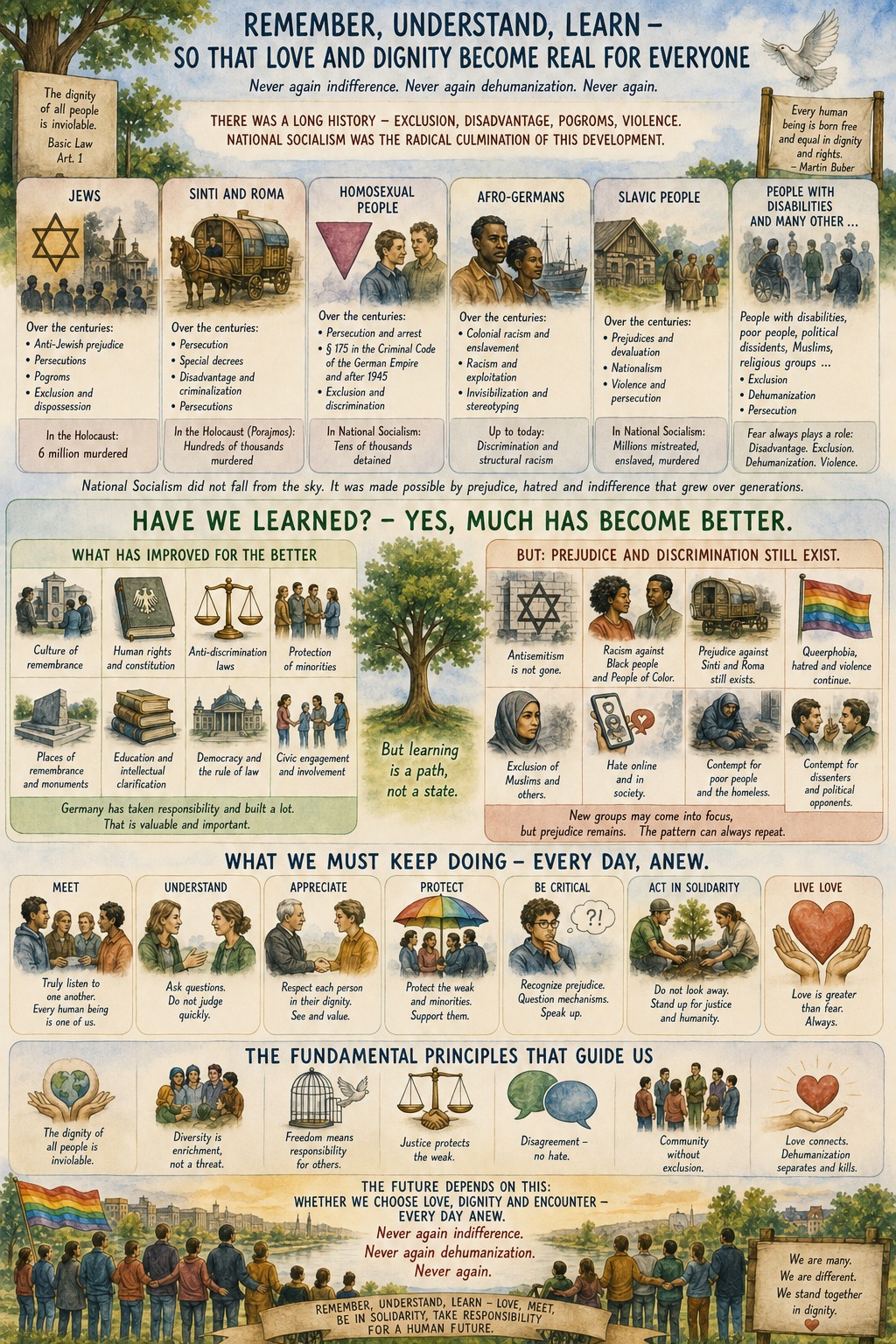
Translation note: This historically sensitive image is an educational overview and should not be used as a sole historical source. The English image replaces Martin Buber's source sentence “Every person is a You, not an It” with wording from the Universal Declaration of Human Rights but still attributes it to Buber—a serious false attribution. The §175 paragraph also omits the Weimar Republic. Names and large-scale victim counts otherwise remain broadly aligned with the German image, but every historical detail should be checked against specialist sources.
All 10 images currently used on the German page are now included. Visible imperfections are retained as prompts for reflection, correction, and discussion.