
Psyche, Self-Knowledge, and Inner Life
The psyche is not a single mechanism. It includes bodily regulation, feeling, thought, will, relationship, memory, expectation, imagination, and the ways people organize their daily lives. These translated images offer models for reflection rather than diagnoses. Each image is accompanied by a visible note about translation limits.
A Five-Force Treasure Chest for Self-Help
Self-help can begin with small, concrete supports. Rest, movement, nourishment, comforting objects, clear thinking, achievable steps, music, and contact with other people address different human forces. The emergency drawer keeps the threshold deliberately low: drink, eat, sleep, move, speak with someone, complete one small task, and do not remain alone.
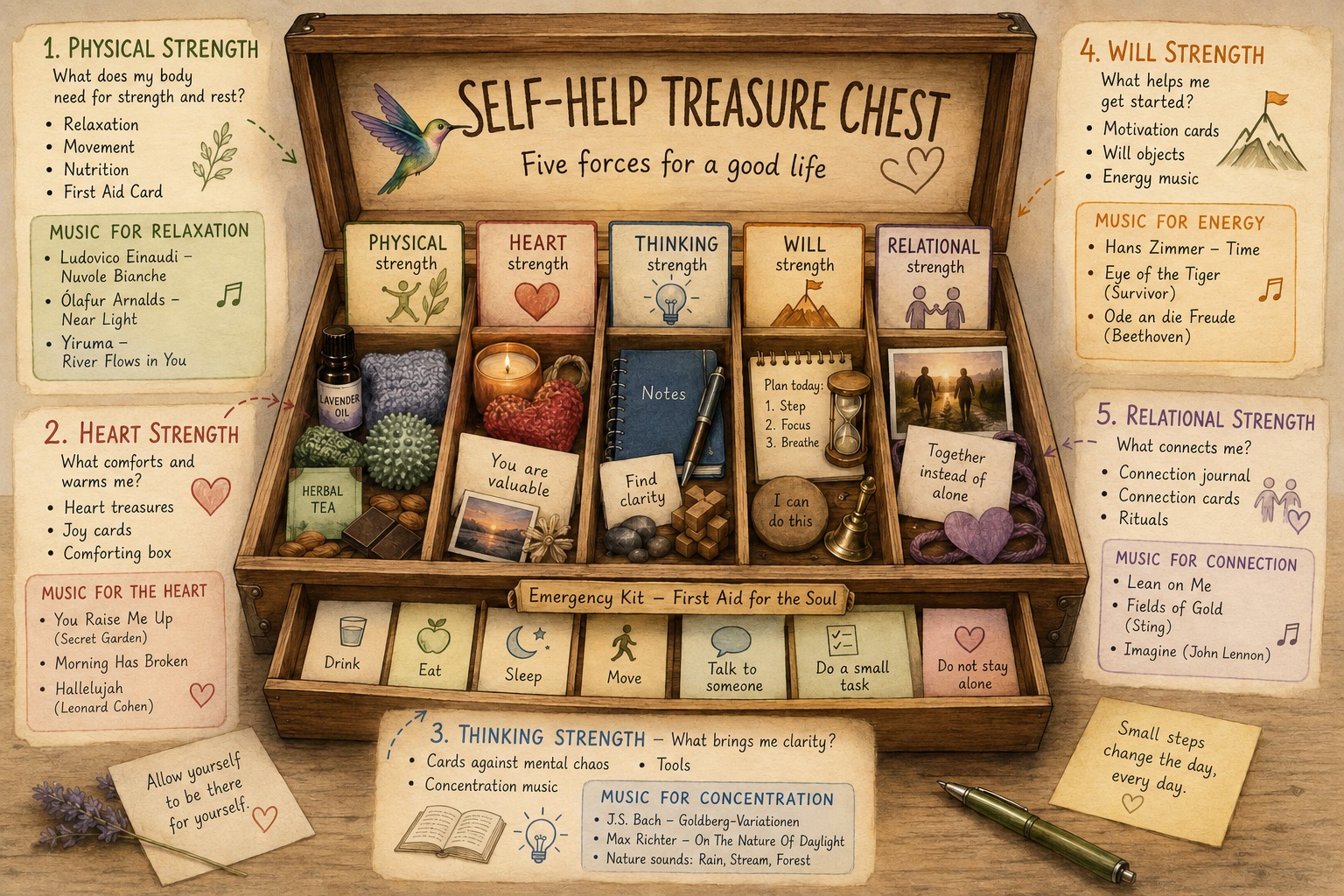
Translation note: The five-force structure, all objects, emergency drawer, music lists, questions, and handwritten notes are translated with exceptional completeness. Song and artist names are preserved. No significant semantic or spelling error is visible.
The Inner Universe
The inner universe includes consciousness, the body, feelings, thought, memory, possibilities, encounter, values, self-relationship, mystery, and different degrees of accessibility. Consciousness illuminates only a small region at a time. Attention, practice, relationship, learning, and gratitude help people discover and care for a world that is larger than any momentary self-description.

Translation note: Despite exceptional text density, all fifteen numbered regions, the central flashlight image, accessibility model, sources, structure diagram, action words, and footer are translated clearly. `What can give me energy in the short term?` is slightly more specific than the source's general `What can give me something in the short term?`; no material error is visible.
When Access to the Inner Universe Is Blocked
An inner world may be shaped by external demands, closed by injury, confined by old boundaries, left unlived, uprooted into constant outward activity, neglected, distorted by a wounded self-image, or disconnected within itself. The task is not forced self-replacement. It is learning to inhabit, understand, care for, connect, and gradually unfold what is already present.
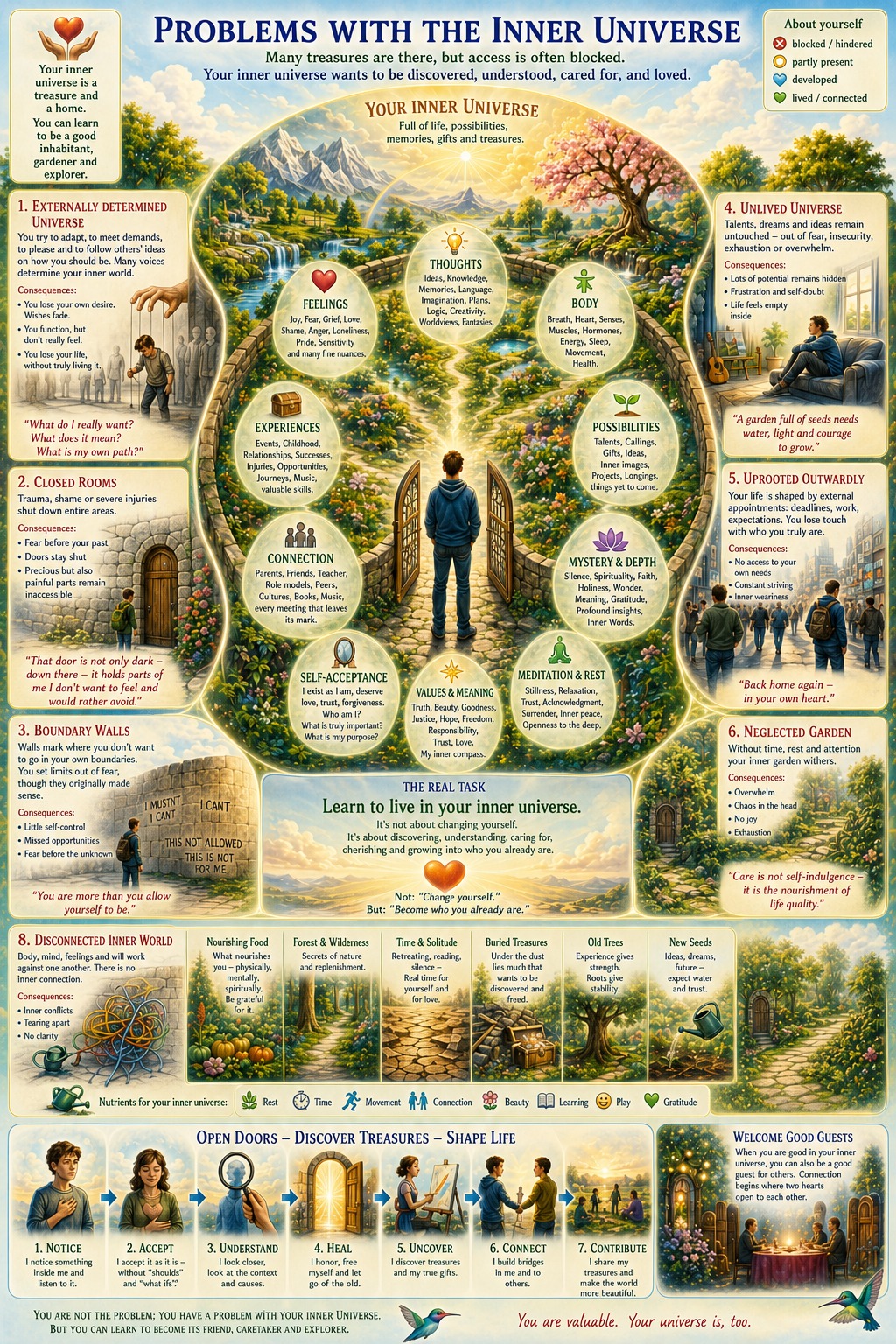
Translation note: The eight problem fields, central garden, inner domains, growth landscapes, seven-step path, guest image, and closing statements are exceptionally complete. In the boundary-wall panel, `small self-image`, `hidden talents`, and `fear of risk` shift to `little self-control`, `missed opportunities`, and `fear before the unknown`; these three consequences are not literal translations.
Five Dimensions and Their Healing Movements
Human experience can be viewed through relationship, security, energy, selfhood, and meaning. Each dimension contains a movement between constriction and a more life-giving state. Love connects separation with closeness, stabilizes fear through support, revives heaviness into flow, raises shame toward dignity, and orients emptiness toward significance.
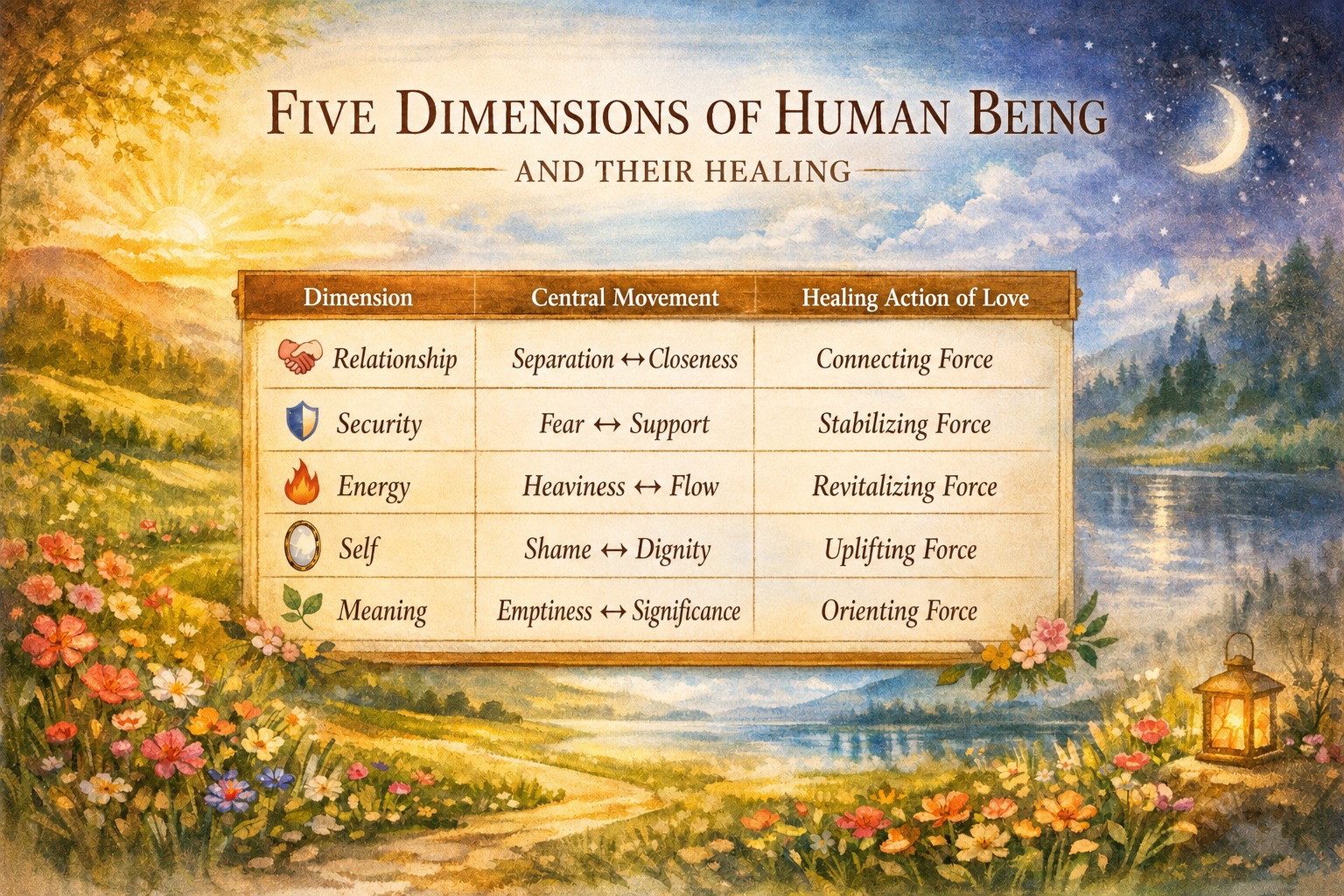
Translation note: The title, all table headings, five dimensions, central movements, healing actions, icons, and order are translated exactly and legibly. No significant semantic or spelling error is visible.
Feelings as Five Fields of Development
Feelings can function as guides across five dimensions. Relationship moves between hatred and connectedness, security between panic and confidence, energy between despair and enthusiasm, selfhood between self-contempt and dignity, and meaning between meaninglessness and fulfilment. The scales are not diagnoses; they are invitations to notice movement and possible growth.

Translation note: The five-column structure, landscapes, central movements, bottom development path, and footer remain clear. Several scale values are materially displaced: in Energy, `despair`, `serenity`, and `interest` become `overwhelm`, `lethargy`, and `apathy`; in Self, modesty/self-acceptance/self-respect shift to blame/self-judgment/self-acceptance; in Meaning, curiosity becomes `Confusion` and fulfilment is split into `Fulfillment` and `Significance`. Do not use the English scales as a literal list.
Feelings Are Windows, Not Prisons
Fear, anger, grief, love, joy, curiosity, wonder, responsibility, and hope reveal different aspects of the same situation. Each window offers useful questions and characteristic blind spots. Wisdom is not remaining in one preferred feeling, but recognizing that attention can move and reality is larger than any single emotional view.
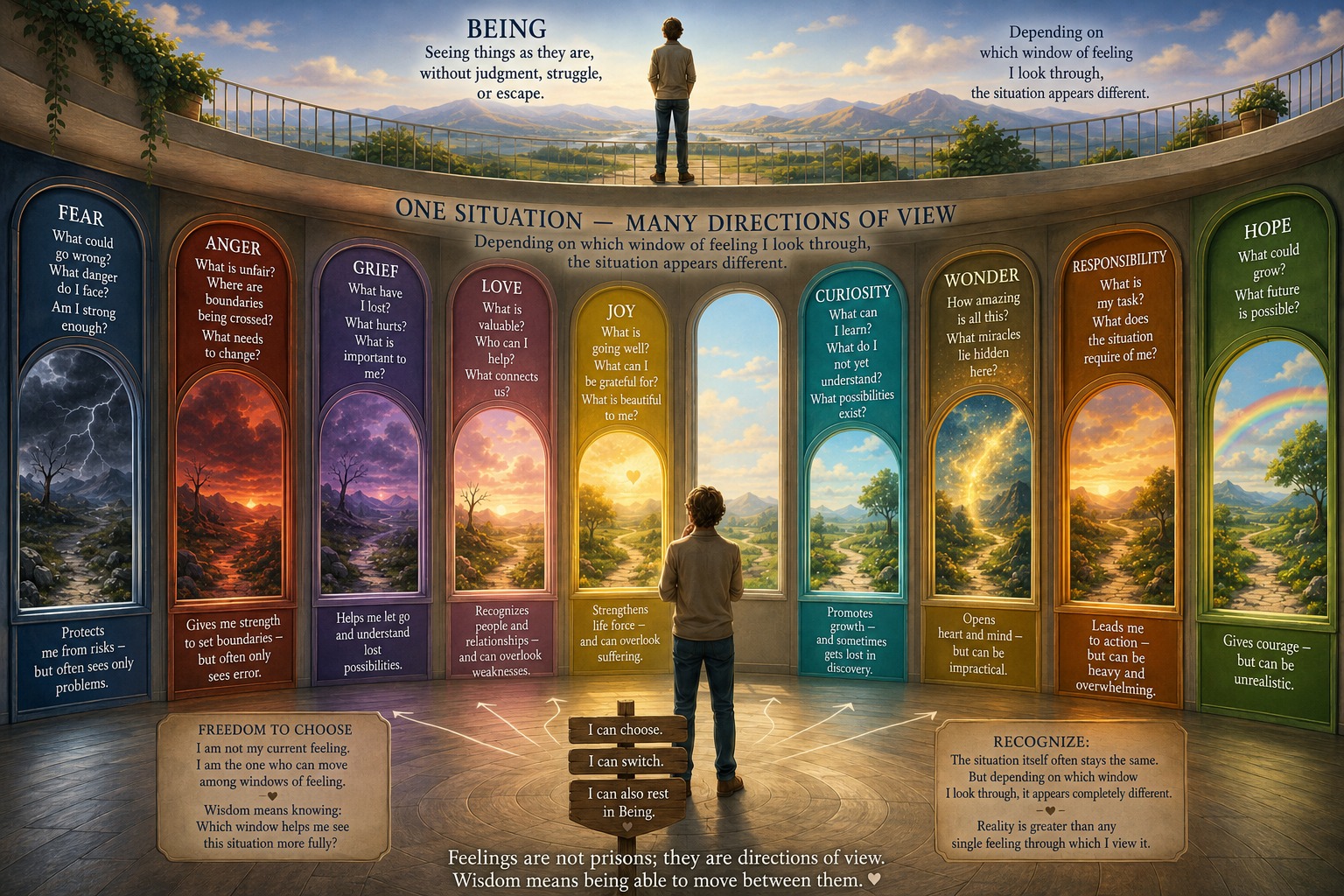
Translation note: All nine windows, questions, strengths and limitations, the balcony text, choice panel, wooden signs, recognition box, and footer are translated with very high fidelity. No significant semantic or spelling error is visible.
Encounter Through Different Feeling Windows
The same encounter can be experienced through several emotional windows. Fear notices danger and boundaries, anger notices injury and injustice, grief notices loss, love notices connection, joy notices what gives life, curiosity explores the unknown, wonder opens to mystery, responsibility asks what is ours to carry, and hope seeks possible paths forward. No single window contains the whole truth.
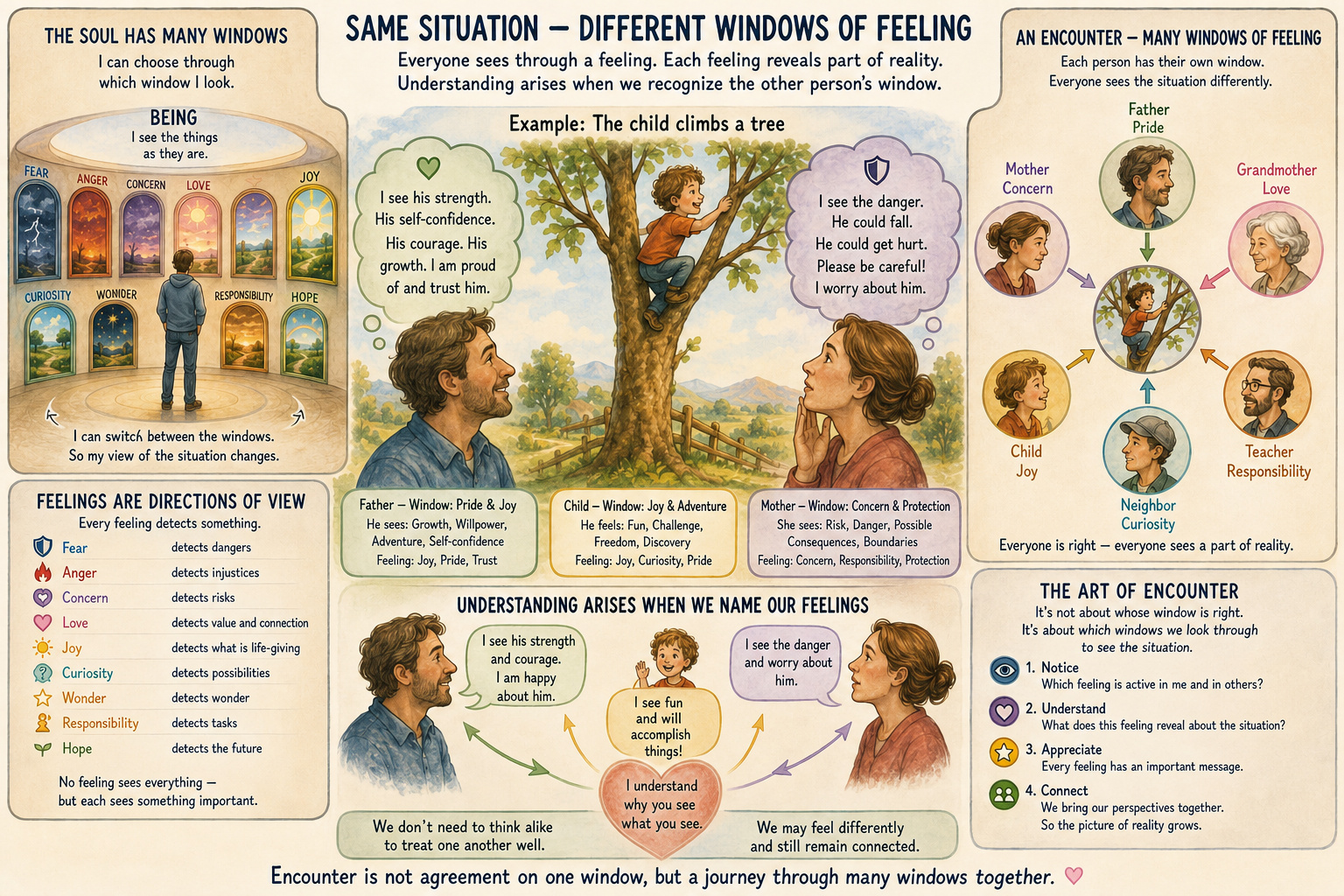
Translation note: The emotional windows, questions, strengths, blind spots, encounter scene, and core message are translated clearly and consistently. No significant semantic or spelling error is visible.
Reducing Stress With Five Complementary Powers
Stress can be reduced through several mutually reinforcing paths: caring for the body, understanding thoughts and priorities, regulating emotions and meaning, using small starting impulses, and seeking supportive connection. The image offers practical orientation rather than an individualized diagnosis or treatment plan.

Translation note: The daily rhythm, practical activities, five powers, explanatory panels, and overall sequence are exceptionally complete and legible. No significant semantic or spelling error is visible. This general educational model is not individualized medical advice.
Why Some People Activate Under Stress
Some people gain focus only when urgency makes a task neurologically immediate. Reward, stress, and time-perception systems can interact so that distant tasks feel unreal until pressure rises. Helpful conditions include visible time, small deadlines, a concrete first step, short work sprints, physical activation, and social commitment. The goal is sustainable activation, not moral judgment.
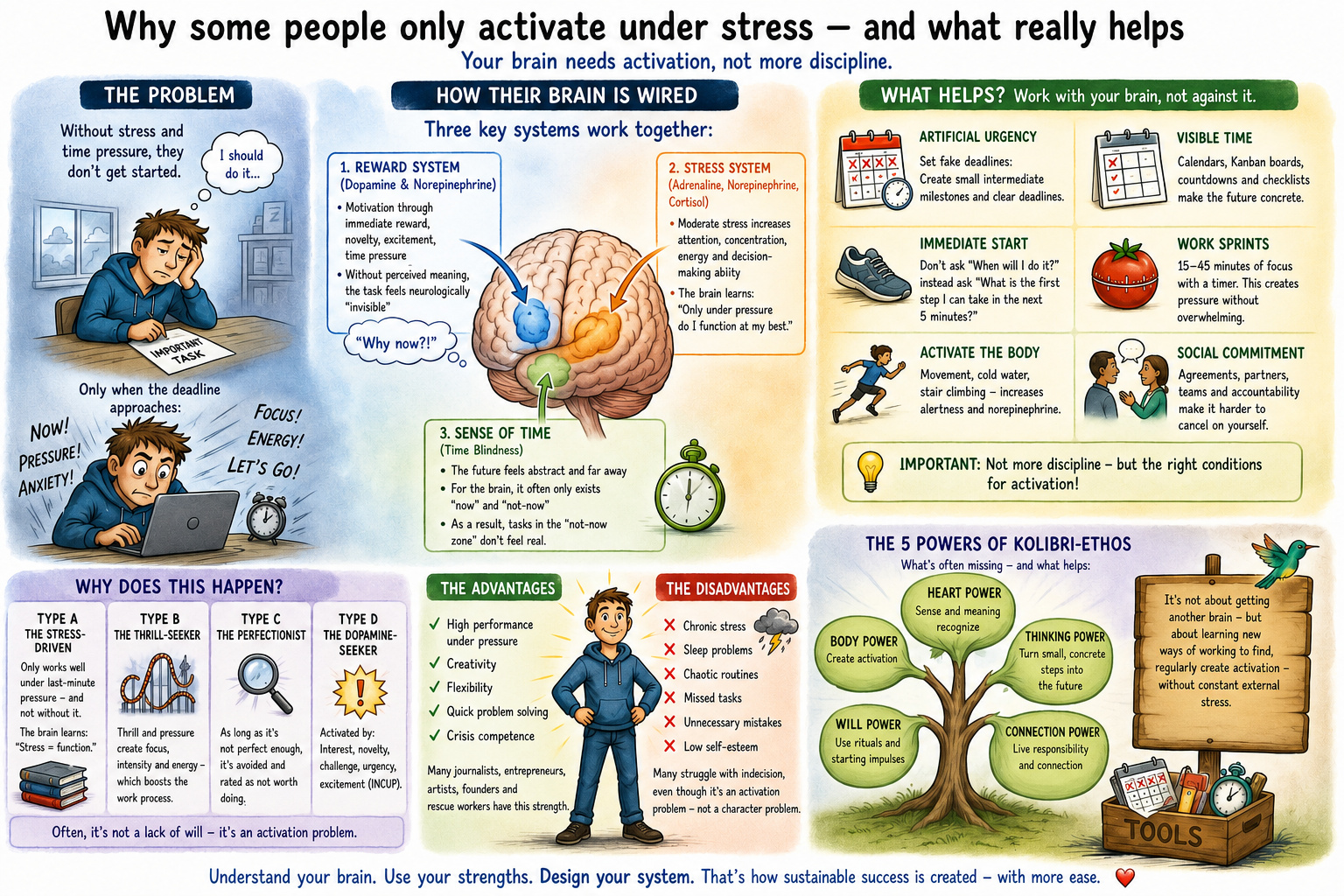
Translation note: The central distinction between an activation problem and a character or discipline problem is preserved very well, as are the three systems, practical tools, strengths, risks, and five powers. The source label `ADD-like activation` is materially changed to `the dopamine-seeker`; this is an interpretation, not a literal translation.
Different Employee Types and Ways of Working
Teams benefit when different cognitive and working styles are recognized rather than ranked. Structured planners, creative visionaries, pragmatic implementers, calm specialists, and people connectors each respond to different environments, stressors, and forms of support. Good leadership creates conditions in which these strengths can complement one another.
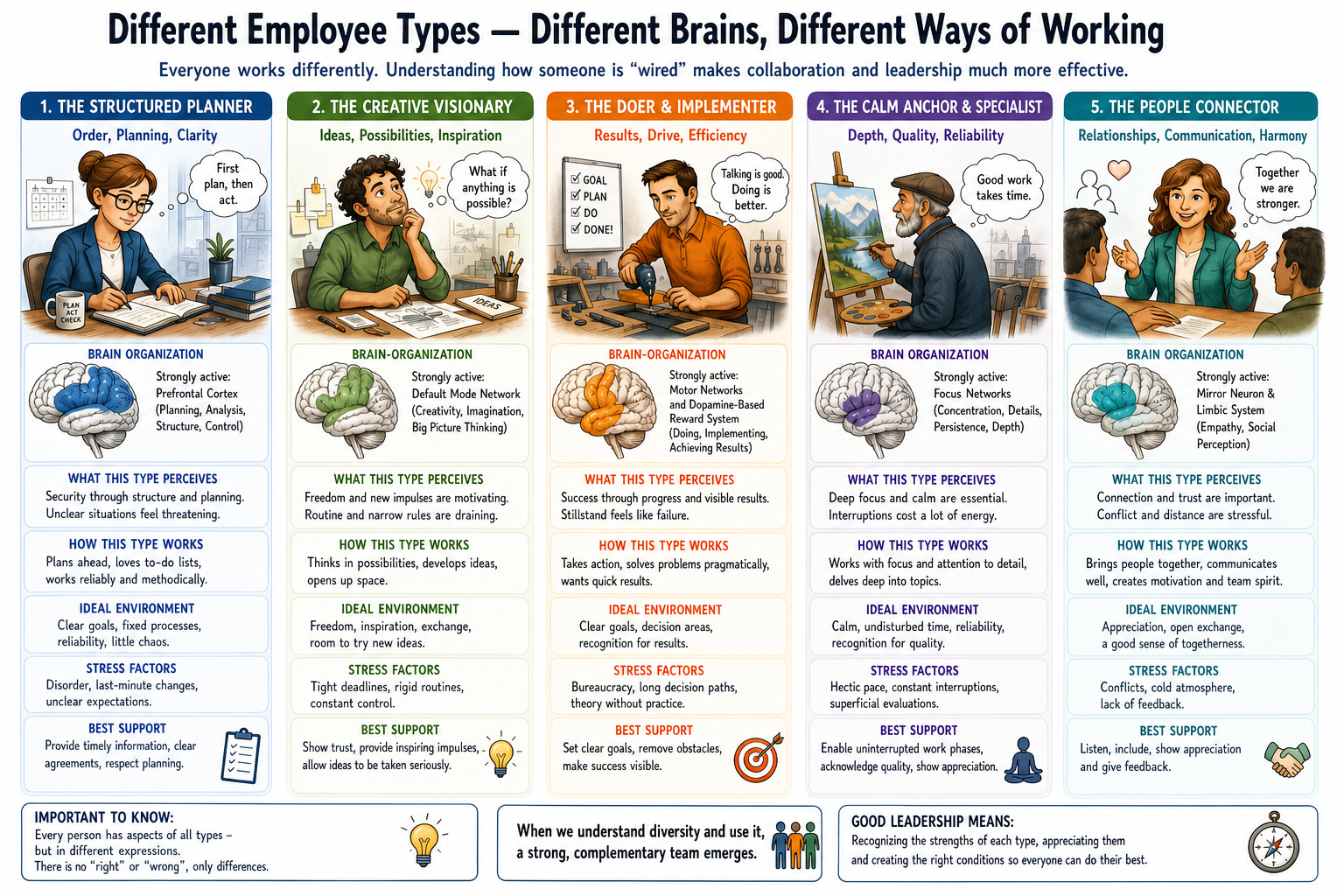
Translation note: All five types, brain-organization descriptions, perceptions, work patterns, ideal environments, stress factors, support strategies, and leadership messages are translated with high fidelity. No significant semantic or spelling error is visible.
Nine Personality Disorders Across Several Dimensions
This overview compares typical tendencies across relationships, emotional regulation, self-image, impulse control, strengths, risks, and core needs. It can support orientation and careful conversation, but it cannot diagnose a person. Human beings are more complex than categories, mixed patterns are common, and change remains possible.
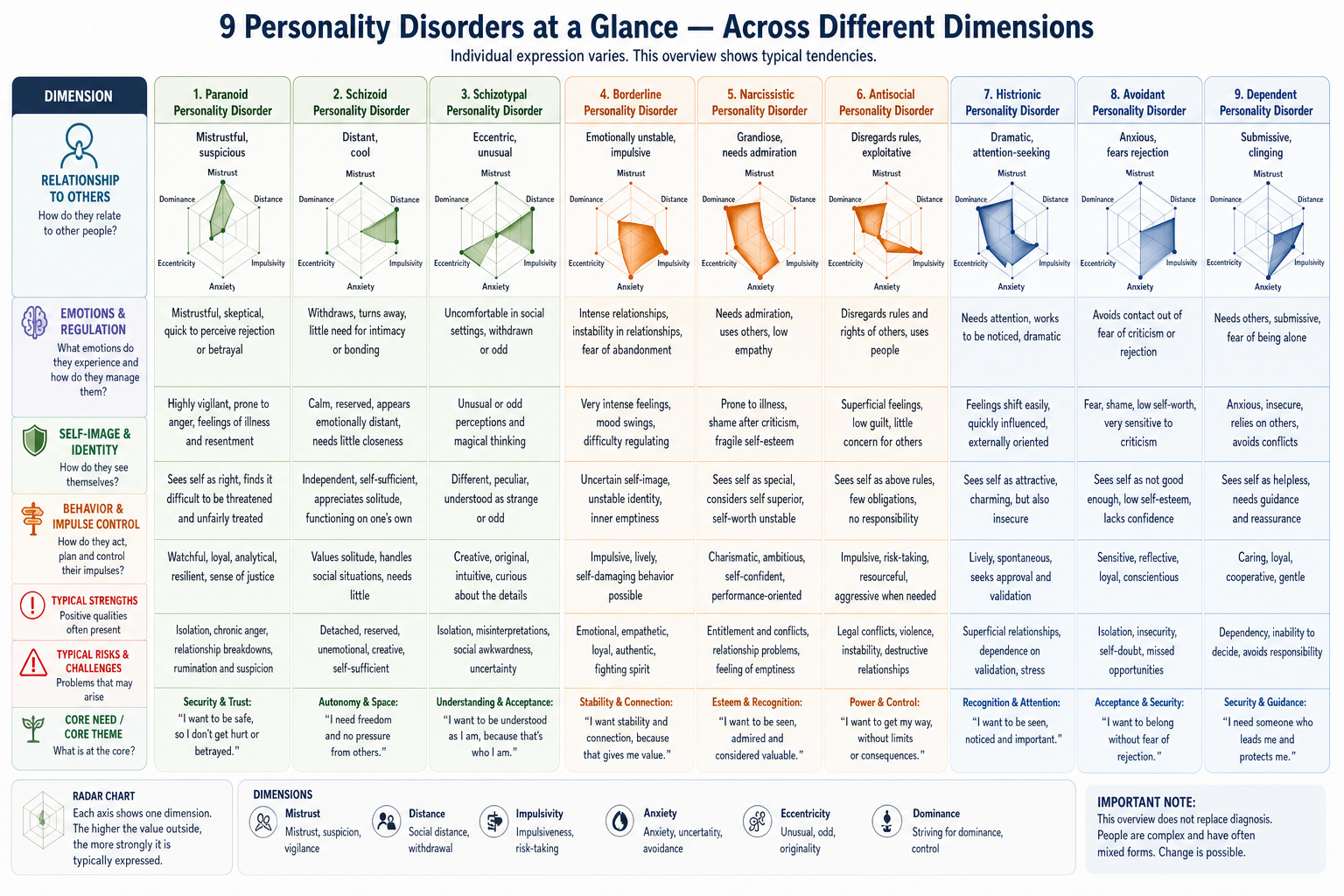
Translation note: The nine disorders, radar charts, dimensional axes, most comparison content, core needs, and diagnostic disclaimer remain clear. Two material wording errors are visible: German `Kränkung` (hurt/offense) becomes `illness` in the paranoid and narcissistic columns. The dense row alignment is also visually compressed in places; consult the source before treating individual cells as exact clinical statements.
Eleven Types of Emotional Character
People may organize experience around different dominant feelings while still containing the full emotional spectrum. The eleven portraits describe characteristic strengths, risks, questions, and ways of relating. They are patterns for reflection, not fixed identities or diagnoses.
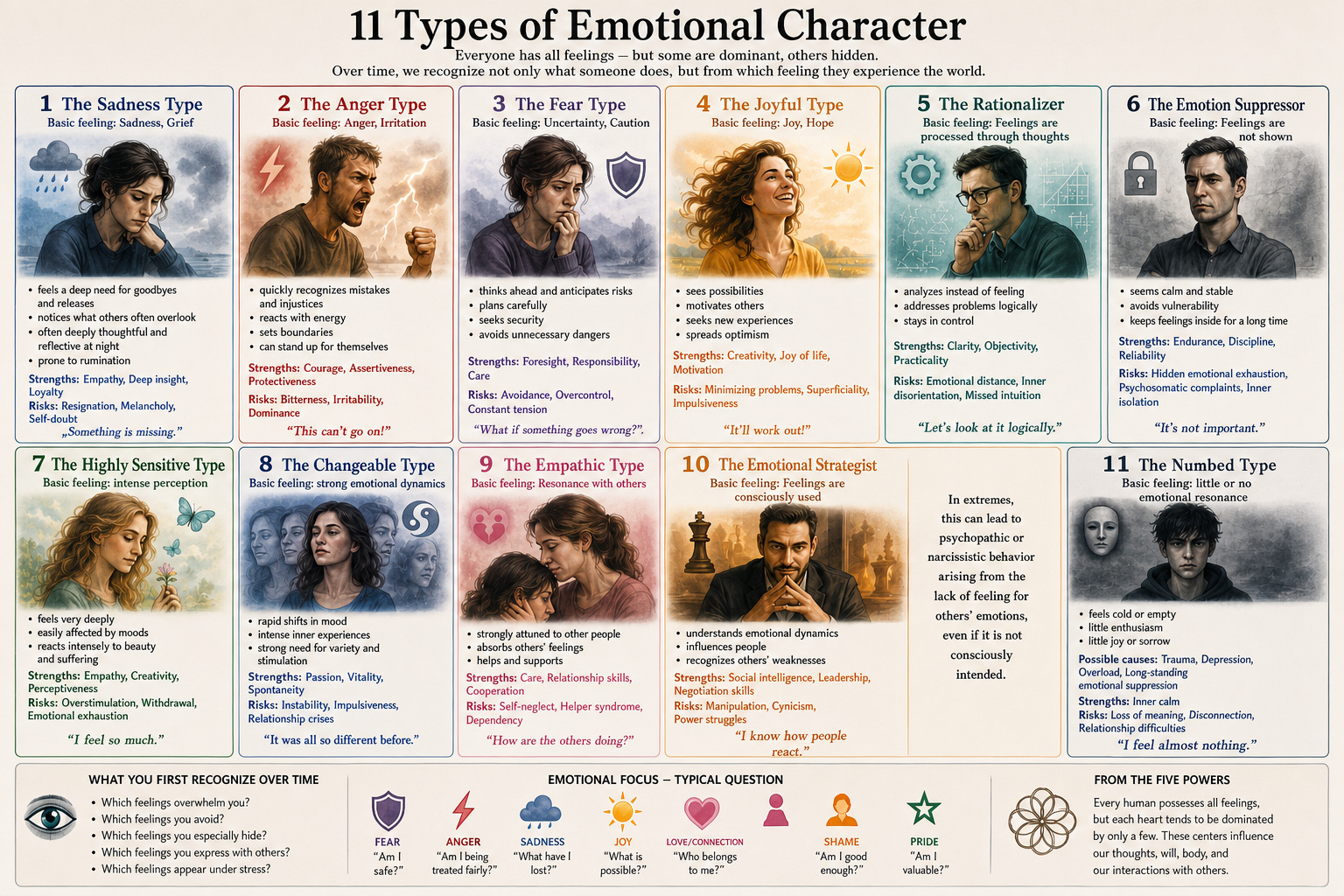
Translation note: All eleven portraits, basic feelings, most characteristics, strengths, risks, quotations, typical questions, and the five-powers conclusion are clear and legible. In the Sadness Type, German `sensitive to goodbyes and disappointments` becomes `feels a deep need for goodbyes and releases`; this reverses the nuance and is not literal. The Rationalizer's reduced self-perception is narrowed to `missed intuition`.
Archetypes as Inner Powers
Archetypes can be used as symbolic languages for inner capacities rather than boxes into which people must fit. Parent, ruler, warrior, lover, creator, sage, seeker, magician, healer, and jester can become more or less present across situations and life phases. The useful question is not “Which single type am I?” but “Which powers am I living, and which do I want to develop?”
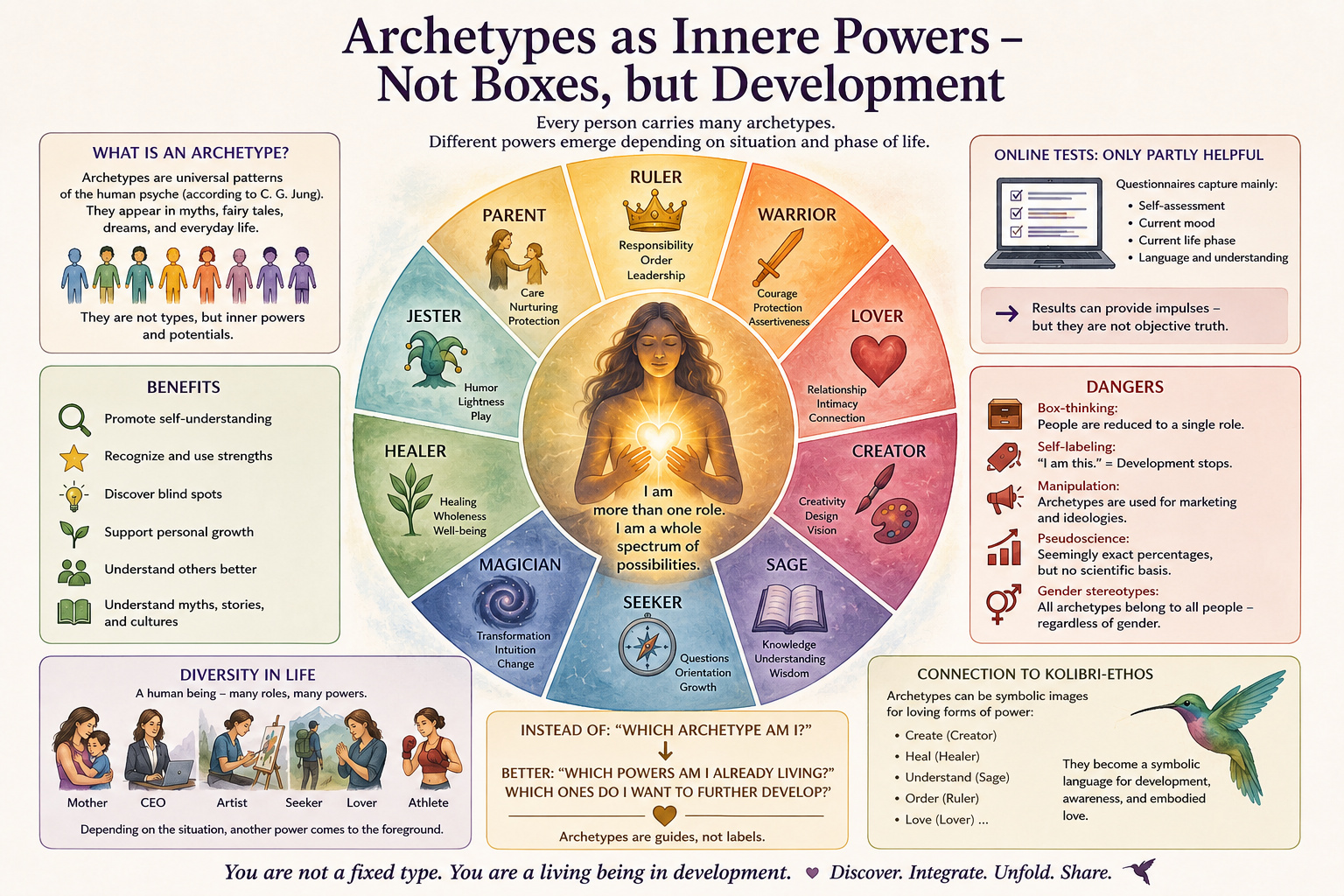
Translation note: The full wheel, ten archetypes, qualities, benefits, test limitations, dangers, diversity examples, reflection questions, Kolibri-Ethos connection, and footer are translated with exceptional fidelity. No significant semantic or spelling error is visible.
Understanding Procrastination
Procrastination may arise from task size, perfectionism, fear, uncertainty, depleted energy, lack of meaning, overstimulation, or inner resistance. Practical responses include making the first step very small, moving information into a visible system, caring for energy, naming the real blockage, and creating supportive external commitment. The image replaces self-condemnation with curiosity and workable structure.
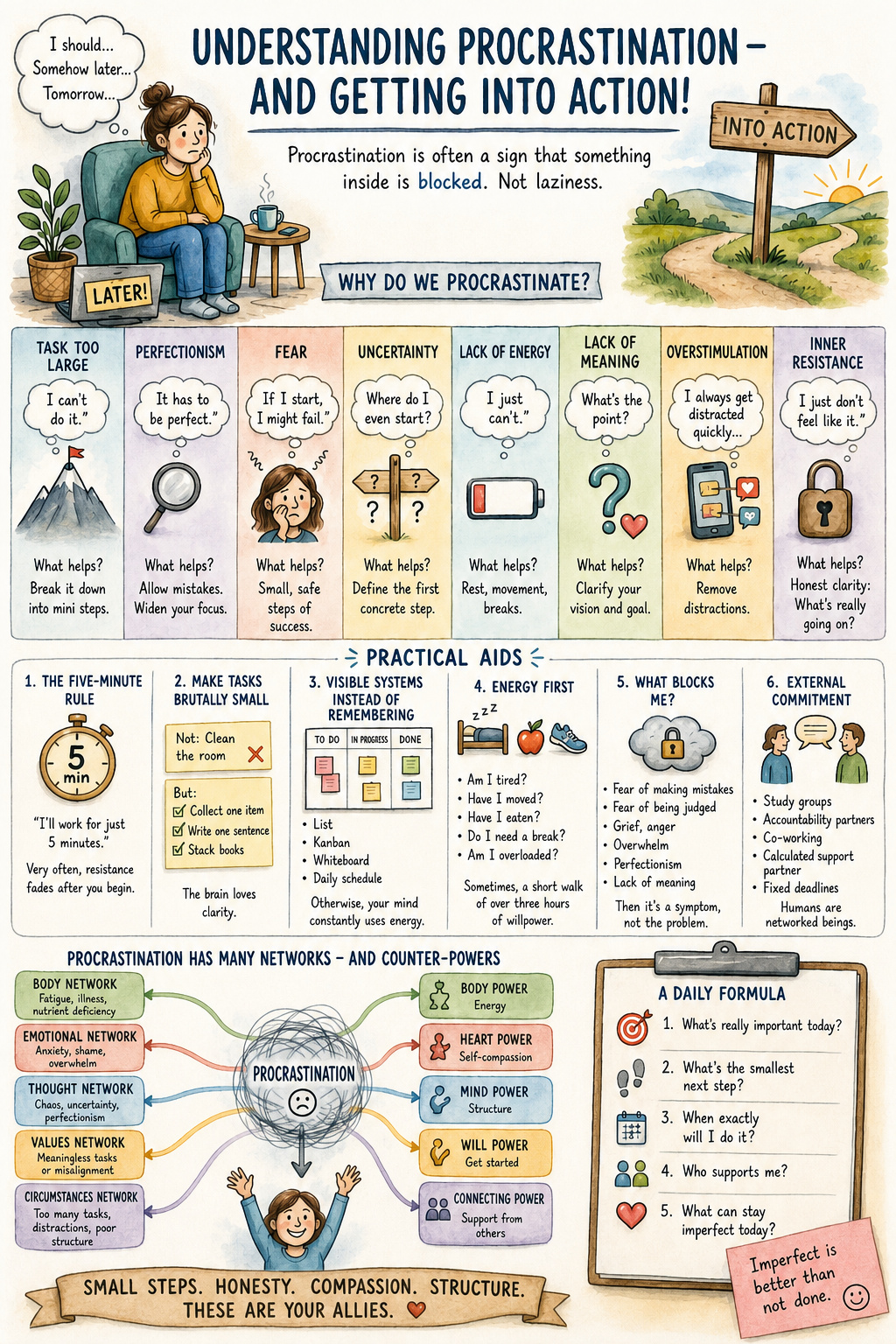
Translation note: The eight causes and responses, six practical aids, five networks and counter-powers, daily formula, and footer are translated clearly and accurately. No significant semantic or spelling error is visible.
GTD and the Next Concrete Step
Getting Things Done helps externalize open loops and turn vague projects into clear next actions. Its five steps — capture, clarify, organize, reflect, and engage — can be complemented by attention to energy, meaning, relationship, and inner consent. Related methods provide different kinds of structure, but no method replaces the question of what truly matters.
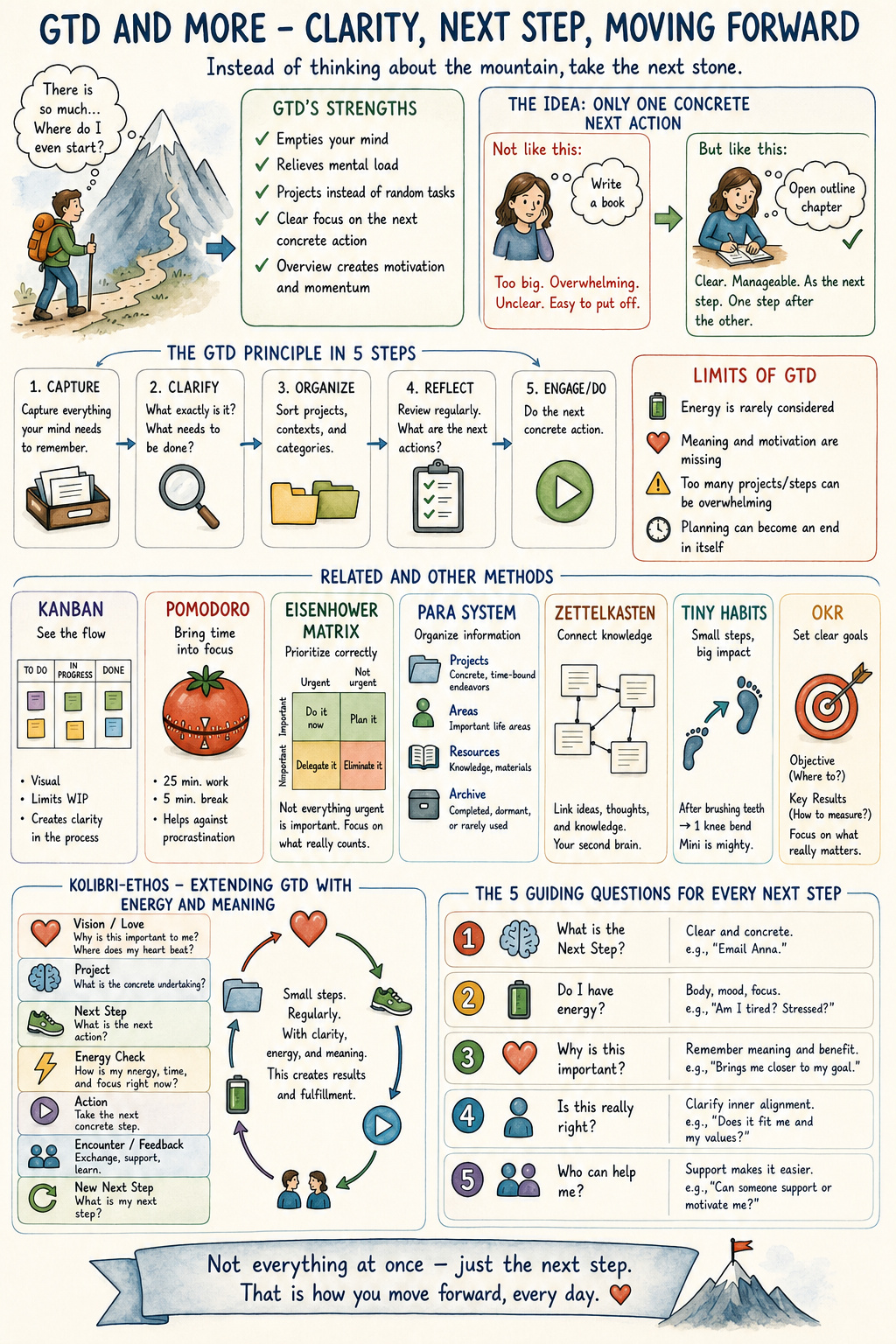
Translation note: GTD's strengths and limits, five-step process, concrete-action example, seven related methods, Kolibri-Ethos extension, five guiding questions, and footer are translated with very high fidelity. No significant semantic or spelling error is visible.
Dreams and Reality
Dreams open possibility, creativity, hope, love, and meaning. Reality asks for endurance, responsibility, repeated action, and attention to what is actually present. A mature life need not choose one against the other: it can dream widely while learning to love small, imperfect, concrete reality.

Translation note: The opposing landscapes, central tension, signposts, values, day plan, strengths of dreaming, art-of-living practices, and central conclusion are translated very faithfully. The final word `grow` in the left notebook appears misspelled or truncated as `grea`; the intended meaning remains recognizable.
Living With Dreams and Reality
Dreams can warm and widen a life, but the distance between longing and the present can also hurt. The image invites neither renunciation nor escape. Maturity can mean keeping the inner fire alive while learning to live with longing, attend to small steps and real moments, and discover beauty in what remains imperfect.

Translation note: The warm and cold worlds, core tension, lists, fire metaphor, benefits of dreams, practices of living, and mature conclusion are translated with excellent fidelity. In the open notebook, source `dream big — love small reality` becomes `big dreams — little moments, true life`; the spirit is related, but the explicit call to love reality is softened.
More Than Performance
Achievement can be a real strength without becoming a whole identity. Small openings toward wonder, play, feeling, encounter, gratitude, trust, and rest can restore neglected dimensions of life. The aim is not a dramatic rejection of discipline, but a broader balance in which performance and love can belong together.
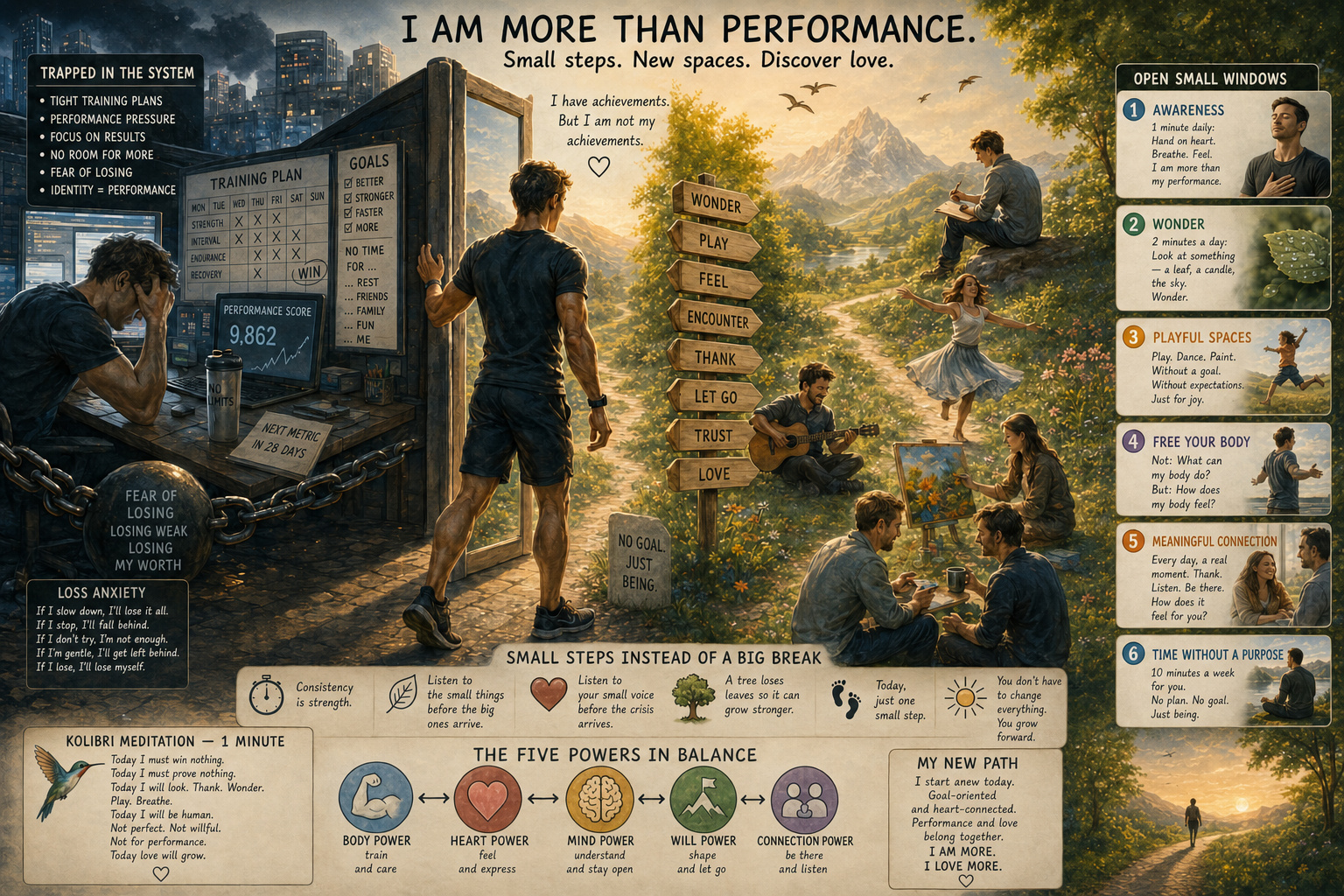
Translation note: The dark performance system, doorway, living landscape, six practices, meditation, five powers, loss-anxiety text, and new path are translated exceptionally well. Source `Slowness is strength` becomes `Consistency is strength`; this is a clear semantic change in one small-step caption.
From Performance Toward Love
Moving from a success-centered life toward love does not require abandoning strength. Listening, care, softness, new experience, value, encounter, and responsibility can make strength broader and more human. The five powers remain in balance when training is joined by feeling, understanding, shaping, and genuine connection.
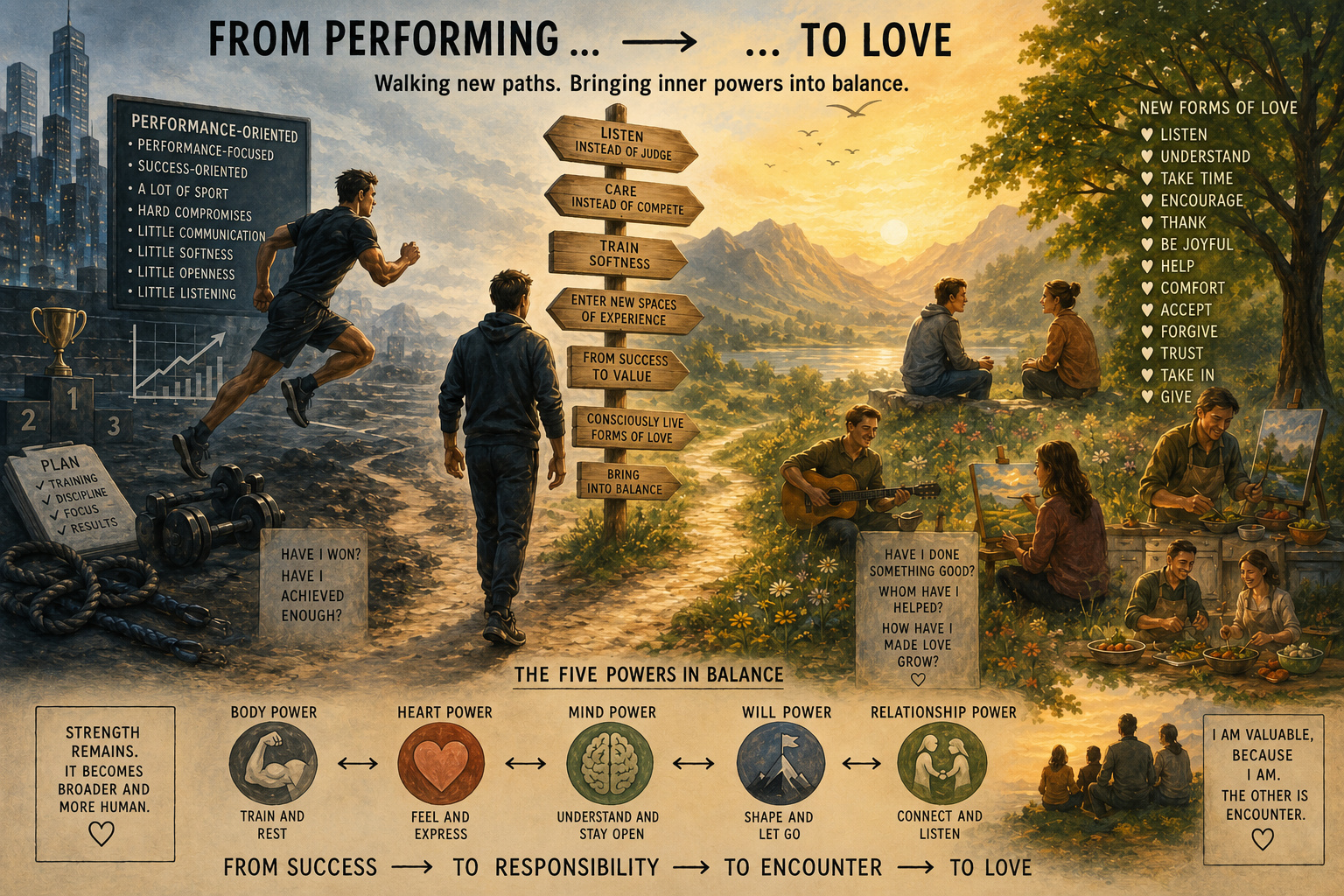
Translation note: The two worlds, central signposts, reflection questions, five powers, and closing movement from success to love are translated with high fidelity. In the `New Forms of Love` list, source `wonder` becomes `encourage`, `accompany` becomes `help`, and an extra `trust/take in` distinction appears; consult the German list for exact wording.
Caution, Fear, and the Capacity for Happiness
The brain detects danger quickly because survival favored caution. Caution becomes restrictive when it no longer reflects real danger and feeds a cycle of fear, avoidance, and fewer good experiences. Well-being can be practiced through gratitude, positive experience, relationship, movement, meaningful goals, mindfulness, interrupted rumination, self-compassion, and helping others — while healthy caution still retains its place.
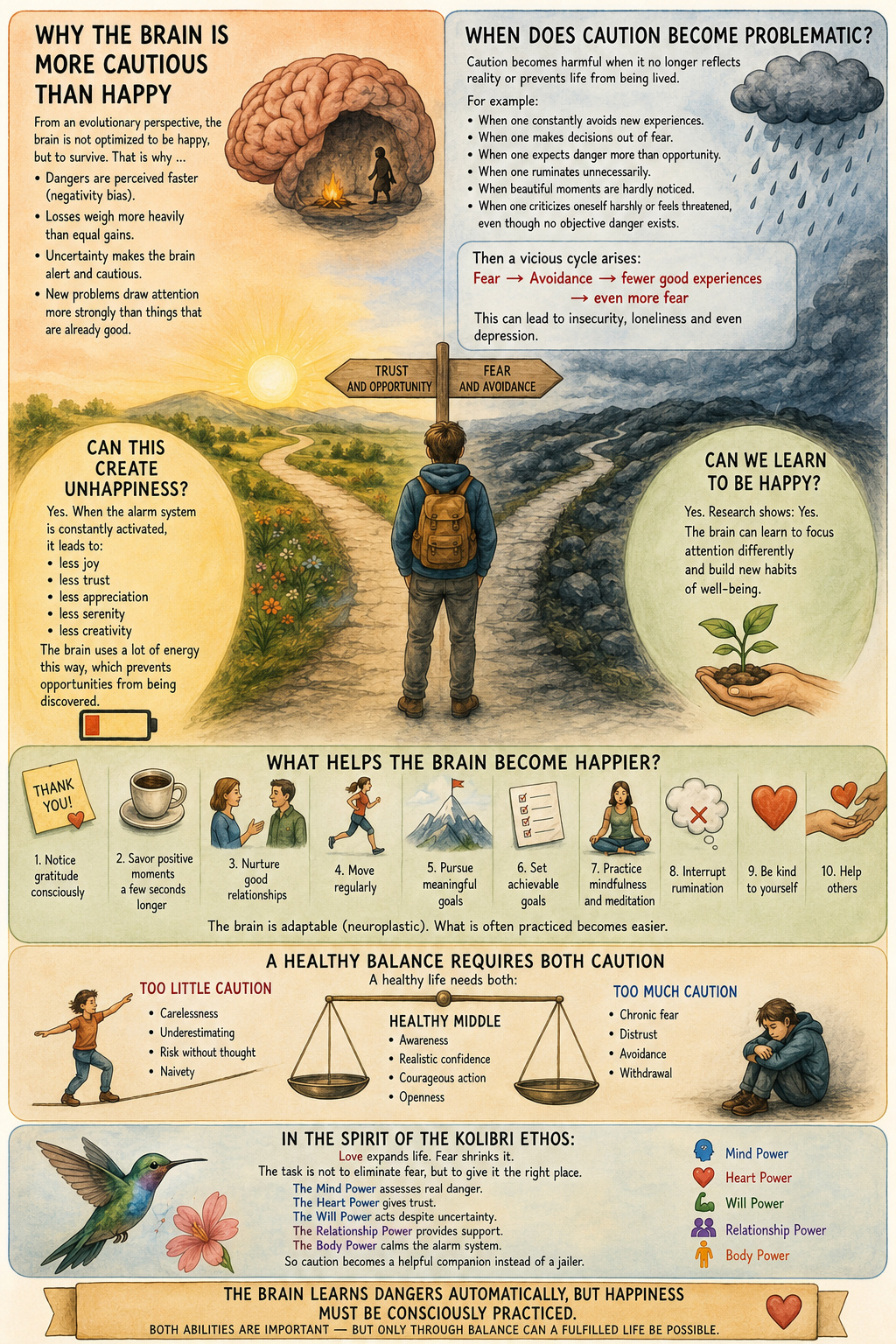
Translation note: Evolutionary explanation, fear–avoidance cycle, learning and neuroplasticity, ten practices, balance model, five powers, and conclusion are clear and largely faithful. In the unhappiness panel, source `less encounter` and `less freedom` shift to `less appreciation` and `less serenity`; those two effects are not literal translations.
The Gap Between Expectation and Reality
Expectations are maps shaped by experience, desire, simplified stories, and incomplete knowledge. Reality is the terrain: more complex, alive, and surprising than a prediction. Remaining curious and open helps us notice unplanned paths, kindness, connection, small moments, and beauty that narrow expectations can hide.

Translation note: The map/terrain metaphor, causes of narrow expectations, closed and open paths, positive surprises, life wisdom, practical responses, and footer remain clear. Several material errors occur: `It will probably turn out well` becomes `I will walk away feeling good`; `I expect the worst` becomes `I count on my own strength`; the warning about overlooking opportunities, helpfulness, and beauty becomes being `unprepared and alone`; and `courage to allow the unknown` becomes `courage to let go of the unknown`.
Expectation Bias and Perceived Risk
Loud, emotional information can make rare dangers feel omnipresent while quieter everyday risks remain less visible. The same person and world can therefore be experienced through very different expectations. Realistic caution asks for good information, self-reflection, an open heart, and attention to both genuine risks and the parts of life worth living.
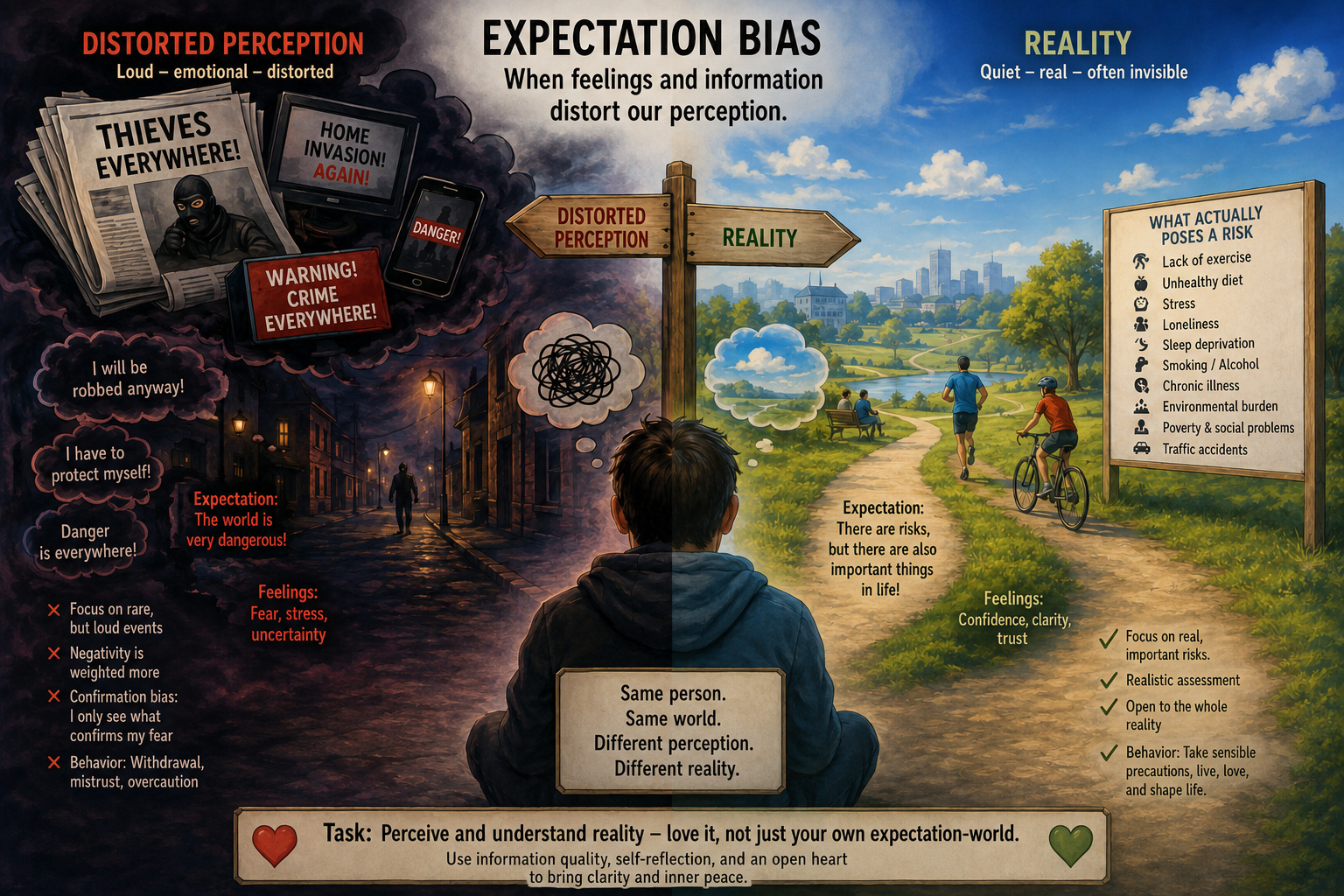
Translation note: The two worlds, headlines, fear thoughts, confirmation bias, behavior, everyday-risk board, balanced expectation, central comparison, and closing task are translated with exceptional fidelity. `Burglary again` is intensified slightly to `Home invasion again`; no other significant semantic or spelling error is visible.
From Acquiring to Completing the Cycle
Finding and acquiring things offers novelty, possibility, and immediate reward. Using, maintaining, passing on, recycling, and releasing them often requires more time, energy, and emotional work. A sustainable life includes the whole cycle: caring for what exists, sharing it, and letting go with gratitude when its time is complete.
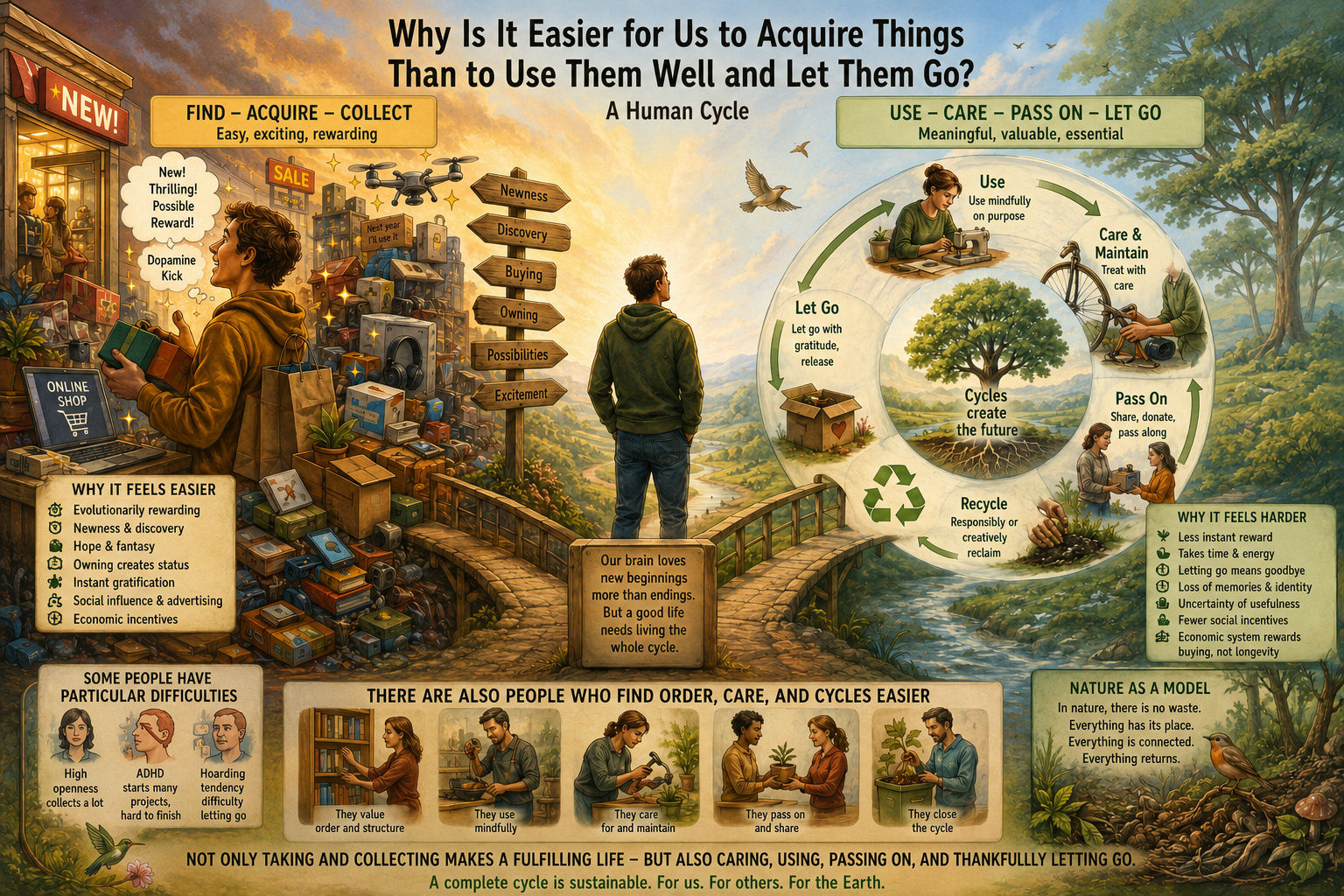
Translation note: The consumer world, reward mechanisms, bridge, complete cycle, reasons it feels harder, differing personal tendencies, nature model, and sustainability conclusion are translated very accurately. No significant semantic or spelling error is visible.
Self-Analysis That Enables Action
Helpful self-analysis begins with what is good, observes without immediate judgment, learns from difficulty, chooses one important area, and defines a very small next step. The five powers and gardener metaphor keep reflection embodied, relational, and compassionate. The question is not “What is wrong with me?” but “Where am I now, and what would be the next good step?”
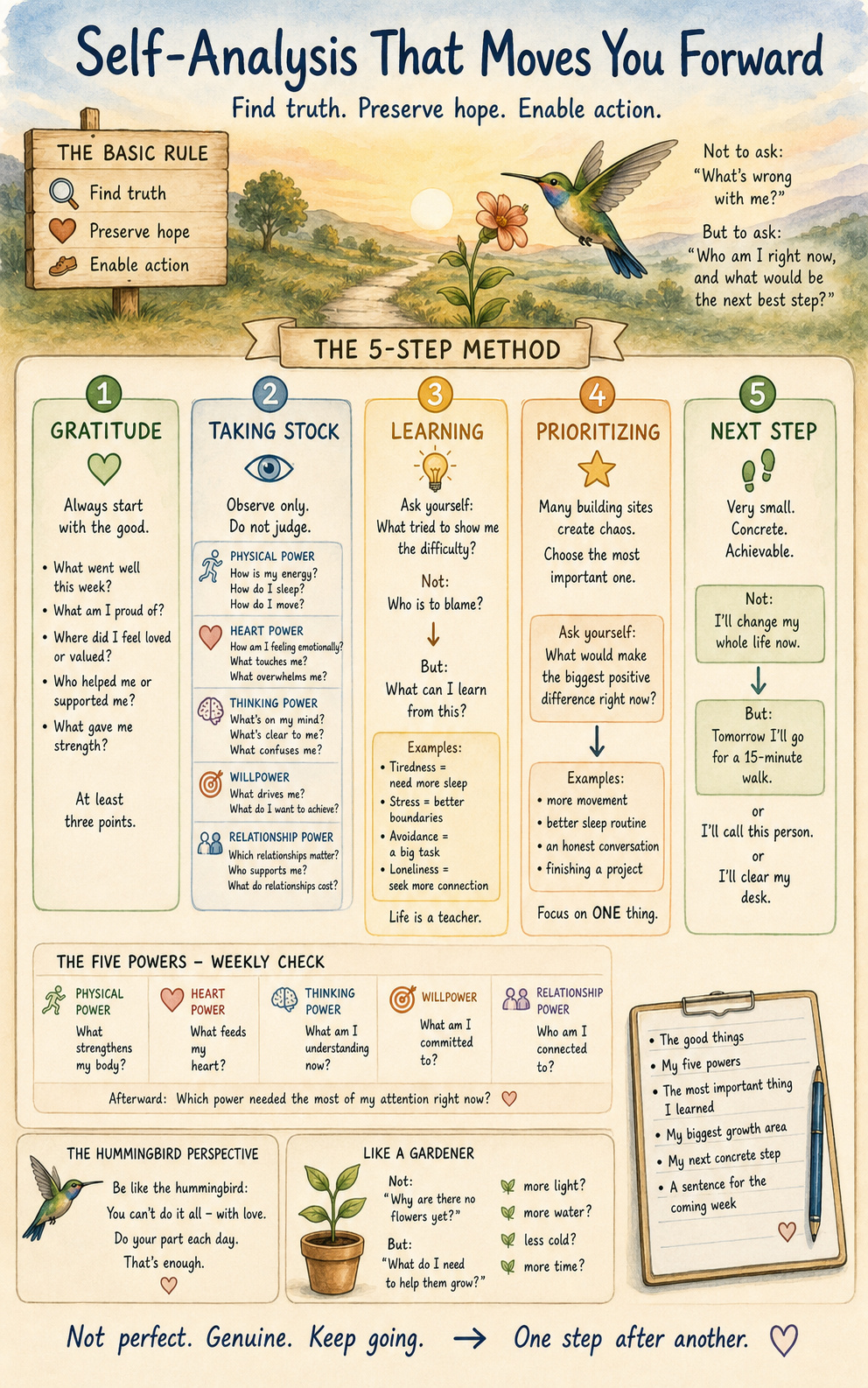
Translation note: The five-step method, inventories, examples, weekly five-powers check, gardener and hummingbird perspectives, checklist, and footer are translated with very high fidelity. In the gratitude questions, active source `Where did I live love?` becomes passive `Where did I feel loved or valued?`; this changes the direction of the reflection.
My Inner Universe Belongs to Me
The inner universe contains body, feeling, thought, memory, possibility, values, mystery, relationship, and encounter with oneself. Ownership here means care, boundaries, freedom, and responsibility rather than blame. External systems and painful inner patterns can narrow access, while slowness, silence, questions, mindful choices, creativity, remembrance, and truthful guests help protect and cultivate the inner field.
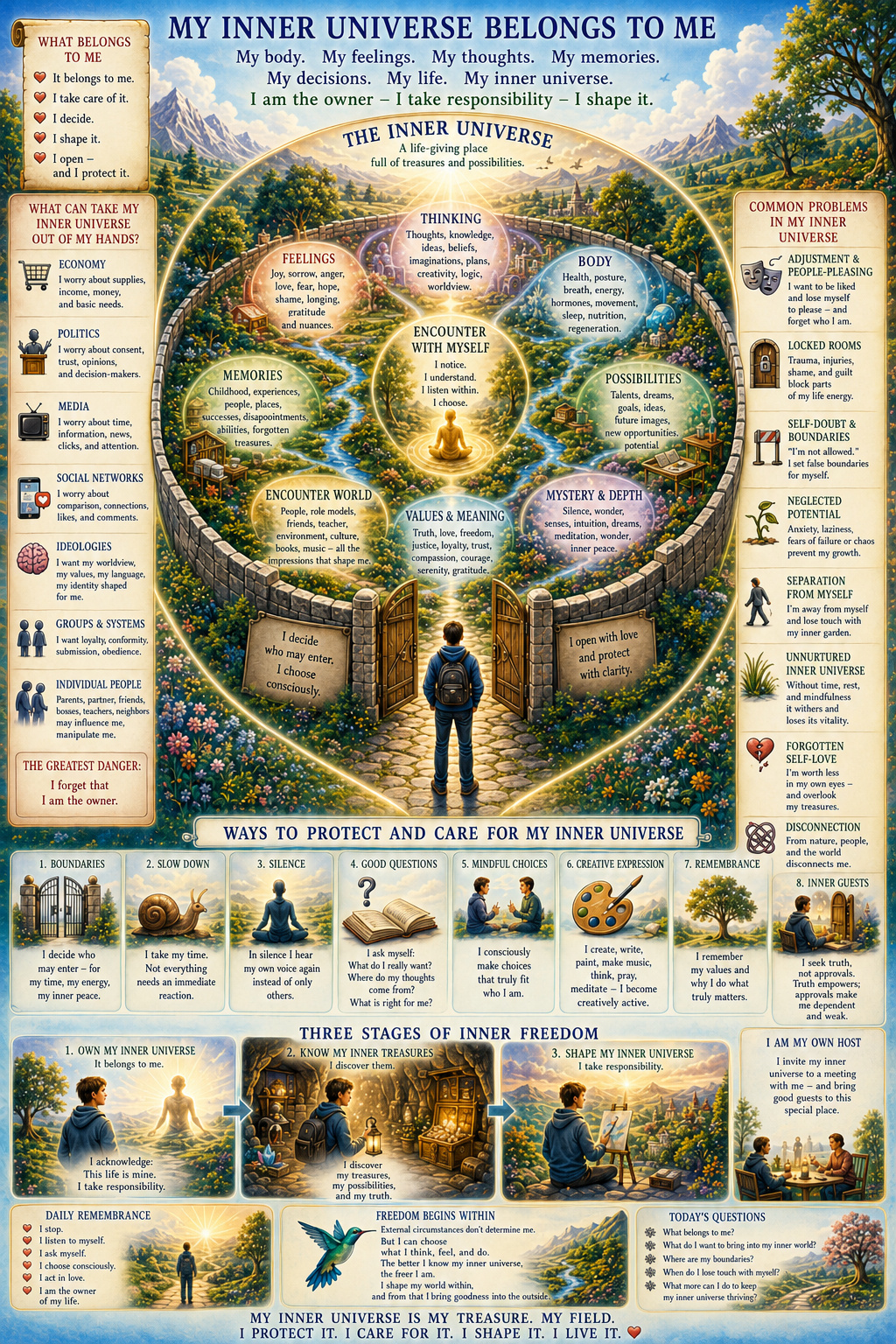
Translation note: Despite extreme density, the full garden, nine inner domains, common problems, eight protective paths, three stages of freedom, host metaphor, daily remembrance, questions, and conclusion are exceptionally complete and legible. The left external-influence list is partly reframed as personal worries: economy, politics, social networks, and ideologies no longer state their attempted influence on attention, consent, comparison, worldview, language, and identity as explicitly as the German source.
Twelve Psychological Theories
Psychological theories illuminate different aspects of how people become, feel, think, act, belong, find meaning, and grow. Behavioral learning, flow, post-traumatic growth, terror management, self-determination, social identity, learned helplessness, emotion theory, social learning, loss aversion, cognitive dissonance, and attachment each offer a partial lens. No theory explains the whole human being; their value grows through careful connection.

Translation note: All twelve named theories, core explanations, diagrams, central synthesis, bottom categories, and footer are clear and academically recognizable. In Post-Traumatic Growth, source `new life goals` and `more compassion` shift to `new priorities` and `more appreciation`; those two bullets are interpretations rather than literal translations.